The Next Generation and the Future of Photography

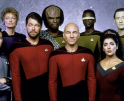
Star Trek, The Next Generation
One of the greatest pleasures in creating and working on Lenscratch each year has been the exposure to the next generation of photographic artists through our Student Prize Awards. There are huge shifts in a photographer’s journey and it’s critical that we understand what the next generation faces, in terms of creating a sustained practice — a need for community, a need for financial support, and opportunities that helps get their work out.
I am grateful to these artists featured today, all part of our Top 25 of 2025, for sharing their hopes, dreams, and experiences.

©Ryan Mitchell, First Time Outside
Ryan Mitchell
Instagram:@tiermir
University of Syracuse, MFA Art Photography
After graduation, I thought I had to keep working, focusing on the next big photography project or continuing what I had done in school. I wanted to set goals and maintain the same discipline and work ethic I had kept throughout my school years. That same mentality often leads to fatigue, burnout, artist’s blocks, and frustration over feeling like nothing is ever enough. I’ve come to realize that after graduation, the school, faculty, professors, peers, and the connections made in the community aren’t expecting you to become the next top photographer of the century but rather a unique artist in your own right.
Opportunities will always be available, come and go. Nothing is preventing you from achieving your goals after graduation, but nothing is stopping you from taking a break either—except yourself. It took me a long time to realize that resting after completing your education is necessary. It’s okay to work at your own pace, to view other art and pieces, encourage peers in their work, and find inspiration. You deserve all of it. Now that you’ve finished school, it’s up to you how you want to pursue your career and at what pace. The thought of life after school and routine may be scary, but someone who has come out of the military after enlisting after high school and gone straight into college can tell you that adjusting to a new lifestyle takes time—whether it’s months or years. Opportunities will always be there. Your development isn’t a straight line and requires patience, as your work reflects your journey and who you are.

©Judson Womack, Bryant’s from Lay Us Down
Judson Womack
Instagram: @judwomack
Columbia College Chicago, MFA in Photography
To be honest, I don’t know what my future looks like. Things seem to be quite tenuous at present. From a career standpoint, the higher-ed world I still have hopes of joining one day seems to be going through an upheaval. This teaching path that historically provided some sense of stability and direction for post-MFA life had become totally oversaturated and immensely competitive by the time I graduated. Enrollment is off a cliff. Mid-level private art schools buying and selling in renowned faculty and providing a place for emerging arts educators to build their careers are struggling to justify themselves in the face of rising costs. To call it a bummer is an understatement. That being said, I’ve never felt more excited about the prospect of making images. With the waning of those institutions, the broader photo community seems to be becoming larger, more accessible, and more democratic in its decentralization. The intellectual bar seems to be rising beyond the simplicity of well-seen images or, at least, the proverbial hand of funding that giveth and taketh away seems to have shifted its priorities in favor of strong intellectual foundations. Fatigue from the digital over-saturation of daily life has paved the way for a resurgence in film photography and the apparent impotence of “AI” seems to have only reinforced, at least in my opinion, a focus on the meaningfulness of the photographic apparatus and act. With all of that in mind, the months leading up to and after graduation meant a long, difficult centering of my priorities that resulted in my leaving a major city with its vibrant, international arts community and loving network of friends for the small, cheap, isolated place I felt would allow me to make the most and best work, and allow me the most freedom to travel and stay engaged with the photo world. I don’t really know if that was the right decision or the right outlook for the successful future I’d like to have but I wake up every morning desperate and able to keep doing this thing and maybe that’s all that matters. No sympathy for the devil. Make work. Stay visible. And if it occasionally gets a little more uncertain than what I had in mind, maybe I’ll chalk it up to “career development.”
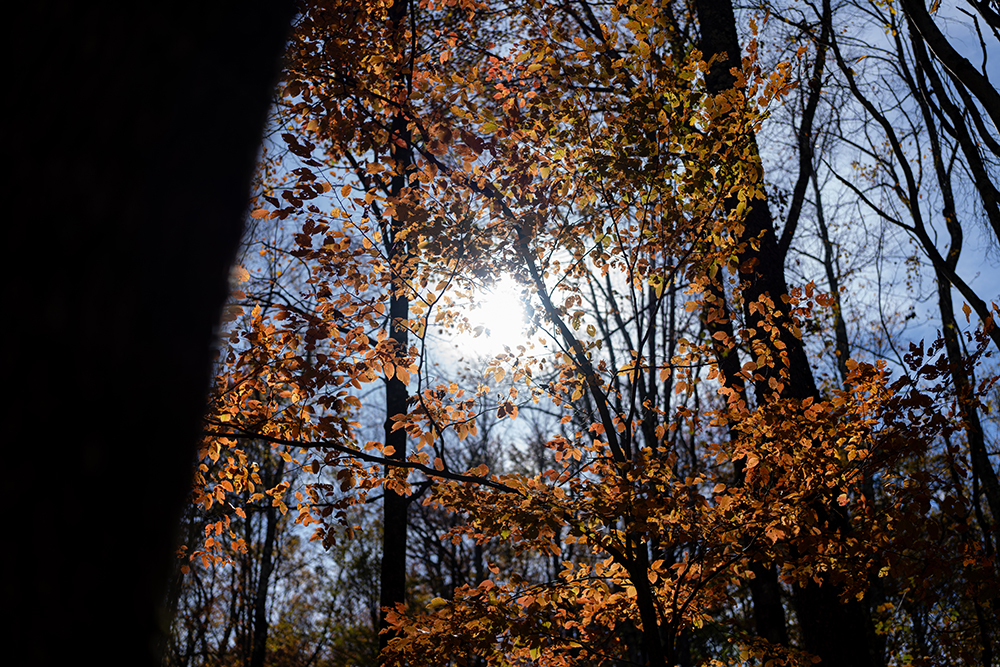
Sunlight filters through a canopy of burning orange leaves in Upstate New York. A quiet reminder that even as the seasons shift, there is always light waiting to be found in the in-between. Photo Credit: Gabriela Passos
Gabriela Passos
George Washington University, MA in New Media Photojournalism
Instagram:@gabrielapassos_photography
Photography has always been a tool for me. A way of seeing and connecting with people whose stories deserve to be told. Since graduation, I’ve given myself permission to wander, to follow curiosity into new mediums and unexpected industries. Letting inspiration come from places far outside my usual orbit. I’ve found myself experimenting, collaborating, and discovering how my work can stretch beyond what I once imagined. And being open to the unknown has shown me that tools can evolve. Leaning into change has led me to video, sound, installation, and other forms that allow me to meet people where they are and tell their stories in deeper, more layered ways.
The future, to me, feels like stepping into a season I haven’t fully named yet, familiar in its rhythm but shaped by colors I haven’t seen before. There’s a sense of openness in this unknown, a space of endless possibility for creativity, growth, and connection. And even though my photography practice looks and feels different now, I’m excited to see what grows here.

©Jordan Tovin, The sun shines through firework smoke in Cluster 7 in Little Earth on July 4, 2024, in Minneapolis, Minnesota.
Jordan Tovin
George Washington University, BFA
Instagram: @jordan.tovin
I’ve been really enjoying how photographers are starting to wake up and utilize the online space the best they can as opposed to letting the online space utilize them. Some have been creating awesome newsletters in lieu of social media—I know I’m subscribed to way too many Substacks at the moment… or maybe not enough. It’s awesome to see people creating their own platform, their own podcasts, video series, blogs, etc. to talk about what makes them happy in the world of photography. So many photographers, including myself, talk about searching for the authenticity within the world of social media, but we then hypocritically engage with it. I’m a hypocrite in that way. But the uptick in zines and personal publications with print on-demand services brings me so much joy. I think everyone can agree that the digital will never rival the tactile when it comes to photography, and the way an image renders on a small screen will never rival the way it shows up on a big newsprint, for example. My hope is that in the meantime, we also began to make that photo-publication space more accessible in every way possible
As a photojournalist, I don’t have a bleak outlook on the future of all of photojournalism, but I also think we should start being realistic about what a sustainable lifestyle in photojournalism outside the realms of politics and sports can look like. I know I certainly don’t have the answers at the moment, but it’s something I will have to navigate after graduation alongside my partner (who is not a photographer) as we try to build a life that’s conducive to both of our passions and the life we want. After graduating, I’m fortunate to be interning this summer as a photojournalist at Reuters, but after that—I don’t have an idea of what I will be doing or what my life will look like. I’ve been half-joking that I want to buy a used sailboat and live in the Chesapeake Bay while fielding whatever photo work I can find, but in all honesty, I’m still working on getting my parents’ seal of approval

©Brianna Tadeo, Bayleaf
Brianna Tadeo
University of New Mexico, MFA in Studio Arts
Instagram: @Brianna_Tadeo
Post-grad life has been a mix of constant motion and sudden creative hibernation. Two days after walking at commencement to receive my MFA, I packed a U-Haul with another UNM MFA graduate from 2024, Anna Rotty, to transport our selected artwork for SF Camerawork’s FORECAST 2025. My partner, our pups, and I hit the road to the Bay Area. It felt like a tender full-circle moment to return to where I lived for thirteen years before moving to New Mexico for grad school and where much of my thesis work first took shape. After that whirlwind, I slipped into a quieter space of processing the last three years of making, thinking, learning, and absorbing everything like a sponge. Re-entering the rhythm of daily life—starting a new full-time job, struggling to find a studio, facing the reality of debt—has been disorienting. No longer in the art school bubble, it was easy to compare my art practice within the art world and wonder, Am I doing enough? That comparison can feel like quicksand if you get stuck in it. There’s also fear in not knowing what’s next and losing momentum after three years of being immersed in a community where ritual and engagement were constant. Peers remind me to be gentle in this pause. After years of creating, hibernation isnecessary to recharge.
This is a time to reflect on my relationship with photography and what it means to be an artist right now. At a moment when funding for research and art programs is being stripped away, I feel deep gratitude for the programs that showed me what art can do. I wonder how we can continue to show up for each other during times of unrest. More than ever, artists need to be pillars for our art communities—extending beyond galleries into maker spaces, local libraries, and recreation centers. If it weren’t for my single-parent mom waiting outside for hours to sign up my siblings and me for free art classes at Fleisher Art Memorial in Philadelphia, I don’t know if I would have found my way into being an artist.
Photography has always been my anchor. In the darkroom at Fleisher, at age twelve, I first learned to process grief and loss through creating images. With each cycle, I discover more about what light, shadow, and time can hold. My MFA years expanded that understanding in ways I’m still absorbing. I don’t know exactly what this next cycle will bring, but I’m excited to exhibit the next iteration of my thesis at Strata Gallery in Santa Fe in March 2026 with the Emerging Artist cohort and to continue growing the relationships I’ve built with my UNM cohort, faculty, and mentors in New Mexico. Entering a new cycle feels like stepping onto uneven ground, but I’m ready to navigate it with my community—uncertainty and all—and there’s something magical about watching that community keep expanding.

©Misael Hernandez, Crosses Composition, 2025
Misael Hernandez
The University at Buffalo, MFA and graduate instructor in photography
Instagram: @misaelhdzstudio
I have to remind myself that my career will function like a trek. There will be points at which I’ve made significant strides toward the top, but also points at which I’ll need to move down to find better routes to the summit. Coming off a fruitful MFA period in Buffalo and moving back to Oregon has been challenging, especially in maintaining current and new relationships with professionals in the field. Rejection can be scary, but I’ll remind you, the art world is high-risk, high-reward. Besides getting the ball rolling in the studio, I’m prioritizing meeting people at openings and following up with an invitation for a cup of coffee or a studio visit. Through it all, I’m learning to have faith in the process, as slow as it may unfold. It takes time and nerves, but if you don’t do it, nobody else will.
I believe the fruit of these relationships will propel me towards my goals. There’s limited time between making work and getting it out into the world. I’m still trying to find a balance for that. But it’s necessary to do both as I’m seeking to exhibit current and new work while eventually breaking into higher education. Residencies seem to be a great way to make work and meet people in the field. Though they are competitive, I think it’s worth the time to apply. You’ll find that having access to art facilities is much more limited after you graduate from a program. The last thing I’ll say is to surround yourself with a tight-knit group of friends whom you trust to provide sound feedback on your work and applications. Having this support has been pivotal for my practice in the last few years.

©Anastasia Sierra, Majesty, 2025
Anastasia Sierra
Massachusetts College of Art and Design, MFA, Photography
Instagram: @anastasiasierra
I almost wish I weren’t graduating yet — the program has been such a transformative experience. At the same time, I’m looking forward to a slower, more reflective pace and the space to deepen what I’ve learned over the past two years. My work has evolved: I’m in a more adventurous place now, and sustaining that momentum is now a major priority. I’ve always been very form-driven, but my approach to image-making has shifted. I’m interested in photography as a psychological stage, where intimate, often unseen experiences — the rhythms of domestic life and the emotional labor it entails — can be explored through performance. I’m especially excited by how contemporary photography engages the complexity of female experiences, including motherhood and caregiving. My current work examines the strangeness and depth of maternal identity, where I create images that inhabit the space between reality, dreams, and fiction.
Another priority is pursuing teaching opportunities. Photography has given me so much, and it’s deeply rewarding to work with students as they discover their own voices. I know this is one of the most challenging job markets in recent history, but artists have always had to navigate uncertainty, and I am somewhat used to it after a decade of freelance work.
I’ve also met many amazing artists during my MFA (and prior), and I want to continue nurturing those connections. I’m inspired by the work being done at Lenscratch, initiatives like the Curated Fridge, and organizations such as the Griffin Museum and the PRC here in Boston. Even as traditional galleries close, the photography community remains vibrant. It has been a strong source of support for me, and I’d love to find meaningful ways to contribute to it.
One practical concern moving forward is access to space and resources. Having a studio and large-format printing facilities has been invaluable, and finding a way to replicate that post-graduation will be a challenge. I hope to grow my grant-writing skills, and I’d love to see more opportunities for emerging artists — especially parents — as the field evolves.
In short, the future may be uncertain, but I feel optimistic. I’m leaving the program with a strong sense of purpose.

©milene Orozco, Surveillance camera piñata, Los Angeles
Emilene Orozco
California State University, Long Beach, BFA Photography
Instagram: @emilenephoto
Since graduating earlier this year, I’ve learned that the question of “what happens after school?” doesn’t have a simple answer. It’s freeing and terrifying at the same time. Without the structure of classes, critiques, or deadlines, you suddenly realize that the future is wide open, but also entirely in your hands. It’s up to you to make new work, seek opportunities, network, apply to open calls, and wear all the hats that artists are expected to juggle. As a first-generation Mexican American artist, I’m navigating this next chapter while continuing to explore themes of immigrant labor, surveillance, and displacement in Los Angeles. My work is rooted in the stories I grew up around, yet the art world often feels saturated and financially inaccessible, especially for emerging artists of color. Still, I’m committed to creating at my own pace, finding community-driven spaces that feel supportive, and eventually pursuing an MFA when the timing feels right. The uncertainty is real, but so is the possibility, and I’m learning that the act of continuing to make work, even without a clear roadmap, is its own form of resilience.

©Christian Lee, You Exist Only in My Song, 2025 (from Wind Burial)
Christian Lee
UCLA, BA in Art
Instagram @christianmakesfilms
There seemed to be no entry point into the photographic language for Asian Americans. You either idolize the deeply problematic white male documentarians or the Eastern imagemakers whom the West exoticizes in Asian-themed exhibitions. As a 22-year-old artist on the verge of graduating from UCLA, I find myself pummeled with these deep questions and emotions. Critiques always feel tense when I choose to interrogate this whitewashed history, and I find myself being shut down by the same peers who claim to champion diversity. I fell completely in love with a visual language and medium that subsequently existed to deny my history, gaze, and narrative. How do I reconcile then?
These inquiries, as Professor Cosmo Whyte reminded me, may take a lifetime to answer. Growing up in a traditional immigrant family, I felt alienated from the religious PWIs I attended and the working-class Chicano neighborhood I called “home.” Living between all these binaries and not fitting within any led to the camera—a true miracle. Entirely self-taught, I pursued business school at a local state college following my mom’s cancer diagnosis during my senior year of high school. After a grueling two years, I transferred to UCLA Arts and encountered many incredible storytellers along the way, who generously mentored me. Winning the Lenscratch 2025 Student Prize changed my life, and meeting its founder, Aline Smithson, marked a milestone of visibility and care that I found cathartic. The encouragement compelled me to continue harnessing the camera as a tool to restore dignity and affirm love. Photographing alongside communities of color and entering into the lives of wonderful folks led me closer to myself in ways I never expected.
I am applying to graduate school and publishing my first book, “Between Suns,” with KGP Monolith, an innovative African American-owned imprint founded by the brilliant hero, Mr. Kris Graves, who juried the student prize submissions. These past few years between high school and university flashed by, and all the beauty, poetry, and energy overwhelmed me with feeling. So much of it. I remain grateful for the camera to concretize those lyrical memories and to contest the complex history that each experience entails. To the many who reached back to pull me forward, I finally found an entry point into my own story, community, and all the loving, chosen family I yearned for. Healing began and continues.

©Joshua Mokry, Specimen, Archival inkjet print, 8″ x 10″, 2025
Posts on Lenscratch may not be reproduced without the permission of the Lenscratch staff and the photographer.
Recommended
-

We Are Celebrating 20 years and Could Use Your Support!July 18th, 2026
-
The Michael Kirchoff MixtapeMay 23rd, 2026
-
Richard Koenig: Field Notes: View from a Hotel WindowFebruary 13th, 2026
-
Beyond the Photograph: Editioning Photographic WorkJanuary 24th, 2026
-
The Next Generation and the Future of PhotographyDecember 31st, 2025