Erin Shirreff: Permanent Drafts
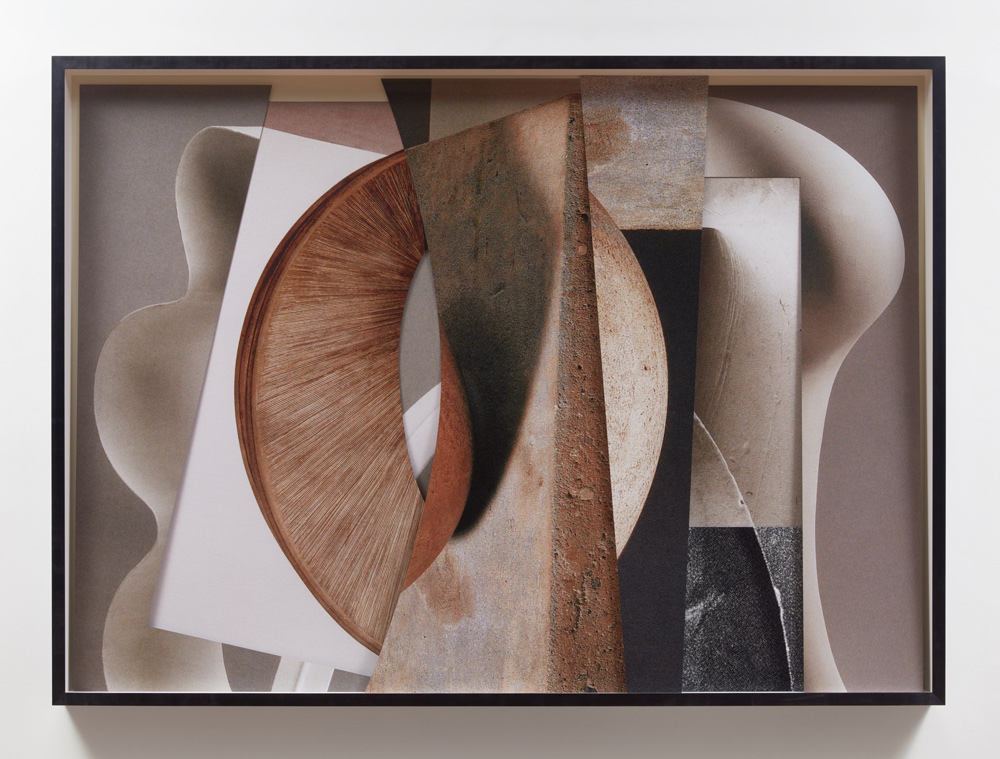
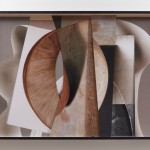
Paper sculpture, 2024. Dye sublimation prints on aluminum and latex paint. (74 3/8 × 102 1/4 × 5 3/4 in.) Courtesy of the artist and Sikkema Malloy Jenkins, New York. © Erin Shirreff
Summer exhibitions need not be an afternoon of air conditioned, undirected wanderings. The Milwaukee Art Museum’s photography exhibition, Erin Shirreff: Permanent Drafts, provides an opportunity to consider artwork both startling and challenging. Herzfeld Curator of Photography and Media Arts, Kristen Gaylord, introduces the viewer to over 40 recent collages, photographs, sculptures, and videos of this resourceful artist, building a case for the rewards of slow and thoughtful observation.
Through a layout developed collaboratively with the artist, Gaylord has brought Shirreff’s sculpture together with photographs, providing an opportunity to experience the nature of transformation over space, size, and medium.
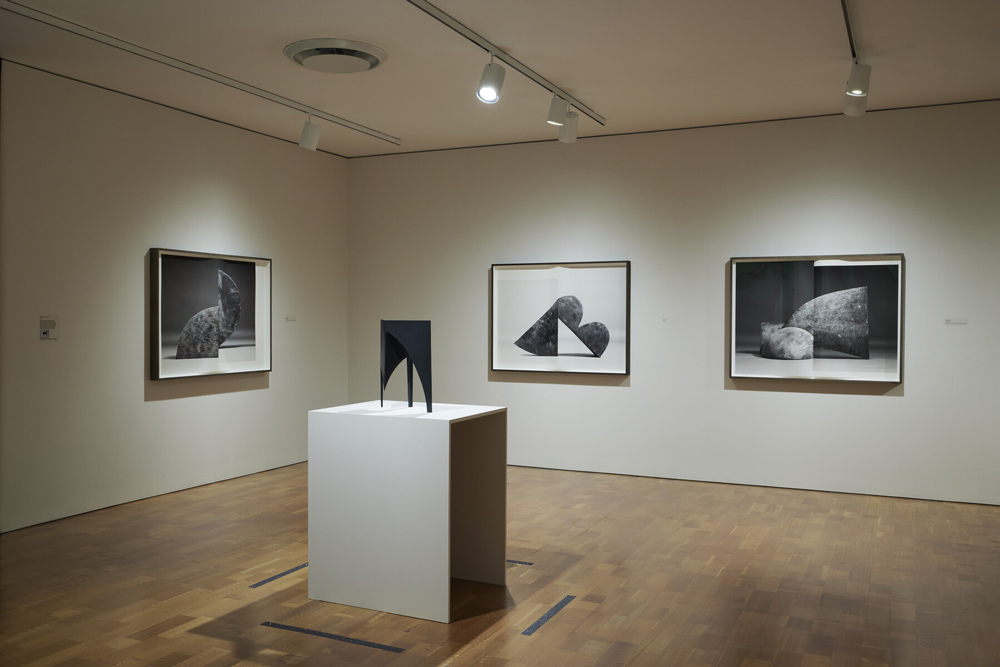
INSTALLATION. FIG SERIES WITH SCULPTURE From left to right: Fig. 8, 2019; Maquette (A.P. no. 10), 2019; Fig. 4, 2017 and Fig. 10, 2019 on view at the Milwaukee Art Museum. Milwaukee Art Museum Institutional Archives. © Erin Shirreff
The artist began her practice as a sculptor and has created a cohesive visual vocabulary inspired by 20th-century modernism. She uses this language to question the nature of how we experience objects, how they are transformed by photography and re-contextualized in time. Gaylord explains that the artist “scours art books published decades ago, when the abstract forms of modernist sculpture entered the canon of art history. [Shirreff] uses these historical reproductions as source material to seek ‘the possibilities in new translations and confusion.’”
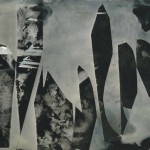
Monograph, 2017, a series of five inkjet prints, represent Shirreff’s observations regarding the fragmentary, sometimes deceptive nature of reproduction. Gaylord explains that although the photographs might at first seem to be unbound publication spreads, closer inspection reveals that each print actually combines two separate images, some of which seem to complete the sculpture of a separate photograph.
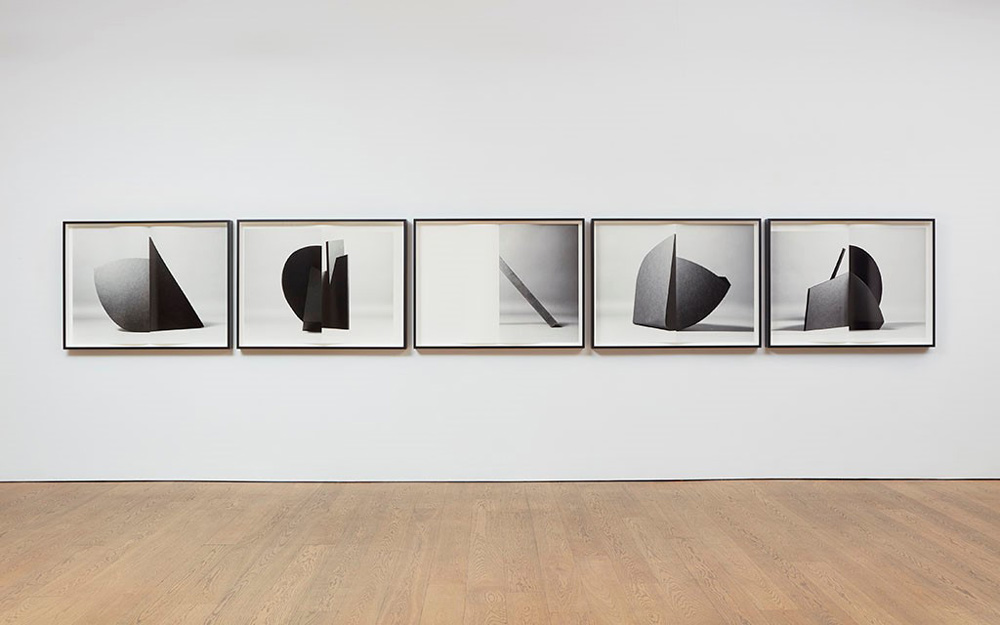
Monograph (no. 6), 2017 Five inkjet prints. Each: (37 × 48 1/2 × 3 1/4 in.) Courtesy of the artist and Sikkema Malloy Jenkins, New York ©Erin Shirreff
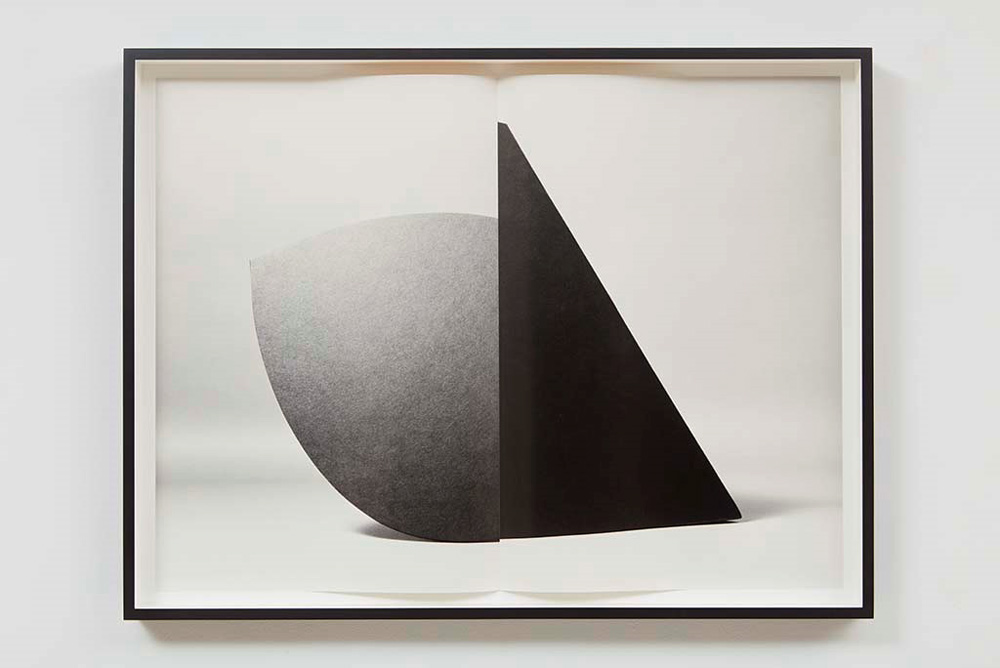
Detail, Monograph (no. 6) Detail, Monograph (no. 6), 2017 © Erin Shirreff
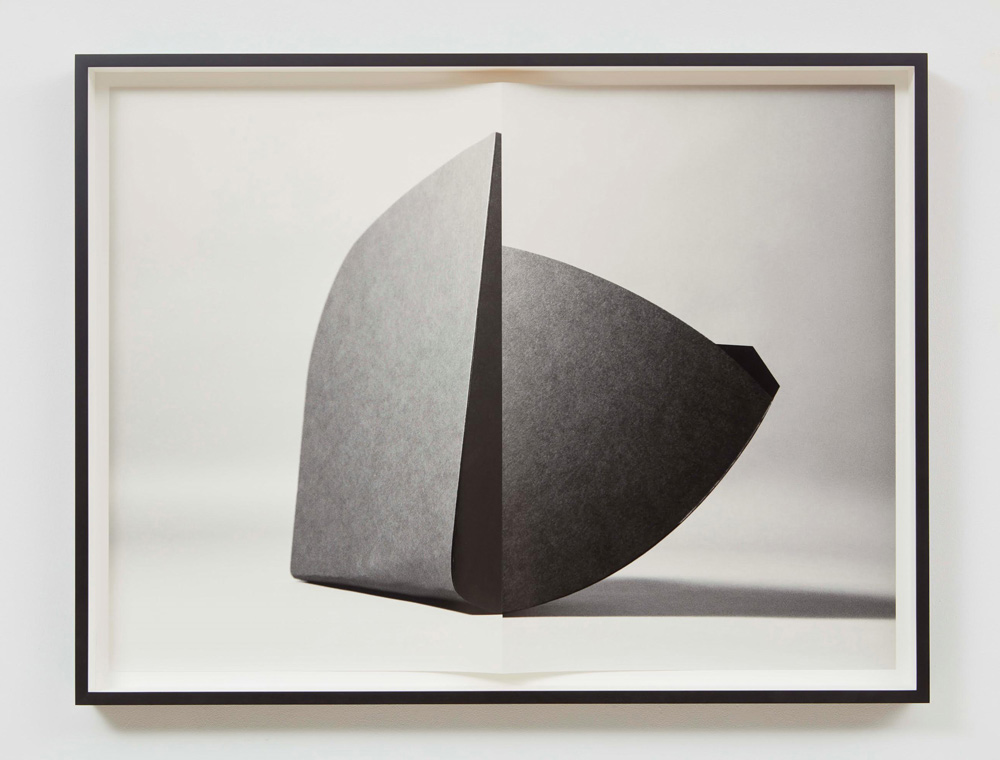
Detail, Monograph (no. 6) Detail, Monograph (no. 6), 2017 © Erin Shirreff
Shirreff employs her own collection of geometric forms in a similar way in the Fig. series. Gaylord describes the….space depicted in [these photographs] both coheres and doesn’t. The contradictory shadows, image borders, and object angles reveal that two separate images have been spliced together. Yet it remains unclear whether we are looking at two angles of the same sculpture or two different objects. The title references the common shorthand for illustrative figures in academic books, where these illustrations would be accompanied by a caption. Subverting this expectation, Shirreff’s Fig. photographs appear without context or identification, requiring that we engage with them on visual terms alone.
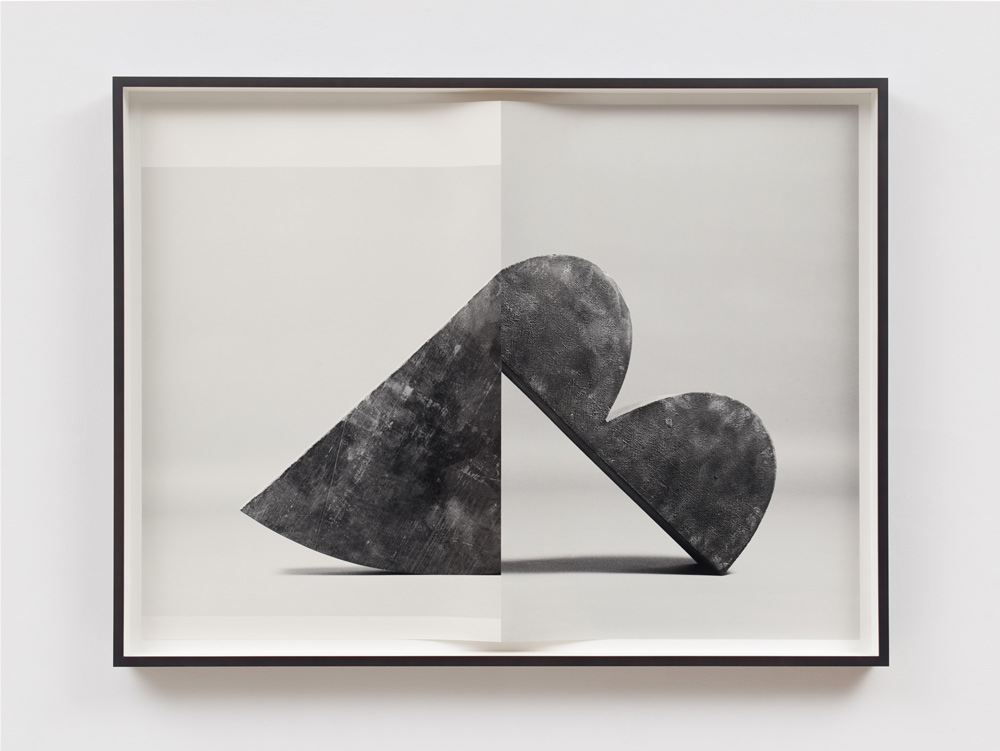
Fig. 4, 2017. Archival pigment print. (43 1/2 × 57 1/2 × 3 1/4 in.) Christine A. Symchych and James P. McNulty. Image courtesy of the artist and Sikkema Malloy Jenkins, New York. © Erin Shirreff
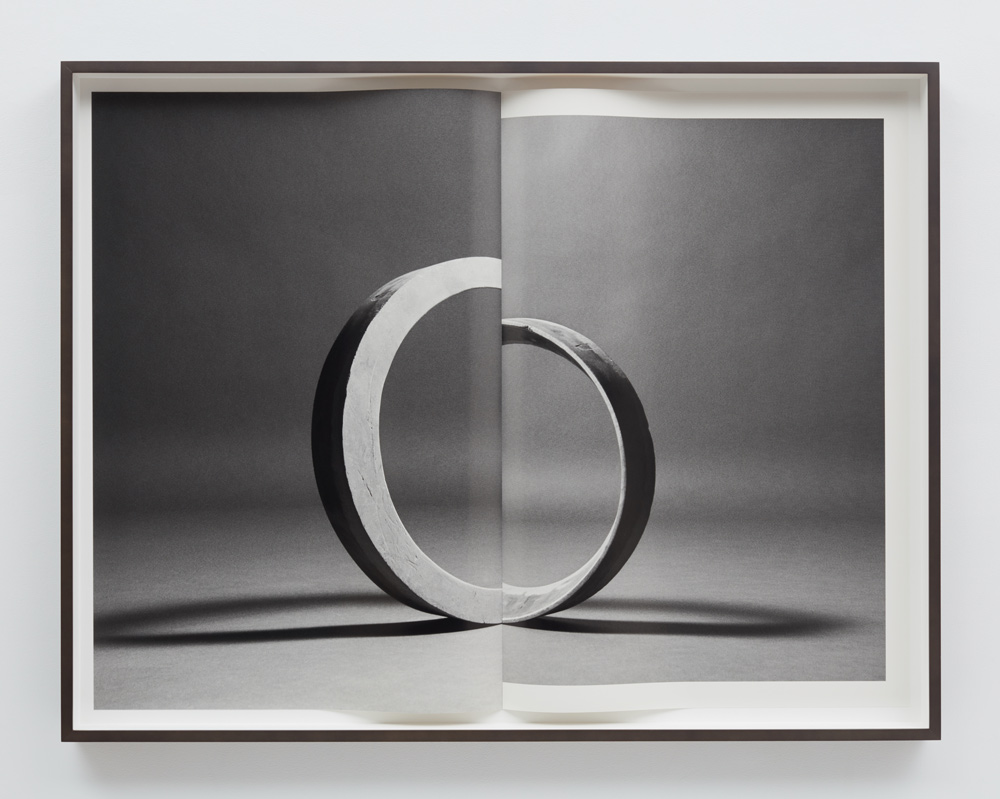
Fig. 5, 2017. Archival pigment print. (43 1/2 × 57 1/2 × 3 1/4 in.) Christine A. Symchych and James P. McNulty. Image courtesy of the artist and Sikkema Malloy Jenkins, New York. © Erin Shirreff
Subverting notions of negative and positive space, Shirreff’s Drop sculptures hang in a precarious state near her photographs. The sculptures are constructed based on the artist’s studio remnants and titled to recall foundry leftovers. Without context, we see that space is relative and impermanent, but what the artist sees is a “wonderful zone of possibility.”
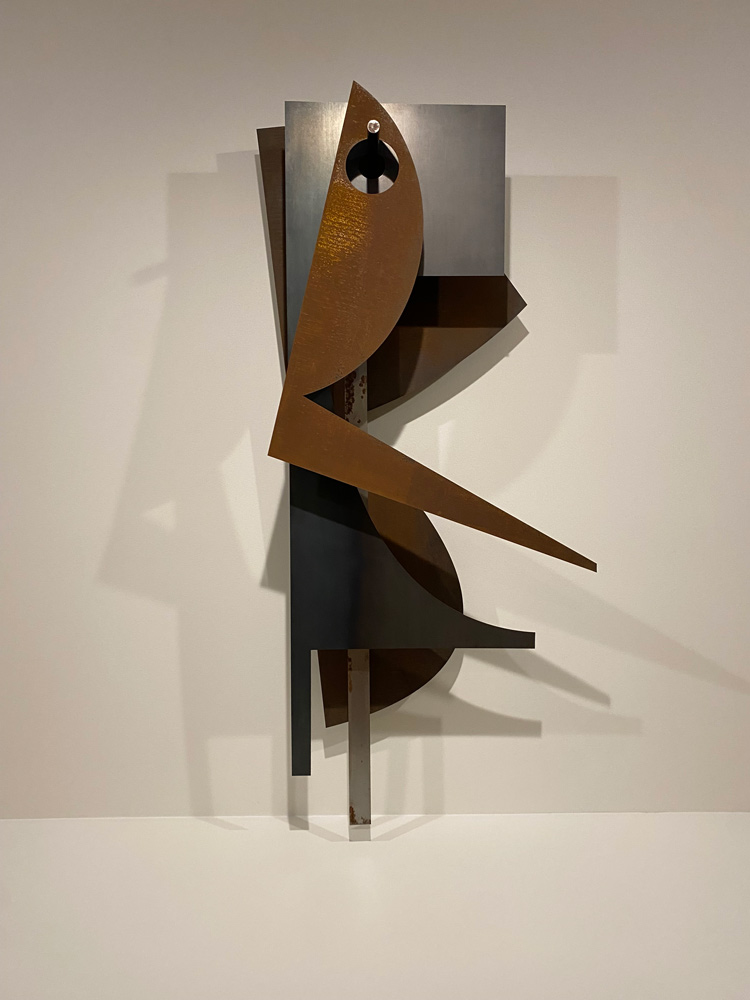
Drop (no. 7), 2014 Hot-rolled, cold-rolled, and Cor-ten steel. (92 × 40 × 20 in.) University of Toronto Collection 2023-013.a-.e, Gift of Alison and Alan Schwartz, 2023. Courtesy Art Museum at the University of Toronto © Erin Shirreff
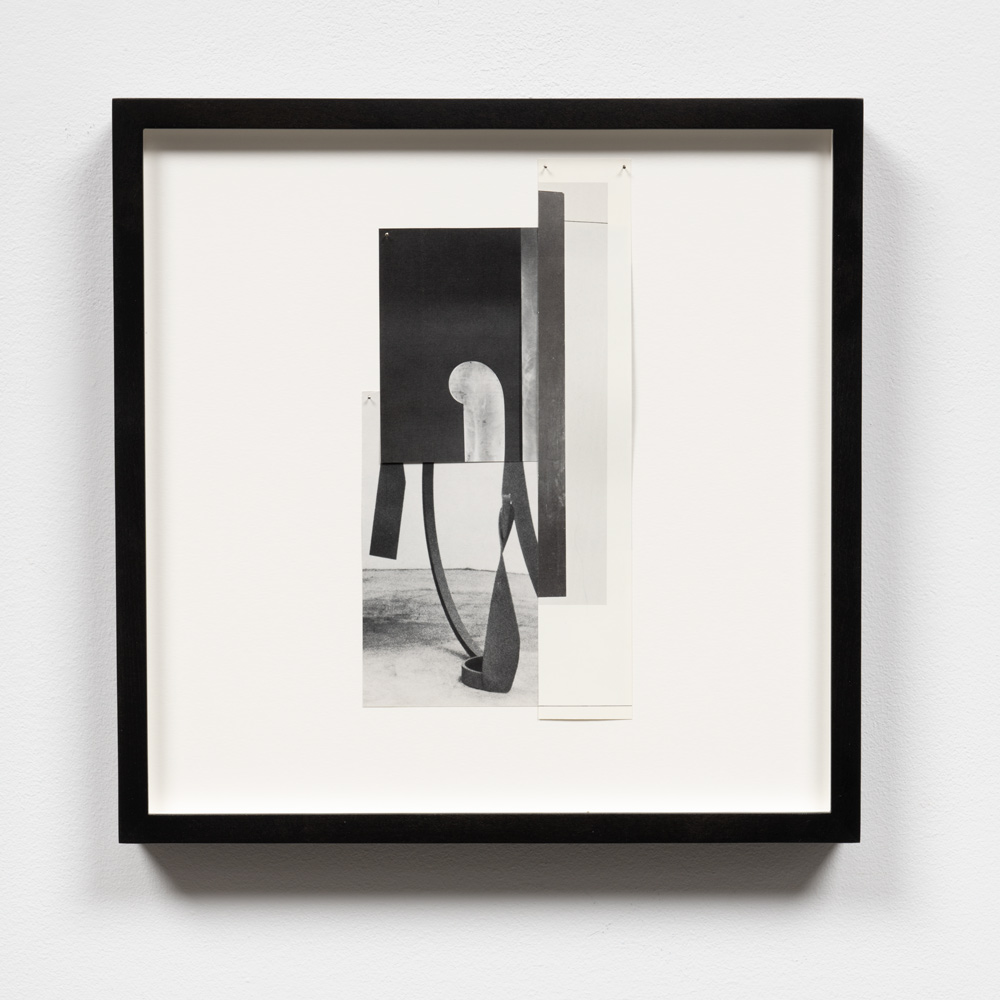
Pages (no. 47), 2023 Book pages, pins (12 × 12 in.) BAP Art Projects © Erin Shirreff
Zones of possibilities multiply in Pages, intimate collages Shirreff has been making since 2011. Fragments sourced from historical sculpture books are sliced and reconstructed demonstrating Shirreff’s studied, deliberate process. Gaylord shared that these modest works on paper have become some of her favorites in the show, because, she argues, they serve almost as a key to unlock Shirreff’s practice. “They’re the most handmade and intimate of the works,” she said, “but also include many of Erin’s core strategies and interests: editing and layering existing source imagery, presenting nonexistent works that have the integrity of physical objects, manipulating forms of the past to give them new resonance, and, at the heart of it, probing the ways we receive information about sculpture.”
Another challenge to see in purely visual terms is evoked by the layering technique in Shirreff’s large scale cyanotypes. The artist used her “inside time” during the COVID-19 pandemic to make commanding large-scale works.
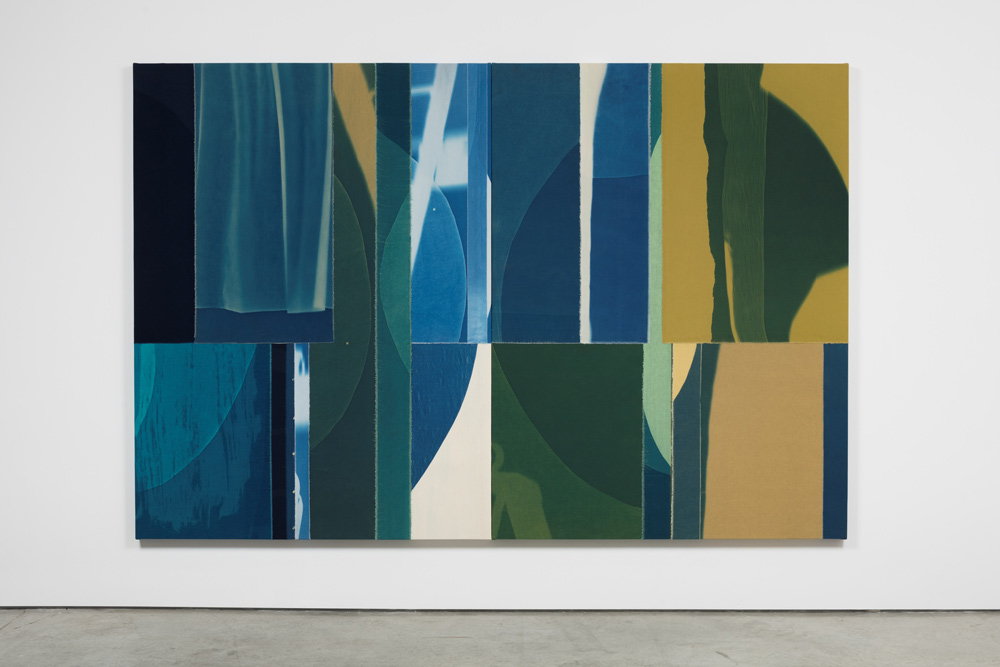
Inside times, 2020. Cyanotype photogram and fabric over panels (diptych). (80 × 120 in.) Courtesy of the artist; Bradley Ertaskiran, Montreal; and Sikkema Malloy Jenkins, New York. © Erin Shirreff
Employing the 19th c camera-less technique on varying shades of fabric substrate, Shirreff created abstract forms. Mirroring the disassembling technique she uses with sculptural images, she ripped the exposed fabric and reassembled it creating compelling collaged compositions. There is a painterly quality to these images, yet the unmistakable Prussian blue of the process keeps them grounded in the photographic world.
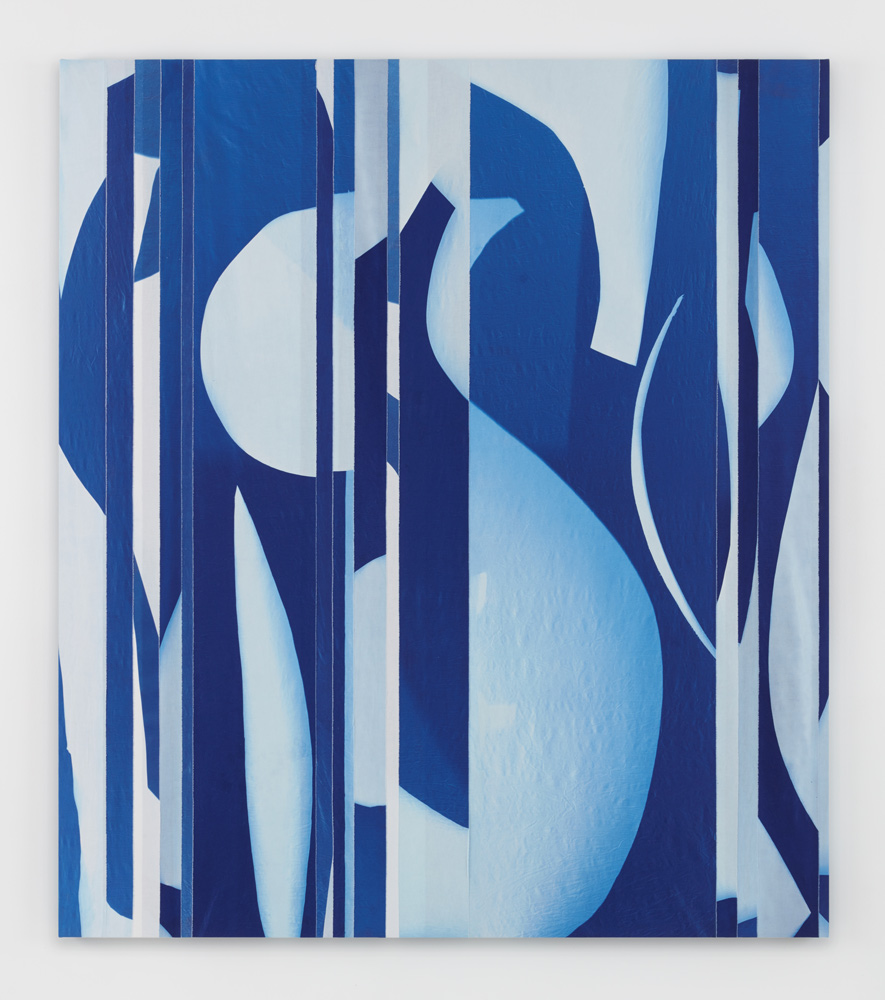
Cuttings, 2018. Cyanotype photogram and muslin over panel. (80 × 70 in.) Christine A. Symchych and James P. McNulty. Image courtesy of the artist and Sikkema Malloy Jenkins, New York. © Erin Shirreff
While large cyanotypes on the soft substrate of fabric are commanding, the expansive 25-foot Drop, 2025 requires the viewer to snap to attention. Space, light, and shadow weave across the wall, creating a visual maze of steel fragments in an installation created specifically for the Milwaukee Art Museum. Describing the work, Gaylord states:
Resting against the wall, these steel sheets appear casually placed. Yet their weight and their composition, which intentionally plays with fundamental art concepts such as positive and negative space, undercut that impression. Shirreff drew from three separate Drop sculptures she made over the last decade to create a new arrangement for this exhibition. The individual forms were inspired by leftover material, but the artist recontextualized them in this layered composition, shifting our understanding of their figure-ground relationships.
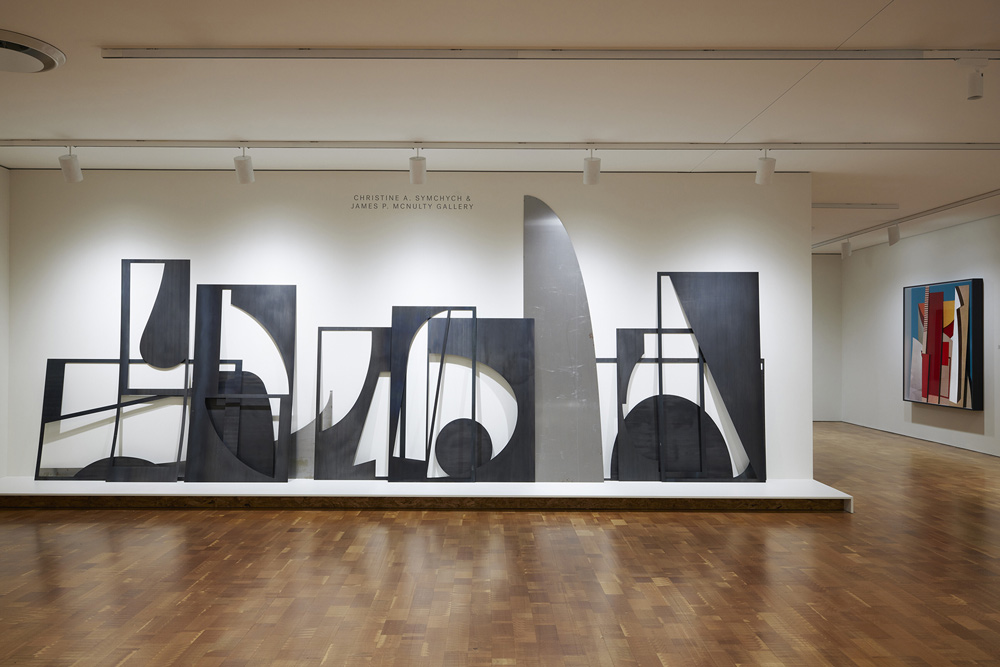
Drop (no. 13), 2015; Drop (no. 7), 2014; Drop (no. 20), 2024; and Drop (no. 18), 2024 on view at the Milwaukee Art Museum. Milwaukee Art Museum Institutional Archives. © Erin Shirreff
Shirreff enlists imposing scale, shadows, and crevices to animate the meticulously arranged planes of her dye sublimation assemblages. Enlarging the dotted halftone patterned surface in historical book reproductions suggests the nature of reinterpretation—dialogue, subversion or unforeseen contingencies.
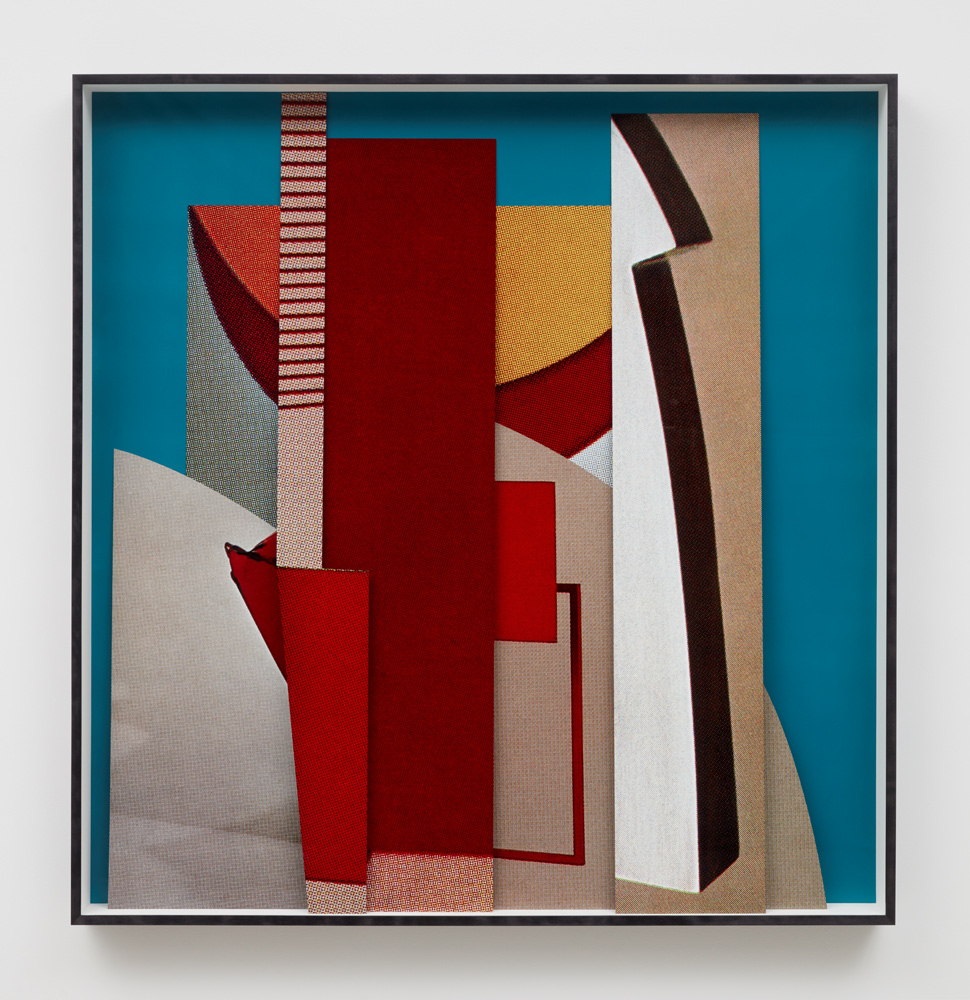
New Moon Construction, Number 10, 2021. Dye sublimation prints on aluminum and latex paint. (73 1/4 × 71 1/4 × 5 3/4 in.) Lent by the Minneapolis Institute of Art, Gift of funds from Mary and Bob Mersky. Image courtesy of the artist and Sikkema Malloy Jenkins, New York. © Erin Shirreff
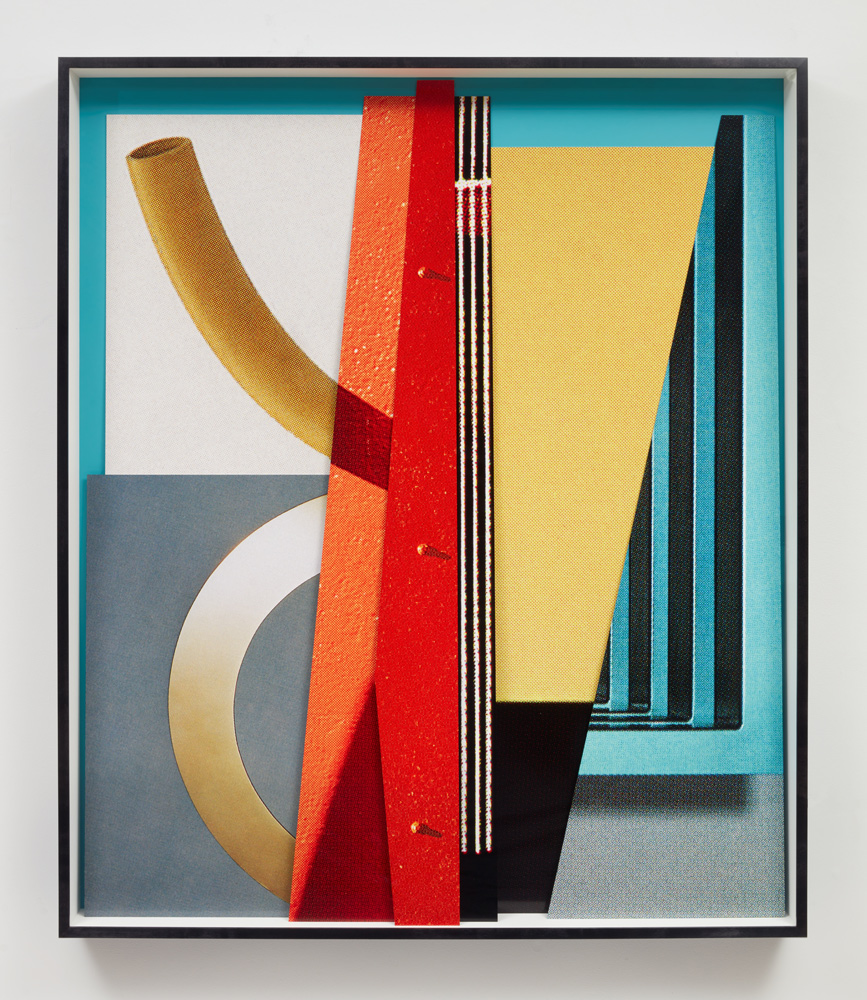
Surface capital, 2022. Dye sublimation prints on aluminum and latex paint. (71 1/4 × 60 1/4 × 5 3/4 in.) Courtesy of the artist and Sikkema Malloy Jenkins, New York. © Erin Shirreff
While viewing each piece, positive and negative relationships shift. Using reproductions with an intense 70s color palette, the artist accelerates the sense of shifting dimensions. Erin Shirreff: Permanent Drafts is a cunning, contradictory exhibition which demands that the viewer decipher a world where solid forms oscillate and space is indeterminate.
Erin Shirreff: Permanent Drafts on exhibit May 30 through September 1
Erin Shirreff (b.1975, British Columbia, Canada) lives and works in Montreal. Recent solo exhibitions of her work have been held at SITE Santa Fe, NM (2024); the Clark Art Institute, Williamstown, MA (2021–22); San Francisco Museum of Modern Art (2019); Kunsthalle Basel, Switzerland (2016); Buffalo AKG Art Museum, NY (formerly the Albright-Knox Art Gallery) (2016); and the Institute of Contemporary Art, Boston (2015). Her work is included in the permanent collections of the Art Gallery of Ontario, Toronto; Centre Pompidou, Paris; Dallas Museum of Art; Los Angeles County Museum of Art; Metropolitan Museum of Art, New York; Museum of Contemporary Art, Chicago; Museum of Fine Arts, Houston; The Museum of Modern Art, New York; National Gallery of Canada, Ottawa; Nouveau Musée National de Monaco; Solomon R. Guggenheim Museum, New York; and the Whitney Museum of American Art, New York, among others. Shirreff earned an MFA in sculpture from Yale University in 2005.
Kristen Gaylord is the Herzfeld Curator of Photography and Media Arts, overseeing the research, preservation, and presentation of the Museum’s photography and new media collections. Since joining MAM in 2023, she has served as site curator for Arresting Beauty: Julia Margaret Cameron (2024) and curated Erin Shirreff: Permanent Drafts (2025). Her upcoming projects include Currents 40: Widline Cadet (2026) and a major survey on the relationship between photography and extractive industries in the U.S., which opens at the National Gallery of Art next year.
Previously, Gaylord was associate curator of photographs at the Amon Carter Museum of American Art and held multiple curatorial roles at the Museum of Modern Art, where she contributed to over a dozen exhibitions and publications. Gaylord holds an MA and a PhD in art history from the Institute of Fine Arts at New York University.
Posts on Lenscratch may not be reproduced without the permission of the Lenscratch staff and the photographer.
Recommended
-
McCall Hollister in Conversation With Douglas BreaultMarch 6th, 2026
-
Jonathan Silbert: InsightsFebruary 19th, 2026
-
Anne McDonald: Self-PortraitsFebruary 17th, 2026
-
Photography Educator: Erin Ryan StellingJanuary 9th, 2026
-
The Female Gaze: Alysia Macaulay – Forms Uniquely Her OwnDecember 17th, 2025