Yumi Janairo Roth: EFFIGY 1462
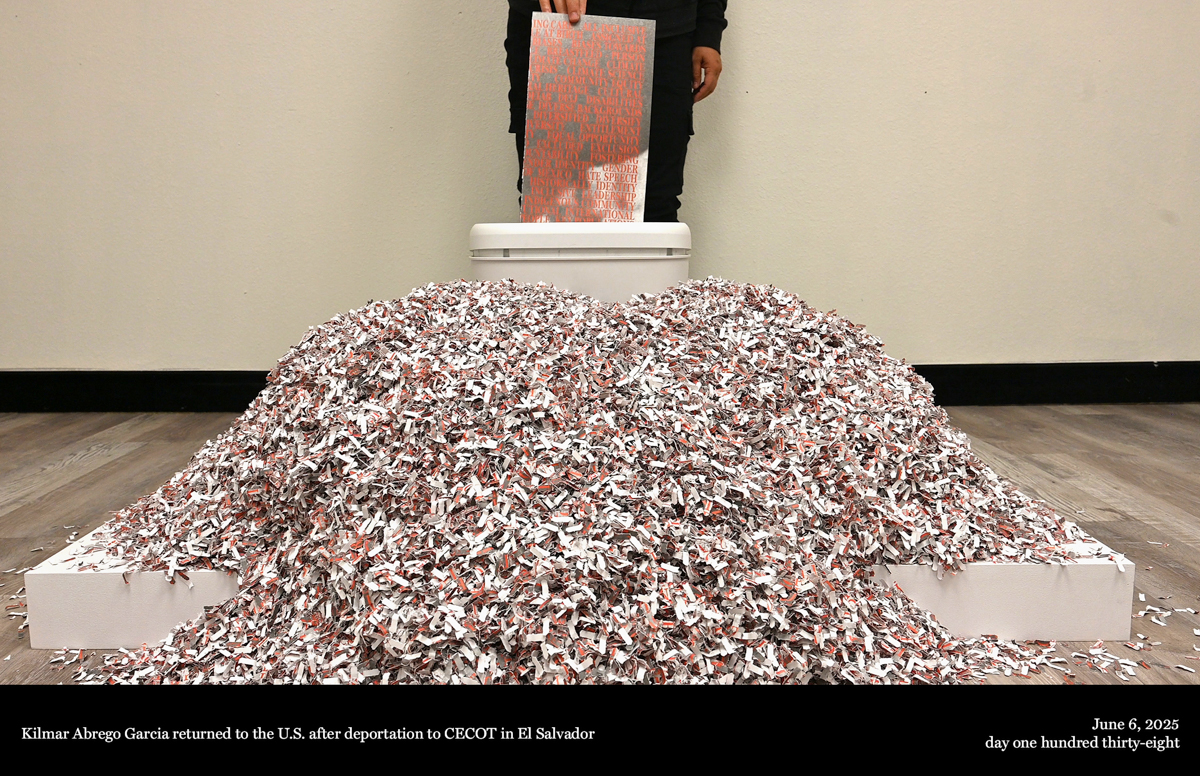
Yumi Janairo Roth’s Effigy 1462 is an installation and an abacus, a performance and a private prayer. It is a somatic tending that is both a metaphorical act of hope and a physical ritual toward surviving the four years of the current Trump administration.
The piece was born from reports of certain words and phrases flagged to review, reject, and/or defund government proposals and organizations—a documented and on-going list of language prohibited and repressed as means to conceal and destroy any dissidents to the current agenda. In the face of such linguistic weaponization, Roth wondered what the inverse might be, how there could be a cathartic release in destroying the prohibition of language. She was also in search of a way to do something, to not turn away.
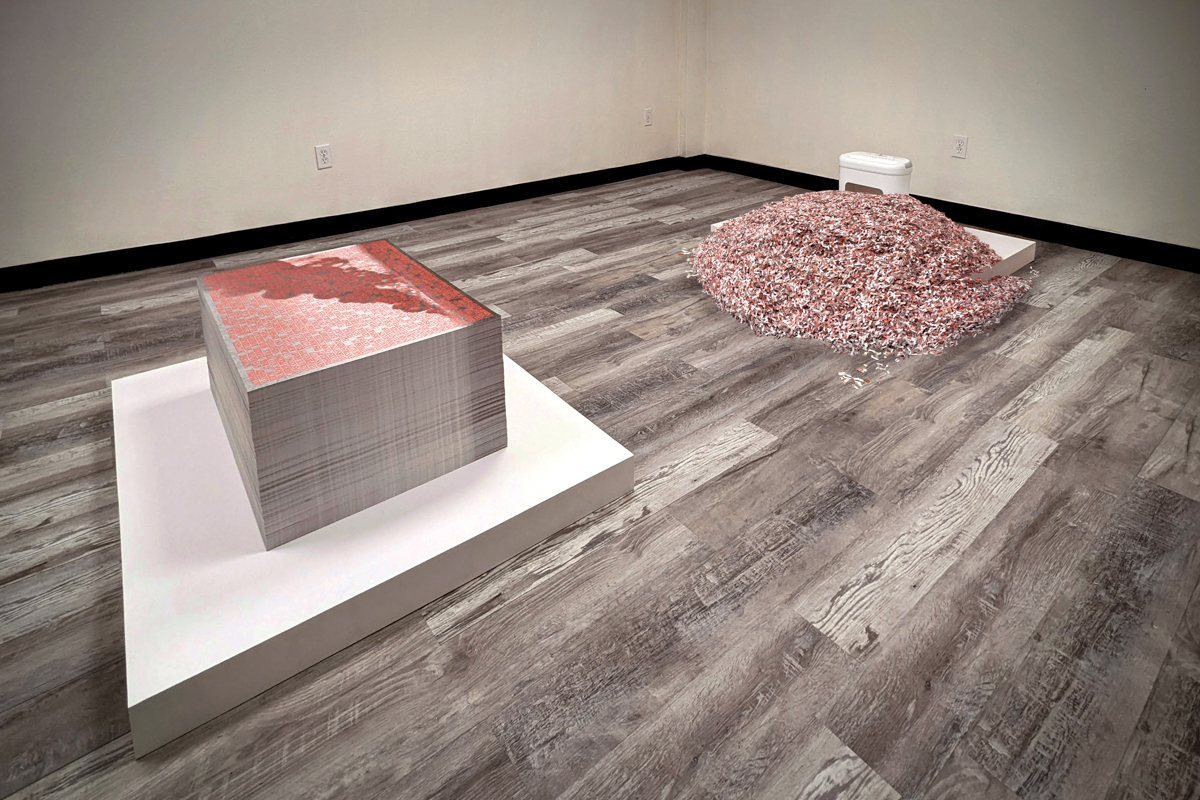
What arose is a site-specific, four-year installation that requires deep attention and presence in order to persist. Hosted by East Window, Effigy 1462 currently exists in an innocuous rented office space in Boulder, Colorado. Accessible only by appointment, the room is a perfect representation of bizarro American office culture: drop ceiling, utilitarian white walls, harsh fluorescent lighting, no windows. It is unnerving in its accuracy as a caricature of American corporate workplace. In the middle of the room, two platforms sit in opposition. On one rests a notable stack of paper; on the other, a paper shredder is near-buried by a hill of shredded confetti. It is in the traverse between these two platforms where Roth’s work takes place, day after day.
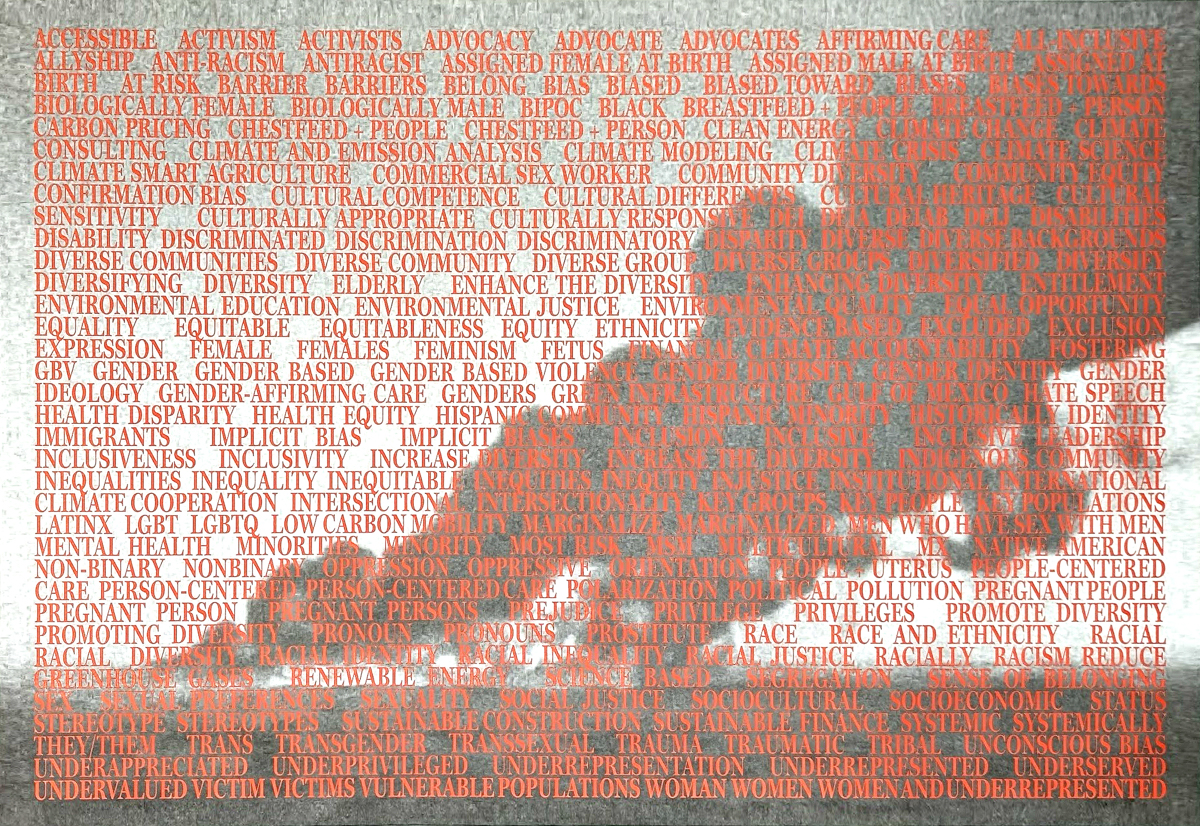
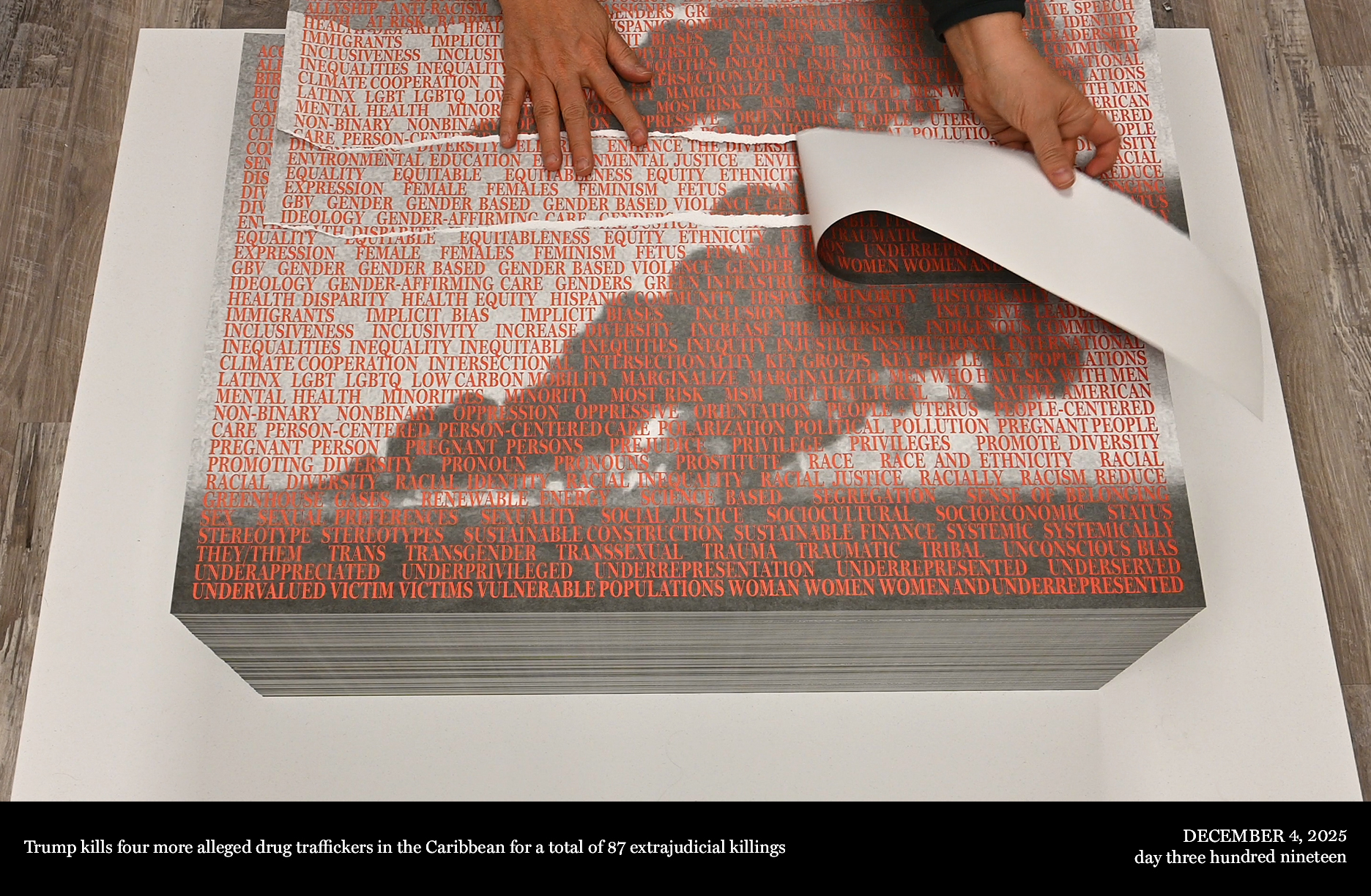
The stack of paper began as 1462 copies (the number of calendar days in a four-year presidential term) of the same print: an ambiguous and slightly pixelated plume of smoke rises in a distant horizon, while a list of red words overlays the foreground. This is the list of words deemed offensible when Roth first started the project, though it is already outdated as the erasure of language (and now, of people) continues to grow more rampant. The words themselves appear alphabetically in an attempt to override the siloing and parsing of different departments, but even still, a clear narrative arises of their implied meanings. The smoke looming in the background is indistinguishable other than being a warning, a signal of emergency, of something going terribly wrong. The print is handsome in design, the paper of fine quality, which makes the destruction of each copy hold even more tension.
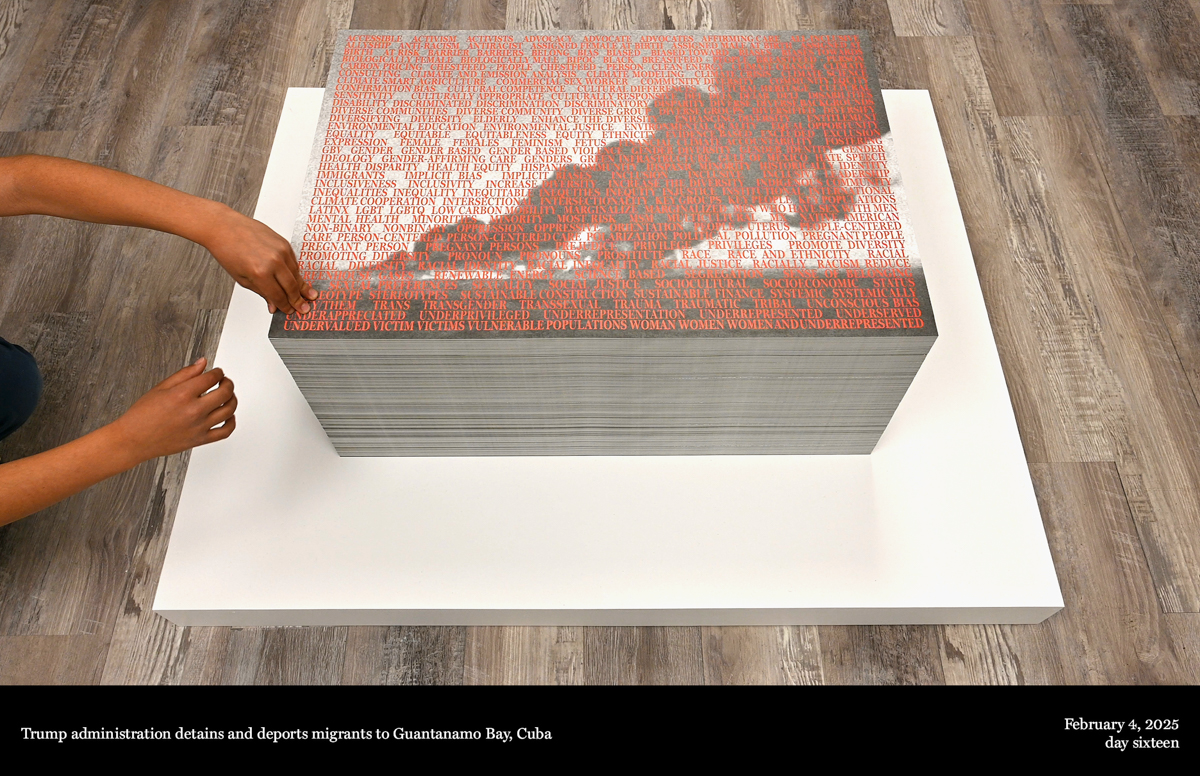
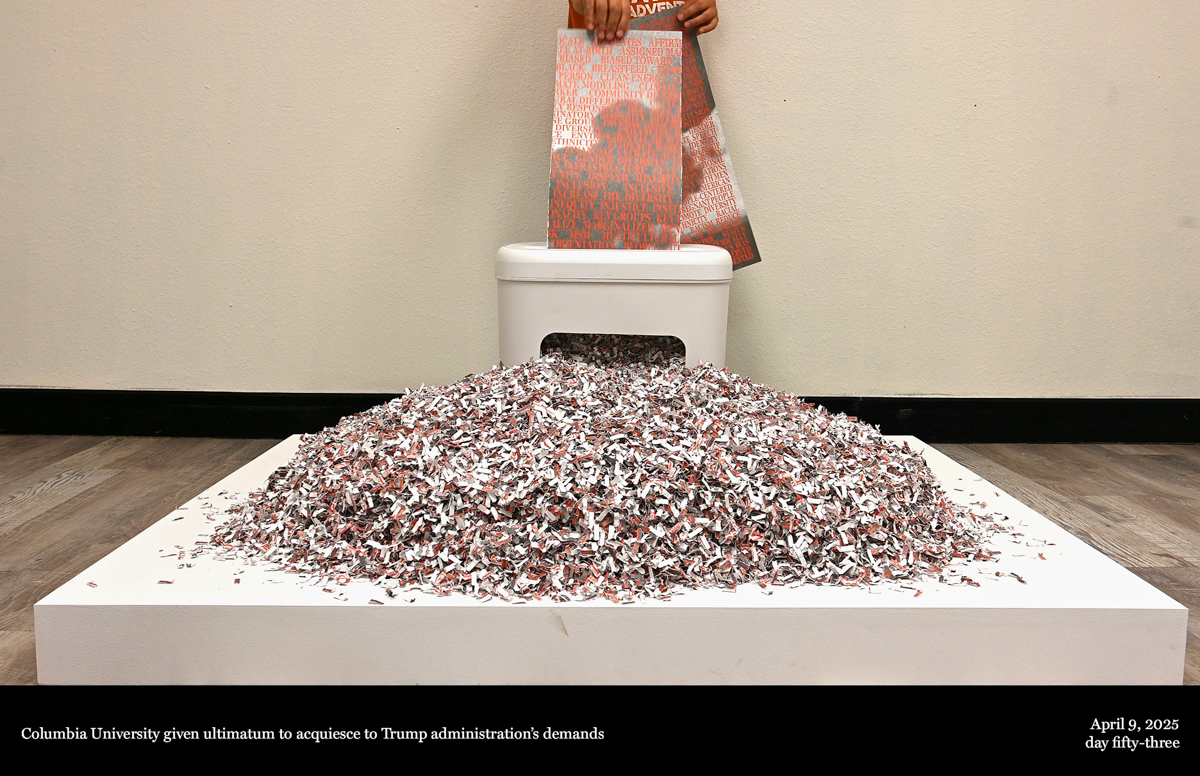
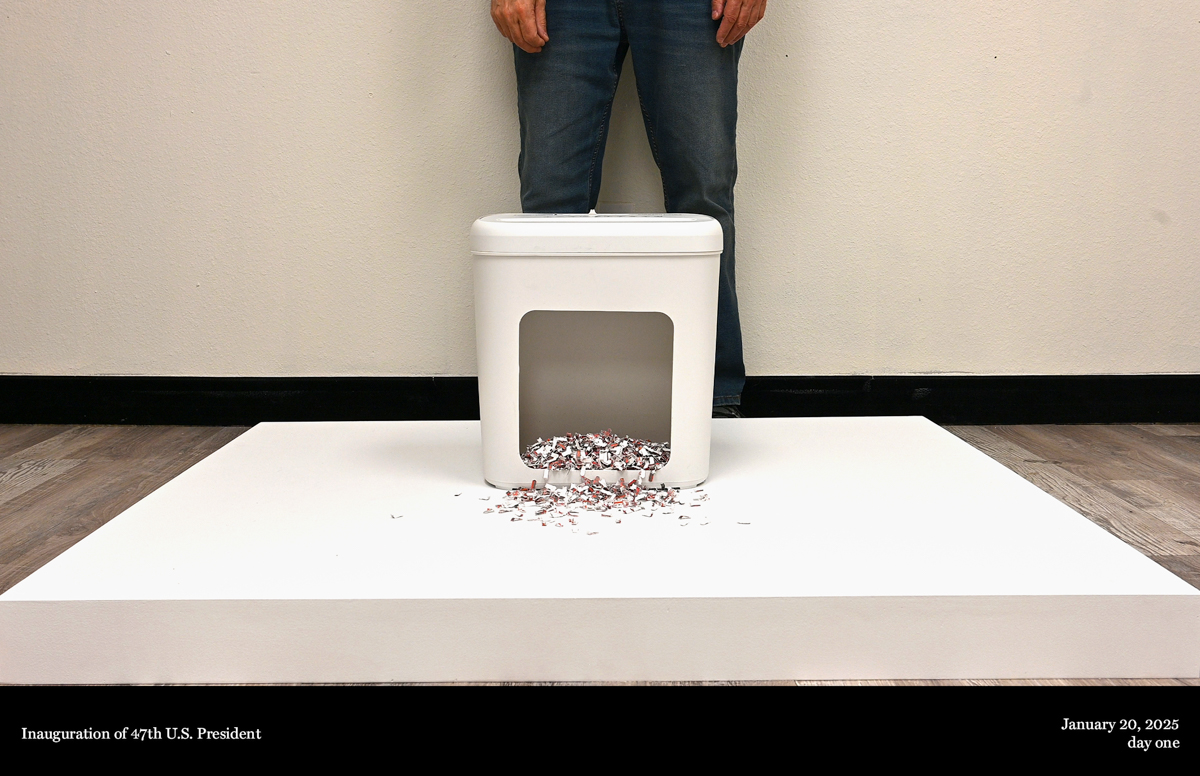
Roth comes to this place as close to daily as possible to pull a sheet from the stack and feed it through the shredder in account for each day of this presidency, the symbolic horror of what we exist within diminishing incrementally but never fully going away. Roth uses her body to enact the futility of how one depletion (the stack of paper) causes a simultaneous accumulation (the shreddings) somewhere else. It is a game of misdirection, a spot-on metaphor for the nature of bureaucracy. The shredder is Amazon Basics brand (no accidental choice), and Roth cut a hole in its receptacle so that the shredded remains vomit literal word salad across the floor. There are limits to the materials: the shredder can only handle one sheet at a time and can overheat; the paper needs to be torn down in order to fit into the feeder. For a project centered around language, the room is ironically non-conversational, overtaken by the churning whir of the shredder masticating today’s sheet. There is a hint of destroying classified documents; while not exactly top secret, this ongoing ritual is happening right under the noses of the building’s other occupants. The combination of the barren space and the repetitive task is a stark reminder of how much of one’s life is spent in sterile rooms, performing monotonous tasks for the sake of survival.
And this is an act of survival. Roth considers the project a way of showing up and being present for the long run. Although the task seems simple enough, it is emotional and exhausting work to hold court with ongoing censorship. The physical and emotional fatigue required is indicative of the intentions of these powers that be: to exhaust us, to wear us down.
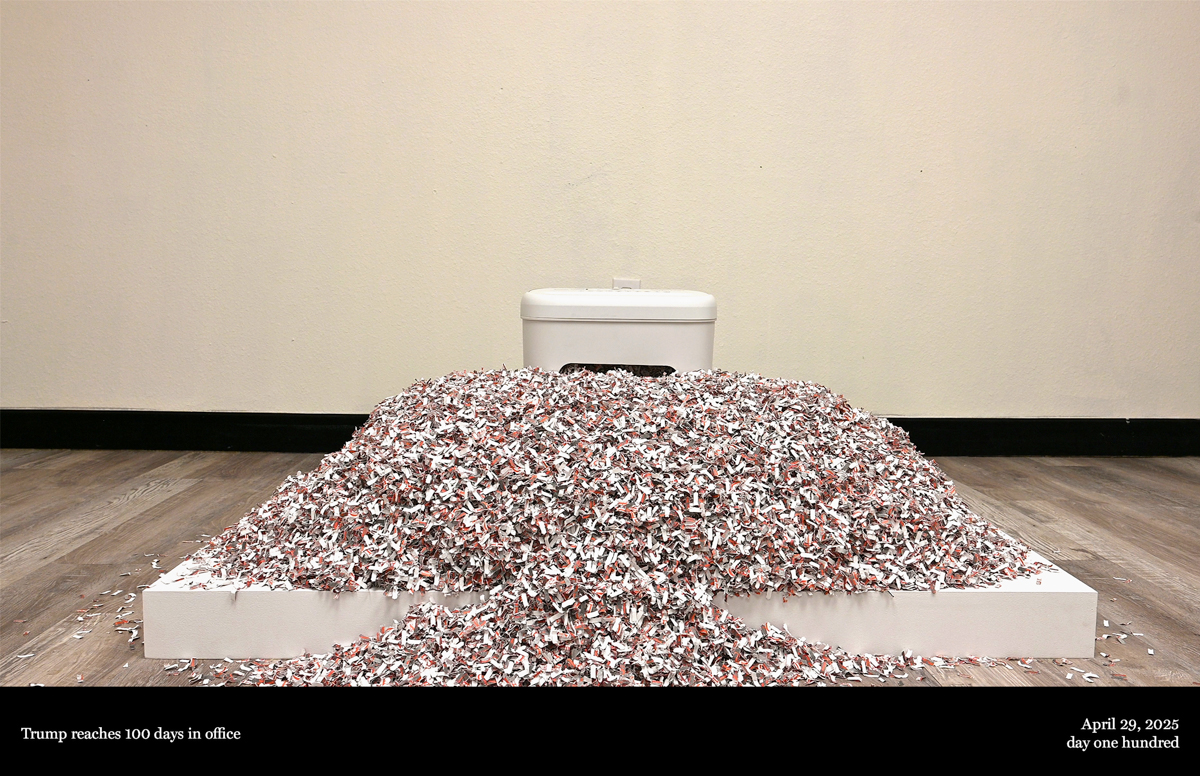
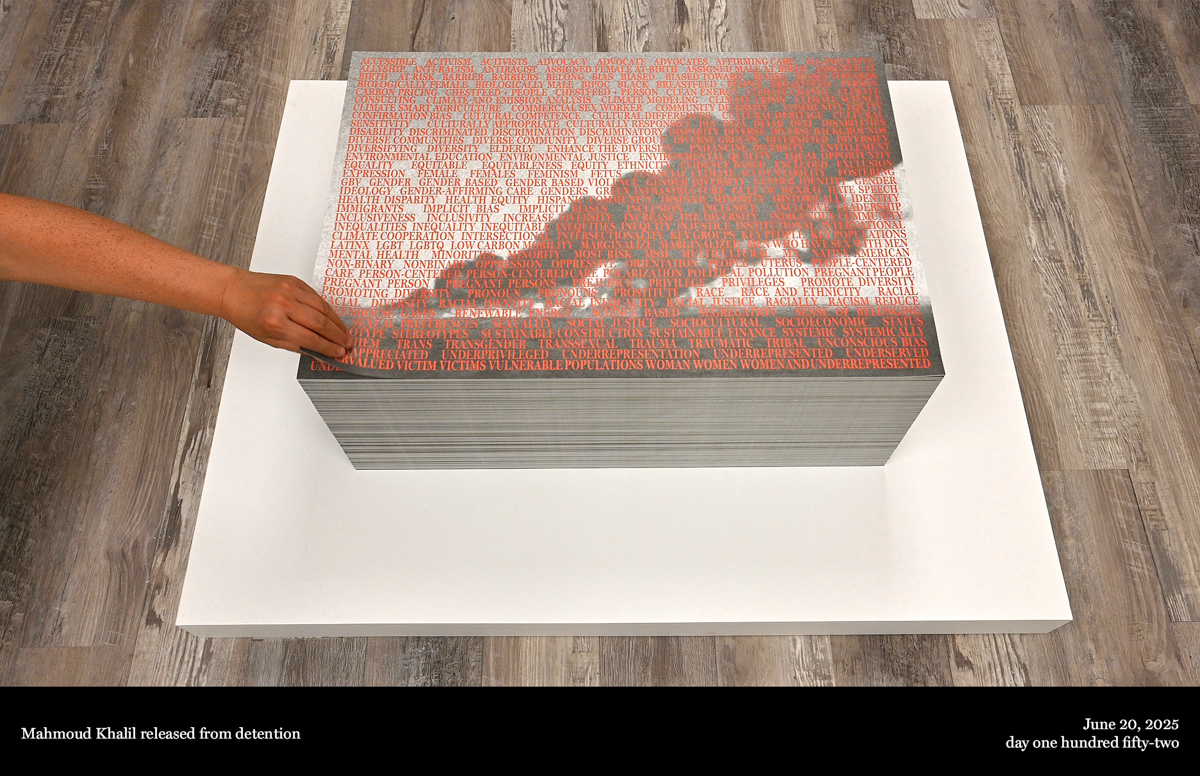
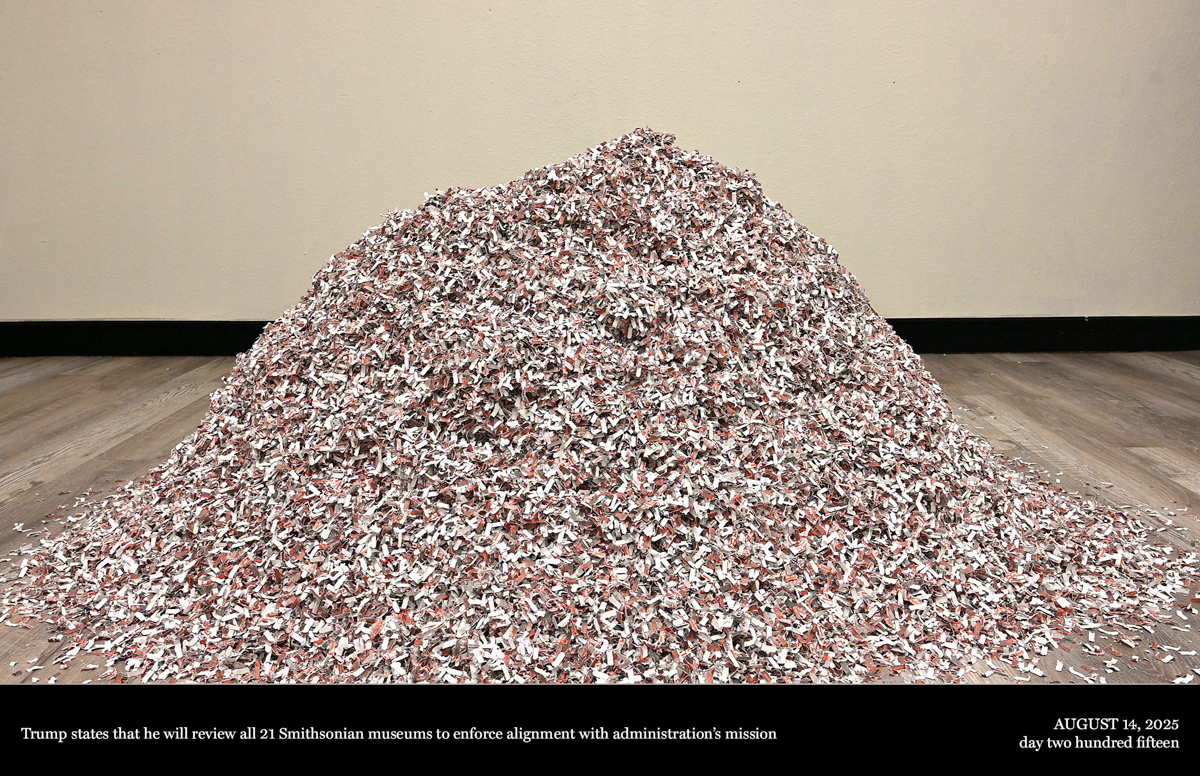
Since the action happens primarily in isolation, documenting each day is essential to capturing the cumulative effect of the project. Roth opts for a straightforward recording of the process. She sets her camera at the same fixed angle. The shots are tight-in. This is not photography of seductive aesthetic or performance; this is documentation for durational accuracy. What results is an almost CCTV-style feed, a resource to refer to for information, for evidence. Keeping the cameras in the same place as the space evolves over time intensifies the staging, her videos a living archive of how actions accumulate in ways we can’t see in real time.
With such a long timeframe ahead, it is unclear what will happen in the lifespan of this endeavor. Logistically, the ever-shifting physicality of the work will present challenges. Heaps of shredded material may make it difficult to reach the shredder or set the camera at its usual mark. There is a fixed lease on the current space, so there are vague plans for relocation(s) at some point(s), including a residency at the East Window gallery. The forthcoming results linger in a perpetual “I don’t know” space; it is unclear if the ending will be interesting, or if there will even be an ending. Perhaps the process will have to start again in the wake of these four years. Perhaps Roth will experience the joy of having erased something horrifying in her own way. Maybe the project will become obsolete. Maybe there will be regret in taking on such a long task, of choosing to endure the responsibility of it.
Regardless of the ultimate trajectory, what lingers most poignantly is the hope pooling in the heart of this commitment. To show up every day is to believe in the possibility of another one to follow. It is sweet to think of how many other rooms around the country something akin to this is happening—how many other people are finding actions and acts to devote themselves to as a way to trudge through what can seem interminable.
Effigy 1462 will be on view in Boulder, CO, through January 20th, 2029 by appointment only. Please contact East Window at info@eastwindow.org for more information.
East Window is an independent arts organization that supports and promotes diverse artistic practices and the ideas that surround them. East Window is designed for the presentation and viewing of programmed as well as guest-curated screenings, exhibits, readings, workshops and installations. They develop and host several collaborative projects and partnerships each year, offering their community exposure to local, national and international artists whose work responds to both personal as well as compelling socio-political issues of our time. East Window serves as a creative incubator for artists to generate and exhibit milestone works motivated by the imperatives of self-recognition and self-representation. The organization hopes that the works it exhibits will attest to contemporary art’s ongoing relevance within social discourse and its capacity to create a more socially just, equitable, accessible and inclusive world.
Follow East Window on Instagram: @eastwindow1
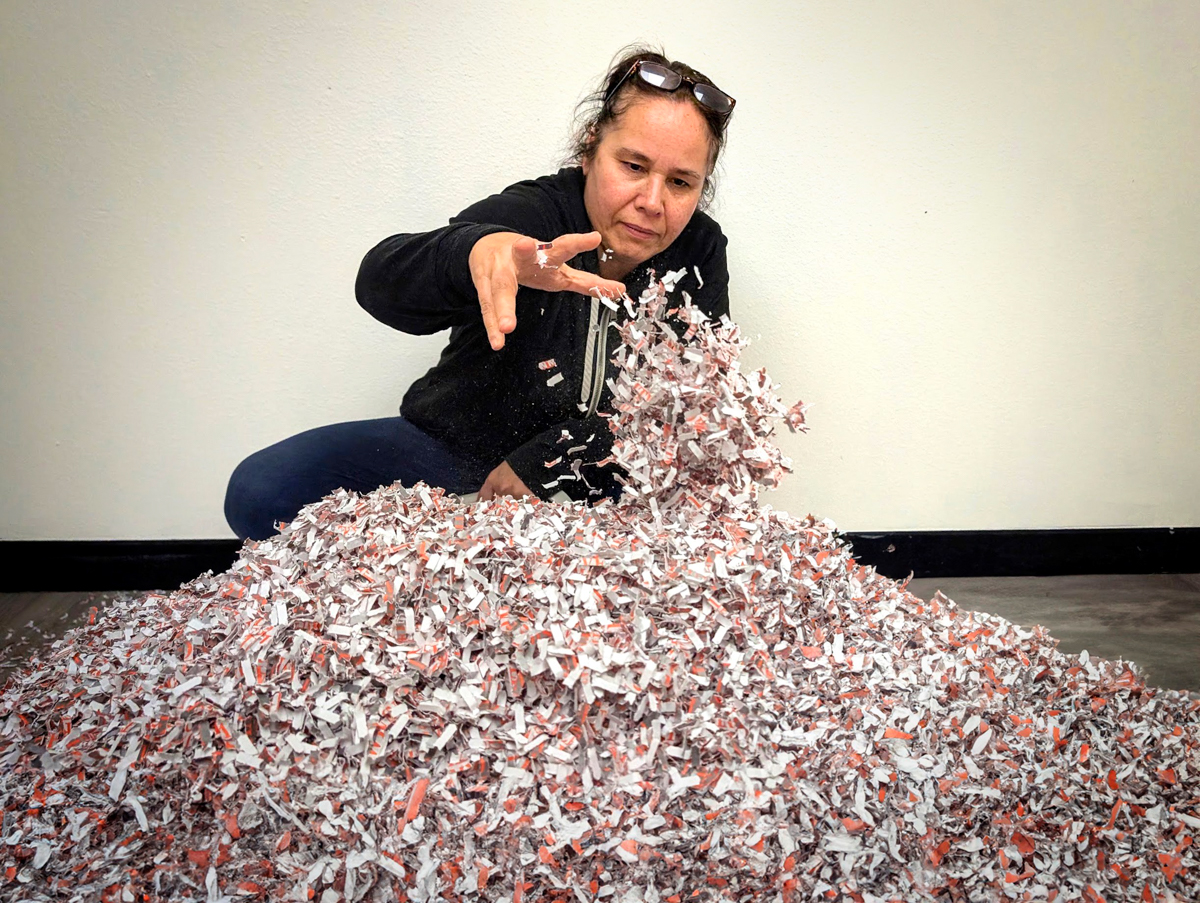
Yumi Janairo Roth was born in Eugene, Oregon and grew up in Chicago, Metro Manila, the Philippines and suburban Washington DC. She received a BA in anthropology from Tufts University, a BFA from the School of the Museum of Fine Arts-Boston and an MFA from the State University of New York-New Paltz. She currently lives and works in Boulder, Colorado where she is a professor of sculpture and post studio practice at the University of Colorado. Roth has created a diverse body of work that explores ideas of immigration, hybridity, and displacement through discrete objects and site-responsive installations, solo project as well as collaborations. In her projects, her objects function as both natives and interlopers to their environments, simultaneously recognizable and unfamiliar to their users. Roth has exhibited and participated in artist-in-residencies nationally and internationally, including Grand Central Art Center, Santa Ana, CA; Lower Manhattan Cultural Council, Smack Mellon, and Cuchifritos in New York City; Diverse Works and Lawndale Art Center in Houston; Institute of Contemporary Art, Portland, ME; Walker Art Center, Minneapolis, MN; Consolidated Works, Seattle; Vargas Museum, Metro Manila, Philippines, Ayala Museum, Metro Manila, Philippines; Frankfurter Kunstverein, Germany; Galerie Klatovy Klenová, Czech Republic; and Institute of Art and Design-Pilsen, Czech Republic.
Follow Yumi on Instagram: @yumijroth
Jade Lascelles is a writer, musician, and artist based in Colorado. She is the author of The Inevitable (Gesture Press), Violence Beside (Essay Press) and All Things Born | Proximate Seams (with visual artist Todd Edward Herman). Her work has appeared in The Rumpus, Women of Resistance: Poems for a New Feminism, the Bologna In Lettere festival’s International Poetry Review, and the visual art exhibits Shame Radiant, Joysome, and Disgust: Unhealthy Practices. She is a regular contributor to the interarts platform Girl Book and is featured in the Ed Bowes film Gold Hill and the Natalia Gaia short film A Spark Catches, which won second prize at the 2022 Maldito Festival de Videopoesia. Jade holds an MFA from the Jack Kerouac School of Disembodied Poetics at Naropa University and plays drums in a few different musical projects.
Posts on Lenscratch may not be reproduced without the permission of the Lenscratch staff and the photographer.
Recommended
-
Photography Educator: Lindsay MetivierFebruary 21st, 2026
-
Jonathan Silbert: InsightsFebruary 19th, 2026
-
Olga Fried: Intangible EncountersFebruary 18th, 2026
-
Anne McDonald: Self-PortraitsFebruary 17th, 2026
-
Review Santa Fe: Leslee Broersma: Tracing AcademiaFebruary 11th, 2026