Mexico Week – Iñaki Bonillas: From the Sideline of a Photograph
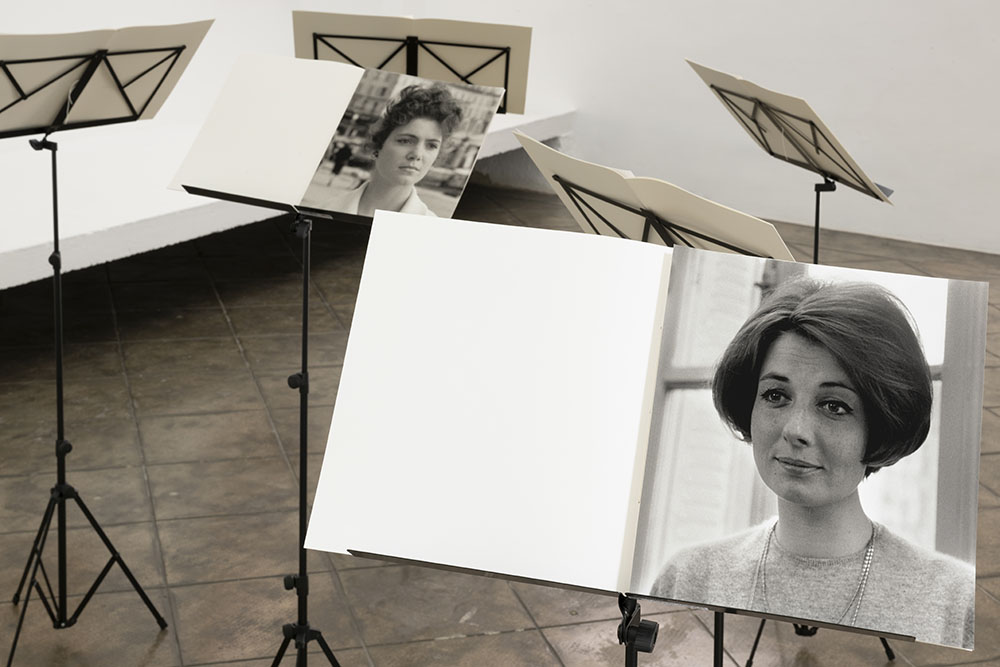
©Iñaki Bonillas, Brief Lives, 2025
When I think of Mexico Week I don’t just see it as a series of interviews, but as a compass of what’s yet to come.
Seven artists, each working from a different place—whether it’s femininity, nature, society, history, identity, architecture, or the unconscious—share an undoubtable longing to express themselves in an innovative and true way.
While doing these interviews I didn’t only find photographs. I found passion, devotion, ideas, processes, humor, time, effort, and a true sense of humanity that deserves to be shared.
This isn’t an academic work. It’s a series of conversations about how our practice as photographers continues to evolve day by day. About how life shapes us and grants us the power to give meaning to what we capture with a click.
In a rapidly changing world, these artists continue to honor the origin of the word “photography” by bringing light and stories into it.
These photographers can look to the past and the future, move between worlds, and build a contemporary curiosity that will inspire many more to follow the path they’ve traced. The image is changing, and I believe we should stop for a moment and ask “What is Mexican photography saying today?”
The artists are: Iñaki Bonillas, Tomás Casademunt, Paola Dávila, Carol Espíndola, Cristina Kahlo, Gerardo Montiel Klint, and David Muñíz.
Iñaki Bonillas wanders through the margins of history, both of art and his family’s, in order to find what lies beyond. What a name, a theme, a look, a shape, or a silhouette can mean. By linking his artistic practice with multiple photography archives—including his grandfather’s—he explores the subtlety of contemporary experimentation and classic tradition regarding photography. Nowadays art asks us to find true artists who include their story in their work, and no doubt, Iñaki does it with mastery.
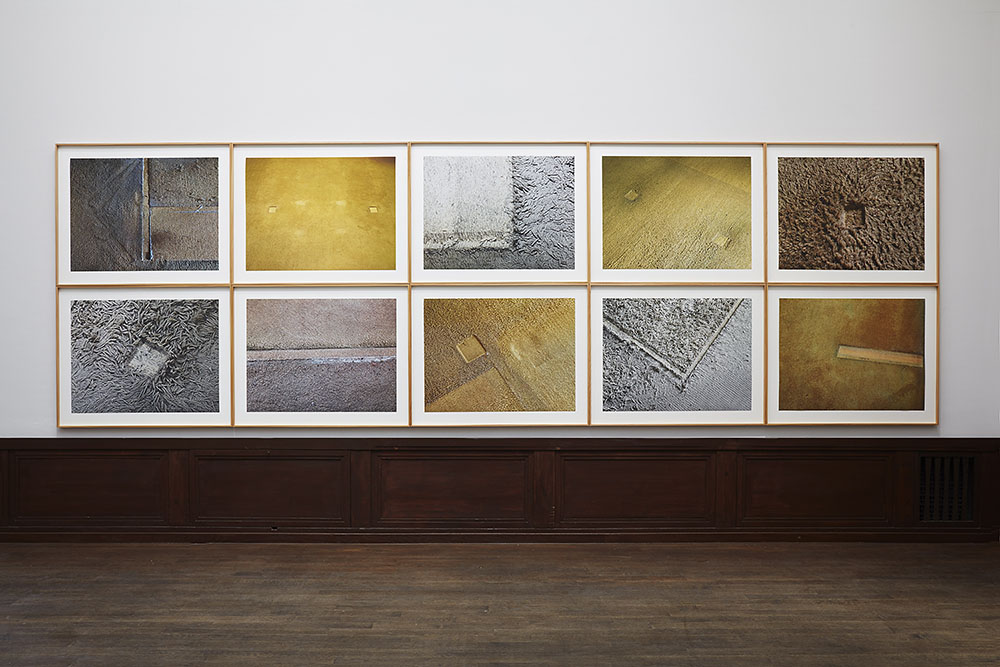
©Iñaki Bonillas, Secrets: Imprints, 2016
Iñaki Bonillas (1981, Mexico City) is one of the most intriguing conceptual artists working with photography today. Personal, biographical narrative is repositioned through a quasi-scientific approach to composition and material: photographs inherited from his grandfather are transformed into new narratives, leading us to question our relationship to memory and reality, and the troubling incompatibility that arises between these two defining components of our personal identities.
Printmaking as a means of transforming archival material is a central focus in Bonillas’s practice. By reframing and editing found imagery, and subsequently creating a sense of permanence through the repetition and multiplication inherent to printmaking, the artist is able to firmly transform his interpretations into a new reality. He gives physical form to the deep-rooted, often subconscious, process of self-editing we perform throughout our lives.
Iñaki Bonillas has had exhibitions across the globe, with solo exhibitions including Plečnik House, Ljubljana; Casa Luis Barragán, Mexico City; La Virreina Centre de la Imatge, Barcelona; Mies van der Rohe Pavillon, Barcelona; Matadero, Madrid; and M HKA, Antwerp.
He has participated in numerous group exhibitions, most notably the São Paulo Biennial; A4 Arts Foundation, Cape Town; Tirana Biennial (Albania) Sonsbeek, Arnhem (Netherlands); Prague Biennial; Musée d’Art Moderne de la Ville de Paris; Kunstmuseum Basel; Malmö Konsthall (Sweden); Pori Art Museum (Finland); National Gallery of Victoria (Australia); and the Venice Biennial.
His works are part of public collections such as the SFMOMA, San Francisco; MACBA, Barcelona; MoMA, New York; and Jumex Museum, Mexico City.
Follow Iñaki on Instagram: @i.bonillas
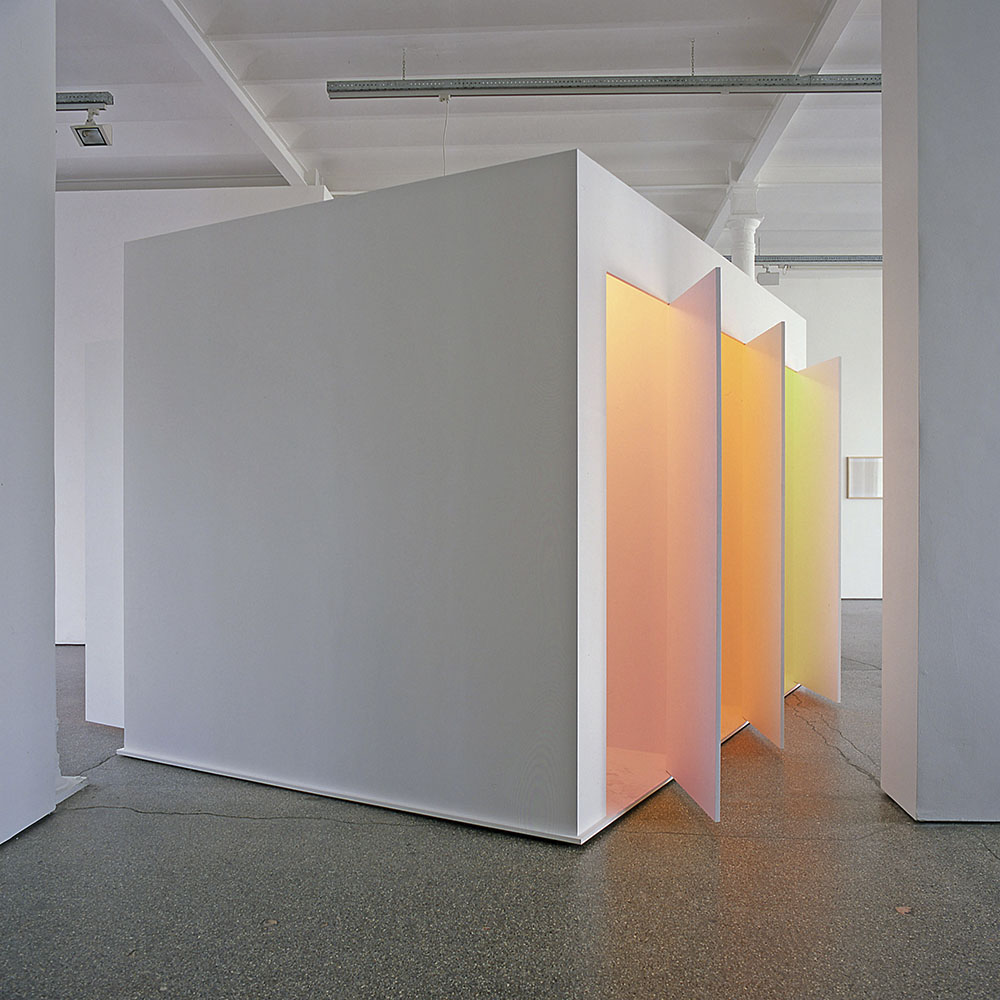
©Iñaki Bonillas, Light Rooms, 2000
I have defined my practice, for lack of a better term, as “attic photography.” By this I mean work carried out on the margins of conventional photography. It is not so much anti-photography as a somewhat parasitic exercise, since it feeds largely on the traces left by traditional photography. In that sense, it is photography that does not rely on the classic notion of auteur photography, which above all pursues what Cartier-Bresson called “the decisive moment,” but rather makes use of any image, however irrelevant or lacking in aesthetic value it may seem, and even incorporates any scrap of image it finds. That is why my work draws mainly on all kinds of existing archives and photographs. I call it “attic photography,” because that is its territory: the garret, the moths, the hidden or neglected, what is in danger of extinction (like paper photography itself). For decades, my work has moved within this para-photographic territory which, for that very reason, does not strictly fall within what is understood as photography, since it is expressed more in terms of a visuality that, in any case, is permeated by the photographic, but not only that; painting, drawing, cinema, and, perhaps above all, literature also have an influence on the research I have been conducting for almost thirty years. —Iñaki Bonillas
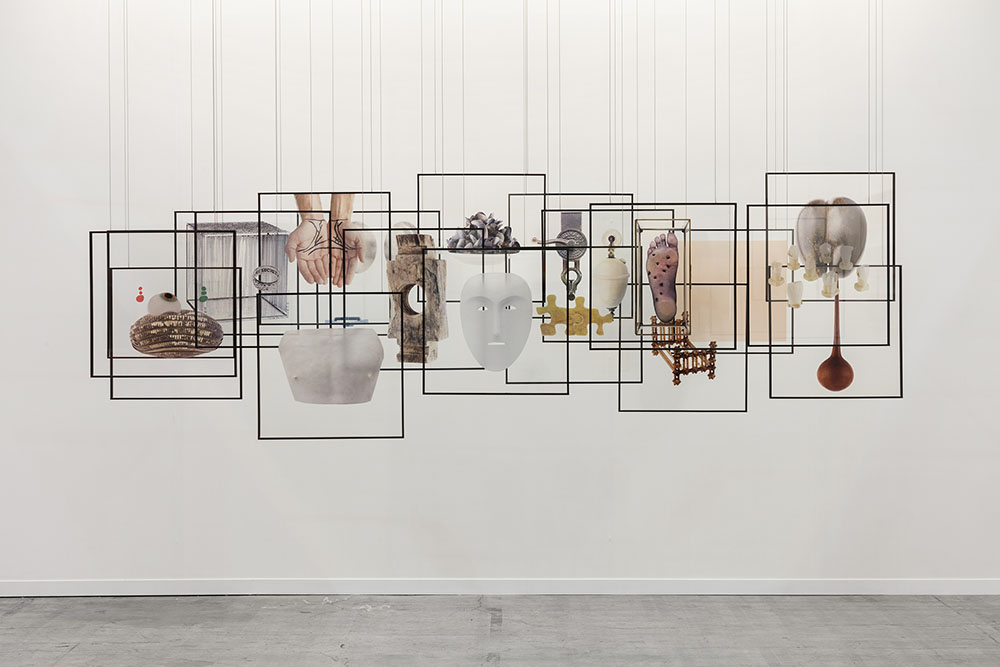
©Iñaki Bonillas, Like Sparrows Around a Pool of Water, 2017
Lou Peralta: Iñaki, why don’t we start with what you’re currently working on?
Iñaki Bonillas: Well, since the FIFA World Cup is coming to Mexico this year, several institutions are organizing an exhibition on the subject. On March 28, Jumex is presenting one that revolves solely around artists that have focused on soccer.
I play soccer and I’ve become a fan of it over the last fifteen years, especially because I’ve worked with a gallery—ProjecteSD—in Barcelona since 2003. I remember that once I had to spend three months there setting up an exhibition and the installers would stop working to watch Barça’s matches. I’d join them and end up completely mesmerized by watching what looked more like a ballet than a game. It was the era of Guardiola’s team, one of the most refined coaches. From that moment on, I’ve been in love with the team and the sport.
So, when I got Guillermo Santamarina’s invitation to participate in Jumex’s project, I didn’t hesitate to accept. It’s a project that not only relates to soccer, but to photography, since a key element is that I’m working with images from the Televisa Archive. I’ve spent several months exploring 35mm negatives to create a project for a fixed spot in the museum that is seldom used: the lockers.
LP: And you’re also working on something related to Marcel Duchamp, aren’t you?
IB: I am. This next October it will be 58 years since Duchamp passed away, and as his loyal admirer I want to pay tribute to him with a work of my own. I’ve been gathering stories that seem to have been forgotten, but not for long.
The interactions he had in Mexico are very interesting for someone who works with photography, because mostly all we know about him in relation to Mexico has to do only with a diversity of reproductions. For example, the first time Duchamp was discussed in Mexico was in the 1920s, in a lecture by Walter Pach, probably through reproductions. Later, at the surrealist art exhibition in 1940 at the Galería de Arte Mexicano, Duchamp presented hand-colored reproductions of three of his works as if they were originals. Then there’s the piece Duchamp gave to Frida Kahlo: a reproduction of Nude Descending a Staircase, hand-colored, which is now exhibited at the Casa Azul. It used to hang in Frida’s main bedroom. And finally, there’s the whole story surrounding Octavio Paz’s book published by Era. For the second edition, a reproduction of Étant donnés appeared—that work which can only be viewed through a peephole in Philadelphia. Originally, the idea was to keep it secret, so that only visitors could see it through the holes in the door, but a Mexican artist, Fernando San Pietro, alias Marcelo del Campo, went in with a camera, took a slide, and that image was widely distributed in Mexico. The best-kept secret of the Philadelphia Museum was made public. There’s a whole series of these very engaging stories related to the reproduction of his work in Mexico. My research is exploring them.
LP: What do you think of Duchamp’s current relevance?
IB: His way of understanding art, which many of us use in different ways, is extremely contemporary. There’s always something new one can say about him. He was someone who opened an endless number of doors that artists of other generations have been able to walk through. He was sort of a philosopher-artist that left with us the possibility of entering new realms.
His time in Mexico is something that we don’t really know much about, and our country’s memory tends to be short-term. I believe it’s important to contribute—even in a small way—to the Duchampian legend that keeps growing day by day. He’s definitely got to be one of the most alive and active dead people I know. He’s still producing and sparking change from beyond the grave. His feminine alter ego, his curatorial practices, his work with Man Ray, it’s all still buzzing around.
It’s significant that New York’s MoMA would soon hold a second retrospective of his work.
LP: In several of your pieces it’s not you behind the lens taking the picture. Why do you delegate that task?
IB: It’s not that I have anything against taking a photograph myself. There have been only a few occasions, but I have done it. It has more to do with something biographical than theoretical. I was an assistant to my uncle Carlos Somonte. Actually, I was the assistant to his assistant, Ángel González, and when you’re in that position you take care of everything that revolves around the photograph, but not necessarily the photographic act itself of snapping the image. That was the first boundary I never crossed. It seemed interesting to me to take up that territory that no one else was broaching in the studio. For example, the sounds of the cameras Carlos worked with. One of my first projects was called Ten Cameras Acoustically Documented. I recorded the sound of all the shutter speeds of ten different cameras. Some cameras were set for 30-second exposures and if you were patient, you could listen to 30 seconds of silence until the shutter curtains closed.
That marginal space of photography—in this case, its sound—was the space I began to inhabit. Carlos would take several tests with a Polaroid, then paste the best one into his agenda, and throw the rest away. I began collecting them. That’s where a spirit of collecting other people’s “leftovers” was born, but it also began a silent conversation with someone else’s work.
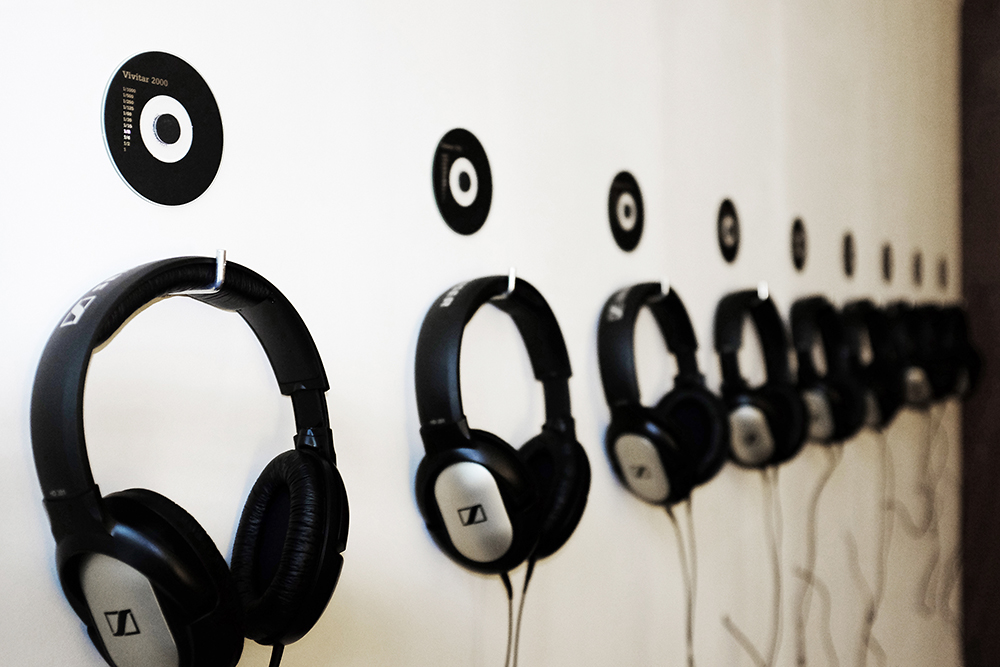
©Iñaki Bonillas, Ten Cameras Acoustically Documented, 1998
LP: How did your grandfather’s photo archive emerge in that process?
IB: When my grandfather died, I moved into his home to be with my grandmother. There I discovered that he had taken portraits of himself throughout his life. He had stored his story in 30 family albums. There were nearly 4,000 photographs.
For me, that archive was somehow a double of the world. Every possible photographable thing was there: if I wanted to work with mirrors, there they were; if I wanted to work with people with their eyes closed, there they were; if I wanted to work with images eaten by moths, there they were.
I don’t think my grandfather did it with an artistic intention. He was probably searching for his identity. He had been a Spanish Civil War refugee, so he never felt entirely Mexican. And when he returned to Spain, he didn’t feel truly Spanish either. Moreover, he wasn’t his father’s biological son, so he probably sensed that something was never revealed to him. I’d like to think that perhaps he constructed his own idea of the self through those photographs.
After analyzing for more than twenty years not only the albums but also documents, slides, annotated encyclopedias and a collection of business cards that make up the entire archive, I myself have been able to build a memory of sorts, one that I lacked, since my father died when I was a child. Without having done so consciously—or perhaps he did, we will never know—my grandfather left me exactly what I didn’t have.
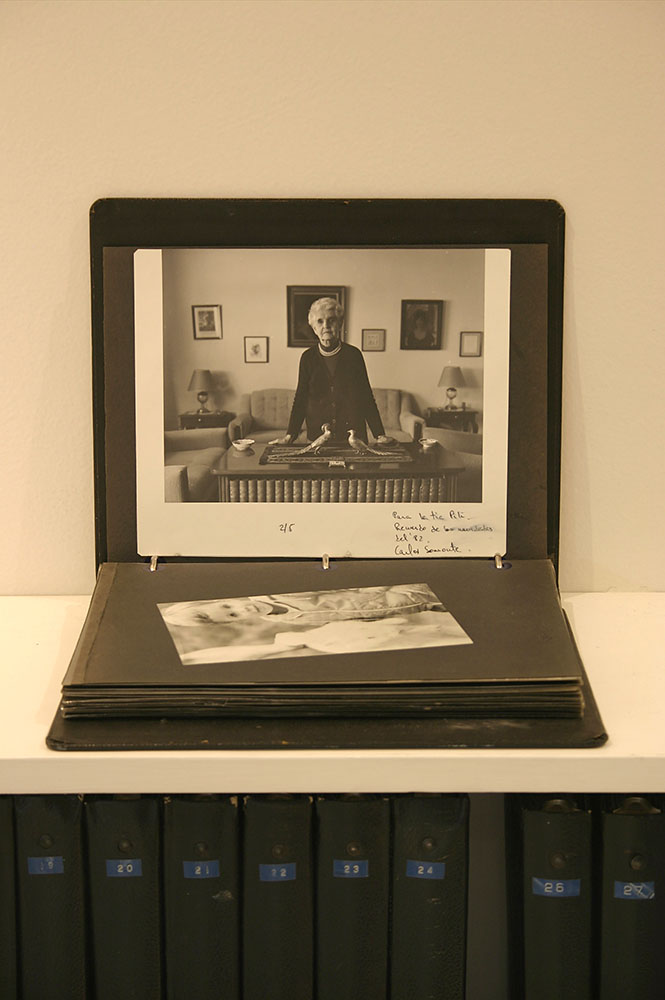
©Iñaki Bonillas, Memory of Christmas, 2006
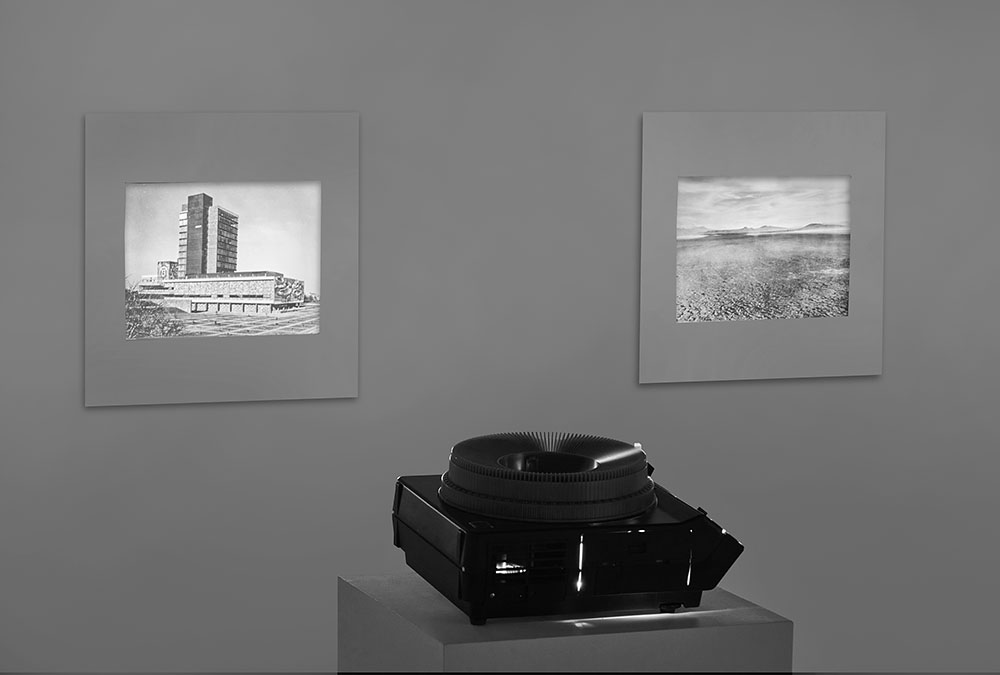
©Iñaki Bonillas, City and Landscape, 2005
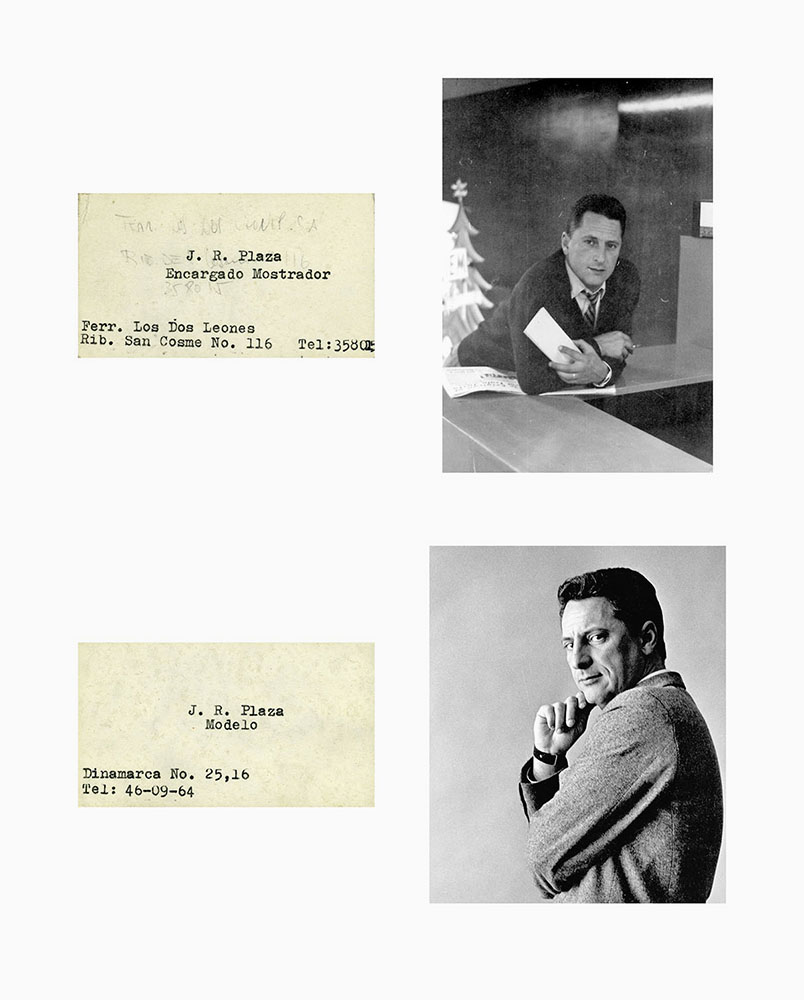
©Iñaki Bonillas, A Business Card for J. R. Plaza, 2007
LP: In Martín-Lunas, an absence marked with a black dot activates the entire series. How did that come to be?
IB: In an initial review of my grandfather’s albums, it became absolutely clear to me that the story was about him. He was the protagonist, and the camera was turned towards himself. But through an opposite strategy, there was another person who pretty much stole the camera from him. And not because of his presence, but because of his absence: his best friend, Antonio Martín-Lunas. He had married one of my grandfather’s sisters and later cheated on her with another sister, creating drama and splitting the family in two. My grandfather was a man of unshakable principles. So, instead of killing Martín-Lunas—which I imagine was his desire—he opted for a symbolic murder. With his scissors, he cut out the silhouettes from all the photographs in which he appeared: 25 in total. He left them as if they were stencils. And in the slides, with the help of a magnifying glass and a brush, he placed a thick black dot over what would have been his face. It truly impressed me that instead of throwing away those photographs, he wanted to leave that mark. He wanted the story to continue to exist. That’s why I decided to make enlarged light boxes: to give that tiny blot of ink a greater presence, to shed light on the matter.
In the end, I think my grandfather’s plan backfired: he tried to erase his friend, and what he did instead was give him the greatest possible visibility.
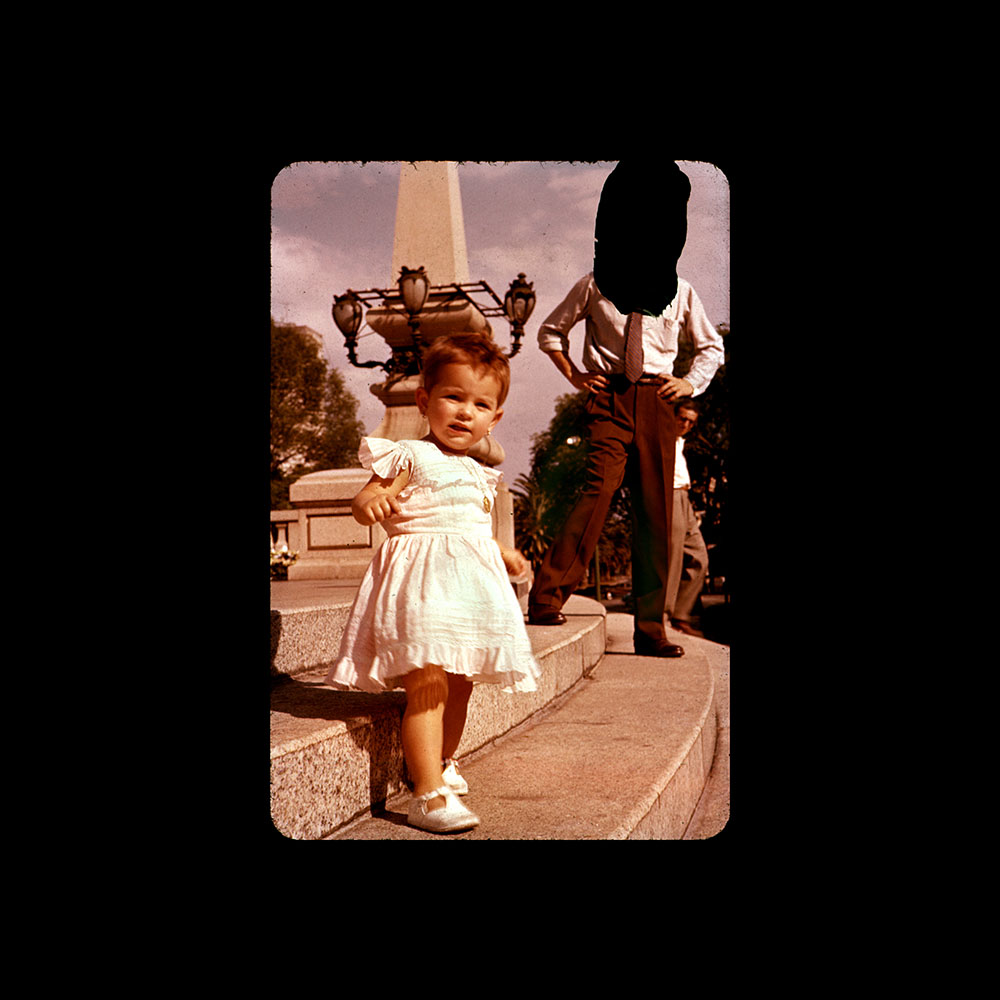
©Iñaki Bonillas, Martín-Lunas, 2004
LP: How did your grandfather’s gesture become your work?
IB: In the archive there are no negatives, only printed photographs—a few of which are intervened by my grandfather. These altered copies became originals. So, I took those 25 photographs into the darkroom, placed them on top of photosensitive paper, threw light on them, and when I removed them, the silhouette appeared. It resembled the outlined marks police officers draw around a body. Later, I wanted to stretch the possibilities of what we understand as photography. On that same photosensitive paper, after it had been chemically processed, but before it had been exposed to the light, I drew the picture’s outline with a pencil. That’s why the series is called Drawn Photographs: 25 drawings drawn by light and 25 drawn by pencil.
Obviously, in these types of stories there’s more than one way to look at the same moment. Everyone has a different point of view, and therefore a different way to read it. In photography’s origins this process of making a camera-less, negative-less impression by leaving an object on photosensitive paper takes us to Anna Atkins and the first cyanotypes. To me there was something similar in what I was doing. Photography has this idea of the negative as an inverted process: making the light shine on that which is not exposed to light. It’s a mirroring game, where everything that is, isn’t.
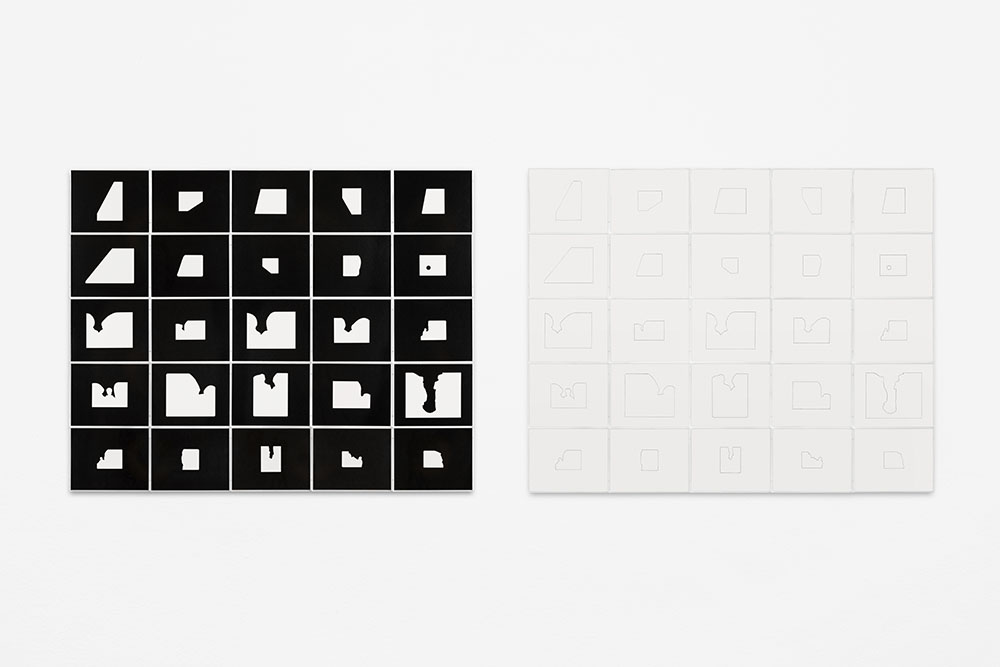
©Iñaki Bonillas, Drawn Photographs, 2006
LP: In your work you seem to recreate some strategies of conceptual art. Do you think it engages in a dialogue, for example, with On Kawara?
IB: My interests have always been divided in two worlds: the history of conceptual art and photography, mainly through my family’s archive. I didn’t go to photography school; I didn’t pursue a formal degree; I was self-taught. I started from the present and worked my way backward. First, I became interested in conceptual artists, and then I gradually moved further into the distant past.
The conceptual generation opened an enormously vast universe of possibilities. I remember I’d watch my grandmother paint every day, struggle with the medium, and it didn’t seem appealing to me to think of being limited by a surface.
Suddenly, I understood that accumulating time itself could be a work of art. I couldn’t ignore the parallelism between the folders of accumulated time by On Kawara and my grandfather’s black leather albums. In Kawara’s case, it’s textual time; in my grandfather’s, it’s photographic time. But there was a clear resonance.
LP: Could you tell us something about Brief Lives, that has also a very conceptual feeling?
IB: During the pandemic I had a lot of free time, and nothing to do with it. So, I decided to revive a tradition I used to share with my grandfather: watch a movie every day at 8 pm. Back then I was very young, and I almost always ended up falling asleep halfway through the movie. So, I wanted to regain that lost time, and with it, I immersed myself in his world of indexed films, since in his film encyclopedia he used to mark with a pencil what he had seen.
What began as a recreational activity ended up becoming a research project. When an image or sequence that caught my attention appeared in the film I was watching, I would note down the exact minute in a notebook to create my own index of possible photograms to build an archive. To me, cinema is the greatest photo archive in existence. Each second in a film has 24 frames. If you multiply that by the amount of films humanity has created, you have the archive of all archives.
For Brief Lives I decided to recreate a work by conceptual artist Giulio Paolini, Apotheosis of Homer, in which he presented a series of photographs of actors portraying famous historical figures. My work stands at the antipodes of what he celebrated. I was more interested in characters whose appearance in a film lasts only a few seconds. Not their biography, but their duration. Their fleeting passage.
LP: Why did you choose to name it like that?
IB: It has to do with John Aubrey, the seventeenth-century writer who wrote Brief Lives. A book where he writes minimal biographies of both known and anonymous people.
There’s an allusion to On Kawara in that counting of time, but also to John Aubrey in the idea of minimal biographies. It’s like a conversation between extremes: a twentieth-century conceptual artist and a seventeenth-century writer.
LP: In Details: Orange you structure installation as text. Are you interested in thinking about photography as a reading system rather than an independent image?
IB: Totally. My starting point was David Hockney’s research that became a book, Secret Knowledge. There, he stated that some painters started to work with great detail and with a previously unseen realism thanks to optical devices. In Vermeer, for example, some things represented appear to be out of focus. That didn’t belong to traditional painting based on perspective. He probably would have used a camera obscura with some kind of lens, and things out of that main plane would be out of focus. Many painters corrected that, but Vermeer painted what he saw.
Based on Hockney’s research I made a library of all the artists he mentions as pre-photography pictorial images pioneers. It’s known that Vermeer was a neighbor of the inventor of the microscope. So, I don’t doubt that there most likely was an interesting exchange of optics information that paved the way for the invention of photography.
Photography then allowed the study of paintings in detail. Something that otherwise would have been impossible. Many features we see today in books are close-ups of artworks. But that’s where the problem of reproductions begins. If you haven’t seen a work of art live, you might find that it is reproduced in a very wide range of colors. Painters always complain that the colors never appear as they see them. Between the person who takes the photograph, the one who develops it, the one who digitizes it, and the device on which we view it, there are far too many variables. So, it seemed interesting to me that certain details reproduced in my books could fall into the category of being “orange” works, even though in reality they weren’t necessarily so.
When making a genealogy through color in reproductions, there are works that share traits thanks to photography, not necessarily to the color used by the artist.
LP: How is that formally translated in the final piece?
IB: I enlarged the reduced book details to the natural size of the painting. Later, I included other details of the same painting directly from the pages of my books, especially paperbacks, like footnotes. Sometimes different editors highlight different details of the same painting, so I created a constellation of images that allowed the painting to be navigated in fragments.
The structure is like a text: main body, headings, footnotes. I wanted images to be read.
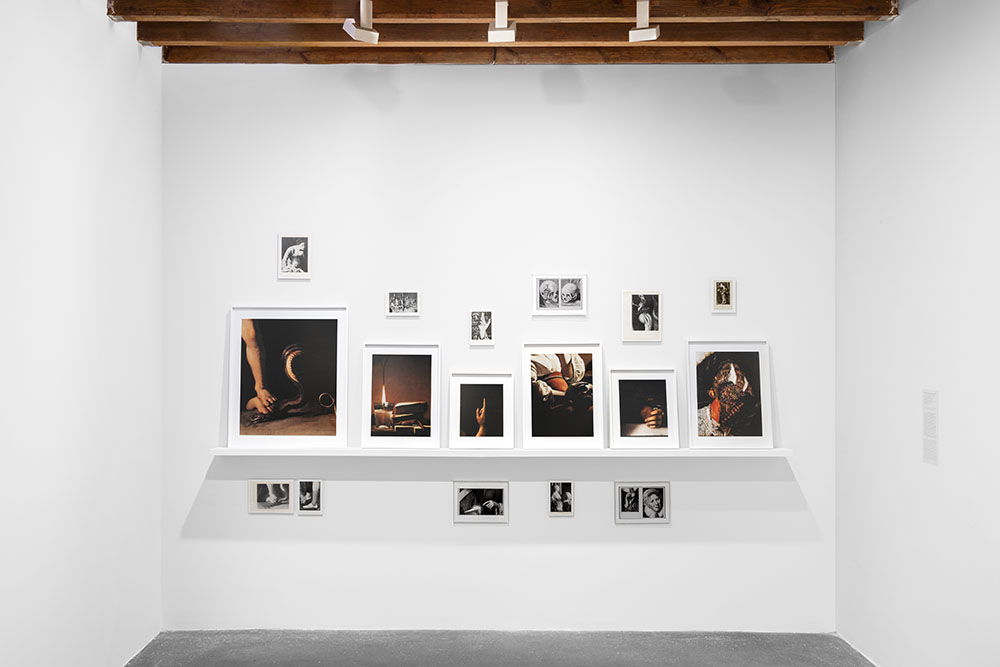
©Iñaki Bonillas, Details: Orange, 2013
LP: And is that when the idea for an imaginary museum came to you?
IB: Yes, in a way. As André Malraux knew with his Imaginary Museum, reproduction allows museums to come closer to the domestic sphere. Much of art history is known to us thanks to photography.
But reproduction also alters the original. It allows study and at the same time distorts the thing studied. I’m interested in working within that tension: photography as a tool for knowledge and as a generator of new readings.
LP: In Marginalia the margin ceases to be a residual space and transforms into the center of the image. What does the margin in a photograph mean to you?
IB: In photography and art books, margins are a kind of waste. In literary books one can take the liberty of interacting with the text: underlining, correcting, even debating silently with the author.
In contrast, in art and photography books that doesn’t happen. They are expensive and the type of paper they use impedes writing on them. So, I asked myself what else I could do with those margins if not intervene them directly.
Books stacked in shelves share space, but the conversation among them is silent. I thought I could use those margins as the white lines on a highway that lead the way and connect images with each other. I began to digitize the margins of photographs: that white area that shares space with the image. Afterwards, I realized it was useful to make a list of certain subjects or specific moments in photography like the appearance of color, close-ups of hands, photographs of sculptures, etc. and use margins to connect fragments of images from my books to each other. The result is a kind of roadmap that allows you to drive through the history of photography in my library.
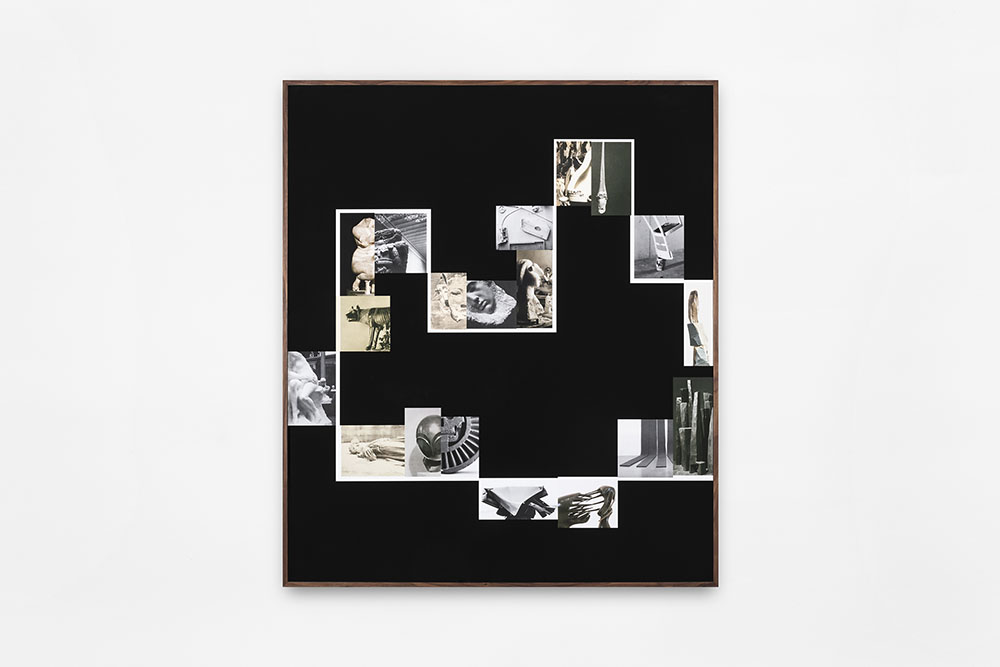
©Iñaki Bonillas, Marginalia 7, 2019
LP: In the twentieth century the margin was paper. Today, it seems to be defined by algorithms. What do you think about that change?
IB: In the digital space the margin has been capitalized on by advertisement in a violent way. If you don’t have an adblocker, it’s torture.
Before, there were these delicious blank spaces around an image. That silence that would allow you to read it. Nowadays it’s the opposite: constant distraction. Our attention span has diminished, and if you add the capitalist impulse to deviate our attention towards shopping, there’s no respite.
Margins used to be a refuge, now they’re a battlefield.
LP: In your piece George W. Rollings, one face can be a thief, an acrobat, or a farmer based solely on the text that frames it. Are you saying that a portrait is the space where identity isn’t fixed, but negotiated?
IB: When my father died, I inherited a collection of his materials. I was five years old, so I had no awareness of where any of it came from. I grew up with those portraits, letters, and books; but the more time passed, the more I lost the chance to ask what the story behind them was. One of those portraits was of George W. Rollings. At that time, I didn’t know who he was; to me it merely was a hand-drawn portrait of a soldier. The fact that it was hand-colored gave it a distinct status to the other black and white photographs. I knew it was important; I just didn’t know why. Later, I found a picture where both my father and I are holding guitars, and behind us you can see this portrait. Then I knew he was important to my father.
Since I’ve always wanted to know more about my origins, I registered on Ancestry.com with my official name: Ignacio Bonillas. I’m the fifth Ignacio in my family. As I filled out the data, a woman who believed I was her cousin contacted me. It turns out she thought I was my father. I told her he had died, but we continued to share information with each other. I decided to share George’s portrait, to which she responded that she had one just like it, and that he was my great-great-grandfather. He was a soldier who rose up to be a colonel. With that information, I searched his name and found an infinite number of results: a train conductor, a wax museum director, a murderer. It felt as if every possible biography fit that name.
The sole fact that the photograph was altered with pictorial layers, like make-up, gave way for me to think it would be intriguing to join this portrait with other people’s biographies under the same name. I reproduced it in black and white, ridding it of its mask. I took it to Donceles Street in Mexico City where artisans color images by hand and asked them to imagine how it would be in color with total creative freedom. George W. Rollins was reborn in a variety of the most curious characters.
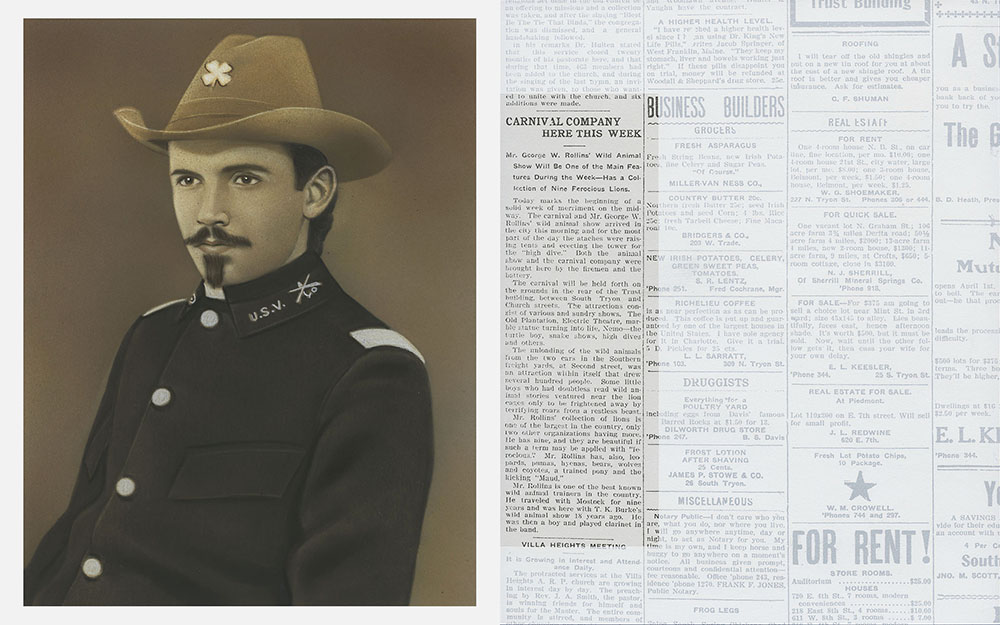
©Iñaki Bonillas, George W. Rollins (detail), 2015
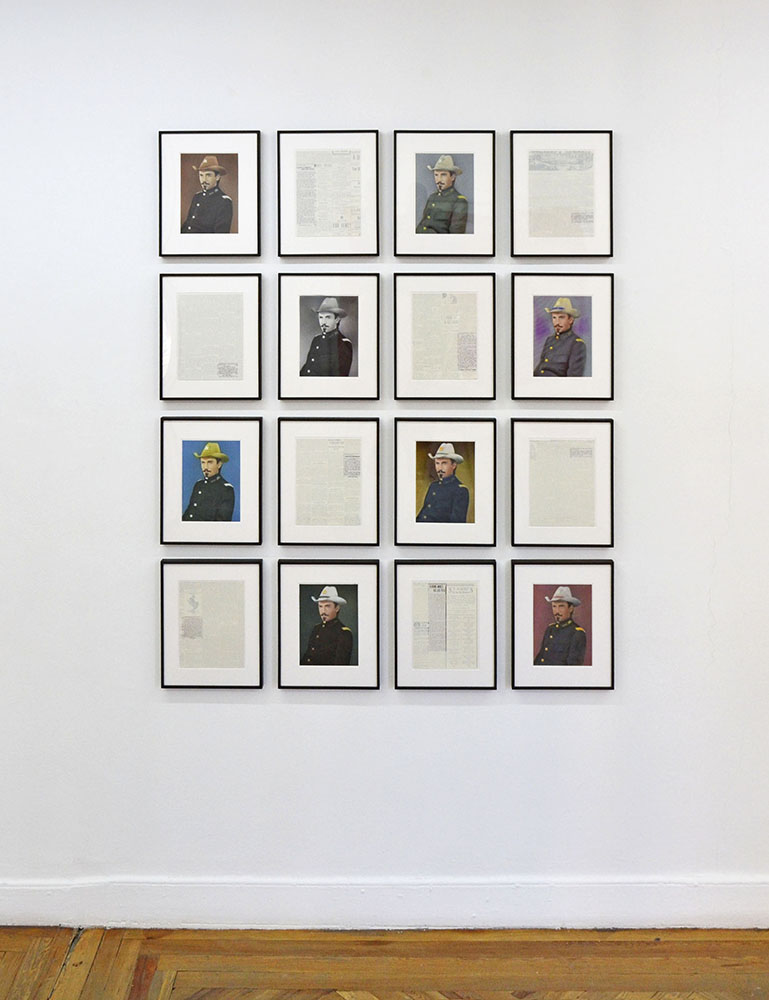
©Iñaki Bonillas, George W. Rollins, 2015
LP: Is there a Mexican element in your work?
IB: It has entered somewhat marginally, but it has never been a topic that I’ve explicitly explored in my practice.
One of the first projects I did was photographing the lettering on taxi license plates from the 1990s. Especially the yellow and green Volkswagens. The green ones were supposedly ecological, but the only ecological thing about them was the change in color. I made two contact sheets of the license plates: one with Kodak and another with Fujifilm, linking the colors of the taxis to the canonical colors of photographic products.
At another time, with the help of a photographer specialized in 4×5 and architecture, I photographed house facades in Colonia Roma that seemed to hesitate if they were to remain standing or not. The OMR gallery, where I worked during the early years of my career, had a seventy-centimeter tilt. It was a topic of conversation at every installation whether to hang the work leveled or to follow the inclination. There, I had an exhibition called Shipwreck with a Spectator. I tried to straighten the house up with platforms and light. That inclined feature was also in the neighboring houses, so I took several pictures of them and also made a series of drawings using a ruling pen, the resource that constructors use to find a straight line.
I respond to the context where my work is being shown. Often the dialogue is with space, architecture, and the situation itself.
LP: In Kurimanzutto you presented No Longer, Not Yet. What inspired you to do it?
IB: Before it was a gallery, that space used to be a lumber yard. That idea paved the way for the exhibition. The project was related to the production of a book and all the steps needed to make it by hand, in workshops on the verge of obsolescence. I’d linger in each stage as if it were a workstation, simulating how a workshop operates.
A lot of my work has to do with that: processes, systems, stages. Each step allowed me to stop and think “what possible work can I do about this particular moment of the process?”
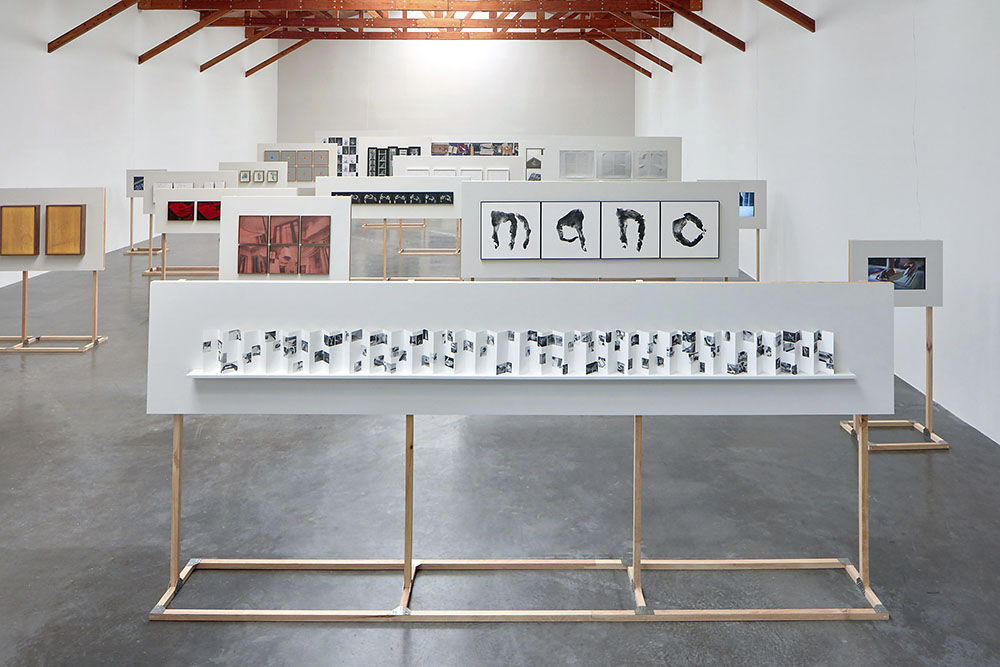
©Iñaki Bonillas, No Longer, Not Yet, 2018
Lou Peralta is a visual artist and contemporary photographer based in Mexico City. She belongs to the fourth generation of a family dedicated to portrait photography—a legacy that continues to nourish her ongoing exploration of the genre. Her practice expands the limits of the two-dimensional photographic image, reimagining portraiture as a sculptural and spatial experience through hand-built structures using materials such as paper, fabric, agave fiber, and wire.
Her work has been featured in solo and group exhibitions in Mexico and abroad. Peralta is a Fujifilm brand ambassador through the X-Photographers program. Recent recognition of her work includes being selected for the Photolucida Critical Mass Top 50 (2023 and 2025), the FRESH Photography Award (2025), the 22nd Santa Fe Photography Symposium in New Mexico (2023), the selection of one of her works for the Ibero Puebla Biennial (BIP) 2025, and an artist residency at The ANT Project (2026).
Instagram: @lou_peralta_photo_based_artist
Posts on Lenscratch may not be reproduced without the permission of the Lenscratch staff and the photographer.
Recommended
-

Mexico Week – Gerardo Montiel Klint: Cartographer of the UnconsciousMarch 28th, 2026
-
Mexico Week – Cristina Kahlo: When Memory Meets the LensMarch 27th, 2026
-
Mexico Week – Carol Espíndola: The World Is My Own BodyMarch 26th, 2026
-

Mexico Week – Paola Dávila: Beyond the LandscapeMarch 25th, 2026
-
Mexico Week – Tomás Casademunt: Time Frozen by LightMarch 24th, 2026