Jane Fulton Alt: Still Life: A Photographer’s Journey Through Grief and Gardening

©Jane Fulton Alt, Book Cover of Still Life, A Photographer’s Journey Through Grief and Gardening, published by MW Editions
What I have come to realize, thru nature, is that love is timeless. It has no bounds.
It is in all of us and if we are lucky, we find someone who can activate that love in us.
Jane Fulton Alt is a remarkable human being and artist. Throughout her career, she has consistently explored the intersection of the deeply personal and the universally human, using photography as a means to examine memory, mortality, and environmental fragility. Alt moves through the world with profound attentiveness, finding joy and meaning in the restorative possibilities of nature and simply living an authentic life.
That sensibility is at the heart of Still Life: A Photographer’s Journey Through Grief and Gardening, a project born from devastating personal loss and transformed into an act of healing. Alt was never a gardener. That changed overnight when her husband, Howard, unexpectedly passed away, leaving behind a partially realized native garden he had begun in response to his growing concerns about climate change. Faced with grief and uncertainty, Alt stepped into a role she had never imagined for herself. With the support and encouragement of Howard’s mentors and fellow environmental advocates, she picked up a spade and began to dig. Through tending to the garden, Alt discovered a renewed sense of purpose and connection. The garden became a place of transformation, where grief gave way to a sense of wonder.
Still Life, published by MW Editions, is ultimately a story of resilience and reawakening. Accompanied by texts from meditation teacher and founding member of Spirit Rock Meditation Center James Baraz, native plant advocate Doug Tallamy, and photography curator W. M. Hunt, the project is a quiet and deeply moving meditation on grief and renewal and is a testament to the ways creativity can help us navigate even life’s darkest passages.
An interview with the artist follows.

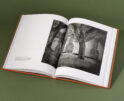
©Jane Fulton Alt, Spread from Still Life, A Photographer’s Journey Through Grief and Gardening, published by MW Editions

©Jane Fulton Alt, Spread from Still Life, A Photographer’s Journey Through Grief and Gardening, published by MW Editions

©Jane Fulton Alt, Spread from Still Life, A Photographer’s Journey Through Grief and Gardening, published by MW Editions
Still Life, A Photographer’s Journey Through Grief and Gardening
I was never a gardener.
Then my husband died, leaving behind an extensive, newly planted native garden. His radical transformation of the green space around our home was stunning. He had worked tirelessly and methodically as he pulled up our lawn and seeded a sanctuary. In the autumn of his life, he had planted a garden for the future.
I asked him one day, “When you are gone, who is going to take care of this garden?” He just looked at me and smiled.
Little did I know it was to be the greatest gift he could have given to me. The garden and the camera have been my loyal and constant companions, a potent combination in adjusting to this new life.
These photographs and thoughts represent the start of my journey.

©Jane Fulton Alt, from Still Life, A Photographer’s Journey Through Grief and Gardening, published by MW Editions
Jane Fulton Alt was born in Chicago in 1951 and began exploring the visual arts while pursuing a career as a clinical social worker. Her award-winning photography explores the universality of the human condition and the non-material world. Alt received a BA from the University of Michigan and an MA from the University of Chicago. She studied at the Evanston Art Center, as well as at Columbia College and the Art Institute of Chicago. Alt is the author of Look and Leave: Photographs and Stories from New Orleans’s Lower Ninth Ward (2009) and The Burn (2013). Her portfolio “Crude Awakening” appeared in publications worldwide.
Alt’s work is held in thirty-one permanent and private collections, including Smithsonian National Museum of American History, Washington, D.C.; Museum of Fine Arts, Houston; Sunnhordland Museum, Stord, Norway; Niigata Science Museum, Japan; Museum of Contemporary Photography, Chicago; and New Orleans Museum of Art. Her work is in many special library collections, including Savannah College of Art and Design, UCLA, University of Illinois, University of Vermont, University of Washington, Wesleyan University, and Yale University. She is the recipient of numerous awards and artist residencies.
Alt resides in Evanston, Illinois, and her beloved adopted city, New Orleans.
Instagram: @janefultonalt

©Jane Fulton Alt, from Still Life, A Photographer’s Journey Through Grief and Gardening, published by MW Editions
How did Still Life begin to take shape after Howard’s passing, and at what point did you realize it would become a book?
Shortly after Howard died I had a thought that I had another book in me. It is only with hindsight that I realized I have repeatedly used the camera to help me process profound loss. Sharing my story through books has been a process not unlike kneading bread. It provides me with a means for processing the deep well of grief.

©Jane Fulton Alt, from Still Life, A Photographer’s Journey Through Grief and Gardening, published by MW Editions
You describe the garden as “the greatest gift”—when did that shift in perspective happen for you?
The shift happened within days. Howard left behind a 3/4 full flat of honey suckle plants. I felt an urgency to get them into the ground, to finish what he had started. When I finally determined where they should be placed, I learned, to my surprise, that he had already put them in the exact same locations I had identified. The connection I felt with him was immediate and gave me confidence that I was on the right track.

©Jane Fulton Alt, from Still Life, A Photographer’s Journey Through Grief and Gardening, published by MW Editions
Did the act of photographing help you process loss differently than gardening alone?
Absolutely. There is something about being able to capture incredible moments of fleeting beauty that is so satisfying. Photographing the garden is another dimension of the creative act, allowing me to freeze a moment in a garden that is in constant change. What I find poignant is that none of the photographs in the book exist in real time anymore. The garden, and all of life, are so ephemeral.

©Jane Fulton Alt, from Still Life, A Photographer’s Journey Through Grief and Gardening, published by MW Editions
What drew you to particular moments or details within the garden—decay, growth, transition?
It was and continues to be about the light, the way it falls on the garden. That is what pulls me in. All states of being are beautiful and deserve my attention.
I started my photographic life 30 + years ago questioning the very nature of love and connection. As I considered this more deeply, I realized that the first disconnect occurs the moment we enter the world and the umbilical cord is cut. The last disconnect is the moment we take our last breath. Hence, I spent a considerable amount of time photographing births and anything related to death and dying. This has been my focus. Every stage is compelling and beautiful, and I have photographed them all.

©Jane Fulton Alt, from Still Life, A Photographer’s Journey Through Grief and Gardening, published by MW Editions

©Jane Fulton Alt, from Still Life, A Photographer’s Journey Through Grief and Gardening, published by MW Editions
Gardens are deeply tied to cycles—how did the passage of seasons influence the narrative of the book?
The theme of life cycles seems to have followed me throughout my photographic career. That said, if the reader picks up the theme in the book, it was less a conscious decision on my part and evolved as the book came into being.
I had a realization after spending time in the rain forests of the Pacific Northwest after Howard died that it is never really over. We construct these words, Life / Death, but in my mind, I think everything cycles through and is continuous. I learned about nursing logs while hiking in the Northwest. A nurse log is a fallen, decaying tree that provides a nutrient-rich, moist and elevated habitat for new seedlings and plants. I became obsessed with them and photographed them over 3 years, proof that what we think as “dead” supports new life. Our ancestors are supporting us, whether we are aware of it or not.

©Jane Fulton Alt, from Still Life, A Photographer’s Journey Through Grief and Gardening, published by MW Editions
What do you hope viewers who have experienced loss might find in this work?
I hope they are comforted by it. I have spent the last 6+ years processing the death of my husband. What I have come to realize, thru nature (the garden and the rain forests of the Pacific Northwest) is that love is timeless. It has no bounds. It is in all of us and if we are lucky, we find someone who can activate that love in us. Howard may be physically gone, but the love I have for him and the world has never been greater or stronger. Nature has been my teacher and I am so appreciative of all that I am learning, from her and the interconnectedness of all of life.

©Jane Fulton Alt, from Still Life, A Photographer’s Journey Through Grief and Gardening, published by MW Editions
Do you still photograph the garden, and if so, how has that relationship continued to evolve?
I am always photographing. It is like keeping a diary journal. That said, my drive to create another body of work is TBD. My focus is more on living an artful life where I am more fully inhabiting the present moment

©Jane Fulton Alt, from Still Life, A Photographer’s Journey Through Grief and Gardening, published by MW Editions
James Baraz is a founding teacher of Spirit Rock Meditation Center and has led the online course “Awakening Joy” since 2003. He is the co-author of Awakening Joy (2012) and Awakening Joy for Kids (2016).
Doug Tallamy is a Professor of Agriculture at the University of Delaware, where he has authored more than a hundred research publications and has taught for more than forty-five years. His work has transformed our understanding of the relationship between native plants and wildlife. Tallamy is the author of Bringing Nature Home (2009), the best-selling bible of for creating native and diverse habitats for insects, birds, bees, butterflies and other pollinators.
W. M. Hunt is a collector, curator, and consultant who lives and works in New York City, where he also teaches at the School of Visual Arts. He is the author of The Unseen Eye: Photographs from the Unconscious (2011).
Link to order the book: https://mweditions.com/books/still-life-a-photographers-journey-through-grief-and-gardening/
Instagram: @mweditions
Posts on Lenscratch may not be reproduced without the permission of the Lenscratch staff and the photographer.
Recommended
-
Bego Antón: All of Them WitchesOctober 15th, 2026
-
Stephanie Duprie Routh: The Atlas of ThingsOctober 13th, 2026
-
John Baer: The Extraordinary Ordinary: A Memoir in Photographs, 1945–1954October 12th, 2026
-
Nata Drachinskaya: BINOMOctober 6th, 2026
-
Book Talk: Text as Structure in the PhotobookOctober 3rd, 2026