Elijah Howe : MIKE : TIS books
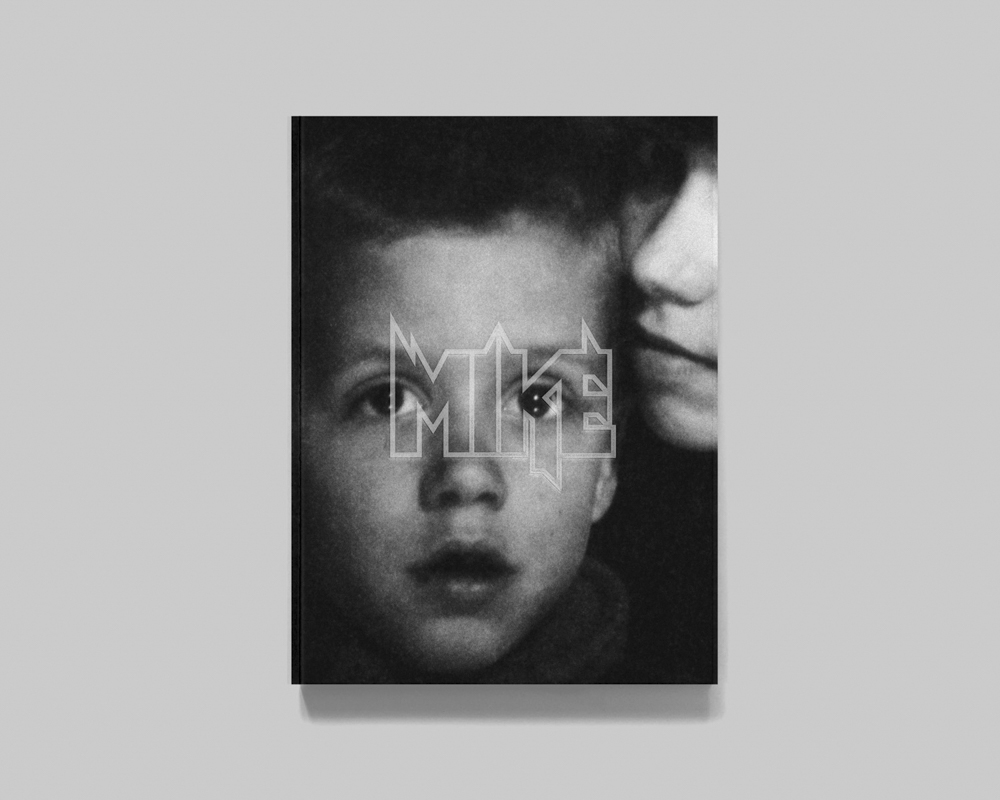
© cover of MIKE by Elijah Howe / TIS books

© image from MIKE by Elijah Howe / TIS books
In MIKE (TIS Books 2025), photographer Elijah Howe assembles a deeply personal visual elegy for his late father, Mike Howe—best known as the lead singer of the heavy metal band Metal Church. The book is a layered blend of family snapshots, Elijah’s own photographs, and artifacts that span decades, including a cassette of unreleased studio recordings and a print from the family archive. Through these fragments, MIKE becomes more than a tribute—it’s an unflinching meditation on memory, grief, and the complex weight of legacy. The images move between vitality and void, mirroring Elijah’s own journey to make sense of his father’s life and sudden death, as well as his own evolving identity as an artist and father.
Elijah and I met in Montana a few years ago at the Chico Review. We both stood in the snow holding photobook maquettes about our deceased fathers and laughed about the legacy of “dead dad photobooks”. Family, memory, and photography will never be tiresome subjects for me. I am pleased that this book has been published and pleased to continue the many conversations with Elijah about this work.
The following is a conversation with Tracy L Chandler and Elijah Howe.

© spread from MIKE by Elijah Howe / TIS books

© spread from MIKE by Elijah Howe / TIS books

© spread from MIKE by Elijah Howe / TIS books
TLC: So, I think we should start with death. There is an image in this book of your father with his arms crossed over his chest. He is standing but this pose reminds me of someone being laid to rest. It feels so prescient. When you made this picture did you have any sense that your father would soon take his own life?
EH: I think this picture is a great example of how a lot of the images in this book operate. When I took this picture I was actually just testing an old graflex and had him pose in front of an abandoned door on a beach (which in hindsight reminds me of your picture of the glass door seemingly floating by itself in a barren landscape). The door was serving as a backdrop to isolate him from the environment and the pose is a reference to a joke gift I had given to him in the past. The gift was matching framed photographs of my brother and I with our hands awkwardly arranged on our chests in the same way as his are in this picture. It was just a shutter test and a joke but in retrospect it feels more like an omen or a prophecy in a weird way. The meaning of many of the pictures in this book change drastically in their current context from their original presence on a film strip or in a family album. Pictures about life can easily become pictures about death and that’s one of the things that I find really powerful about working from an archive.

© Framed prints of Elijah Howe and Avery Howe, a gift from Elijah to his father

© Elijah Howe photographing his father Mike Howe in California a few months before his death

© Prints from the archive of Mike Howe
LC: Yes, well said. That life-to-death line is thin and omens feel easy to see in hindsight. I am curious about this archive… Were these photographs you always grew up with around the house or did you come upon them later?
EH: After my dad died, we were in California emptying out his house and he had boxes of family photos in the garage. I took them to digitize for the family and realized that all of the print envelopes still had the negatives in them, untouched since the day the film was developed. I transferred the negatives into sleeves and made contact sheets of around 200 rolls worth of film and began thinking of these images outside of their original context. A few of these images were pictures that I had grown up with in photo albums but my experience of family photos was largely from the early 2000’s onward when my family switched to digital cameras. When I looked at the pictures on the contact sheet, many of them damaged by mold and heat, it felt like I was experiencing a new world where either I wasn’t born yet or I was young and living a life that feels alien from my life today. It’s a time when my memory feels like it is based off of pictures I’ve seen, not events that I remember experiencing. The film strips from these envelopes also reveal images that never made it into my family’s albums. There are pictures that never saw the light of day which were taken at the same time as familiar images from the family albums.

© image from MIKE by Elijah Howe / TIS books

© image from MIKE by Elijah Howe / TIS books
TLC: So most of these images you came upon after he died? Looking through all of the negatives, was there a marked difference in the ones that he deemed as “keepers”—worthy of the family album? It’s always interesting to get a glimpse into someone else’s selection process—like why did he choose this one over that one?
I am also wondering how the man you see in these pictures relates to your personal experience of your father as you were growing up. Maybe this is another example of photo-hindsight, but I’m wondering if the new-to-you images revealed something about him previously unseen?

© image from MIKE by Elijah Howe / TIS books
EH: I think in family albums most of the selected images are usually illustrative of the event or person that they are depicting (Side note: it would have been largely my mom making the photo albums so the keepers would have been mostly selected by her). They try to show things as they are so that they can be remembered in the future. When going through the contact sheets more often than not I am drawn to images that aren’t totally clear in what they are showing or raise more questions than answers. It makes them more universal and less about my own personal history. I think the selection of images in the book create a more open reflection on the life of my father viewed through the eyes of many different people who photographed him and in the context of the book it allows the viewer to experience them in a way that isn’t as prescriptive and allows them to form their own relationship with the person, people, and life depicted.
The new-to-me images didn’t change my personal experience of him, they more solidified it. My favorite picture in the book is the first images that show him laying in bed with a stuffed rabbit. The photograph was from over 50 years ago but somehow it feels exactly like the him that I know and weirdly feels like at the same time it is me and is also my son. Seeing him from a child until adulthood makes me think about his life but also my own life. There’s a lot that is shown and not shown in the pictures that feels more universally human than just pictures about a specific man.

© spread from MIKE by Elijah Howe / TIS books

© image from MIKE by Elijah Howe / TIS books
TLC: That photo of him with the red rabbit is such a powerful image—it holds something that’s hard to name and offers a strong juxtaposition to the metal-god persona in other images. And I love how you describe it as being “the most him”, but also you, and also your son. That kind of layering—of identity, time, memory—feels central to the experience of looking at these pictures. There is a conflation of subject, author, and viewer.
Something else I keep thinking about is your mom’s presence. She’s in the images, but she’s also behind many of them, and behind the selections that made it into the family albums as you say. Even though your dad is the central figure, it seems like your mom’s hand is quietly shaping so much of what we see. I’m curious how you thought about her role when you were assembling the book?


© spread from MIKE by Elijah Howe / TIS books
EH: These pictures were made by many different family members, friends, and maybe even strangers and they all have their own relationship to my dad. My mom appears alongside my dad in various pictures in the first half of the book but then beneath the cover flaps and throughout the second half she appears as a lone figure. She is working in the background of this lifelong photographic project but also kind of represents “what remains”.
The boxes and envelopes of images I was working from were a multigenerational collection from both trees of my family. They came together in one cardboard box so their proximity to each other greatly impacted the framing of the life documented as well as the “photography project”. Multiple people’s unknowing involvement in the making of this work over the past 60 years created a weirdly complex authorship and sense of identity to the book.
I’m curious about your perspective (Tracy L. Chandler) on your own involvement in its creation… When we met you were a stranger to me and to this project and vice versa. I had a loose collection of images but it feels like two strangers just sat on a bench in the snow and something emerged in front of us. It was kind of like other people did the hard work of photographing for decades and we were the last piece in the puzzle. Maybe shared experience itself was a crucial part of the creation of this project. Do you have a similar feeling or insight?

© image from MIKE by Elijah Howe / TIS books
TLC: I remember this well… you had a stack of Kinkos prints and like 20 minutes before you were due for your next review. As you quickly learned, I love and make work about memory, grief, and coming of age and so I was very interested, even a little envious, of this work. With the clock ticking, we dove in and tried to make a sequence that not only assembled the narrative of this deeply personal story, but also held space for the chaos. I think that for me was the challenge, not only making sense of the various voices and vantage points, but also the content itself––there were multiple formats, color and b&w, etc––there was just so much going on. I remember having to give up on creating order or any linear story structure and just go with the flow––much like a metal band descends into bedlam during a live performance. That said, we did land on one structural anchor by starting and ending with the funeral images. Can you talk about those?

© spread from MIKE by Elijah Howe / TIS books
EH: The book is arranged into two sections. The first half is linear and functions as a portrait of a specific person and the second half sort of represents what remains after he is gone. These two sections are bookended with three black and white images that function in a much different way than the other pictures in the book. These images were taken by me while I was in Eureka for my dad’s funeral. They were all on the same roll of film taken over the course of a few days. They are quiet moments empty of any action. The first picture in the book is the door leading out of the venue for his funeral pointing towards the ocean, beginning with the ending. The middle section is a doorway somewhat obscured by shrubs and a single concrete block. The last image shows clearcutting of the redwoods on a hike near my father’s house. They all show a level of destruction but also peace. A complicated relationship with this place he loved, which was home of 20 years as well as his final resting place. I’m not entirely sure what all of that adds up to mean but it felt like an important part of the puzzle.

© image from MIKE by Elijah Howe / TIS books
TLC: Yes, and I think part of what this book does so well is allow for those open ends. The unanswered questions feel like the point. The door is literally left open.
These quieter images seem to do something else as well. They seem to bring things down to earth a bit. Your father had a larger-than-life persona but was also a human with private thoughts and feelings. I feel like these images bridge those extremes and give us a glimpse into his pain as well as make us wonder where he is now. The 1st person vantage point of these images also brings you into the story and we get this conflation of narrators, father and son.
That’s just my take though. You made this very personal family archive into something public—something people can hold in their hands and project their own meaning. What has it been like to let it go and see others relate to it? Did you think about your audience when you were making the book with TIS? Can you talk about the book-making process itself? There are lots of fun components—a tape, a sticker, a print. It’s more than a book!

© spread from MIKE by Elijah Howe / TIS books

© special edition of MIKE by Elijah Howe / TIS books
EH: When I first started this project, I honestly thought nobody would care. It felt too much like my own life to be interesting in an art context. I brought it to Montana as a kind of backup project because I was so unsure of it. But you encouraged me to show it, and watching people flip through the pages completely changed my perspective. Almost everyone moved steadily through the first half, following the obvious timeline of my father’s life, and then stopped at the same points later in the book. I’d never made anything before that could actually halt people like that, and it gave me confidence that maybe the work was more than just a wallowing photographer with an archive.
I wasn’t really thinking about an audience when I was making this project. I was just doing it for me, and I guess that’s really why you should do anything in art. Making something that is truly important to you can generate something that also becomes important to others. Pretty cheesy.
For the book, we wanted it to feel small and intimate, an object that would show wear as people spent time with it. The sequence is mostly the same as the original edit, with some variation in image size. Carl (Carl Wooley co-founder of TIS books) designed the layout, including the interior flaps that reveal pictures at the beginning and end, and he created the cover, which I love. People often ask if it’s me on the cover. It isn’t me but it kind of feels like it is.
For the special edition, we wanted it to resemble a heavy metal album box set. I made 5×7 silver gelatin prints, but I felt like I was sitting on this collection of images made by a big group of people who contributed to this project and I wanted the ownership of that to be shared in some way. Each box includes an original photograph of Mike pulled from the shoeboxes where this project originated. Because music is such a big part of this project, we also wanted to include a cassette. One side is the band messing around in the studio while recording their Blessing in Disguise album. The other came from a cassette that I inherited labeled “Happy Songs,” is my dad singing songs I still haven’t identified. Carl recreated the cassette packaging from my scans, and Matt Page in Kentucky restored the audio to make the vocals clear. Toward the end of the tape, my dad says, “Pretty soon you won’t see me at all.” It’s kind of spooky. I hope we proved him wrong at least a little bit.

© collection of items in the special edition of MIKE by Elijah Howe / TIS books
MIKE by Elijah Howe is now available from TIS Books. MIKE is also available in a special edition complete with a 5×7 silver gelatin print made by the artist, an original photograph from the family archive, and a recently remastered cassette that includes Happy Tape!, original recordings of Mike Howe solo material, as well as Metal Church outtakes from Sept-Oct 88’.
Elijah Howe received his BA in photography from Humboldt State University and his MFA from University of Kentucky. He currently lives and works in Felton, California. Howe’s work is interested in the fragmentary nature of photography and people’s relationships with one another as well as their relationship with the land. His work explores quiet transitionary spaces in the landscape and the unsettling melancholy of the human condition. He recently released a Monograph titled “MIKE” with TIS Books, has had solo exhibitions at 2nd Story Gallery and Bolivar Galleries in Lexington Kentucky, and has work in the Permanent collection of the Monroe Moosnick Medical and Science Museum at Transylvania University.
Follow Elijah Howe on Instagram
Mike Howe (August 21, 1965 – July 26, 2021) was an American heavy metal singer who performed with Metal Church, Heretic, and Snair. After leaving Metal Church, Mike pursued a career in carpentry and was a father to two sons. He rejoined Metal Church in 2015, producing two more albums before his death in 2021.
Tracy L Chandler is a photographer based in Los Angeles, CA. Her monograph A POOR SORT OF MEMORY is now available from Deadbeat Club.
Follow Tracy L Chandler on Instagram.

© spread from MIKE by Elijah Howe / TIS books

© image from MIKE by Elijah Howe / TIS books
Posts on Lenscratch may not be reproduced without the permission of the Lenscratch staff and the photographer.
Recommended
-
Bego Antón: All of Them WitchesOctober 15th, 2026
-
Stephanie Duprie Routh: The Atlas of ThingsOctober 13th, 2026
-
John Baer: The Extraordinary Ordinary: A Memoir in Photographs, 1945–1954October 12th, 2026
-
Nata Drachinskaya: BINOMOctober 6th, 2026
-
Book Talk: Text as Structure in the PhotobookOctober 3rd, 2026