Mexico Week – Tomás Casademunt: Time Frozen by Light
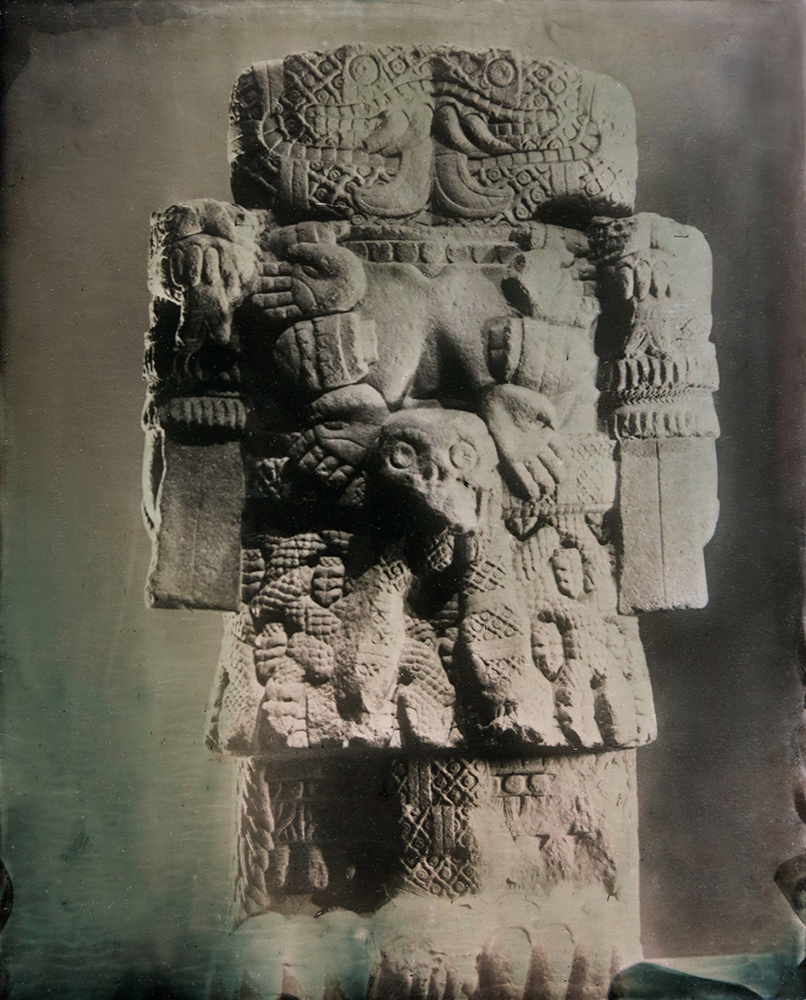
©Tomás Casademunt, “Museo Nacional de Antropología – Coatlicue,” from the series TC2025, ambrotype, 8×10″
When I think of Mexico Week I don’t just see it as a series of interviews, but as a compass of what’s yet to come.
Seven artists, each working from a different place—whether it’s femininity, nature, society, history, identity, architecture, or the unconscious—share an undoubtable longing to express themselves in an innovative and true way.
While doing these interviews I didn’t only find photographs. I found passion, devotion, ideas, processes, humor, time, effort, and a true sense of humanity that deserves to be shared.
This isn’t an academic work. It’s a series of conversations about how our practice as photographers continues to evolve day by day. About how life shapes us and grants us the power to give meaning to what we capture with a click.
In a rapidly changing world, these artists continue to honor the origin of the word “photography” by bringing light and stories into it.
These photographers can look to the past and the future, move between worlds, and build a contemporary curiosity that will inspire many more to follow the path they’ve traced. The image is changing, and I believe we should stop for a moment and ask “What is Mexican photography saying today?”
The artists are: Iñaki Bonillas, Tomás Casademunt, Paola Dávila, Carol Espíndola, Cristina Kahlo, Gerardo Montiel Klint, and David Muñíz.
Tomás Casademunt’s work challenges not only how we as humans see our surroundings, but also how we feel them. His work explores and plays with elements such as light, time, space, history, spirituality, and identity; blending them with natural techniques that mesmerize the senses. With his very own creation: the Saturno camera, he has managed to encapsulate not only the Mexican landscape, but also his very own universe in a series of prints that allow the observer to reflect on its meaning. Tomas’s work not only transcends time, but defies it, making it a must-see.

©Tomás Casademunt, “SPECTROGRAFÍA Reforma 27,” from the series Spectrografías
Tomás Casademunt was born in Barcelona in 1967. He worked as a photojournalist for a regional newspaper, where he covered all kinds of news events. This experience allowed him to develop strong skills with the 35mm camera and photochemical darkroom processes.
He produced his first portrait series in Cuba in the 1990s, spending six months photographing the faces of the foremost son singers and musicians known as soneros. Son de Cuba was his first photography book, published in Barcelona in 1992. A new edition was later released in Mexico, the country where he has lived since 1995. Since then, he has developed his work with the ultimate aim of publishing a photography book, an expressive format ideally suited to conveying his visual narratives.
In 2000 he published Fabrica de Santos (Factory of Saints), a series of photographs taken in religious statue workshops in Spain and Mexico. In 2006 he photographed the Zapotec-Mixtec ruins of Mitla, captivated by the glow of the ancient stone under the moonlight. Over the course of eight years, he conducted research in several states in Mexico, documenting Day of the Dead offerings, which were brought together in the book La muerte en altar (Death on the Altar), published in 2008.
A year later he published Maya Puuc, large-format photography book on ancient Maya palaces in Yucatán made through long nighttime exposures. For years he has visited buildings under construction, working around architectural processes. He published Obra Negra (Cold Shell Construction) in 2013 and Spectrografías (Spectrographs) in 2020, a meticulous visual investigation of space and time in relation to buildings under construction in Mexico City.
He was a member of Mexico’s prestigious National System of Art Creators (FONCA) in 2006, 2011, 2019, and 2022.
He is currently developing the project Volcanes de plata (Silver Volcanoes), with support from Mexico’s Ministry of Culture, producing a series of direct, in situ images of twelve active volcanoes in Mexico using the mobile Saturno camera and large-format wet collodion plates.
Follow Tomás on Instagram: @tomascasademunt
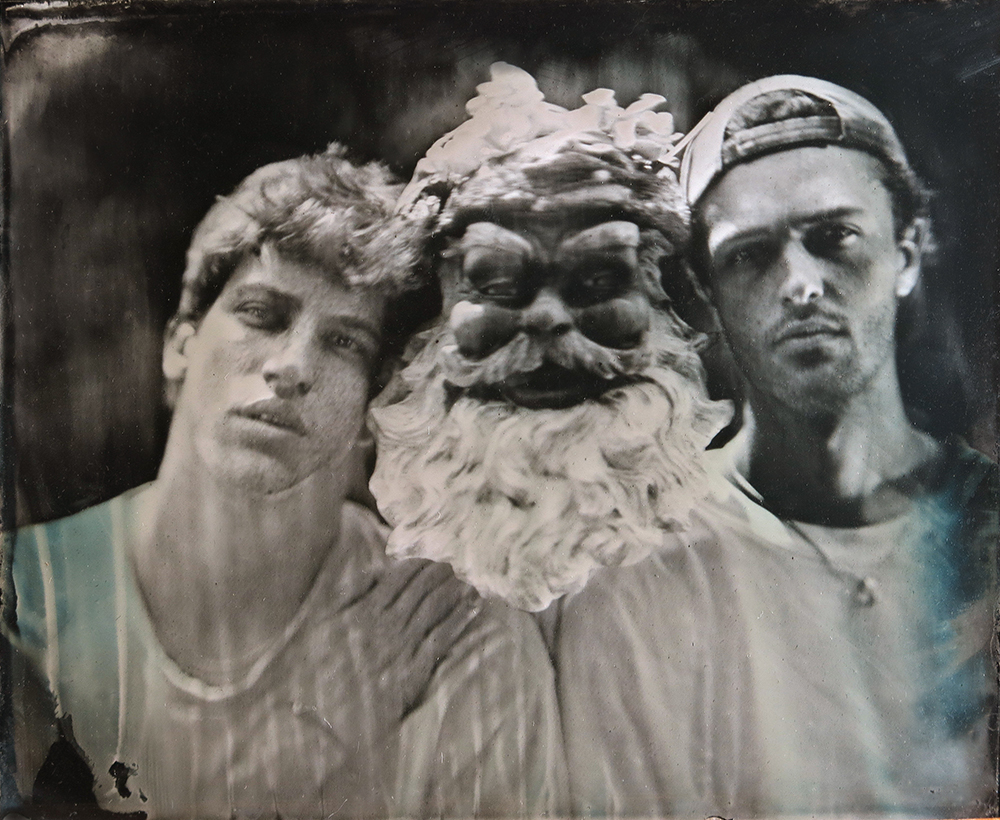
©Tomás Casademunt, “Jishui&Jabbah,” from the series Retratos con Saturno (Portraits with Saturno), ambrotype, 8×10”
In my photographs, stone projects its spiritual dimension. With my mobile camera/laboratory, I seek existential glimmers within it: traces of past lives, imagining what life might have been like in Mesoamerican territory two thousand years ago. I explore rain and its transformative power. I experiment with repeated exposures over years on a single photographic plate, capable of condensing the space-time spiral into a single visual impact. I reiterate records and intentions within a single compositional frame in order to transcend the boundary of the purely contemplative.
I build my own photographic cameras. I customize every aspect of the work process with a spiritual and alchemical longing. Today, the wet collodion process and silver allow me to move beyond the mere tangible representation of objects and people to reveal invisible worlds and forgotten times. — Tomás Casademunt
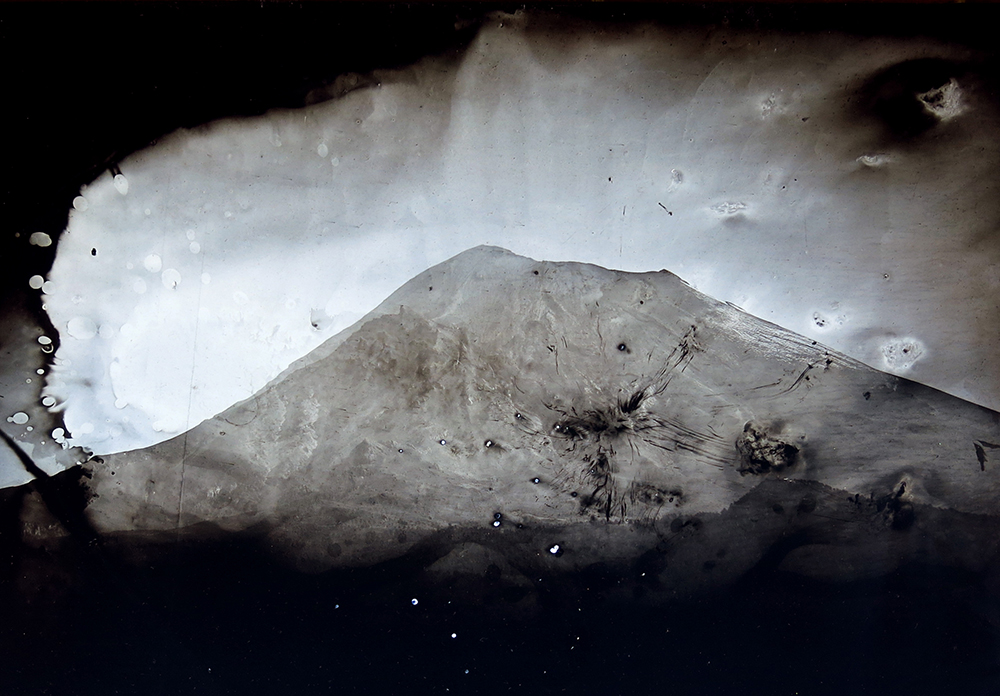
©Tomás Casademunt, “UVA,” from the Popocatépetl series, wet collodion, 20×25”
Lou Peralta: How did you find your way into photography?
Tomás Casademunt: My relationship with photography is vocational. I set up my first photography lab when I was just a kid. Then, a short time later I began to study Information Science, I was fortunate to work for a regional newspaper as a photographer/graphic editor. For five years I covered all types of events with my 35mm camera and I had to develop and print everything (everyone’s material, not only my film) in a rush. It was a great school for me. I was forged with a documentary perspective with journalistic imperatives with a margin for poetic license. Being humans unable to delve deeply into subjects, the desire grew in me to carry out my own long-term, in-depth research.
LP: You’ve studied, travelled, and lived in many different places. Have those experiences shaped your way of looking and creating?
TC: Photography is a great excuse for gaining access to places often off-limits to ordinary mortals. When I left my job at the newspaper, I traveled to Havana, deeply moved by the songs of Cuban soneros from the 1950s—many of whom were still alive. The complete series of portraits brings together, in a single photographic album, the faces of Cuban musicians living on the island and those of the diaspora. Photographing them in their homes after hours of shared time, working without any time constraints, was a remarkable experience. It became my first book. I didn’t return to portraiture until now, since I’ve taken it up again through the wet collodion process.
LP: Why did you choose to name your series Spectrografías?
TC: A spectrograph measures the decomposition of light into its wavelengths, making it possible to study the interaction of energy with matter. In astronomy, the trace of that decomposition reveals the chemical compositions and speed of the motion of distant stars and planets. With my iron cameras—boxes built in my workshop to remain in the same position for years—I recorded the progress of unpredictable construction sites. Open frames awaiting architectural development, in which light accumulated across countless moments registers maneuvers and forms of engineering not always decipherable, but also the lives of construction workers who died on the job. Those ghosts inhabit the walls, cast into the concrete as spectral shadows.
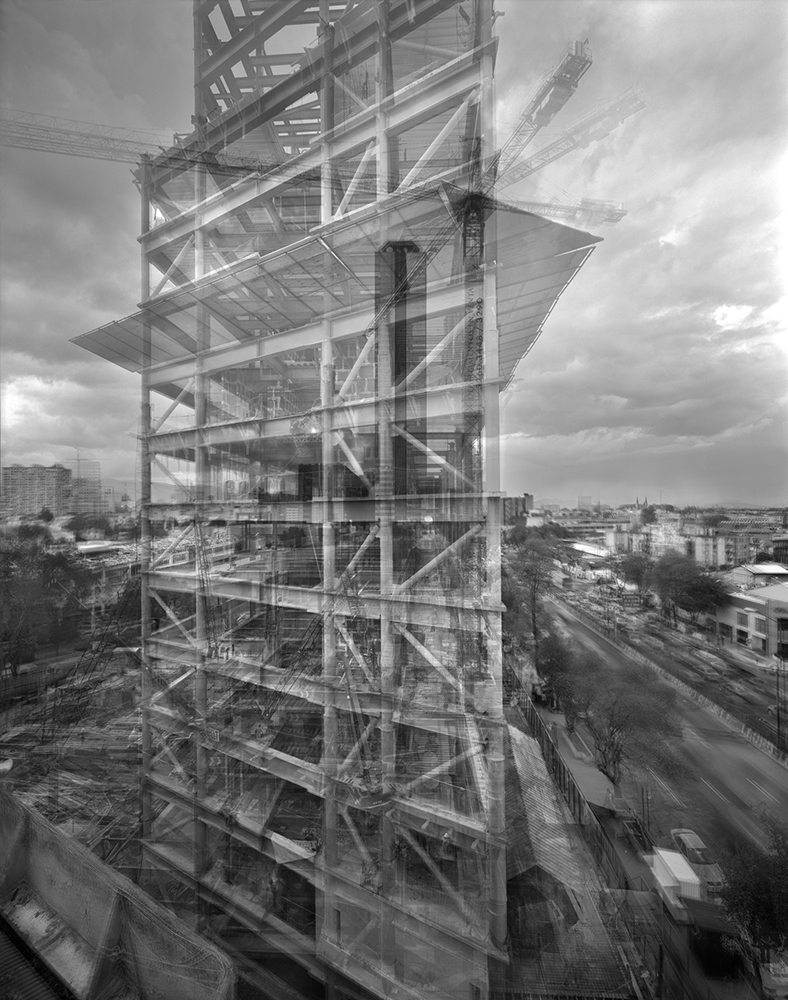
©Tomás Casademunt, “SPECTROGRAFÍA Marina 1,” from the series Spectrografías

©Tomás Casademunt, “SPECTROGRAFÍA Toreo 1,” from the series Spectrografías
LP: When seeing Spectrografías, it feels as though you’re reaching a dimension we can’t reach, as if time and space visibly coexisted. What role does time play in your work?
TC: Time is the main axis of my work; it’s intertwined with space forming an infinite spiral. When I went to set up my fixed cameras on rooftops near the sites where construction would take place over several years, I had to imagine the body of the finished work. Once the camera was positioned, contemplation began. I would cycle along the route of my cameras scattered across the city, observing the progress of the construction and choosing key moments for a new exposure on the same photographic plate. When all the layers were combined, the result was a highly abstract scene. Parallel universes can be a good way to describe it: photography once again exceeds our threshold of perception.
LP: What is the technical process you use to create the images?
TC: I build my own photographic cameras in order to peer into those other overlapping dimensions. They are metal structures that I turn into cameras once I fit them with a lens and a photographic plate. Spectrographs are superimposed layers: Ilford FP4 film plates in 8×10″ format, paired with large-format 1950s lenses. I always stopped down to the maximum (F/32 or F/64) to compensate for any misalignment in the focal plane, ensuring that everything remained in focus. Exposure was always approximate, with different values for each, decreasing after each successive overexposure. Even though it was my intention to follow a scientific method, an intuitive approach ultimately prevailed in the development and strategy of each camera.
LP: For this particular series you fuse analog and digital photography. Why did you decide to work this way and what process did you follow?
TC: Film has a potentially infinite resolution in pixels, and its errors are beautifully noted by its silver crystals. In digital photography, one can assemble a puzzle and transform the elements that compose the image to unsuspected levels of perfection. They are indistinguishable from the impossible images generated by artificial intelligence. Film, on the other hand, implies that the negative bears witness to the fact that you were there to press the shutter. The photographic act is a personal, non-transferable experience.
Digital files and photochemical techniques are highly compatible. They allow one to create acetate negatives or positives that can be used to work with historic photographic processes such as contact printing, reprography, and other graphic printing techniques. That knowledge is universal.
In Spectrografías, I worked with photographic plates that I overexposed between 10 and 15 times over the course of several years. I always installed two cameras per construction site, each assigned several 8×10″ plates or plate holders. This allowed me to establish different strategies for the repeated exposure of the plates. Once it was completed, I removed the cameras. With great uncertainty, I developed the film, made contact prints, and became familiar with each plate. I then scanned the negatives with an expanded tonal range. This was followed by a post-production stage in which the layers were assembled, carefully balancing information to achieve smoother transitions between different luminous values in each layer.
The final file had to measure 8×10″ at a resolution of 1000 dpi. I sent this file to a laboratory in Washington, where it was output onto 8×10″ film. This way, I obtained a final 8×10″ negative that I could place in my handmade large-format enlarger and project onto a wall. Each spectrografía finds its own scale: large pieces that allow the viewer to take in all the information they contain.
LP: How long did this process take?
TC: I worked on Spectrografías for 14 years. I later wanted to publish a book about the research on the intensive urban transformation that was taking place on Eje urbanístico Reforma a main urban artery in Mexico City. Today, I provide maintenance to those cameras to photograph other realities and to continue experimenting with mind-blowing visual representation of this encapsuled time and space layers.
LP: David Chipperfield, a renowned British architect winner of the Pritzker Prize in 2023 said that he’s not interested in “decorating” or following trends, but to answer to function, context, materiality, and use of space. In your work I believe there’s something similar. It’s as if you’d remove the facade to a construction site in order to let us see its own story without embellishments or masks: just their own “personalities” that contain a secret life. What do you strive for when photographing architecture?
TC: All the energies that connect in a big construction make up the mutant building. The intertwining of iron and actions that overlap each other accelerate their step when one tries to understand the logic of the order of appearance of its layers: gray lines, deep blacks, light leaks.
I try to peak into everything that remains hidden beneath the finishes: architecture as a whole, years of transformation in a single visual impact. Photography, once again, reveals the intangible with its light pulses.
LP: You dedicated a series to the Popocatépetl volcano and other archaeological sites. By using your Saturno camera, your process recalls that of nineteenth-century traveling photographers: the heavy equipment, long journeys, and a patient gaze. What does it mean to you to travel into the field or the jungle with Saturno and all your gear?
TC: Everything that can go wrong will go wrong. Murphy’s Law is real. Any loose end in the equipment check will sooner or later be exposed under extreme conditions during my expeditions with Saturno. What’s wonderful about photographic outings to remote places is that you’re at the mercy of what unfolds in real time. All the energy is focused on moving forward, overcoming any obstacle. Attention isn’t broken down into working hours—it’s continuous from the moment you leave home until you return days later. Every decision is binding; everything shapes the moment when the plate is exposed. It’s fascinating and terrifying.
The pioneering photographers who took the first photographs in Mexico are a great inspiration to me. Désiré Charnay and Teobert Maler photographed ancient Maya palaces in Yucatán and they achieved an extensive collection of ambrotypes (glass plates sensitized with wet collodion). They overcame unimaginable hardship, accompanied by mules carrying their heavy trunks. My 8×10” photographic plates, exposed to moonlight, complement their imaginary narrative. All these complications make that experience a continuous learning process. In the face of adversity, the testimony of the pioneering photographers gives me comfort. You can’t help but feel privileged to be working with the means of our own time. The difficulties they faced were immense.
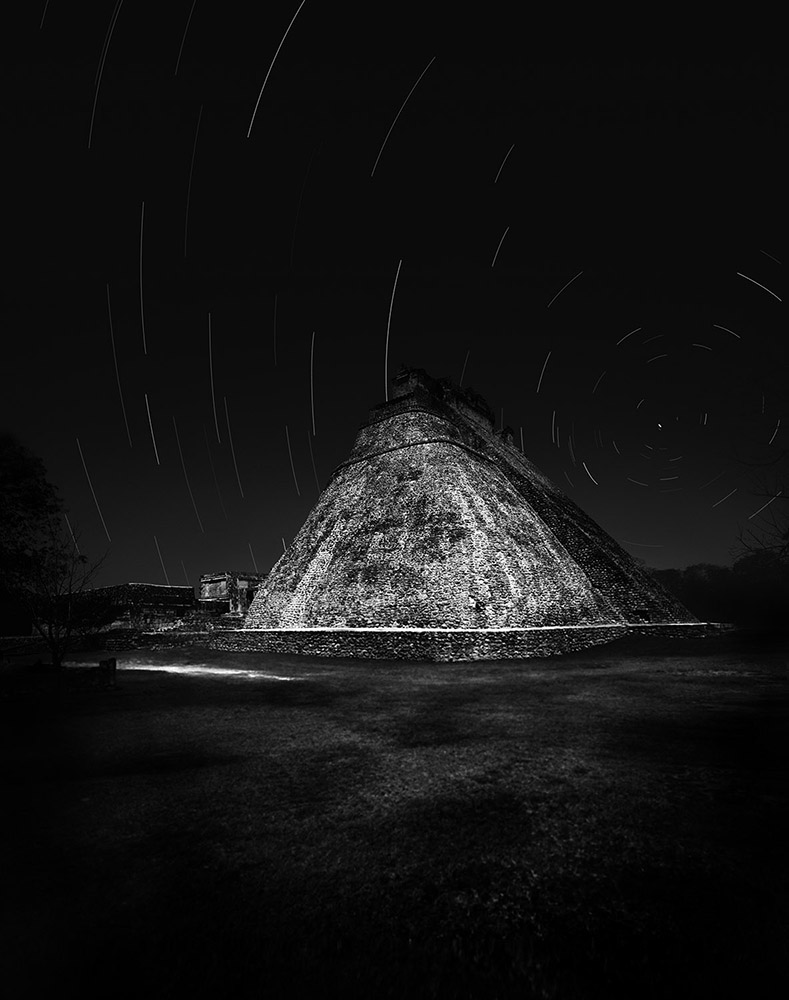
©Tomás Casademunt, “Pirámide del Adivino” (Pyramid of the Magician, Uxmal), from the series Maya Puuc
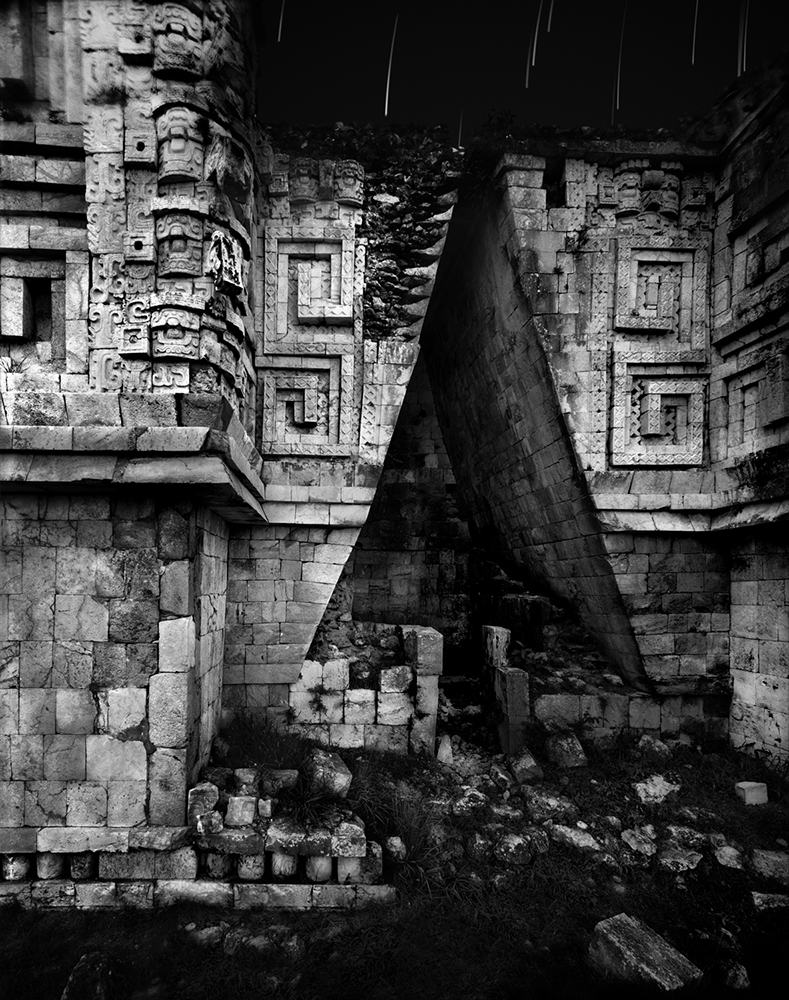
©Tomás Casademunt, “Palacio del Gobernador IV” (Palace of the Governor IV, Uxmal), from the series Maya Puuc
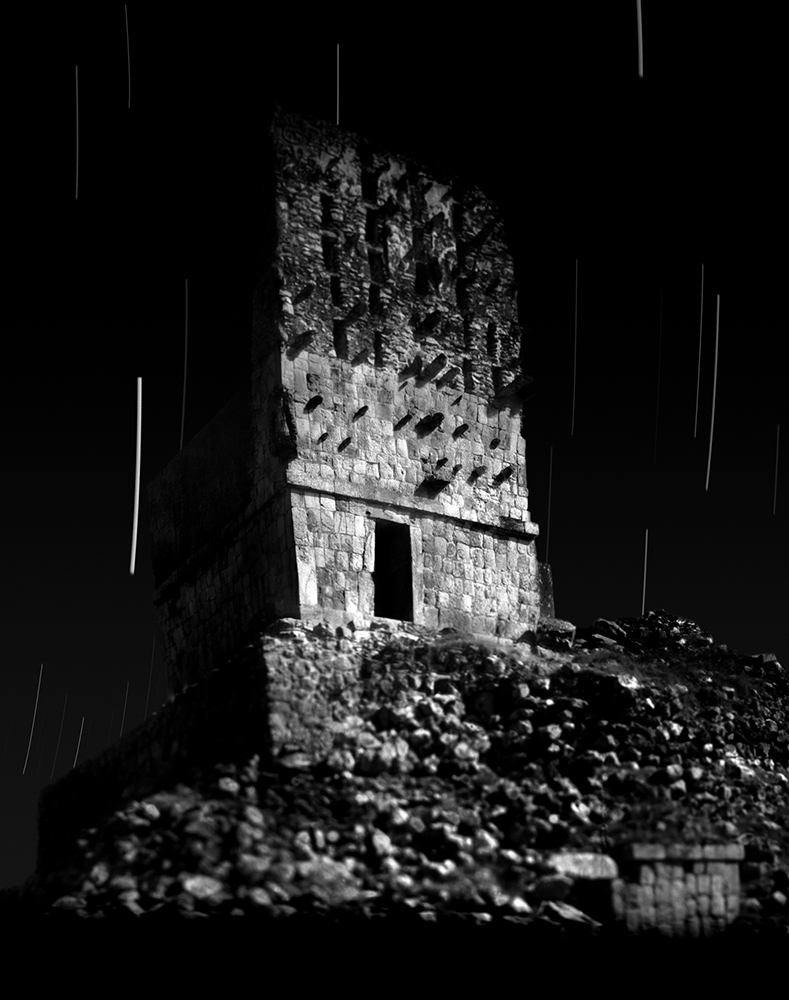
©Tomás Casademunt, “Mirador, Labná” (View Point Labná), from the series Maya Puuc
LP: What drew you into taking a journey to Mitla, Teotihuacan, and other archaeological sites? Is there a spiritual part to it?
TC: I have a deep connection to stone. In Mexico the latent energy in these sacred spots is very strong. It holds the memory of what it has lived. Stone emanates truly powerful energy. I use silver as a conductor to retain these vibrations. The long exposure under moonlight catches many of them. The beauty that remains carved by generations of craftsmen are bound by time. And the ritual use that constitutes them, confers innate spiritual strength. Long photographic exposure increases their pulse energy.
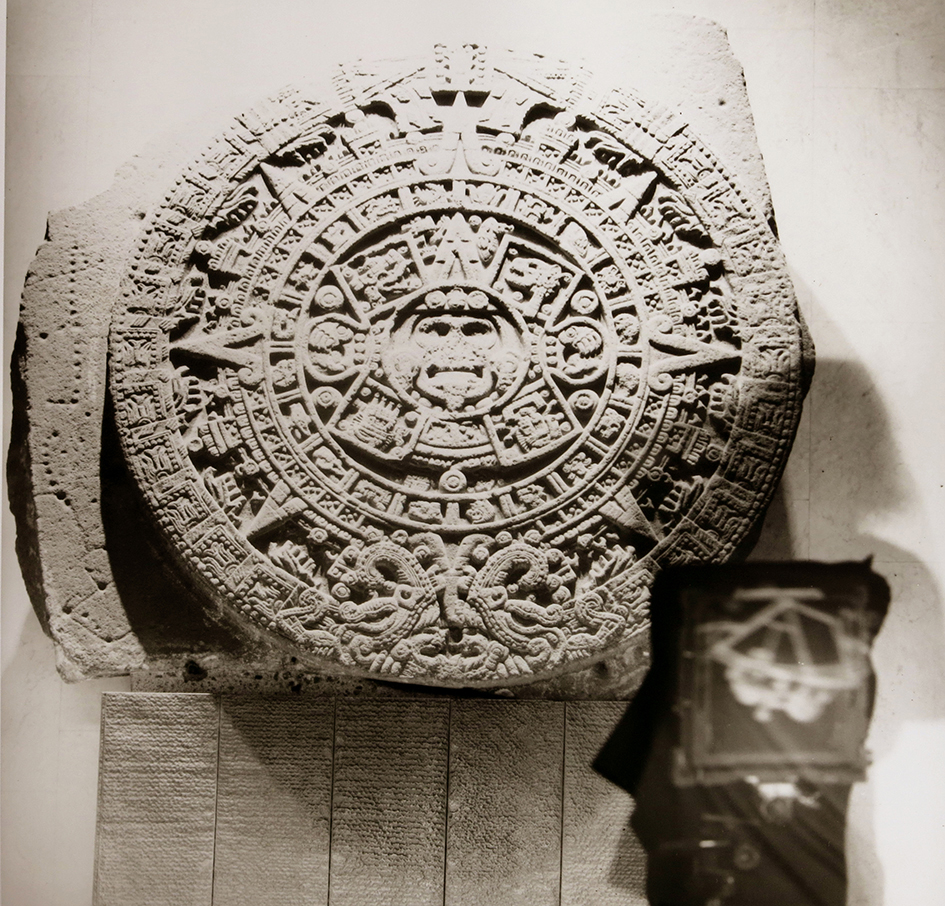
©Tomás Casademunt, “Solar” (Sun Stone), from the series Saturno
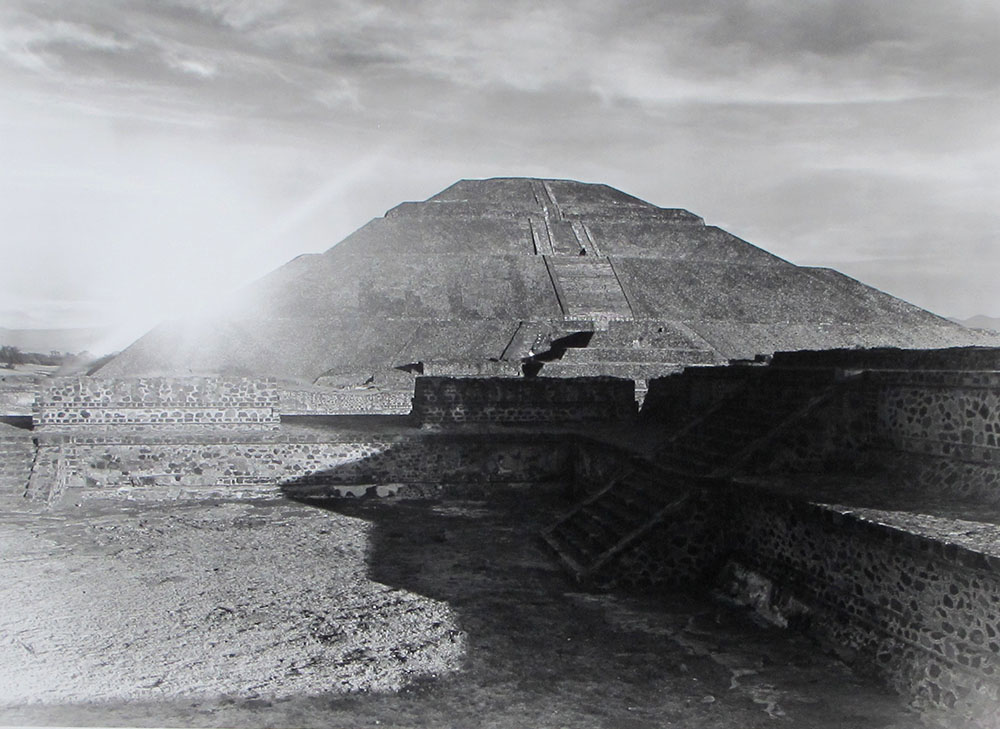
©Tomás Casademunt, “Ollin 30,” from the series Teotihuacan
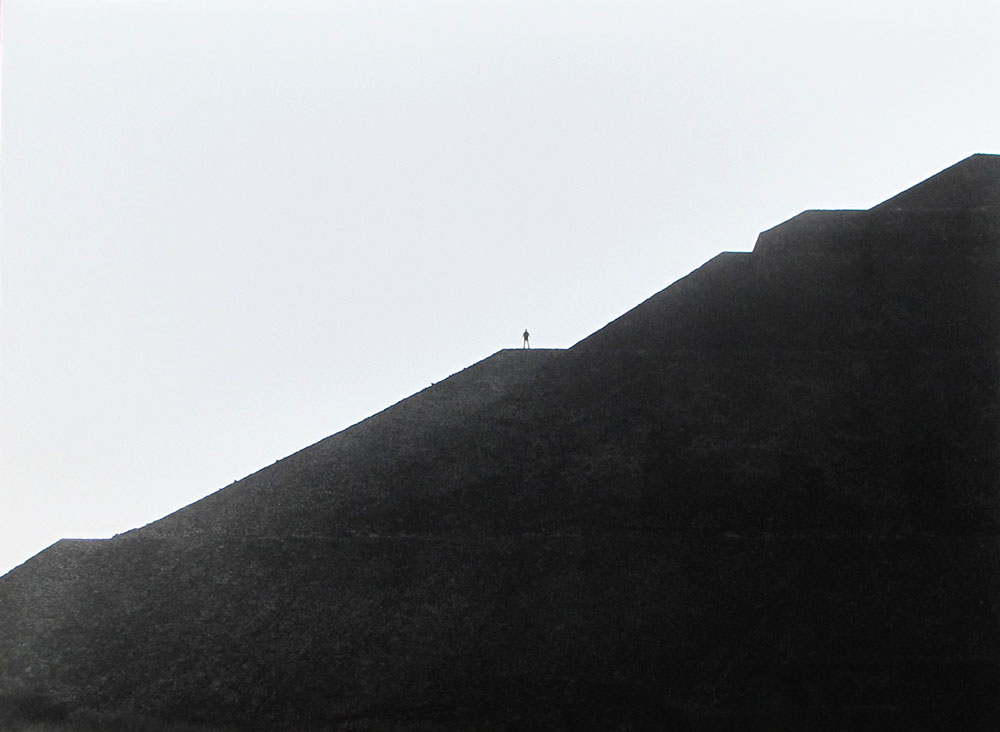
©Tomás Casademunt, “Ollin 28,” from the series Teotihuacan
LP: What is your creative process when photographing a pyramid or an archaeological site? Do you have a specific ritual?
TC: All my expeditions always begin with prayers and copal incense. Always with great respect for the past lives of people who lived there and for archaeological heritage. I get to know the cities of ancient Mexico well before photographing them. I do extensive research on what life was like in those places. I’m fascinated by how the mythology of these sacred sites has been shaped through the luminous gaze of different must-see photographers over the last 150 years.
My long nights in Mitla, Teotihuacan, or the palaces in the Puuc hills flowed without setbacks, pulled by a strong energy connection. Each pyramid, each structure reveals its own imaginary world. The love I have for these stones and their history has grown with every visit, with every empirical experience accumulated over the thirty years I’ve been living in Mexico.
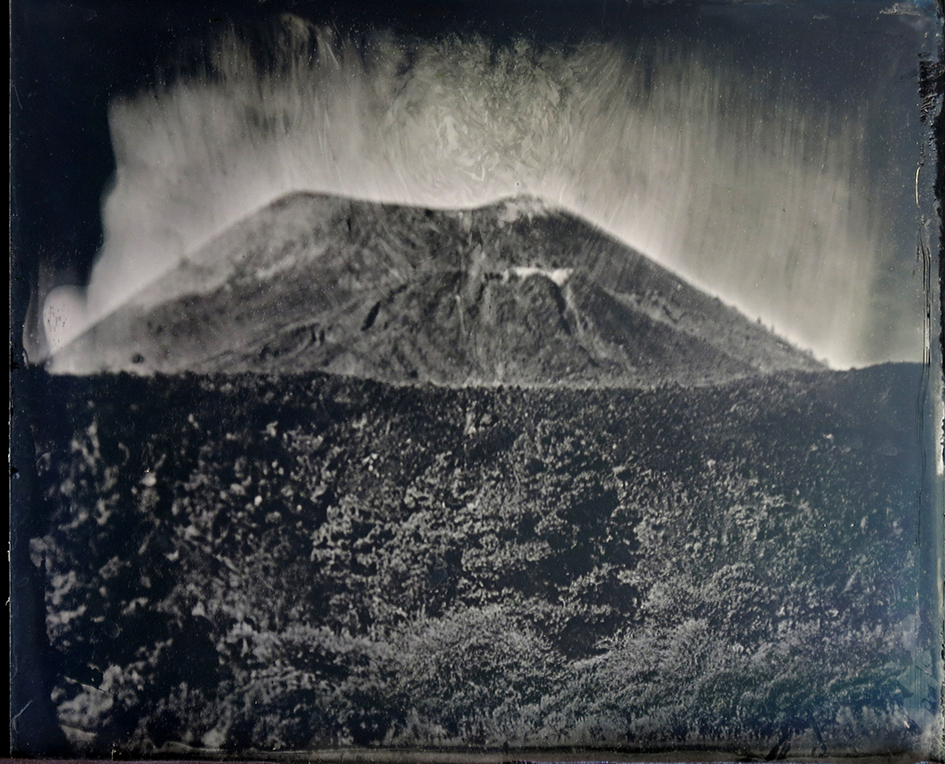
©Tomás Casademunt, “Paricutin 3,” from the series Volcanes de Plata (Silver Volcanoes)
LP: Your processes are long, precise, and demanding. In this day and age, not many people are willing to dedicate that much of their time to something. Where does your aspiration to observe come from?
TC: Less is more. I work with the sole purpose of giving to each and every one of the works that leave my workshop an electric charge that defines them. I produce a small number of pieces and exhibit them every once in a while. I believe in organic personal processes on a human scale, where everything fits in a lax time, even if that means that different series overlap each other.
LP: What is the Saturno camera? How does it work?
TC: Saturno is a movable, large-scale camera through which I work wet collodion plates. It functions as both a camera and a lab. Its height allows me to work inside it, so I don’t need plate holders or bellows. It’s as simple as placing a glass plate on a support and letting light pass through a special lens built in 1860. Then, a doubly inverted latent image forms a luminous circle one meter in diameter. From a quantum perspective, I sense that my mere presence inside the camera obscura conditions the experiment.
Inside the camera, light operates mysteriously, doubly inverting the external image: up/down, left/right. Selective focus. The white collodion emulsion flickers brightly, struck by photons. To witness that moment, extending over minutes, is beauty of the highest order. With each new exposure I make using Saturno, I try to further refine my spiritual involvement in that foundational moment. I’m an emotive witness in the dark.
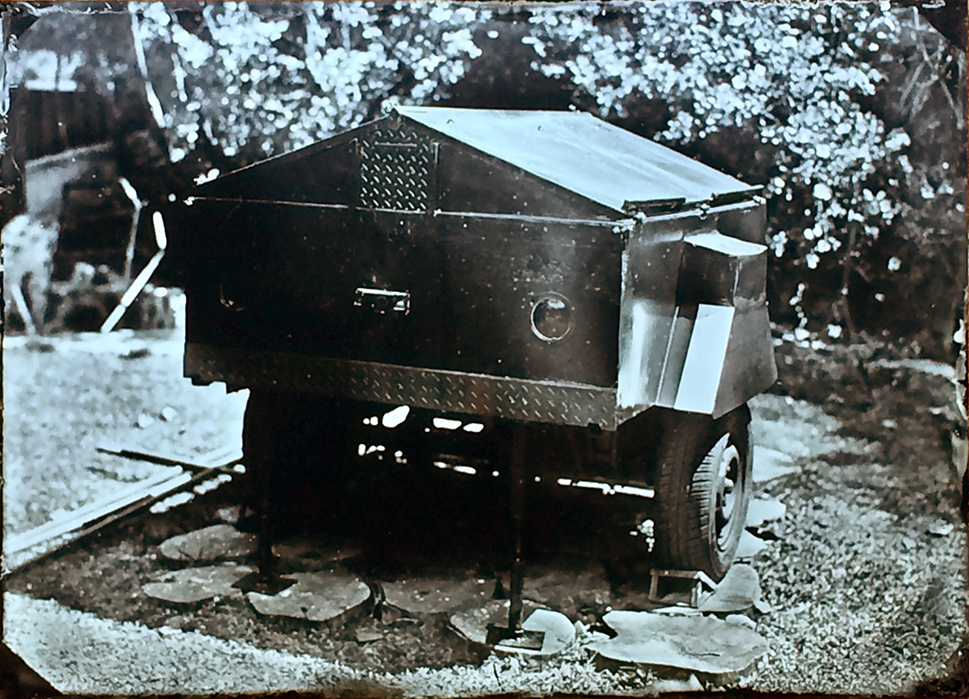
©Tomás Casademunt, “Cámara Saturno” (Saturno Camera), from the series Retratos con Saturno (Portraits with Saturno)
LP: And how did it come to be?
TC: The persistent idea of building a camera that was big enough for me to fit inside it emerged during late nights in the Yucatán rainforest. I spent long hours next to my 8×10” camera. I watched over it so a deer or even the wind wouldn’t knock it over. In strictly photographic terms, the camera didn’t need me, so the illusion of being a witness to the direct impression of light on the photographic emulsion bloomed.
Its name responds in multiple ways to the ringed planet, especially the ice crystals that orbit it and build its beautiful image. Besides, Saturno is time’s titan. With each journey I make I adjust it and improve its design. It has been forged in extreme situations: rough paths, tall mountains, and heavy rainfall. Today, it is set up in a beautiful garden in southern Mexico City on Saturdays every other week making portraits in wet collodion so they can walk in and witness the miracle of light and its process as it was done in 1860.
LP: What attitude do you perceive when someone goes to have their portrait taken and discovers the process lasts several hours? Do you think they experience both time and themselves differently?
TC: We’re still working on shortening the time it takes to do it. We’ve managed to do a session in an hour, even though it’s our intention to be able to do it in half an hour. The big challenge is to quickly narrow down the many potential technical obstacles presented by the wet collodion process, which are manifested in multiple ways due to the elements composing it: the purity of the silver, the viscosity and cohesion of the emulsion, variations in ambient temperature and humidity, the drying of the varnish protecting the glass plates, and finally, the framing. Illusion remains our fuel.
Introspection happens before and after the session. When you have the opportunity to be alone for a while inside the camera, then you receive a glass portrait in your hands that will accompany you all your life. It implies a high dose of confidence, curiosity, and acceptance of oneself. Traits that demonstrate your family’s history peak out, little gestures or looks that mirror when looking at our own image and that take us back to an ancestor.
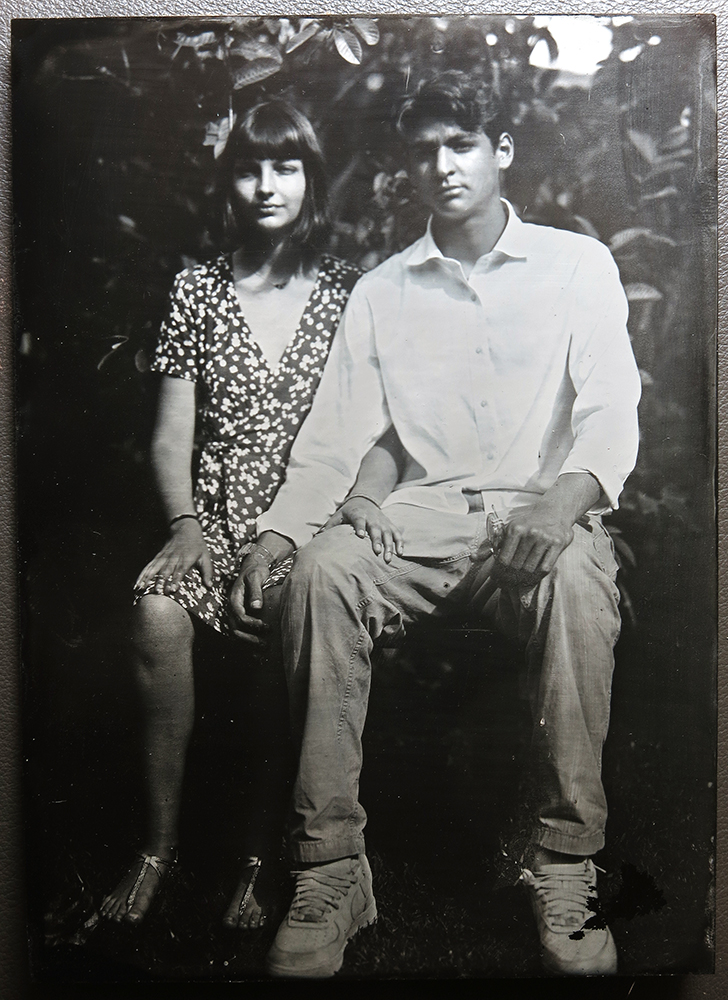
©Tomás Casademunt, “Shaula & Hamal,” from the series Retratos con Saturno (Portraits with Saturno)
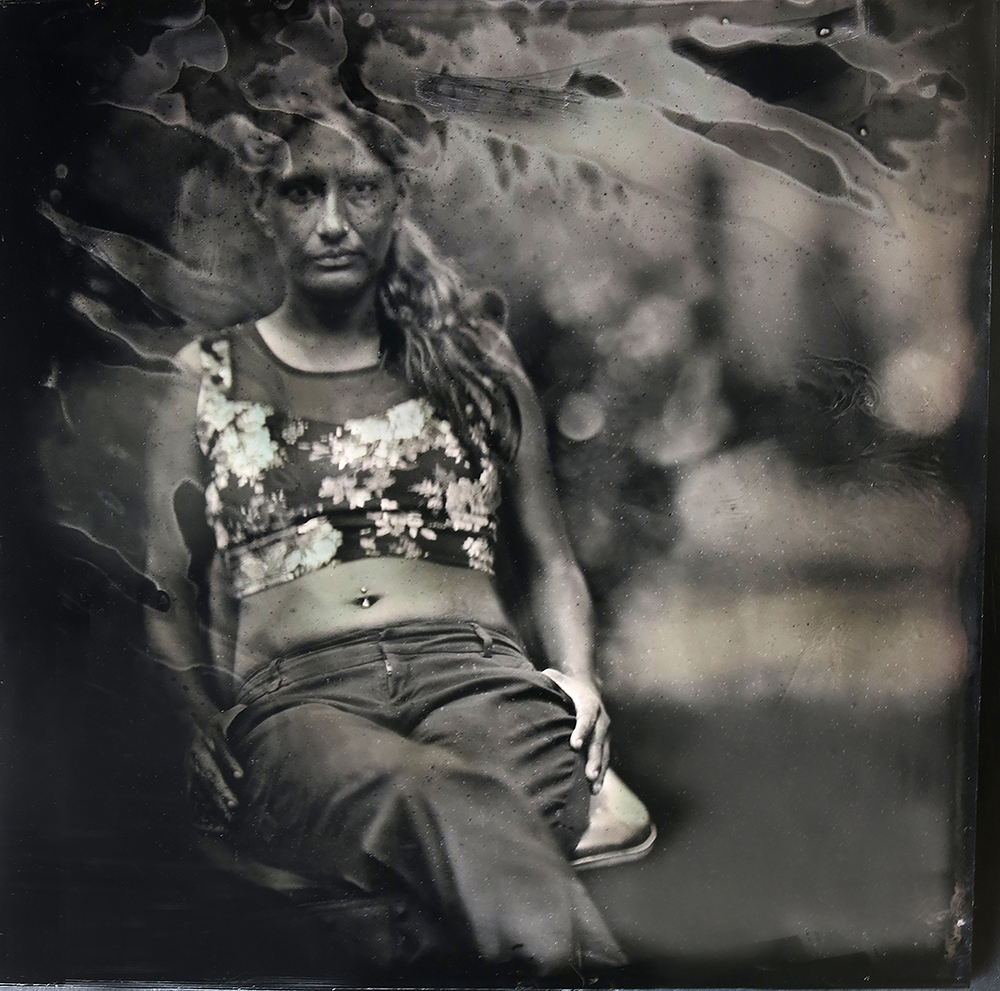
©Tomás Casademunt, “Electra”
LP: What led you to work with such an old process like wet collodion? What would you say to someone who wants to venture into it?
TC: I had already built large-format cameras and enlargers. When I wanted to experiment with preparing liquid emulsions, I encountered collodion. I took advantage of the pandemic to refine the technique: cotton cultivation, collodion preparation, silver dissolution, and tool design. I’ve just completed a series about Mexico’s volcanoes. It took three years of travelling with Saturno, exposing glass plates up to 20×25”. Now, thirty years after Son de Cuba (Cuban Son), I returned to portraiture as a unique experience rooted in proto-photography, from which everything emanates. An extraordinary opportunity open to the general public, every two weeks in the same location in southern Mexico City.
To whoever wants to start I would say that the simplest way to begin is by making exposures with a pinhole camera on black-and-white photographic paper. Then, to continue to experiment with cyanotype: connecting cellphone cameras with hands-on work. Those who become fascinated will likely keep searching, gradually becoming accustomed to formulas and aseptic processes in the lab.
LP: In a world as fast and digitalized as ours, do you believe we need slower, analog, in-person processes to truly observe?
TC: I’m inclined toward slow-cooked soups. I aim for the impossible. In my photographic lab I hung a photograph of the inscription that don Manuel Álvarez Bravo wrote in his own lab: “There is time, there is time.” In my understanding, that phrase embodies an attitude toward life and toward the practice of photography. The routine of the universe repeats itself day after day. It’s enough to observe the world calmly and attentively with the senses. Spontaneous photo-epiphanies are the prize for the patient. More than a question of medium, whether it’s photochemical or digital, what truly matters is cultivating your own way of seeing.
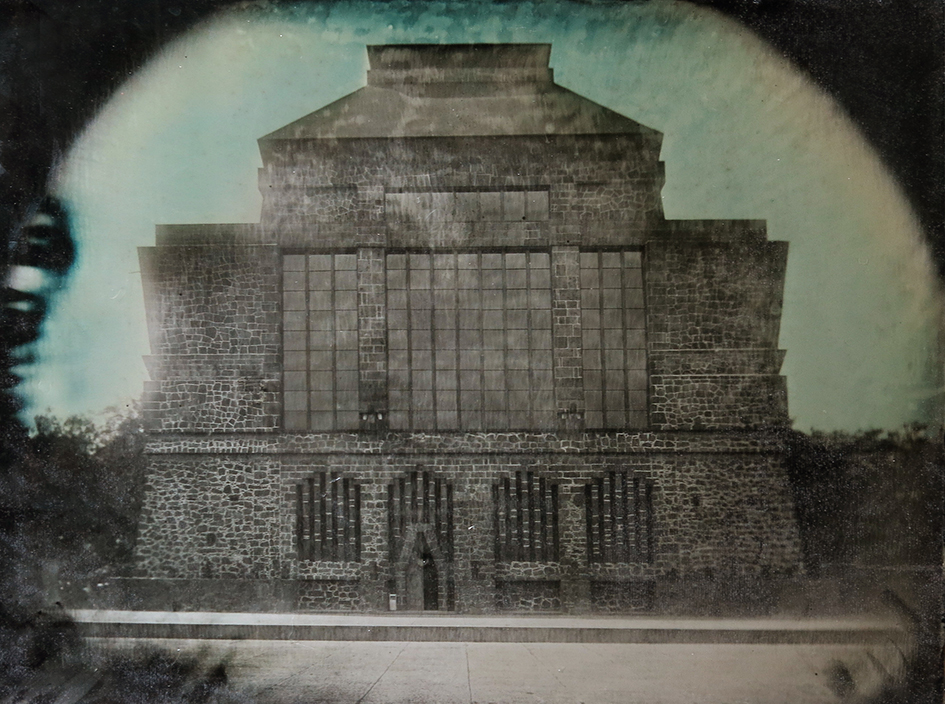
©Tomás Casademunt, “Museo Anahuacalli”
LP: Out of all the illustrious characters a photographer can portray, you were able to have a session with the Coatlicue, the Mexica Earth Goddess. Who is she to you? What did that experience leave you with?
TC: It was a great privilege for me to photograph the great Coatlicue with Saturno in the National Museum of Anthropology in Mexico City. It worked as a lab to process the exposed plates in front of the goddess. This great carved stone shows from the front and the back the Mexica mother of the earth, fertility, and death. Beautiful and fearsome. The ambrotypes resulting from that were left with a strong presence of that life and death duality.
LP: And finally, when you look forward, what questions do you ask yourself? What are you interested in exploring next?
TC: I’ll continue to explore the surroundings with my cameras as long as I have the energy to do so. I also spend a lot of time reviewing past work and giving it new meaning through new editions, crossing printing techniques, and supports. Recently, I incorporated a heliogravure workshop into my universe. Now, I can transfer my photographs onto copper plates and onto paper that I make myself from recycled remnants from print and plotter workshops. I continue to personalize my processes as much as possible, turning them into an inspiring journey that results in timeless works with a strong spiritual charge.
Lou Peralta is a visual artist and contemporary photographer based in Mexico City. She belongs to the fourth generation of a family dedicated to portrait photography—a legacy that continues to nourish her ongoing exploration of the genre. Her practice expands the limits of the two-dimensional photographic image, reimagining portraiture as a sculptural and spatial experience through hand-built structures using materials such as paper, fabric, agave fiber, and wire.
Her work has been featured in solo and group exhibitions in Mexico and abroad. Peralta is a Fujifilm brand ambassador through the X-Photographers program. Recent recognition of her work includes being selected for the Photolucida Critical Mass Top 50 (2023 and 2025), the FRESH Photography Award (2025), the 22nd Santa Fe Photography Symposium in New Mexico (2023), the selection of one of her works for the Ibero Puebla Biennial (BIP) 2025, and an artist residency at The ANT Project (2026).
Instagram: @lou_peralta_photo_based_artist
Posts on Lenscratch may not be reproduced without the permission of the Lenscratch staff and the photographer.
Recommended
-
Photography Educator: Jillian M. BrowningJuly 24th, 2026
-

Craig Easton: An Extremely Un-Get-atable PlaceJuly 6th, 2026
-

The 2026 Paula Riff Award Winner: Angélica ArbulúJuly 3rd, 2026
-
The 2025 Paula Riff Award Winner: Marni MyersJuly 2nd, 2026
-
The 2024 Paula Riff Award Winner: Minwoo LeeJuly 1st, 2026