Mexico Week – Carol Espíndola: The World Is My Own Body
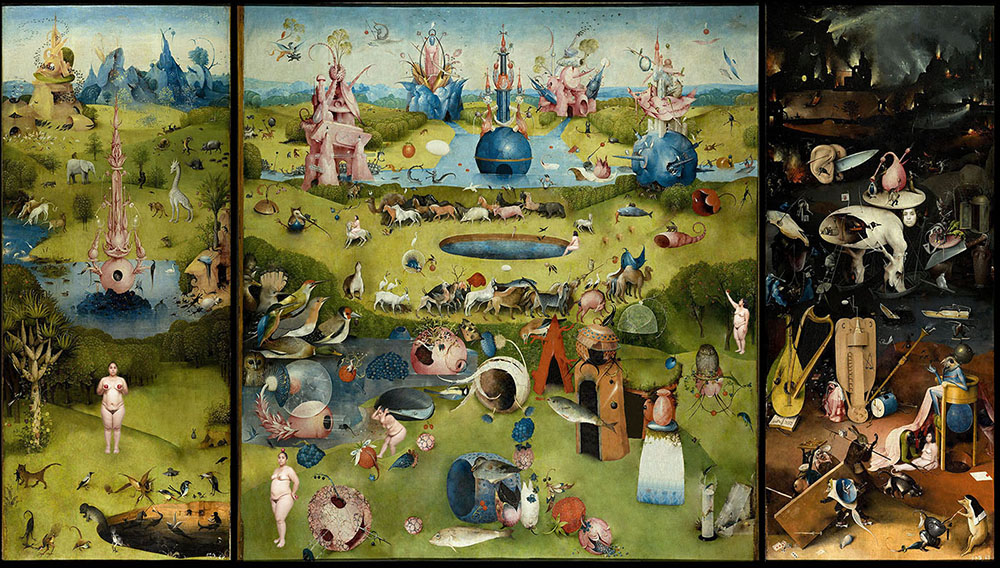
©Carol Espíndola, “Sobre el jardín de las delicias” (On the Garden of Delights), from the series La Atlántida o La utopía del cuerpo femenino (Atlantis or The Utopia of the Female Body), digital collage, 2016
The perfect female body resembles paradise, the perfect world in which we must ever dwell. Guilt, lust, almost all forms of sin are attributed to women from their creation in paradise and their exile to the world. There was no turning back. In “On the Garden of Delights” I have erased all human figures (from the original triptych) to place myself in the landscape without assuming the guilt attributed to Eve. Rejecting the ideal of beauty imposed on the female body, it alludes to the posture of Bosch as the tree-man who turns to see the world become hell, but now as a woman whose hell is her own body.
When I think of Mexico Week I don’t just see it as a series of interviews, but as a compass of what’s yet to come.
Seven artists, each working from a different place—whether it’s femininity, nature, society, history, identity, architecture, or the unconscious—share an undoubtable longing to express themselves in an innovative and true way.
While doing these interviews I didn’t only find photographs. I found passion, devotion, ideas, processes, humor, time, effort, and a true sense of humanity that deserves to be shared.
This isn’t an academic work. It’s a series of conversations about how our practice as photographers continues to evolve day by day. About how life shapes us and grants us the power to give meaning to what we capture with a click.
In a rapidly changing world, these artists continue to honor the origin of the word “photography” by bringing light and stories into it.
These photographers can look to the past and the future, move between worlds, and build a contemporary curiosity that will inspire many more to follow the path they’ve traced. The image is changing, and I believe we should stop for a moment and ask “What is Mexican photography saying today?”
The artists are: Iñaki Bonillas, Tomás Casademunt, Paola Dávila, Carol Espíndola, Cristina Kahlo, Gerardo Montiel Klint, and David Muñíz.
For Carol Espíndola photography wasn’t merely a way to grow professionally, but through it she discovered a language with which she could express the desires, critiques, and interests in her daily life. In her work she explores and challenges how society, history, art, and even science have formed the feminine image; taking her personal context and classical art pieces as a foundation for it. For her the body is a landscape, one that when seen with accepting and loving eyes may be the most beautiful world of all.
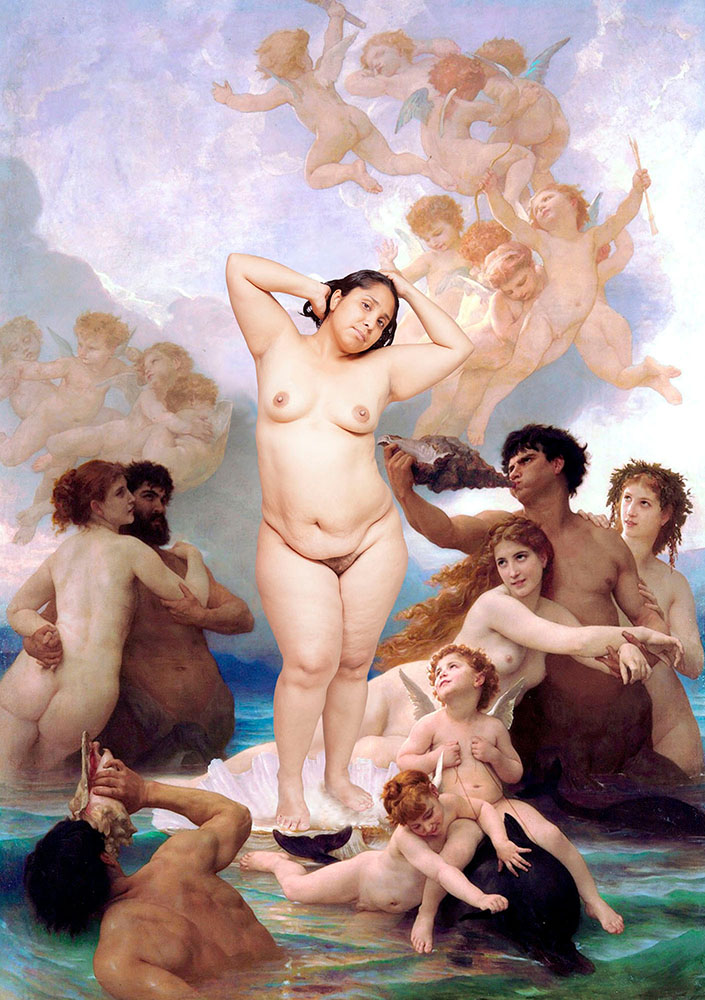
©Carol Espíndola, “Sobre el nacimiento de Venus II” (On the Birth of Venus II), from the series La Atlántida o La utopía del cuerpo femenino (Atlantis or The Utopia of the Female Body), digital collage, 2016
Carol Espíndola Photographer, educator, feminist, and mother. She did her undergraduate degree in Education Sciences and a master’s in Art Pedagogy at the Universidad Veracruzana. Through her work she seeks to break with stereotypes and social burdens imposed on the female body. Her work has been exhibited in Mexico, Spain, the USA, France, Aruba, Germany, and Argentina. She has been a member of the National System of Creators of Art (2018–2021) and has participated as an instructor in programs like Young Creators of the SACPC (formerly FONCA) and others. She won The Light Factory’s 11th Juried Annuale (2019), the Emmanuel Carballo Essay Prize (2016), and the Tlaxcala Visual Arts Prize (2014 and 2005). She published the book Sobredosis de fotografía (Photography Overdose) in 2019. Her work is in major photo collections such as that of the Bank of America, Fototeca Nacional, and Museo de Arte de Tlaxcala. Since 2012 she has been Director of the Laboratorio de Arte y Fotografía (LafO), an independent space dedicated to preparing public audiences for photography and contemporary art by developing curatorial projects and educational approaches to photography and contemporary art, aimed at children, young people, and the general public. This work is done in collaboration with photographer Guillermo Serrano, her partner of 25 years. She is joint coordinator of Rosa Chillante, an experimental feminist photography lab, together with photographer Greta Rico, designed as an online program for women in any part of the Spanish-speaking world. She is the coordinator of #unARMAradical, a pedagogical initiative aimed at promoting and disseminating feminist art in Mexico.
Follow Carol on Instagram: @espindolacarol
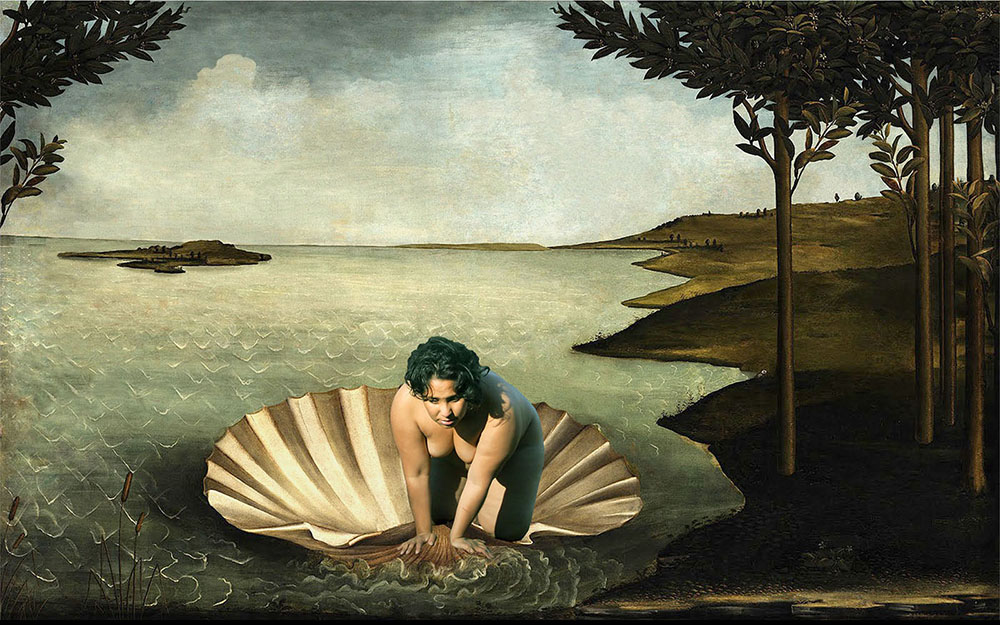
©Carol Espíndola, “Sobre el nacimiento de Venus I” (On the Birth of Venus I), from the series La Atlántida o La utopía del cuerpo femenino (Atlantis or The Utopia of the Female Body), digital collage, 2015 Venus does not appear enclosed in her shell, instead she emerges from the sea, like Atlantis.
For me nudity is a way of inhabiting the body, showing with honesty and without doubt who one is . . . it’s my way of making my declaration on the body public, stripping it of the sexual charge that is attributed to it. Carol Espíndola’s work is based on the vindication of the real female body and on a constant critique of standards of beauty imposed by culture, science, and art history. For the artist, the body transcends its condition as an aesthetic object to become a discursive territory and a “great story-teller.” Under this premise, her work questions the external gaze that has historically conditioned women to live under the surveillance of stereotypes. Espíndola seeks to demystify utopian perfection to propose, instead, the contemplation of an “existing beauty”; one that embraces tangible reality, the passage of time, and aging. In this context, the nude and self-portraits are not presented as erotic elements, but as acts of honesty and political and pedagogical tools. Her production establishes a critical dialogue with history and science. Through the appropriation of images and digital collages—visible in projects like El origen de la mujer (The Origin of Woman)—the artist refutes gender biases and evolutionary theories that have relegated the woman to passive roles. By inserting her own body repeatedly in these narratives, she confronts traditional representations, such as the mythical figure of Venus, to re-write history and propose new ways of understanding femininity. – Carol Espíndola
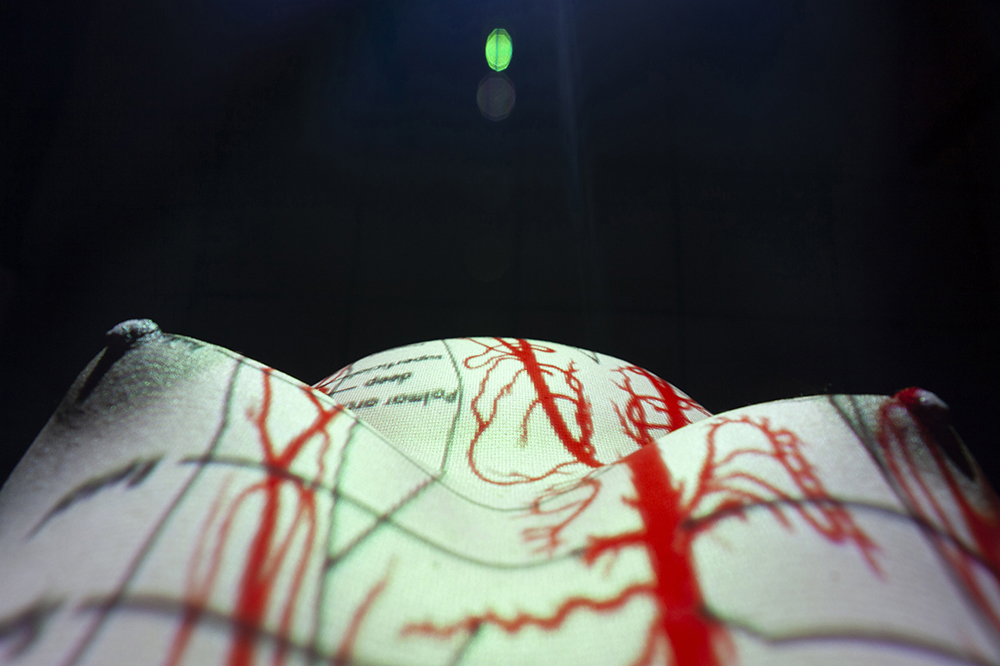
©Carol Espíndola, El origen de la mujer I (The Origin of Woman I)
Lou Peralta: Do you remember the first time you held a camera in your hands? How did photography begin to become your primary language?
Carol Espíndola: In my house, we didn’t really use a camera very much. My first encounter was with a disposable Kodak camera, and from that moment on, I found taking photos very fun. Later, when my parents saw that I liked it, they bought a 110 camera. I became the one in charge of taking photos in the family. Curiously, as often happens with photographers, I had very few photos of myself. In fact, when I got married and went through my things to take to our new home, I only found about 40 or 50 images from my entire childhood and youth.
My husband, on the other hand, came from a family of commercial photographers, and since we lived together, I wanted to learn how to use the cameras he had. At first it was very intuitive: reading manuals and magazines, until I began photographing my daughters. I wanted them to have the memories that I didn’t have.
At the same time, I realized that I was also documenting everyday life: my home, my kitchen, the laundry room. That’s when I discovered that there was something beyond family photography: photography as an artistic language. In Tlaxcala, in the early 2000s, that wasn’t very common, and through trips I began making to Mexico City, I was able to broaden my worldview. Over time, museums, the Centro de la Imagen, the Consejo Mexicano de Fotografía (Mexican Council of Photography), and seeing the work of other women photographers opened up my perspective and confirmed that this was where I felt the most comfortable.
LP: In series such as La Corteza de Venus (Venus’s Bark), La Atlántida o la utopía del cuerpo femenino (Atlantis or The Utopia of the Female Body), and El origen de la mujer (The Origin of Woman), there’s a very personal cosmology. When did you realize that you wanted to look at the body as a territory for artistic research?
CE: It really was a process of finding myself. I got married very young, and I had the desire to form my own family, but at the same time, as I was building it, I was also finding myself. I began to see both the outer world and the inner one. From that first stage, I started listening to my body. People always told me: look within yourself—what do you have or want to say? And in that inner search, I trained as a photographer and gradually detached myself from being only a housewife.
Then something happened: my daughters entered adolescence, and I became aware of how much of a burden and concern exists around the female body in our society. I had lived that with my mother and my grandmother, and I didn’t want to continue that cycle. My first impulse was to portray the transition of my daughters and nephews from childhood to adolescence. At some point, I decided not only to photograph them, but also myself, because I too was going through a transition: from being a young woman to becoming a formally adult woman who was also finding her place. It served as a form of self-recognition, a way of seeing myself, of turning my gaze toward myself.

©Carol Espíndola, “Sobre Friné” (On Phryne), from the series La Atlántida o La utopía del cuerpo femenino (Atlantis or The Utopia of the Female Body), digital collage, 2015
Phryne was a Greek courtesan, celebrated for her great beauty, used as a model for representations of Aphrodite. Around 350 B.C. Phryne was accused of impiety, an unforgivable offense in Ancient Greece (it was the crime that Socrates was condemned to death for). During the trial, to avoid the death penalty, Praxiteles revealed her body, arguing that the world could not be deprived of so much beauty. With this strategy, he was able to secure a unanimous acquittal from the court: beauty is good.
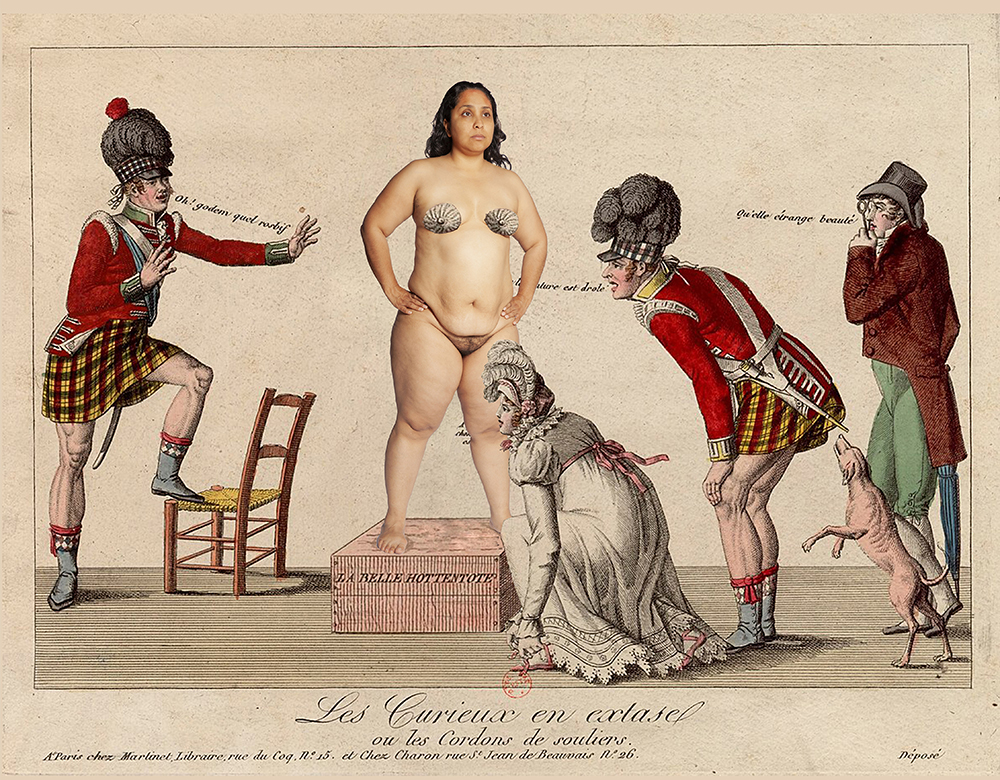
©Carol Espíndola, “Sobre el nacimiento de Venus II” (On the Birth of Venus II), from the series La Atlántida o La utopía del cuerpo femenino (Atlantis or The Utopia of the Female Body), digital collage, 2016
LP: What was it like to face self-portraiture and nudity from an artistic place in such a sexualized world?
CE: At first, I wasn’t even thinking about undressing. I started making self-portraits and, little by little, I began taking off my clothes. It was like an exercise in recognition, where I did what the photograph asked of me. It was a very emotional moment. I remember looking at the images while they were still on the camera and feeling as though I had detached myself and observed myself from the outside.
My intention was never to sexualize the body, but rather to observe it—to show it honestly, as a whole. Something society doesn’t tend to do, especially to younger audiences. I wanted my daughters to understand that a person’s value does not lie in meeting a beauty standard imposed by contemporary culture, but in who they are, what they think, and how they relate to others.
LP: Would you say that La Corteza de Venus is a series about change, identity, and acceptance from a female perspective?
CE: Yes, absolutely. It’s a series that began and carried me through the inevitable crisis that occurs during a transition. It’s a search for identity after not knowing who you are. That’s why it touches on themes such as feminism, beauty, being overweight, relationships, family, and the future. I noticed that the female figure has always been portrayed as pure and simple, without taking into account the true complexity of being a woman.
So, after getting inspiration from an image I took of my daughter, I thought about the classical figure of Venus. That’s where I began questioning how female beauty has been represented throughout history. I was interested in engaging in a dialogue with those images, bringing them into the present and confronting them with my own body and my own context. That’s why landscape, skin, and the idea of corteza (the bark of a tree) as both surface and territory were so important.
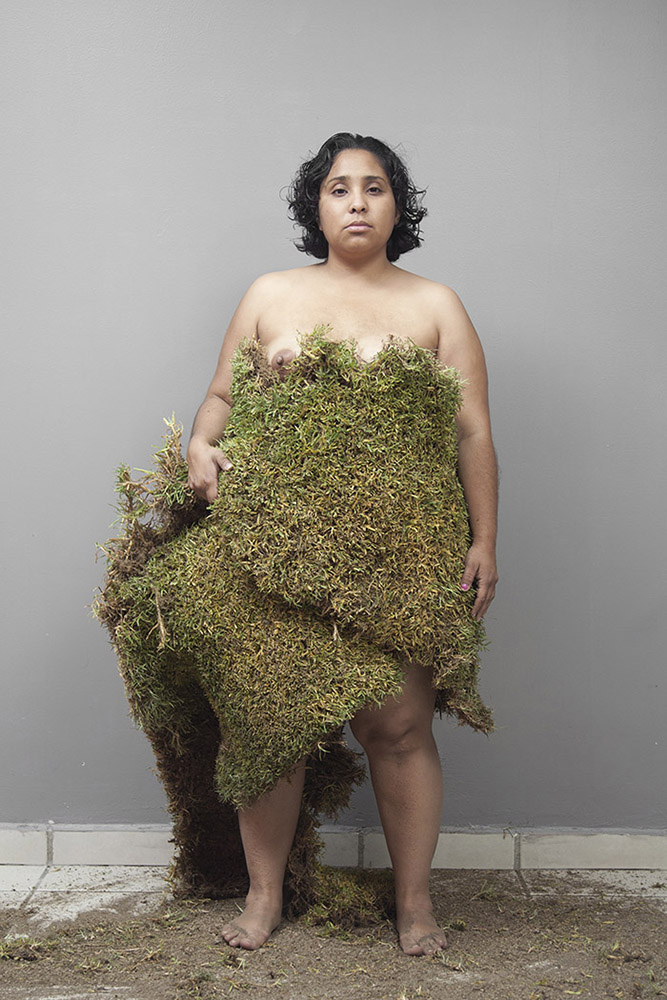
©Carol Espíndola, La corteza de Venus 01 (Venus’s Bark 01)
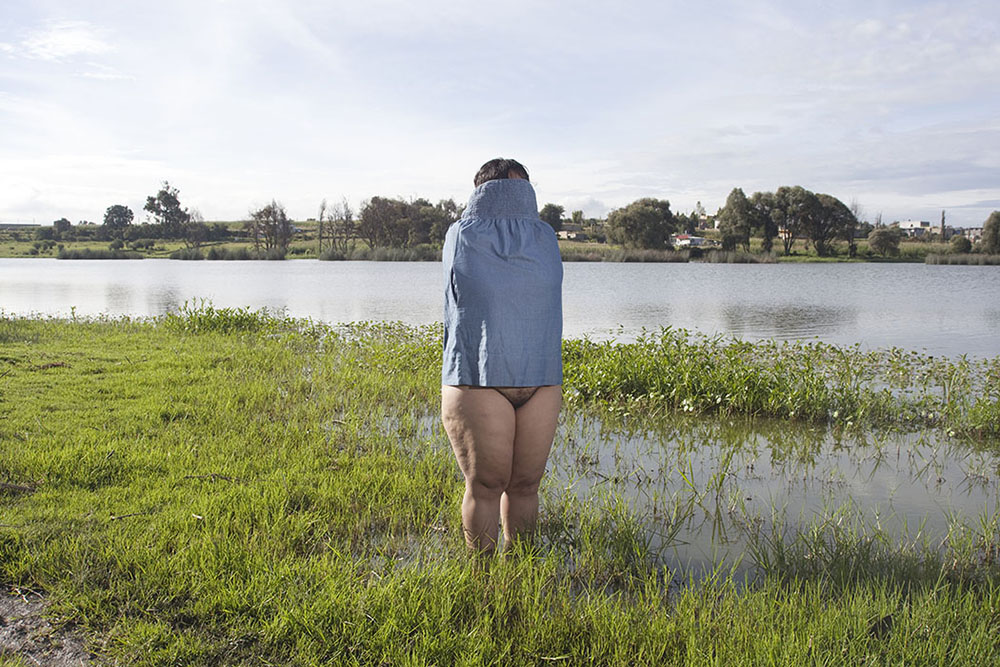
©Carol Espíndola, La corteza de Venus 02 (Venus’s Bark 02)
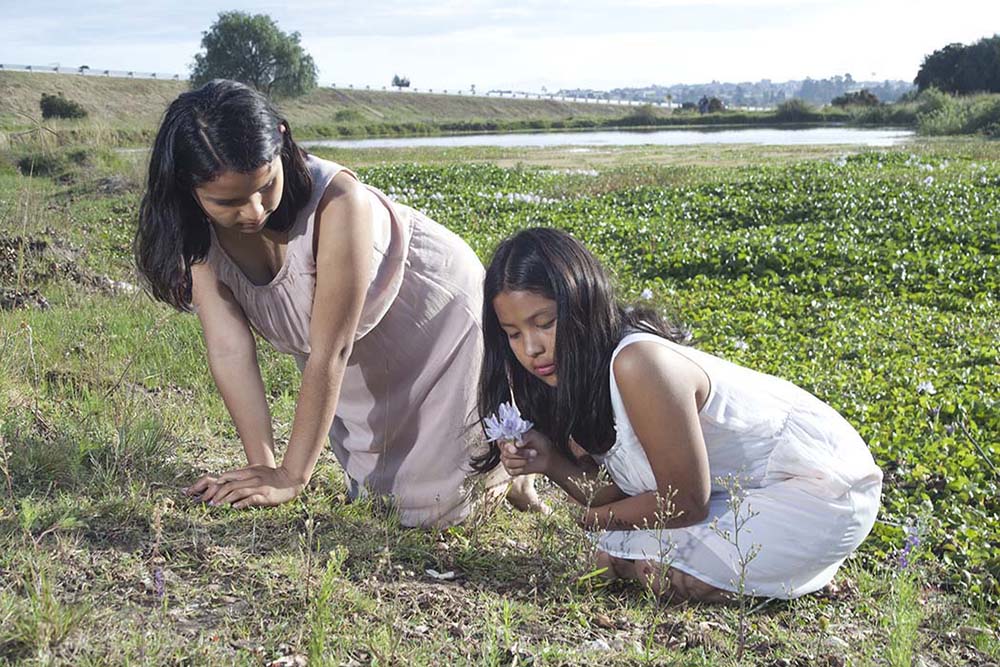
©Carol Espíndola, La corteza de Venus 03 (Venus’s Bark 03)
LP: In La Atlántida o La utopía del cuerpo femenino, the idea of utopia appears. How does this concept connect with your reflection on the body?
CE: La Atlántida allowed me to think of the female body as an impossible construction. Each era creates its own ideal of the perfect body, which gives rise to the idea of utopia: someone fits in, and someone is left out. The perfect body is a utopia because it is never attainable for everyone.
In this project, I began to dialogue not only with photography, but also with literature and history. I decided to use references such as utopian cities, imaginary journeys, or classical narratives to speak about the body as a changing, political, and deeply personal space. An example of this blend is my work Around the World in Eighty Days, based on the novel by Jules Verne. My body is my own world, and by placing myself in that image, I set out to travel around my very own being, to get to know every part of it with the excitement of discovering something new.
LP: In that same idea of women being discovered, El origen de la mujer incorporates historical and scientific research. What inspired you to begin this project, and what are you seeking to question with it?
CE: This project was born from observing how the female body has historically been made invisible or sexualized, even in science. As a primary school teacher, I noticed that when anatomy was taught, the bodies shown were almost always male. And it’s truly interesting, because when the female body appears, it is usually burdened with a sexual or symbolic charge that makes it inappropriate for “neutral” study.
As I did further research on this, I discovered how scientific theories, such as Darwin’s, were used to justify the inferiority of women and deny them rights like voting, among many others.
One of the most significant discoveries for me was finding the responses that some women gave to these discourses in their own time. Something that “time” has left to oblivion. For example, four years after the publication of Darwin’s book, an author named Antoinette Brown Blackwell wrote a text that refutes his claims about supposed female inferiority point by point. Recovering these silenced voices became a central part of the project.
El origen de la mujer is therefore built as an exercise in critical revision of scientific books, anatomical treatises, engravings, illustrations, and historical paintings. One example is my work inspired by Leonardo da Vinci’s Vitruvian Man. I wanted to emphasize that measurements are unique and that there is no single, perfect set of proportions for every woman.
By truly making the subject my own, placing it in my context, and portraying myself, I place my body in those spaces from which it was excluded—not as a substitution, but as a gesture of evidence, confrontation, correction, and acceptance.
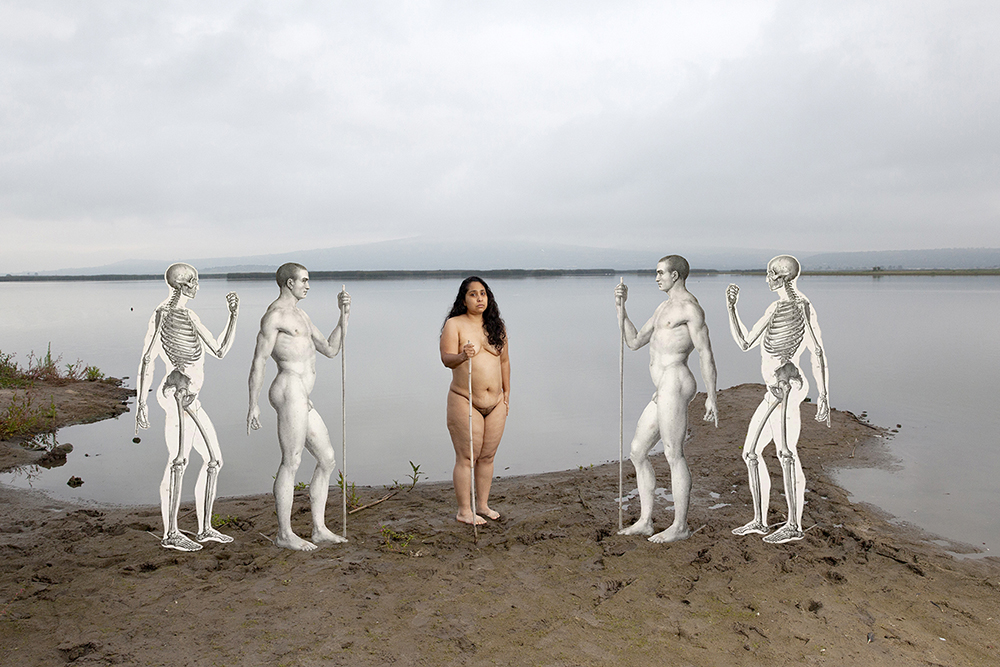
©Carol Espíndola, El origen de la mujer II (The Origin of Woman II)
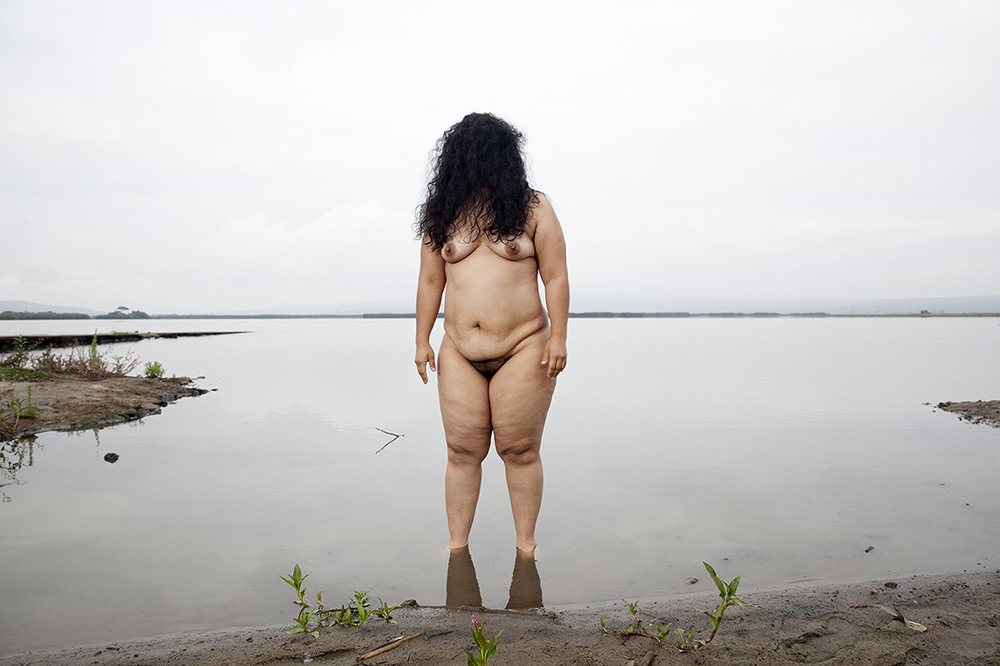
©Carol Espíndola, El origen de la mujer III (The Origin of Woman III)
LP: We live in a world that is constantly changing. How do you think this change is reflected in your work?
CE: I believe that just as the world has changed, so have we. Since antiquity, we have been in a constant process of learning and questioning. Especially now, I think the last 20 years have made it possible to rethink and re-establish how things are constructed and taught.
Knowing that nothing is static has allowed me to incorporate ideas of femininity from different perspectives—myths, archetypes, art—and blend them to arrive at another definition. It’s this ability to question everything while not letting go of our essence.
LP: To continue with this idea of change, in a moment when images multiply and artificial intelligence can generate them, what do you think a photographer contributes from the human perspective?
CE: It’s an interesting topic, because although there’s this idea that everything has already been written or done, the truth is that it hasn’t. No one has lived what someone else has lived, so each person has their own way of telling it. Each person has their own language, and their own place from which to speak. As long as there are humans and time, there will always be something that not everyone knows. That individual essence, what each person has, is what cannot be repeated. Every person has a unique story, context, and experience. I can confidently say that no machine can experience that.
However, tools like the camera, Photoshop, and AI are just that: tools. What matters is the intention, honesty, and clarity with which they are used. I’m not opposed to the use of artificial intelligence, but I am opposed to telling lies. Being clear about where something is created from is part of the ethics of artistic work.
LP: Your practice crosses personal work, research, pedagogy, and cultural management. How do all these dimensions coexist, and what would you like to explore in the future?
CE: Honestly, I began to expand unconsciously. As I said before, at the beginning I didn’t want to have just one dimension or facet. It’s hard to explain, because I felt like I wanted to do and be everything: I wanted to be a mother, I wanted to have a beautiful family, but also to work in something I could be proud of. Fortunately, over time I’ve found a way to integrate everything. With that said, I like organizing my creative process so I divide my practice into four axes: work, research, pedagogy, and action. Within the work itself, I divide it into image and text.
Today, I’m interested in continuing to do interdisciplinary work and exploring new formats, even three-dimensional ones. In the future, I want to develop a project about the motherhood of my adult daughters: how that bond is transformed when they no longer live with you, when motherhood becomes something else. Something seen from different eyes.
In the end, everything I do comes from the same place: the body as territory, the world as one’s own body, and the need to keep asking questions.
Another thing I’ve been working on—and that I’d like to finalize this year or perhaps early next year—is a personal essay. Just as writers often write about their practice, about the act of writing itself, that’s what I want to do: write about the practice of photography and how inevitable it is to include personal life within it.
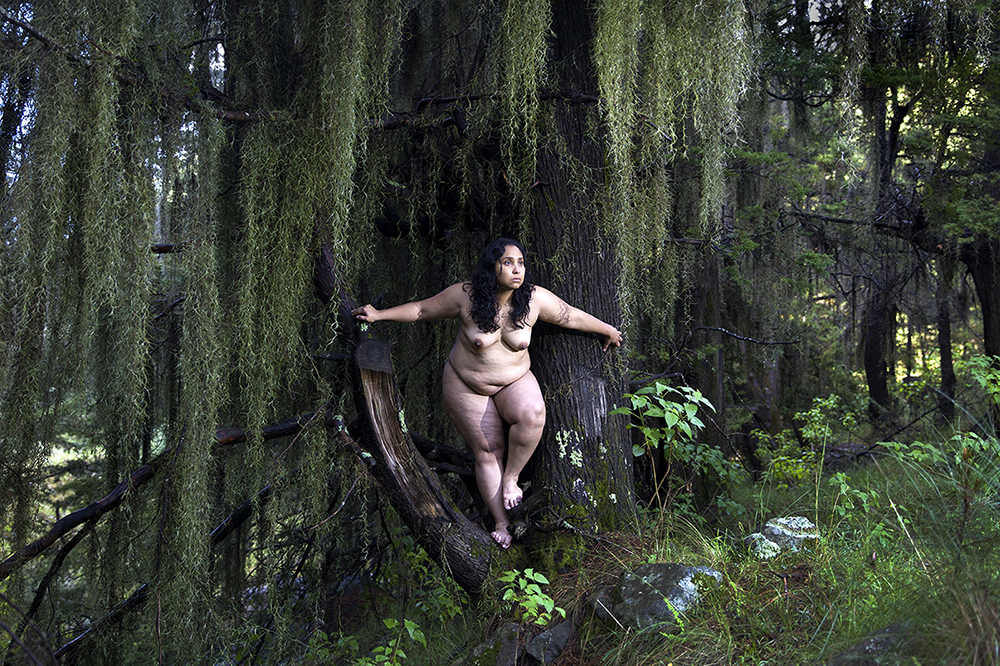
©Carol Espíndola, Siendo Lucy I (Being Lucy I)
Lou Peralta is a visual artist and contemporary photographer based in Mexico City. She belongs to the fourth generation of a family dedicated to portrait photography—a legacy that continues to nourish her ongoing exploration of the genre. Her practice expands the limits of the two-dimensional photographic image, reimagining portraiture as a sculptural and spatial experience through hand-built structures using materials such as paper, fabric, agave fiber, and wire.
Her work has been featured in solo and group exhibitions in Mexico and abroad. Peralta is a Fujifilm brand ambassador through the X-Photographers program. Recent recognition of her work includes being selected for the Photolucida Critical Mass Top 50 (2023 and 2025), the FRESH Photography Award (2025), the 22nd Santa Fe Photography Symposium in New Mexico (2023), the selection of one of her works for the Ibero Puebla Biennial (BIP) 2025, and an artist residency at The ANT Project (2026).
Posts on Lenscratch may not be reproduced without the permission of the Lenscratch staff and the photographer.
Recommended
-
Mexico Week – Carol Espíndola: The World Is My Own BodyMarch 26th, 2026
-

Mexico Week – Paola Dávila: Beyond the LandscapeMarch 25th, 2026
-
Mexico Week – Tomás Casademunt: Time Frozen by LightMarch 24th, 2026
-

Mexico Week – Iñaki Bonillas: From the Sideline of a PhotographMarch 23rd, 2026
-

Photography Educator: Eirik JohnsonMarch 20th, 2026