The 2026 Lenscratch Student Prize is OPEN!
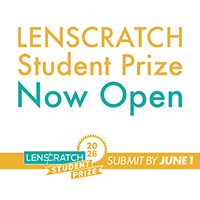
 The 2026 Lenscratch Student Prize is now open for submissions. The LSP seeks to support the next generation of photographers by offering monetary awards and professional networking opportunities to artists creating innovative and compelling work. Educators! Please share widely!
Students currently enrolled in any bachelors or masters degree program in photography are encouraged to apply.
SUBMISSIONS ARE OPEN!
DUE DATE IS JUNE 1st….NO late submissions accepted
AWARDS
FIRST PRIZE
a $2000 Cash Award and a feature on Lenscratch
a year long mentorship with Aline Smithson
a review session with Crista Dix, a seat at the New England Portfolio Reviews, and a family membership from The Griffin Museum of Photography
a review session with Samantha Johnson of the Colorado Photographic Arts Center
a review session with Rotem Rozental, a seat at the Exposure Reviews, and a membership from the Los Angeles Center of Photography
a mini exhibition on the Curated Fridge
a $500 gift certificate from Freestyle Photo
a collection of books from St.Lucy Books
a collection of books from Kris Graves Projects
a collection of books from Zatara Press
a collection of books from Workshop Arts and Luminosity Lab
a Lenscratch T-Shirt and tote
SECOND PRIZE
a $1000 Cash Award
a feature on Lenscratch
a mini exhibition on the Curated Fridge
a Lenscratch T-shirt and Tote
THIRD PRIZE
a $750 Cash Award
a feature on Lenscratch
a mini exhibition on the Curated Fridge
a Lenscratch T-shirt and Tote
4 HONORABLE MENTIONS
$500 Cash Award
a feature on Lenscratch
a mini exhibition on the Curated Fridge
a Lenscratch T-shirt and Tote
(Hopefully more prizes to be added)
JURORS
Aline Smithson, Founder and Editor-in-Chief of Lenscratch, Educator and Artist
Daniel George, Submissions Editor of Lenscratch, Educator and Artist
Linda Alterwitz, Art + Science Editor of Lenscratch and Artist center
Kellye Eisworth, Managing Editor of Lenscratch, Educator and Artist
Vicente Cayula, Social Media Editor of Lenscratch and Artist
Alexa Dilworth, former publishing director, senior editor, and awards director at the Center for Documentary Studies (CDS) at Duke University
Kris Graves, Director of Kris Graves Projects, photographer and publisher based in New York and London
Karen Haas, the Lane Curator of Photographs at the Museum of Fine Arts, Boston,
Yorgos Efthymiadis, Founder of the Curated Fridge, photographer
Hamidah Glasgow, Curator and Former Director of the Center for Fine Art Photography, Fort Collins, CO
Samantha Johnson, Executive Director of the Colorado Photographic Arts Center
Alayna Pernell, Artist, Lenscratch Editor, Educator
Epiphany Knedler, Artist, Editor for Lenscratch, Educator, Curator of MidWest Nice
Jeanine Michna Bales, Beyond the Photograph Editor of Lenscratch and Artist
Jordan Tovin, Artist, winner of the 2024 Lenscratch Student Prize
Drew Leventhal, Artist and Publisher, winner of the 2022 Lenscratch Student Prize
Allie Tsubota, Artist and winner of the 2021 Lenscratch Student Prize
Raymond Thompson, Jr., Artist and Educator, winner of the 2020 Lenscratch Student Prize
Guanyu Xu, Artist and Educator, winner of the 2019 Lenscratch Student Prize
Shawn Bush, Artist and Educator, winner of the 2017 Lenscratch Student Prize
Drew Nikonowicz, Artist, winner of the 2015 Lenscratch Student Prize
PREVIOUS WINNERS
2025 Jordan Tovin
2024 Mosfiqur Rahman Johan
2023 Christian K. Lee
2022 Drew Leventhal
2021 Allie Tsubota
2020 Raymond Thompson Jr.
2019 Guanyu Xu
2018 Zora J. Murff
2017 Shawn Bush
2016 Drew Nikonowicz
2015 Lauren Kelly
2014 Frances F. Denny
2013 Elizabeth Moran
“Winning the Lenscratch Student Prize unleashed a great amount of support. Several people and organizations donated what they could to push another artist forward and I think that’s what stood out to me. Community is important, and Lenscratch has harvested that for people like me and you. The support came at a pivotal moment where I was open to new ideas. The most impressive part of the prize was the one-on-one sessions with Aline. She literally invested her time into whatever I was thinking about as an artist at that point in time. Time is important and that sacrifice is what I appreciate the most. I would recommend anyone interested to apply now.” – Christian K. Lee, 2023 Lenscratch Student Prize Winner
“Being a part of the Lenscratch Student Prize changed the whole trajectory of my career and motivated me to keep improving my practice. It really is a uniquely generous prize, full of connections and support and capped off by the chance to work directly with Aline Smithson. My time with Aline was transformative and her mentorship helped me get to where I am now. The wonderful part is that this is just the beginning; the connections and friends and support I received from Lenscratch have stayed with me in the years since I won the award. For anybody on the fence about applying: go for it, it’s the best thing you can do for your practice.” – Drew Leventhal, 2022 Lenscratch Student Prize Winner
“The Lenscratch Student Prize has opened a world of connections and opportunities, and most meaningfully, it’s offered a network of support through Aline Smithson and the Lenscratch community. The exposure afforded to me through the prize has been invaluable as I begin my career, and mentorship with Aline has helped me to navigate an expansive and unfamiliar art world. This award year has been instrumental in allowing me to build a rich foundation for my creative work to come.” – Allie Tsubota, 2021 Lenscratch Student Prize Winner
“The Lenscratch Student Prize has opened up a whole new line of connections, opportunities and exposure. The mentorship with Aline Smithson helped me learn to navigate an art world that was foreign to me. Our conversations filled in a gap that was missing in my art school education and will be invaluable as I move forward in my career. I believe the seeds that I planted in this award year are going to bear fruit well into the future.” –Raymond Thompson Jr, 2020 Lenscratch Student Prize Winner
Posts on Lenscratch may not be reproduced without the permission of the Lenscratch staff and the photographer.
Recommended
-

BEYOND THE PHOTOGRAPH: Q&A WITH COMMERCIAL PHOTOGRAPHER ANDY MAHRMarch 22nd, 2026
-
Bryan Whitney: The Spiritual LightMarch 17th, 2026
-
The 2026 Lenscratch Student Prize is OPEN!March 16th, 2026
-
The 2026 LOVE Exhibition, Part 2February 14th, 2026
-

The 2026 LOVE Exhibition, Part 3February 14th, 2026