The Female Gaze: Alysia Macaulay – Forms Uniquely Her Own
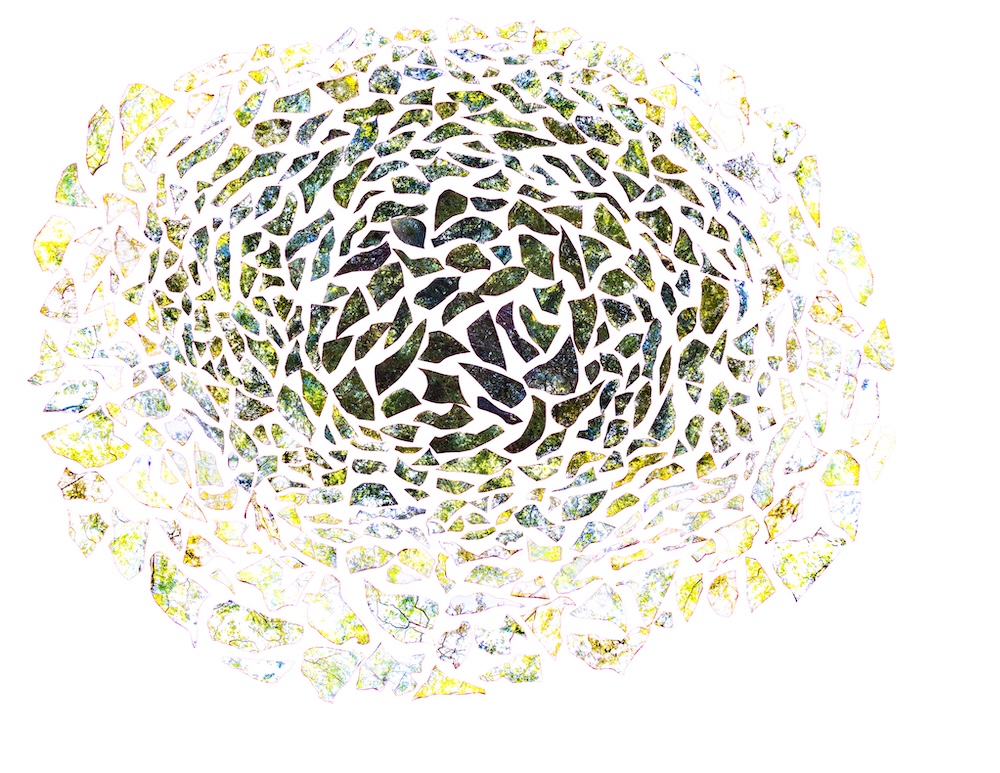
©Alysia Macaulay: Angel Oak Mosaic, Dark Center (2025) from the series Angel Oak
Born in Boston, Massachusetts, Alysia Macaulay received a BA from William Smith College, with a concentration in Art History. She studied at the International Center of Photography in New York from 2009-2011. Her work has appeared in numerous solo and group exhibitions, including “The National: Best Contemporary Photography 2022” at the Fort Wayne Museum of Art and The 2023 Danforth Museum of Art Annual Juried Exhibition. Alysia Macaulay was named a “FRESH 2023 Finalist” at the Klompching Gallery in New York. The Microsoft Art Collection holds several of Alysia Macaulay’s works in their permanent collection.
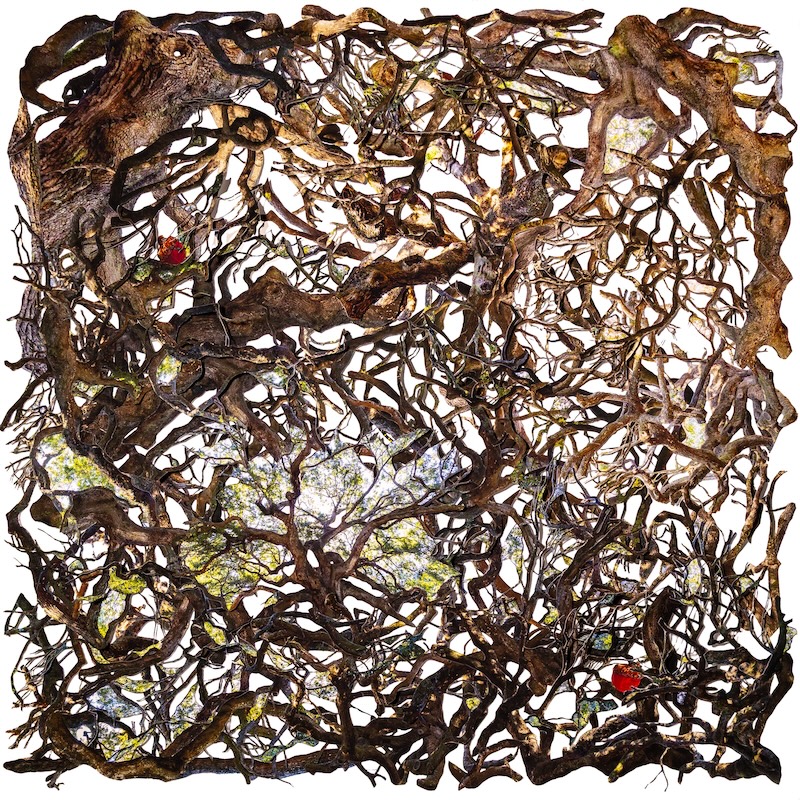
©Alysia Macaulay: The Beast (2025) from the series Angel Oak
I often find myself bored with photographic work that is cut and collaged into geometric shapes and patterns, because it seems—at least to me—that much of the work is about the geometric shapes rather than the content. That leaves me bored; I want more from work than a contemplation of form.
I don’t recall how or when I first came upon the work of Alysia Macaulay, but I have been intrigued by it for a while. The various series do not repeat the same techniques endlessly, they are paired to the ideas she is working with for each. She reinforces her viewpoints and lived experiences, and, as such, the work is instantly recognizable as her own. I find Macaulay’s interventions, collages, cuttings, and weavings refer back to her concepts, and that is what pushes them into the realm of transcendent for me.
I hope you enjoy this glimpse into Macaulay’s practices and ideas.
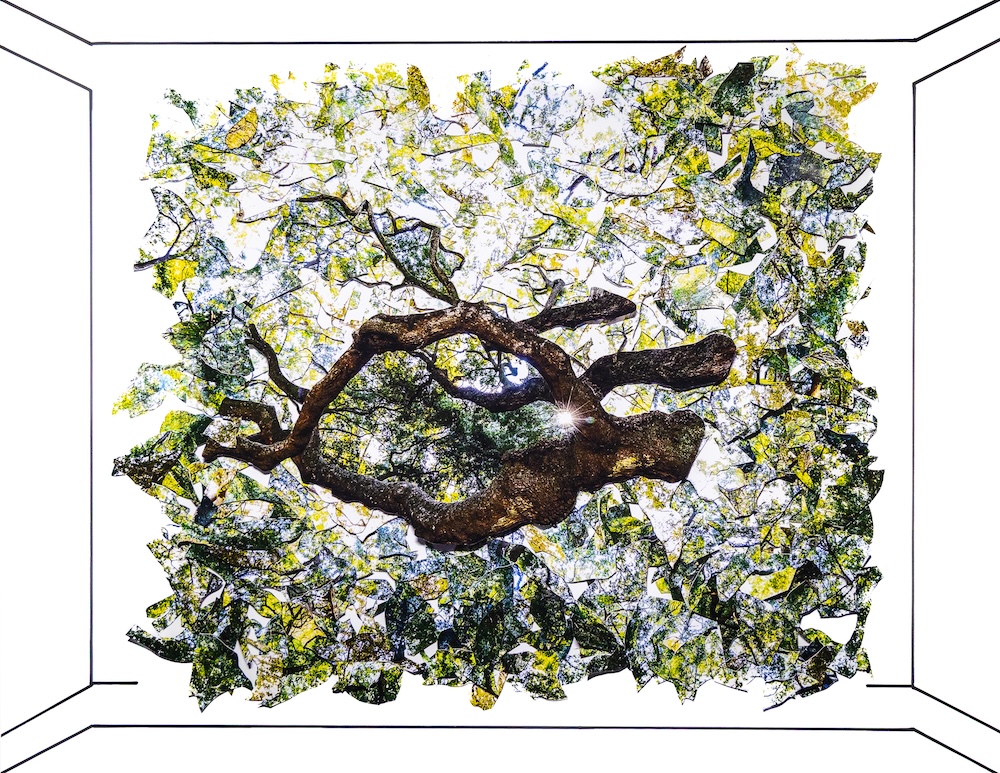
©Alysia Macaulay: Boxed In Angel Oak (2025) from the series Angel Oak
DNJ: Tell us about your childhood.
AM: During my formative years, I spent summers on the Greek island of Spetses. Those summers had a profound impact on how I saw the world. As the child of Greek parents, it fostered my love of Greece, its history, terrain, people and my connection to the sea.
I was raised in Boston Proper in the 1970s. For me, it was a time when parental oversight was quite relaxed and I was free to make my way around the city on my own. My divorced parents both lived in historic neighborhoods, so I would traverse Boston weaving my way through the Financial District down to the waterfront and using little known shortcuts like a side entrance to cut through the Golden domed State House. Those shortcuts were like the secret passages and pathways only a child knows of their playground, which, for me, was the city itself.
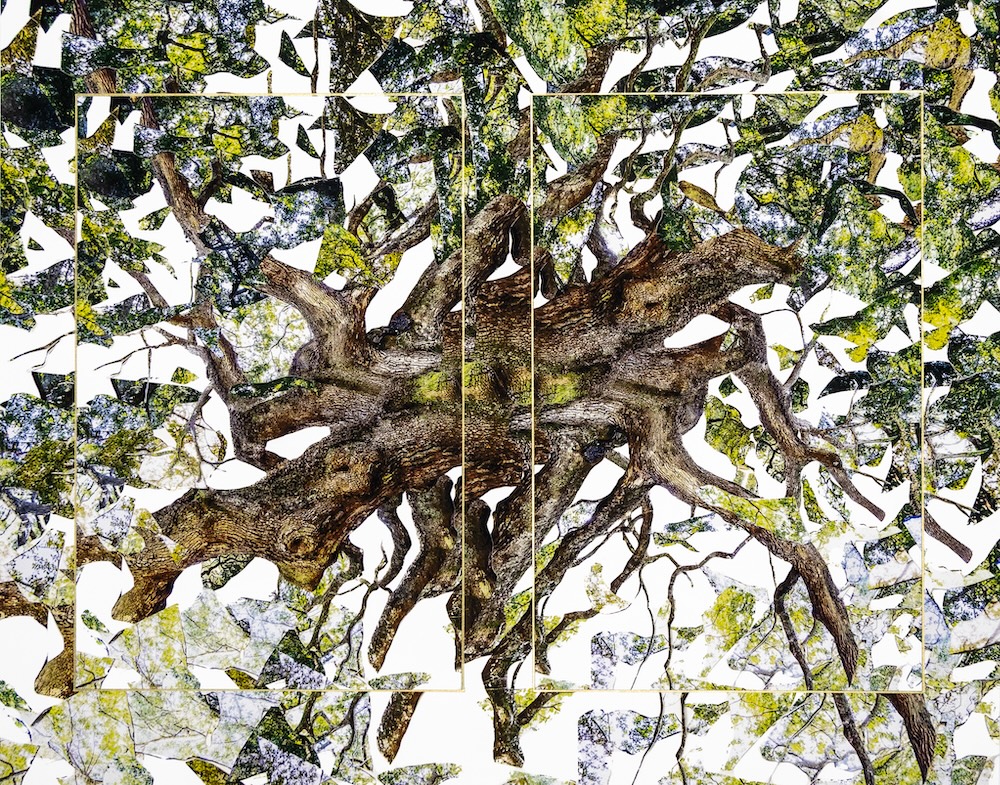
©Alysia Macaulay: Entwined Angel Oak Double with Rectangles (2025) from the series Angel Oak
DNJ: What were you like as a child?
AM: Honestly, I was very shy. Reading was a beloved escape for me and I always looked forward to the end of the school year when we would be given the summer reading list. I have such fond memories of walking into the jewel box of a bookstore at the bottom of our street and the formidable Boston Public Library, summer reading list in hand, and coming out with a stack of books I would spend my summer immersed in.
As well, I was raised on a steady diet of contemporary art. My mother was deeply involved with the ICA in Boston from the 1960s onward. As a child and young adult, she would take me to the show openings at the ICA where we would discuss the work. It was through those visits that I developed an eye and mind for art and learned about the inner workings of a contemporary art museum and the importance that art plays in our lives. It made the art world feel approachable to me, welcoming.
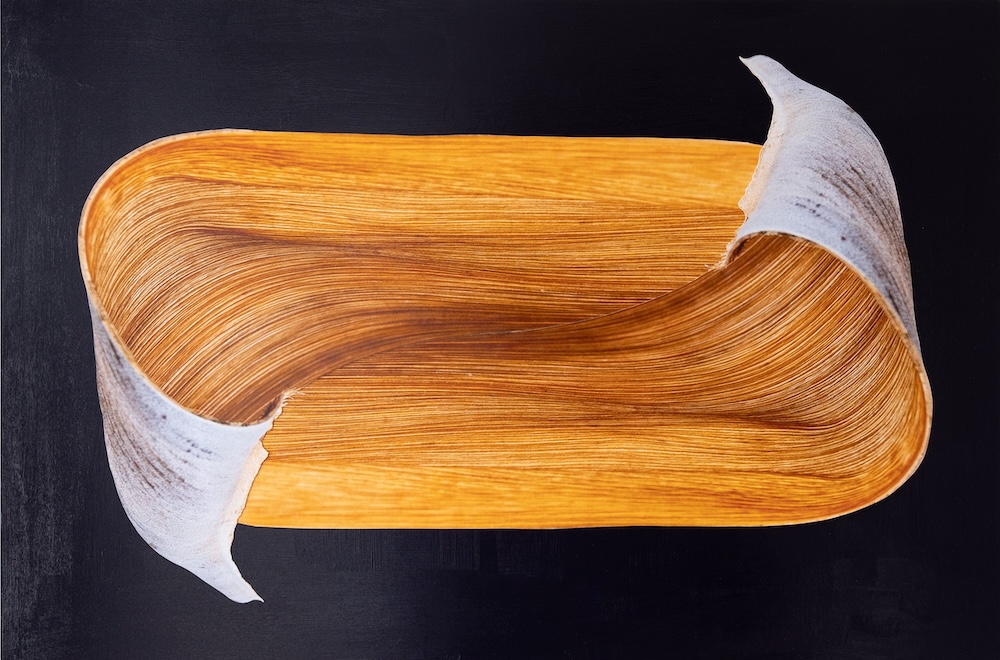
©Alysia Macaulay: Wrapped Sheath Abstraction on Dark Plum (2023) from the series Sheath Abstractions
DNJ: How/why did you start in photography? What’s kept you with it for all these years?
AM: I have a very clear memory of my father giving me a camera for my birthday when I was in grade school. It was a Konica SLR and I cherished it. My father enjoyed photography as a hobby, frequently experimenting with different lenses and filters, and taking endless pictures of my sister and me. That passion most definitely influenced my love of photography and honed my ability to look with intention.
In high school I took a photography class my freshmen year and was hooked. As I’m sure is the case for many photographers of my generation, there was no better feeling than losing oneself in the darkroom for hours creating and refining prints.
During my college years I did not touch my camera. I majored in Art History, expanding my knowledge and interest in art, and I wrote my baccalaureate essay on “Migrant Mother” by Dorothea Lange, thereby working on my craft intellectually, but not in practice. It was also during this time that my father passed away after a long battle with cancer. As soon as I graduated college, I returned to photography, in many ways as a means of staying connected to him.
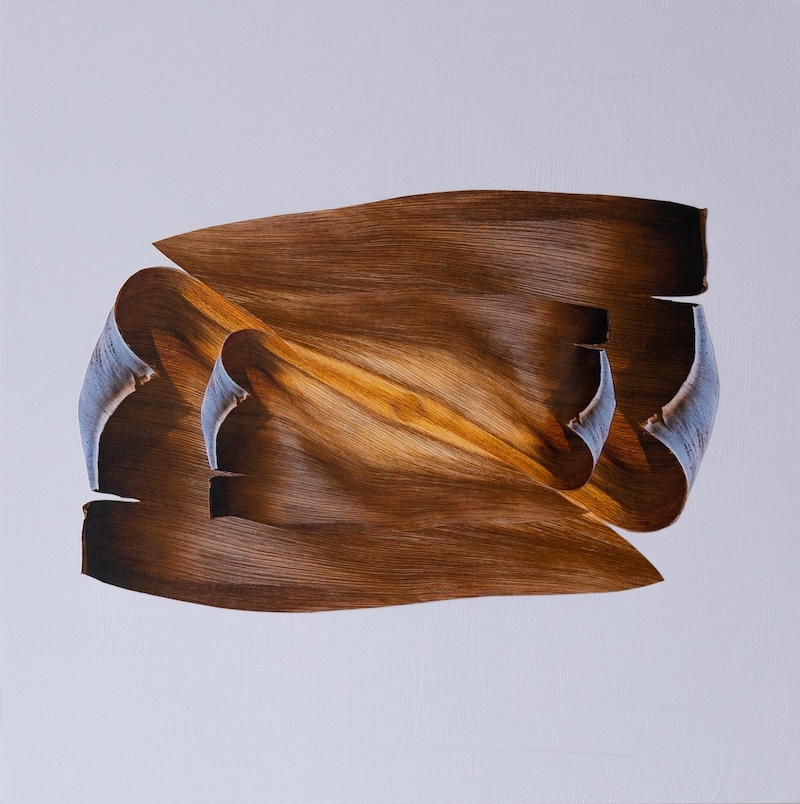
©Alysia Macaulay: Double Sheath Abstraction on Pale Lilac (2023) from the series Sheath Abstractions
As an adult living in New York City, raising a young family, I took advantage of my proximity to the International Center of Photography and would head to class after dropping my kids off at school. My passion for photography was once again rekindled, my ambition sparked, and my confidence as a photographer flourished.
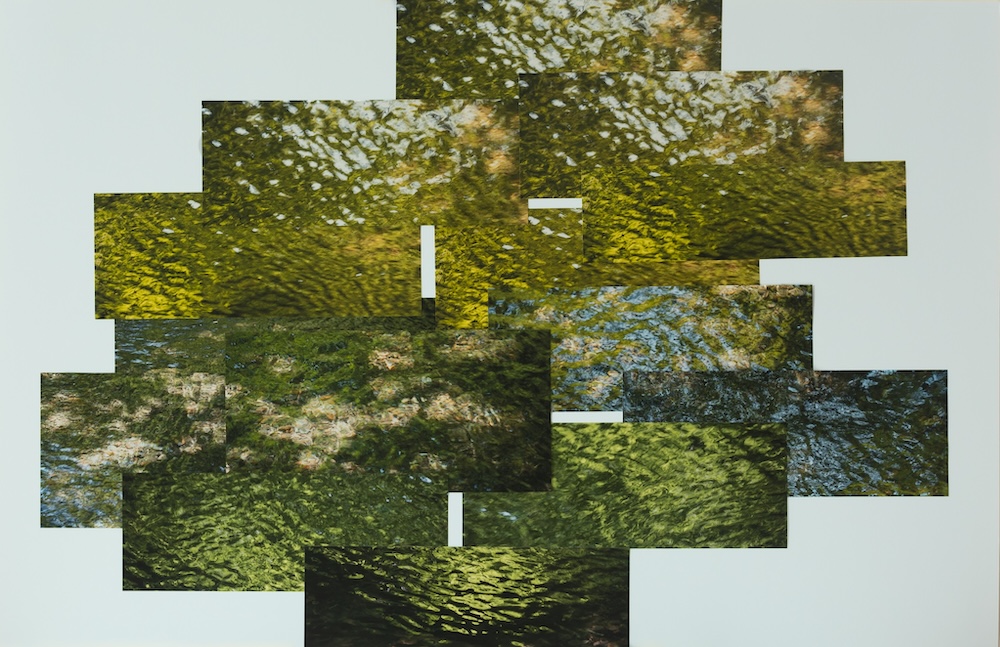
©Alysia Macaulay: Dorset Brook (2019) from the series Reshape and Reshuffle
DNJ: Water has played a large part in your work? Can you speak about that?
AM: Water is everything. It is light, movement, energy, color, time, connection, history, the touchable and the untouchable. For me water represents the past, present and future. It offers me a profound connection to those I have loved and lost, and time on and in the water has strengthened the bonds I have with those that I love and still have in my life. Water is everything.
From my summers swimming and sailing among the Greek islands to years of sailing in Boston Harbor and beyond with my father as a young girl, water has always played a pivotal role in the memories I hold closest to me. And I would be remiss not to mention that my husband, a life long sailor, brought me back to the water as an adult, and for that (and for him) I am eternally grateful.
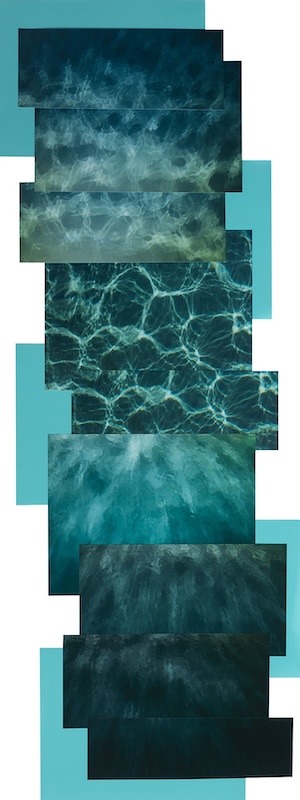
©Alysia Macaulay: Britt’s Pool (2019) from the series Reshape and Reshuffle
DNJ: Where do the ideas you work with come from? How do they influence each other if they do? Have any projects lead directly to the next one?
AM: Nature, natural elements, historic and familial context often play a key role in my work. I am a very visual person, constantly looking. I get excited about color combinations, angles and shapes, optical elements in art and light. And I tear-sheet constantly.
I love the last part of this question because every new body of work is inspired by the previous one. There is always a seed that is carried forward and then explored and nurtured in a new way.
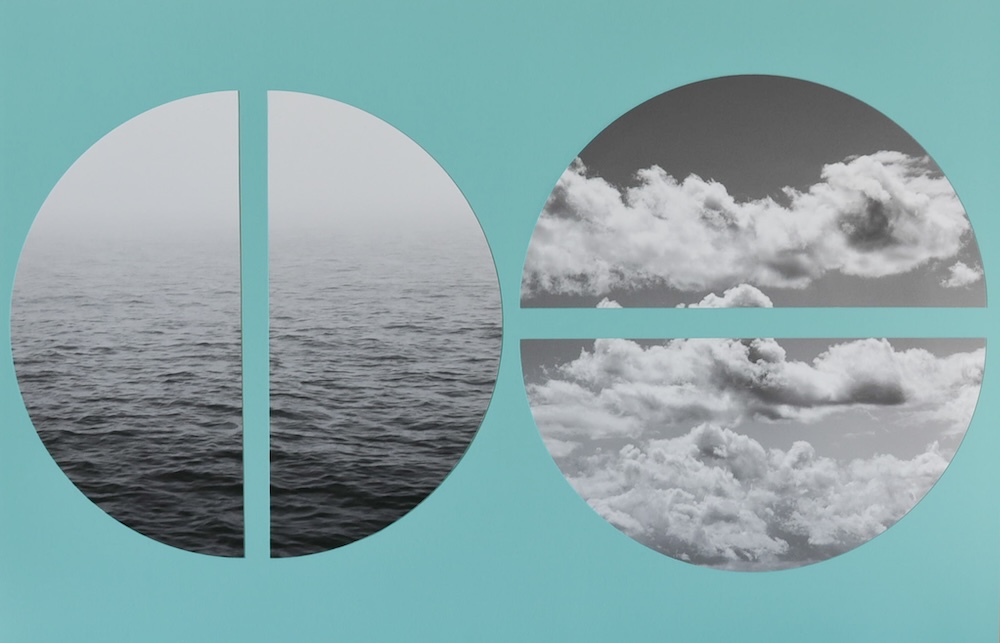
©Alysia Macaulay: Split Sea, Split Sky (2019) from the series Reshape and Reshuffle
DNJ: Over time, you have worked with different styles in photography. Do you always have a concept in mind when starting a project, or do you shoot and let the images guide you to what the project will be? How do you determine which process or style is best for any given project?
AM: I am a restless artist. At the completion of a body of work, typically after a dedicated year or so, I want to move on to a new project. My work and the mediums I incorporate are constantly evolving. I am self-taught with the various mediums to which I engage, with the exception of time spent studying photography at ICP, which was invaluable. When I have an idea of what I want to create, I then embark on a path of education and experimentation, to learn how to work with a new medium or combine two mediums in a unique way to achieve the end result I am after.
Travel is when I shoot the most. I will photograph whatever catches my eye with no specific vision in mind. I may have a rough concept to guide me, but that is ever changing. The images I shoot are at times fully composed, and others simply elements, components, visual fragments that I am drawn to. So in that sense, I let the images guide me when embarking on a new body or work. In terms of process and style, once I have settled on a visual concept, then I begin to play around with the images and mediums in my studio.
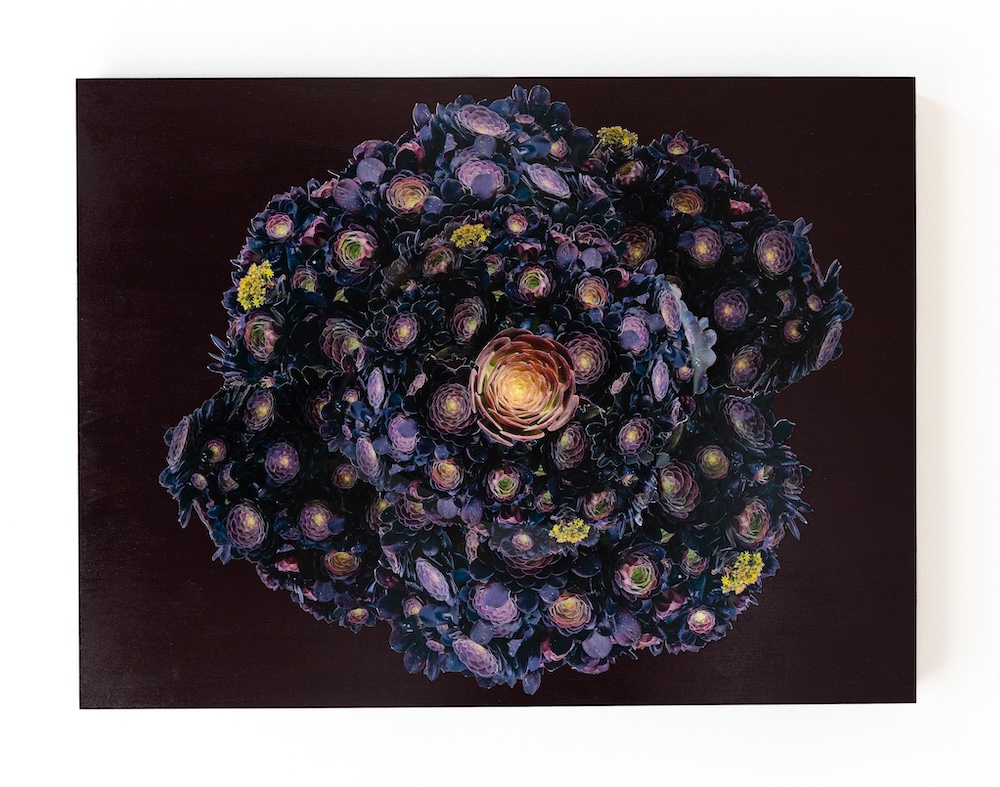
©Alysia Macaulay: Grecian Succulents (2023) from the series Anathasia
DNJ: Can you share your approach to creating the work? What do you do when encountering a period of creative block?
AM: I typically have a spark of an idea that I will ruminate on for a long time before experimenting in my studio, working to create what I see in my head. This too is my approach to working through a creative block. Stepping back and away from my studio let’s me stay open. I don’t search so much as always look and mull things over until I feel ready to dive in.
Once back in my studio I will work on the images, editing, cropping, digitally manipulating colors, printing, and cutting up or carving out the parts I want to incorporate in my work. And most importantly, I keep everything! What I cut away from an image is as important in the end as what I am carving out of the image. All of these components end up in my finished pieces.
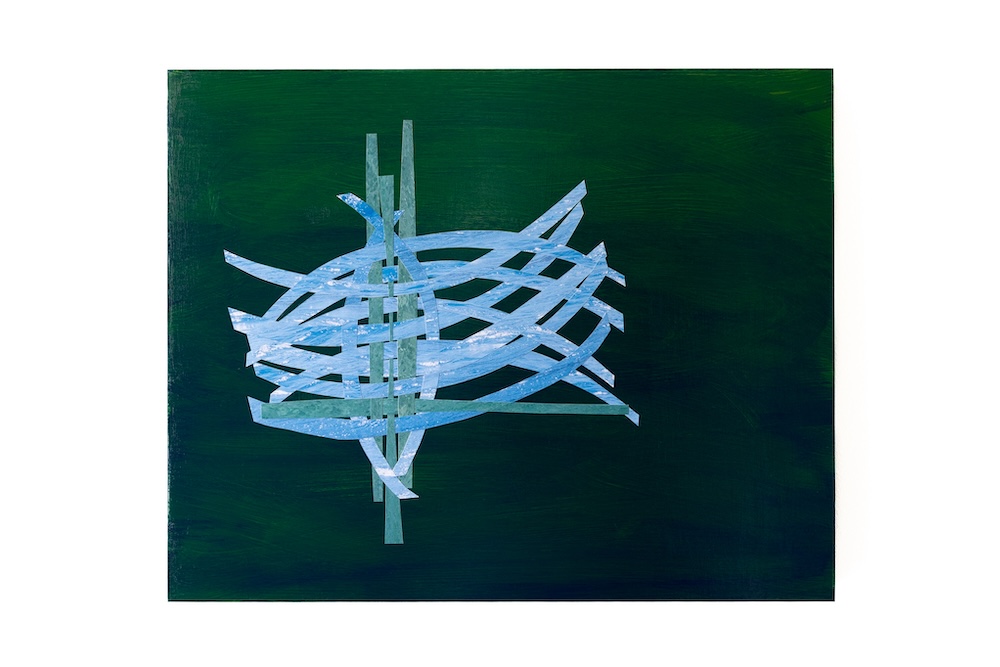
©Alysia Macaulay: Green and Blue Composition on Dark Sea Green (2023) from the series Anathasia
DNJ: What do you hope the viewer takes from your work? Does it vary by series? If so, how?
AM: As an artist you can never truly know or control what people experience when viewing your work. What is most important to me though is that the work carries not only archeological history and natural elements through imagery, but also evidence of intent and time behind its production. For the most part when I create work my initial concept is merely a jumping off point. Where the work ultimately lands is discovered through the process of breaking an image down and reworking the fragments, the end result is often entirely unexpected. As with my more recent works, the collaging process is a contemplation of the subject. So I hope that the viewer will take the time to not only absorb the overall visual experience, but also what makes it up, the elements that are dissected and rebuilt into a new form. There is a meditative quality to my work that I strive to convey to the viewer.

©Alysia Macaulay: Mellow Yellow I & II (2018) from the series Aiónios (Eternal)
DNJ: What is influencing your work lately?
AM: The process of art making is what ignites my creativity and propels me forward. Being open and unafraid to trust my instincts and explore new approaches ultimately pushed me in ways I never could have imagined.
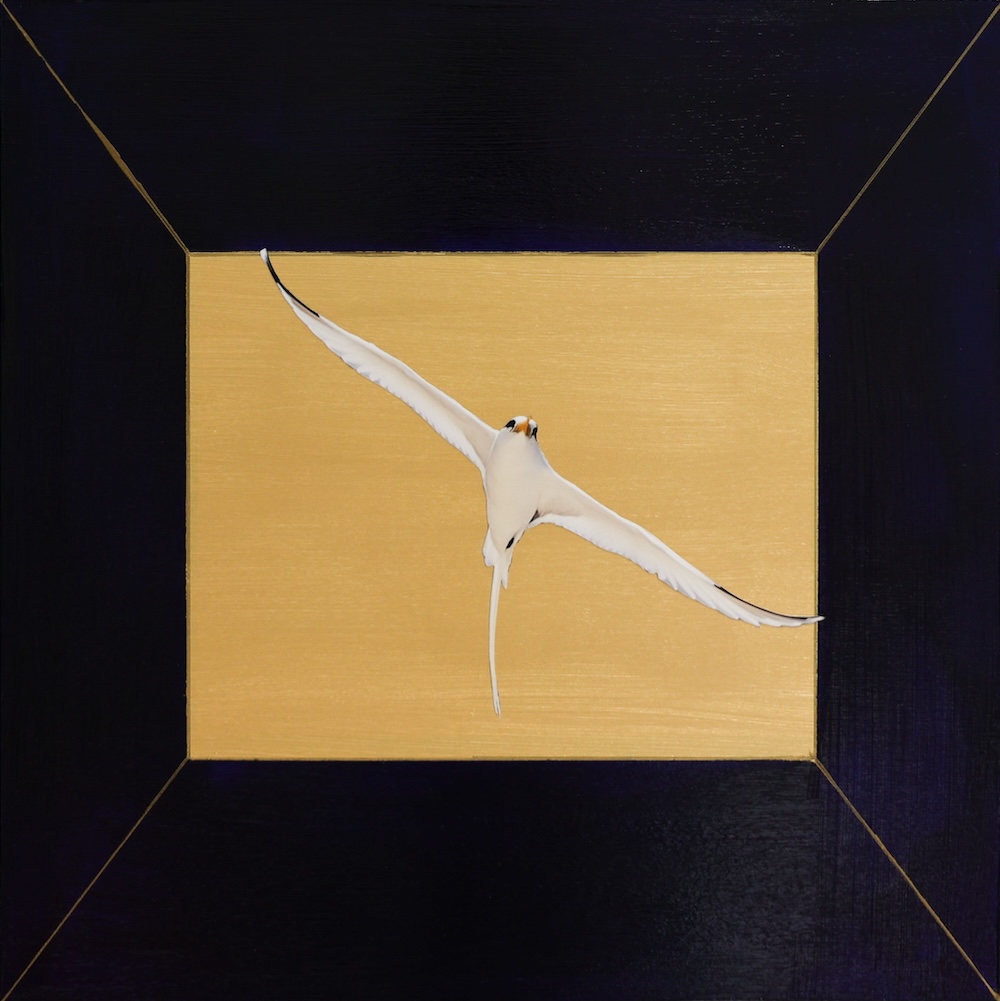
©Alysia Macaulay: Golden Cube (2022) from the series Bermuda Longtail
DNJ: Please tell us what you are working on now. What’s coming on the horizon for you?
AM: I am currently toggling between two different, yet related, bodies of work. The first one is an on-going project titled “Angel Oak” where I am creating collage works, at times incorporating linear elements, from the images I took of the Angel Oak tree in Charleston, South Carolina last winter.
The second body of work, as yet untitled, is the same medium described above, but with this one I am working with images taken during time spent in Greece this past summer. Cut-out cobblestones and water are playing an important role in this series so far.

©Alysia Macaulay, Murky, Mossy, Moody 2018 Aiónios (Eternal)
Thank you ever so much, Alysia, for taking your time to give readers this insight into you and your practice. I look forward to seeing your next series!
Posts on Lenscratch may not be reproduced without the permission of the Lenscratch staff and the photographer.
Recommended
-

Sandra Cattaneo Adorno: Light, Memory and the Everyday SublimeJune 25th, 2026
-
HANDMADE ARTIST BOOKS WEEK: Ryoko AdachiMay 28th, 2026
-

Cozette Russell in Conversation With Douglas BreaultMay 14th, 2026
-
McCall Hollister in Conversation With Douglas BreaultMarch 6th, 2026
-
Jonathan Silbert: InsightsFebruary 19th, 2026