Ellen Harasimowicz and Linda Hoffman: In the Orchard
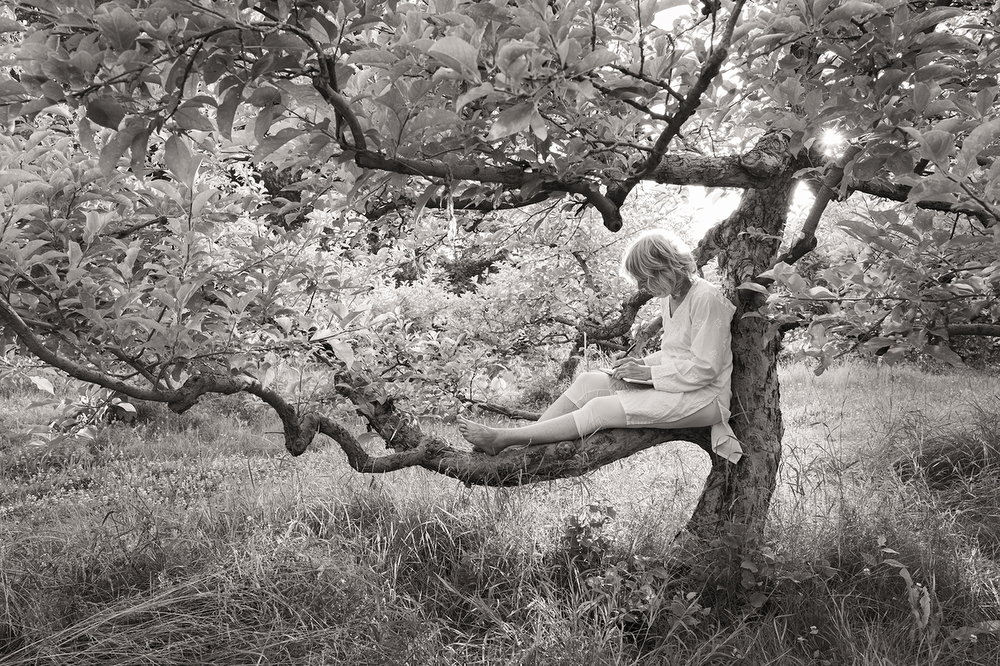
©Ellen Harasimowicz:, Old Frog Pond Farm
I have so appreciated Ellen Harasimowicz’s focus on the land, on farming, on beauty, and meaning. We featured her project, Living Like Grass, several years ago that was a poignant exploration focused on the life and last years of a family farm in Massachusetts. Today we feature Overheard in the Orchard, a collaboration between writer Linda Hoffman and photographer Ellen Harasimowicz. This hybrid artist book is a series of twenty-four conversations between a Golden Delicious tree and the orchardist over the course of one year. Harasimowicz photographed the trees, birds, and other creatures, while Hoffman wrote down the conversations. Christina Labey at Convey0r Studio designed the book.
An interview between the artists follows.
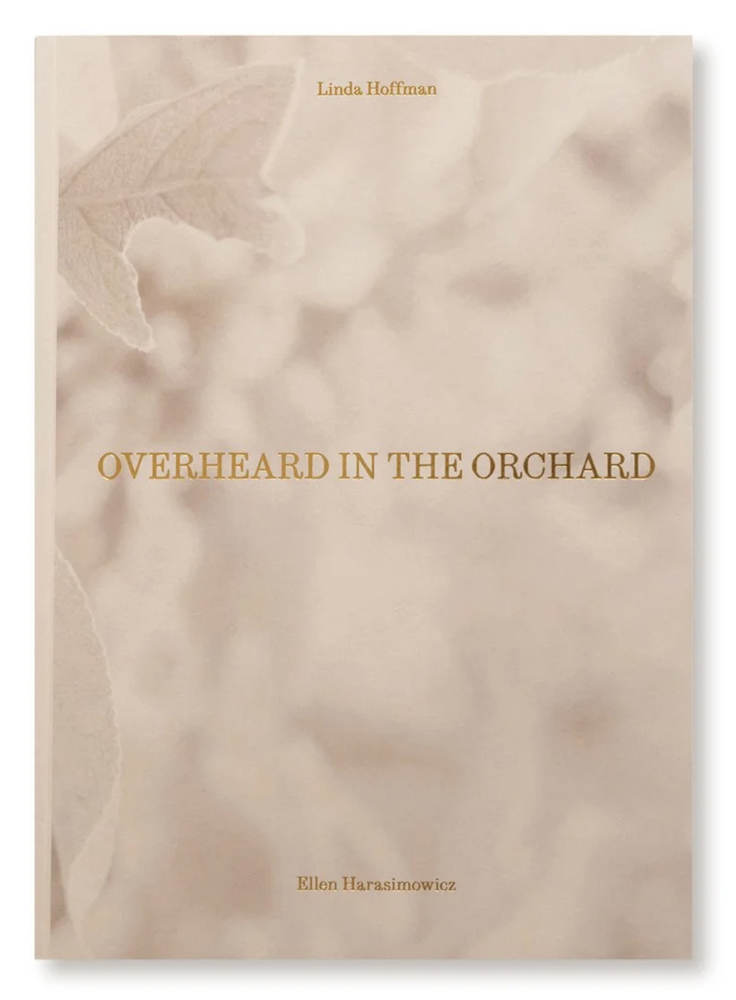
©Ellen Harasimowicz and Linda Hoffman, Cover of Overheard In the Orchard
I know a woman who talks to her Golden Delicious apple tree. And her tree talks back. Linda Hoffman is a writer, sculptor, and orchardist. We both live in Harvard, Massachusetts, a town well known for its many fruit orchards.
Our collaboration came about serendipitously when I approached Linda about photographing in her organic orchard at Old Frog Pond Farm, telling her I wanted to express the whole world through an apple. Seasonal patterns, the cycles of life, and the elements of attraction, reproduction, and immortality are all there in the apple. She told me about a project she had just started in the voice of one of her apple trees, and suggested we might create something together.
I spent a year wandering through Linda’s orchard, open to what might reveal itself through slow, careful observation. Everywhere, I saw poetry. Initially, my orchard images were in color, but after reading Linda’s early conversations, I knew my photographs needed to be more abstract, more elegant, to be in concert with her words. My orchard images became warm duotones, and with her words, they evoke the wisdom of the tree and the long relationship of humans and apples.
When we began this project, neither of us knew how our artistic threads might weave together. This shared experience has evolved into an abiding friendship, a deeper appreciation for the natural world, and a book titled Overheard in the Orchard.
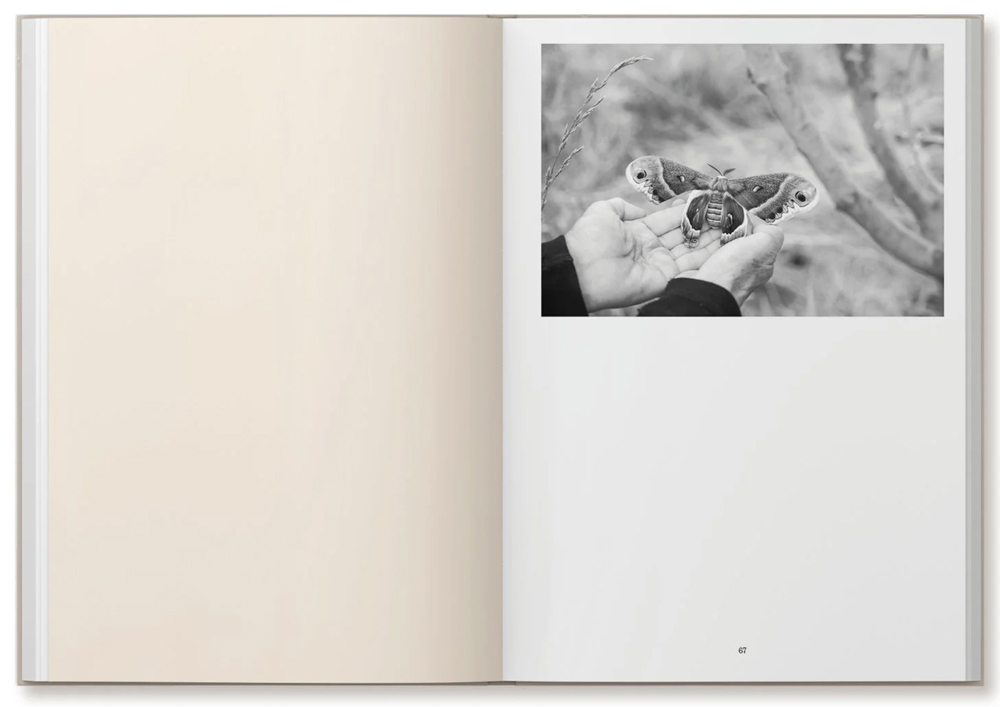
©Ellen Harasimowicz, Spread from In the Orchard
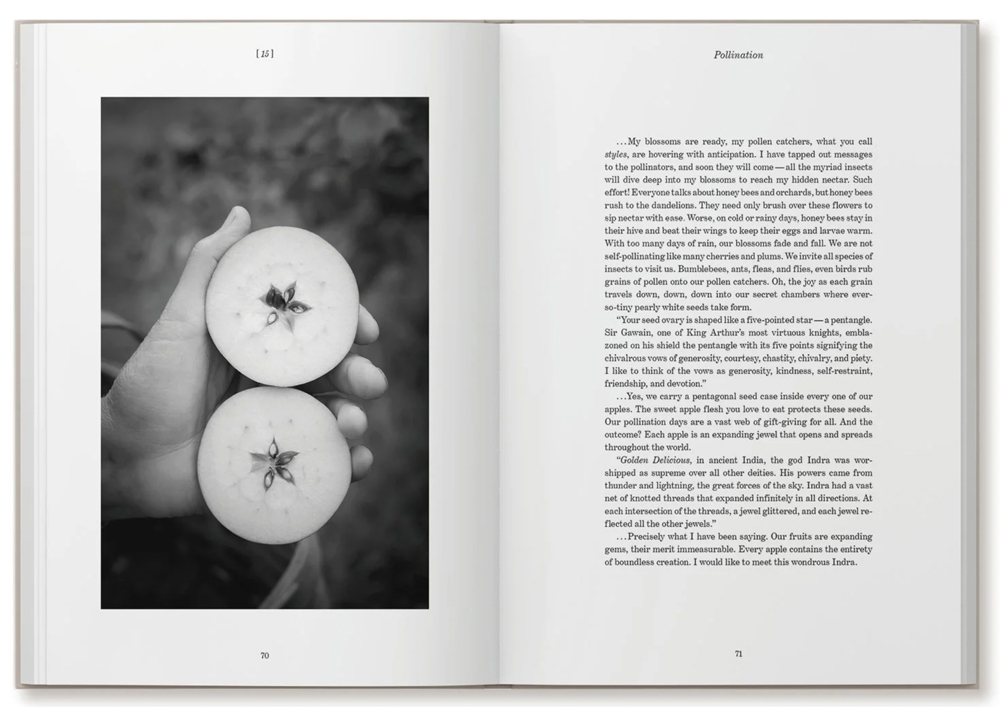
©Ellen Harasimowicz and Linda Hoffman, Spread from In the Orchard
Ellen Harasimowicz is a visual storyteller exploring themes of community and connection to our place in the natural world. She started her career in documentary photography, working primarily for the Boston Globe, and later specialized in education and NGO photography. Harasimowicz produced award-winning children’s books about nature with publishers Houghton Mifflin Harcourt, Henry Holt, Millbrook, and Charlesbridge. Assignments and personal projects have taken Harasimowicz to remote locations in India, Myanmar, Uganda, and Rwanda where she photographed ethnic groups living subsistence lifestyles. Harasimowicz believes that all beings are bound together, and we must take care of one another and our living land for the mutal benefit of all. In 2022, Harasimowicz received her MFA from Maine Media College.
Instagram: @ellenharas
An honors graduate of Bryn Mawr College with a degree in Fine Arts, Linda Hoffman studied at the Sorbonne and at the École Internationale de Théâtre Jacques Lecoq in Paris. Awarded a Thomas J. Watson Fellowship after graduating from college, she trained for two years in the Noh Theater in Kyoto, Japan.
A lifelong passion for poetry converged in 1981 with her work as a graphic artist in the form of her first sculpture, a poem in cloth, launching an extensive exploration of narrative sculpture incorporating language, natural fibers, wood, stone, and found objects. In 1997, she began using old agricultural tools to create lyrical and poignant sculptures decrying New England’s vanishing agricultural landscape. Represented in museums and private collections, Hoffman has public sculptures installed in towns and cities across the region.
A contributor to WBUR’s Cognoscenti, Hoffman was a founding editor of Wild Apples, a journal of nature, art, and inquiry. She is the author of three chapbooks of art and poetry, and the letterpress art book, Winter Air, created in memory of her mother, Dr. Annette Weiner.
In 2001, Hoffman and her three children moved into an old farmhouse with an abandoned orchard, Old Frog Pond Farm in Harvard, Massachusetts. Hoffman restored the orchard and it became the first organic pick-your-own orchard in Massachusetts. Now, with twenty years of experience growing organic apples, Hoffman contributes to a holistic apple growers’ forum, teaches workshops, and is respected by an influential holistic apple growing community.
Hoffman lives with her partner, Blase, his parrot, Orco, and friends who move in for a few days, weeks, or a season who are part of the farm’s growing creative and spiritual community. A Zen Buddhist, Hoffman leads mediatation three monrings a week in her studio. In 2021 The Artist and the Orchard: A Memoir, her first book was published by Loom Press.
Instagram: @lindahoffmanstudio
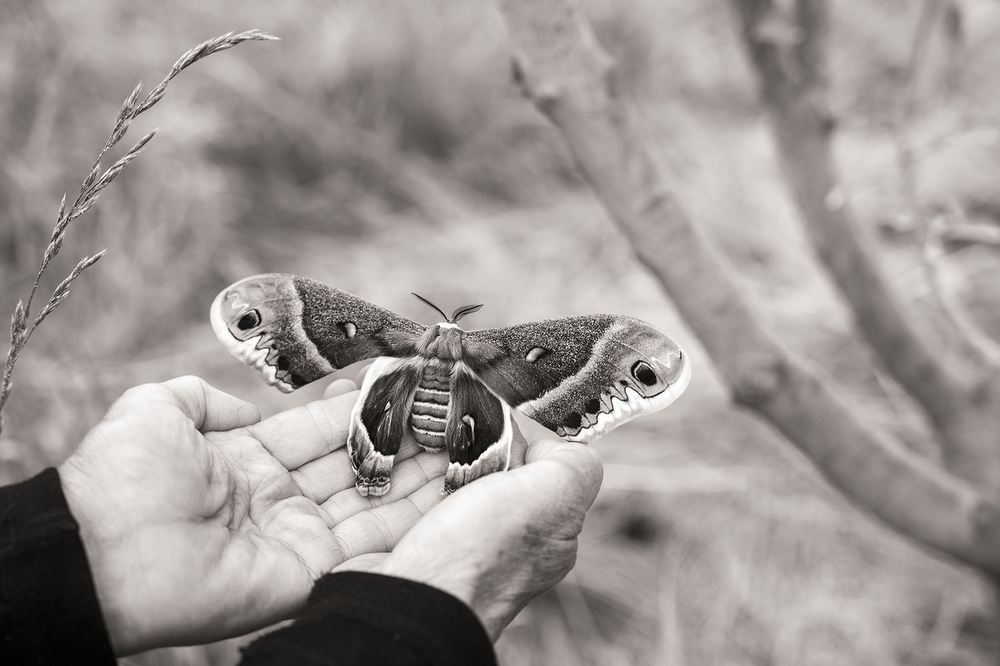
©Ellen Harasimowicz and Linda Hoffman, Spread from In the Orchard
Ellen: Tell us about your growing up and how you became a writer, sculptor, and orchardist?
Linda: After graduating as a Fine Arts major at Bryn Mawr College, I traveled to Kyoto, Japan where I absorbed the Japanese traditional aesthetics of simplicity, beauty, and the patina of age. Upon returning to the states, I began an extensive exploration of narrative sculpture using reclaimed tools, fibers, wood, stone, and found objects with poetry influenced by the Zen poets. In 2001, I left a long marriage to Paul Matisse, grandson of Henri Matisse, and moved with my three children to a rundown farm with an abandoned orchard in Harvard, Massachusetts. I didn’t know anything about apples, but decided I would bring the orchard back and do it organically, although everyone I mentioned this to said, “Oh, that is really difficult.” In bringing back the abandoned orchard and grafting new varieties onto old trees, I grafted a new life. The farm grew to welcome a community of writers, artists, farmers, and spiritual seekers as I became an apple grower.
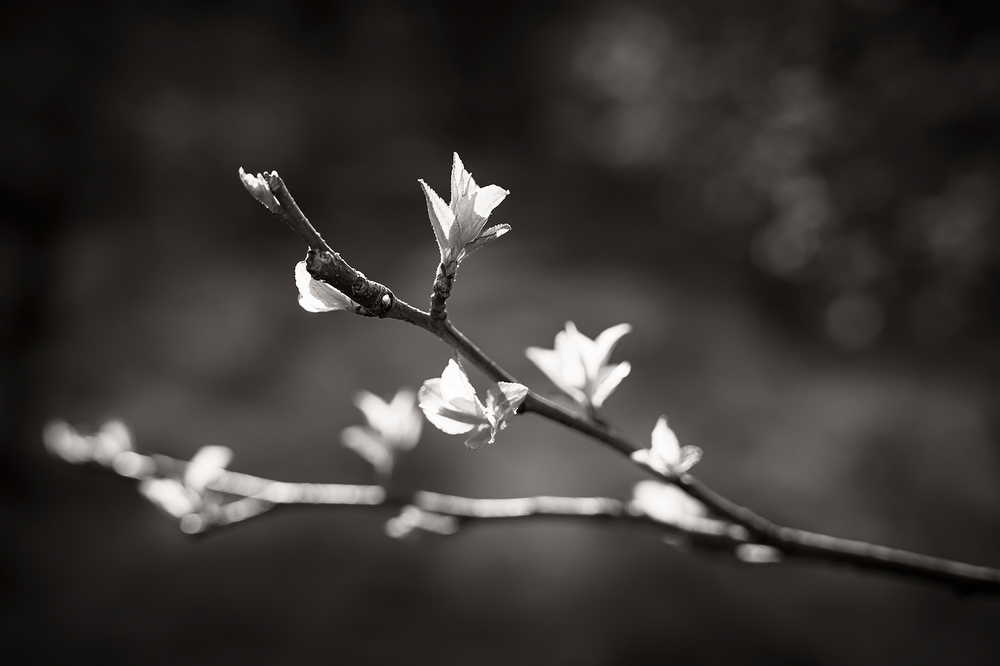
©Ellen Harasimowicz and Linda Hoffman, Spread from In the Orchard
Ellen: What inspires you?
Linda: I am in awe how trees take care of each other. Mostly they connect through their roots. If a tree needs a nutrient, they share. If they do not have it, they alert another tree to the need. Trees release scents to keep pests at bay and always help weaker trees defend themselves. I am most inspired by their resilience and compassion. Despite the drought, the loss of habitat, disregard by many people, trees respond by always giving, always growing as well as they can.
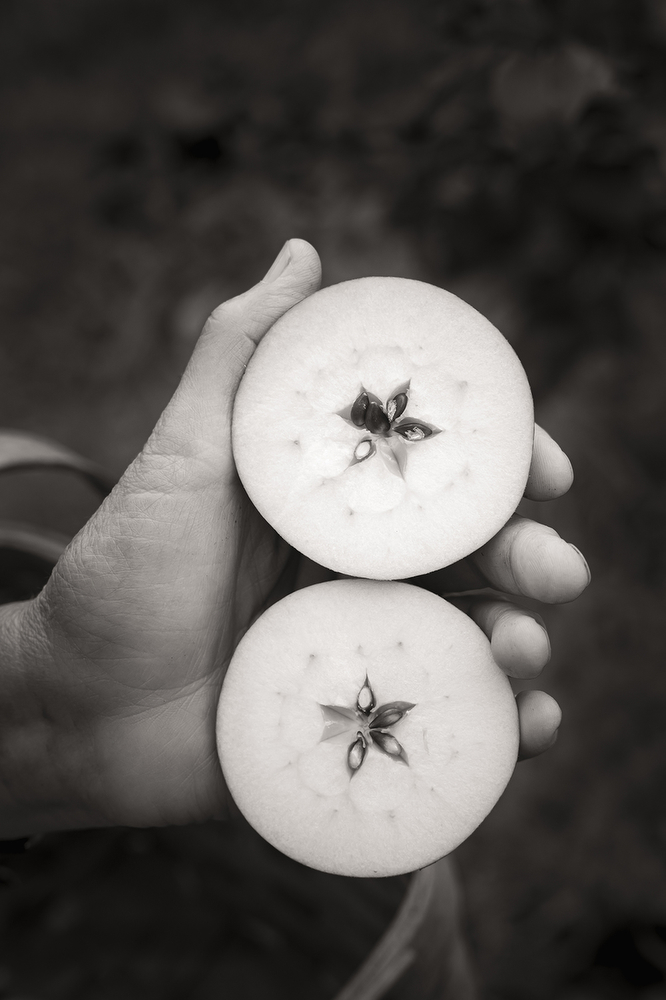
©Ellen Harasimowicz and Linda Hoffman, Spread from In the Orchard
Ellen: What did you take away from our collaborative project?
Linda: I started this project, Overheard in the Orchard, as a series of conversations between one Golden Delicious tree and their orchardist, because I wanted to explore my concerns for our fragile planet by listening closely to the wisdom of a single apple tree. When you stopped by the farm and wondered if you might photograph in the orchard, I knew very quickly there was going to be even more to this collaborative project. We worked with each other, with language and image, with the seasons and the creatures, with wind and rain, the heat and the cold, and our shared love for apples and the New England landscape to create a book that takes the reader into the orchard, among the trees, inside the buds, up close with the pests, and finally to taste the fruit. I could never have done it alone.
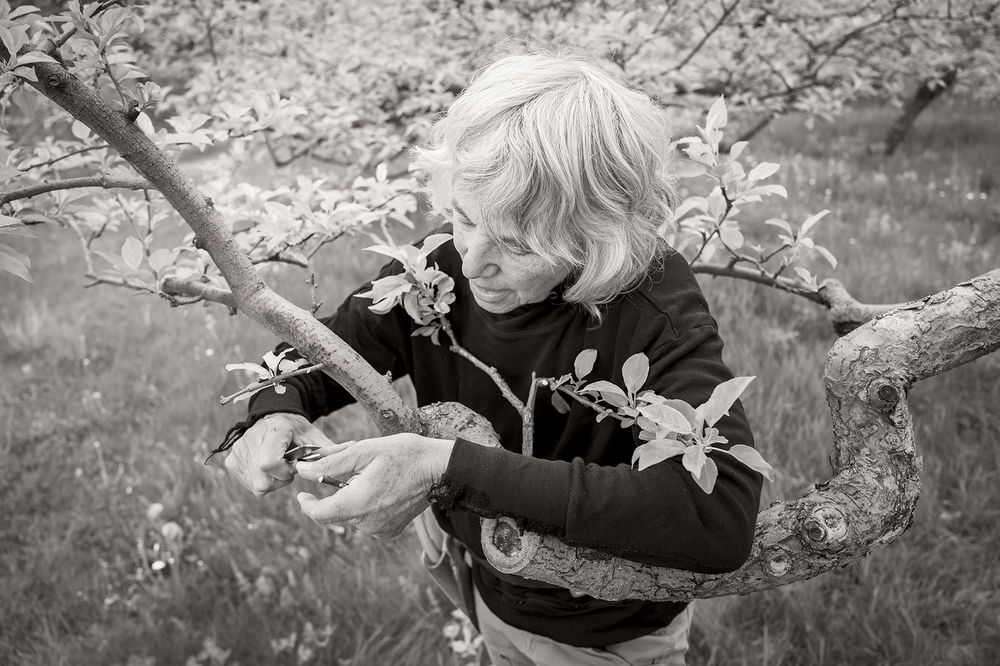
©Ellen Harasimowicz and Linda Hoffman, Spread from In the Orchard
Ellen: What have you learned from trees?
Linda: I have learned the importance of a chill time for apples trees. Without these cold hours, the fruitbuds may not open and the fruiting will be haphazard. Slowing down prepares the buds for flowering. Silence concentrates vigor. A good long chill produces a more bountiful crop. I have learned patience and to wait and not respond too quickly when there is a problem. I have learned that no matter what I think I know, there are vast, intricate, and beautiful unseen ways that nature responds to the impermanent nature of reality.
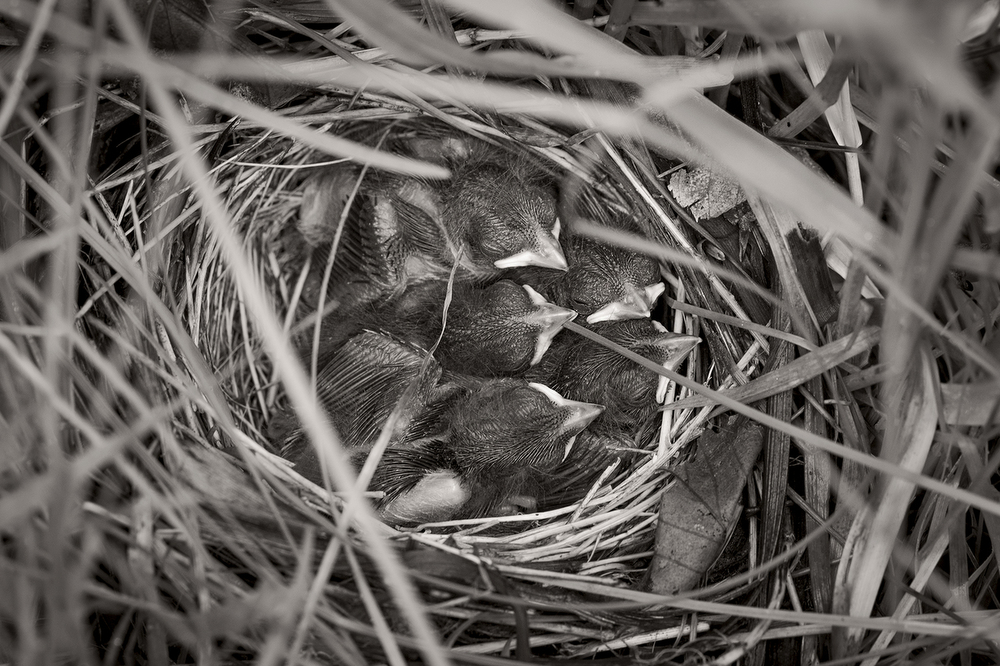
©Ellen Harasimowicz and Linda Hoffman, Spread from In the Orchard
An exerpt from the book Overheard in the Orchard:
winter pruning
. . . I have an orchardist. My twig tips constricted the first time she climbed to the crown of my canopy and pulled her saw from its leather scabbard. Her blade pressed my bark. And then came the rasp as she pulled and pushed, back and forth, through sapwood and into my denser hardwood. It seemed the sawing would never end, until with a great thud, a large branch fell to the ground.
. . . After a few more cuts and clips, she finished, stood back, and gazed attentively. She said, “This is a beautiful tree.”
. . . She has returned to prune ever since, and often with a friend. Now when they arrive in midwinter, saws at their sides and long-handled loppers in hand, my branches relax. Walking round and round my trunk, they study every branch, contemplating structure and height. They prune to encourage clear direction for my spring growth.
. . . A fast growing branch often shades lower branches. A branch without sunlight will wither and die. My orchardist and her friend remove what no longer serves, make room for the new, and create openings for sunlight to ripen my fruit. Without their pruning I could become off-kilter, grow so far in one direction I might lose my way.
. . . When they are finished pruning they step back, she says as always, “This is a beautiful tree.”
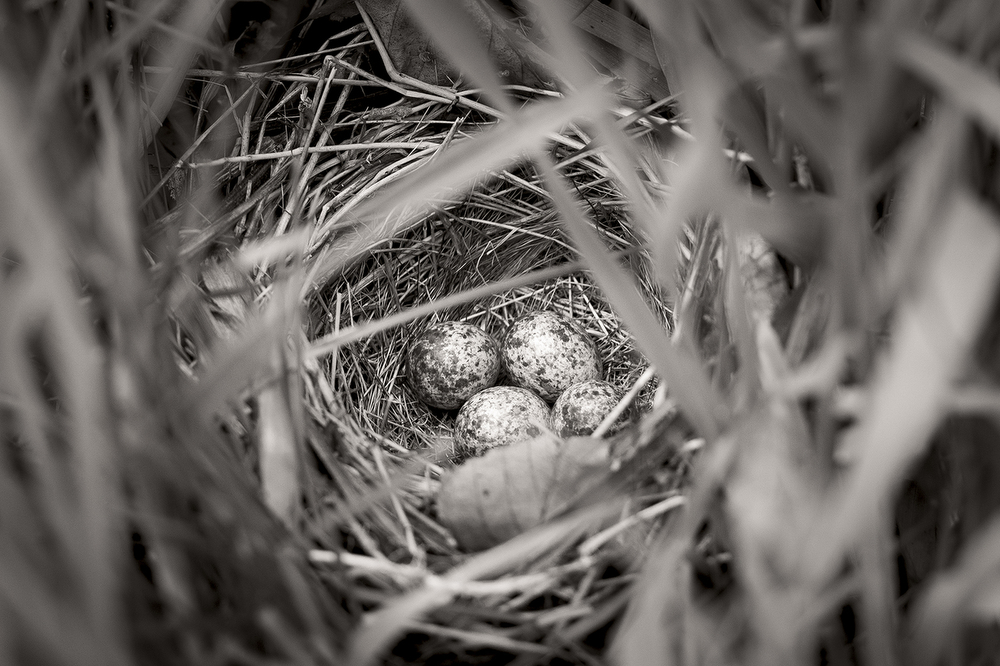
©Ellen Harasimowicz and Linda Hoffman, Spread from In the Orchard
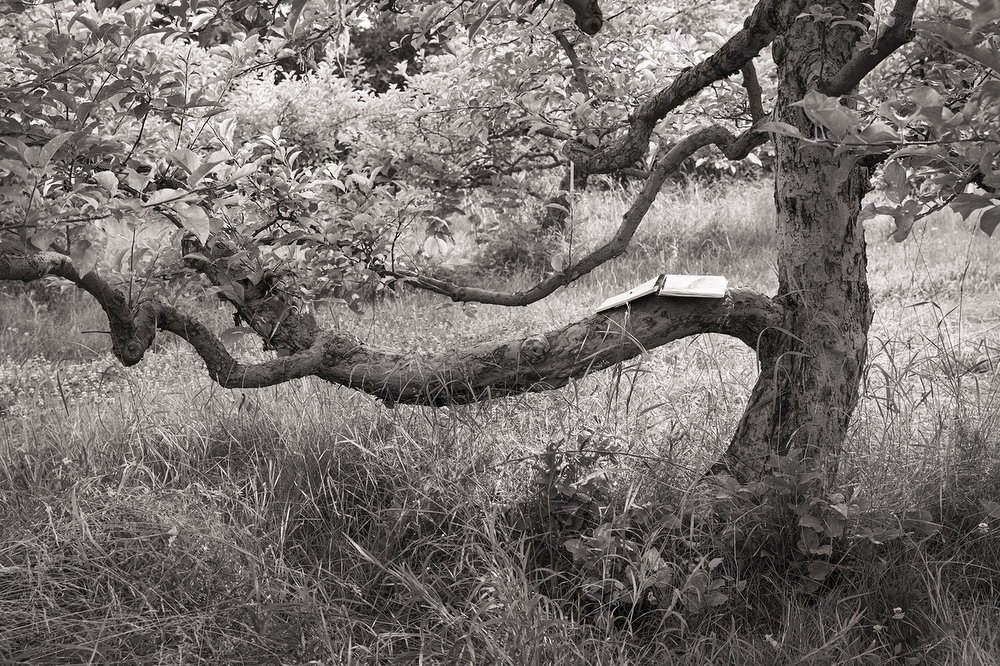
©Ellen Harasimowicz and Linda Hoffman, Spread from In the Orchard
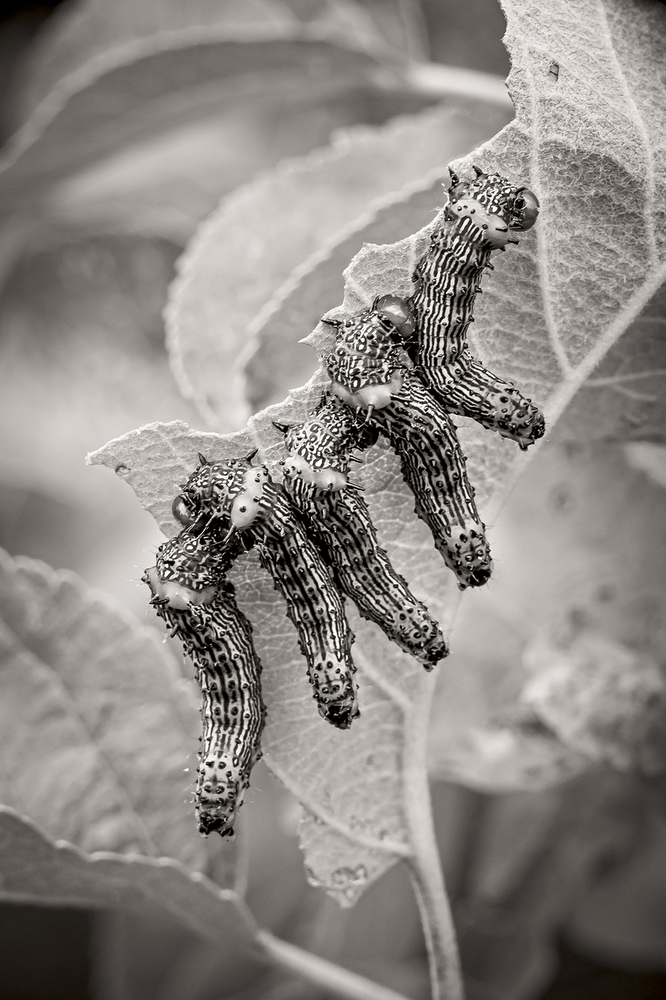
©Ellen Harasimowicz and Linda Hoffman, Spread from In the Orchard
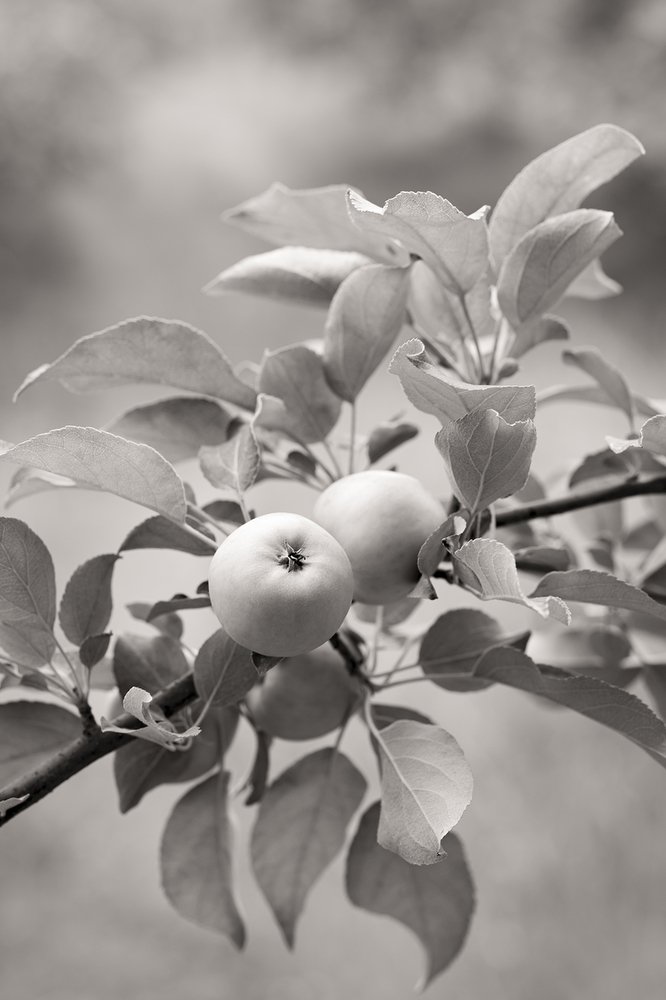
©Ellen Harasimowicz and Linda Hoffman, Spread from In the Orchard
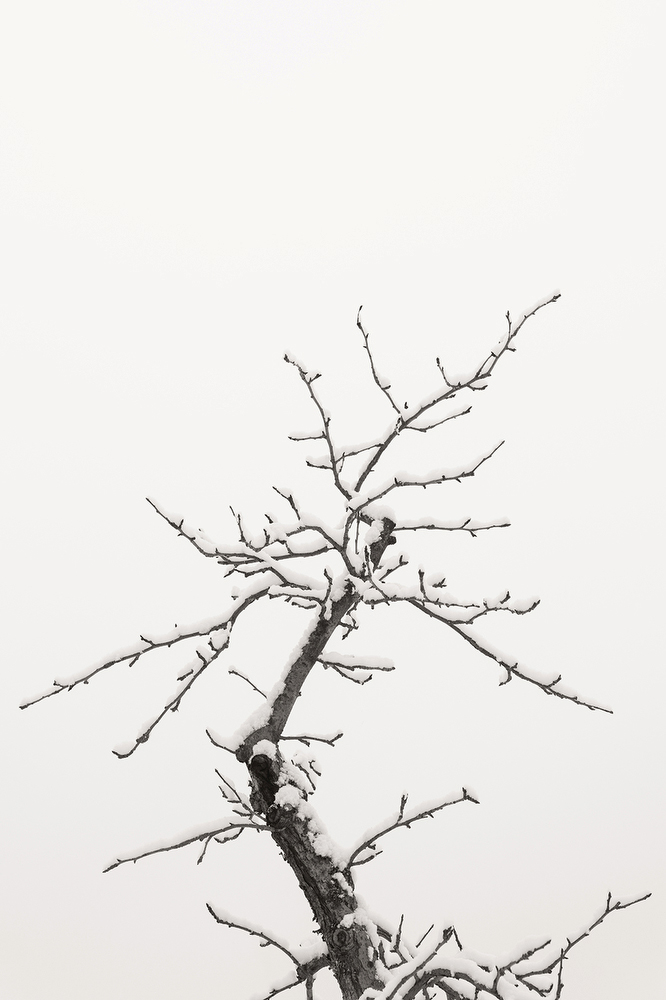
©Ellen Harasimowicz and Linda Hoffman, Spread from In the Orchard
Posts on Lenscratch may not be reproduced without the permission of the Lenscratch staff and the photographer.
Recommended
-
Zackery Hobler: Beneath Two SkiesJuly 20th, 2026
-
Danielle L Goldstein: TransienceJuly 19th, 2026
-
Laurie Lambrecht: tēxēreJuly 17th, 2026
-
Daniel Dorsa : To Skip A Sinking Stone : In Conversation with Tracy L ChandlerJuly 16th, 2026
-

Nick Meyer: Good BonesJuly 8th, 2026