The CENTER Awards: The Editor’s Choice 1st Place/Director’s Choice 2nd Place: Noelle Mason
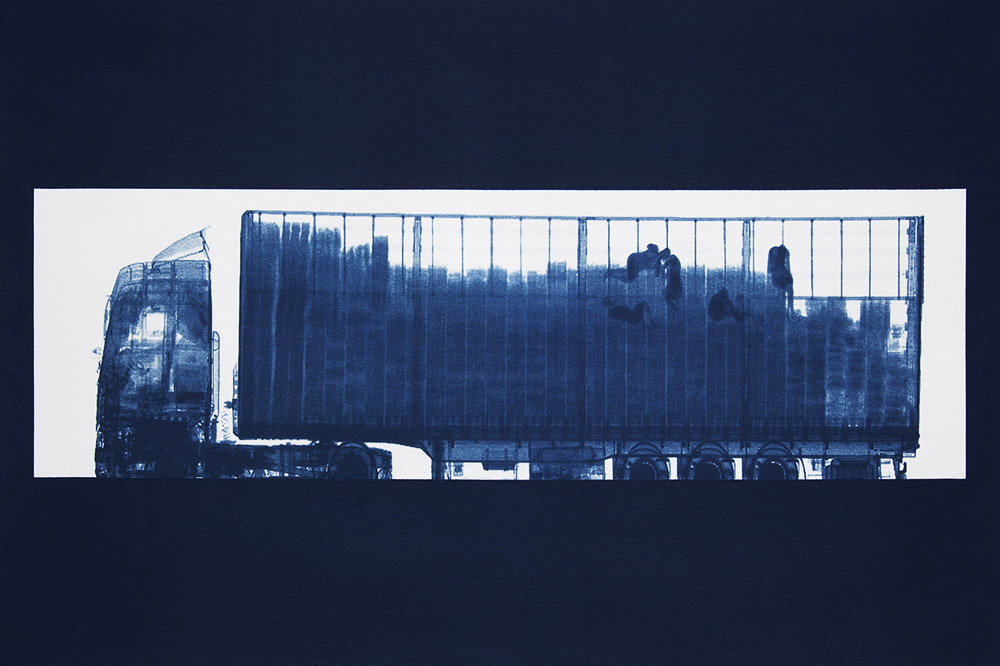
©Noelle Mason, Backscatter Blueprint (Los Tristes)/ Cyanotype on Watercolor Paper (18″ x 24″)
Congratulations to Noelle Mason for her First Place win in CENTER’s Editors’s Choice Award AND her 2nd Place win in CENTER’s Director’s Choice for her project, X-Ray Vision vs. Invisibility. The Choice Awards recognize outstanding photographers working in all processes and subject matter. Images can be singular or part of a series. Winners receive an opportunity to be part of the Winners Exhibition at El Museo Cultural de Santa Fe, complimentary participation and presentation at Review Santa Fe for the 1st place winner in each category, and an Online exhibition at VisitCenter.org
The juror for the Editor’s Choice Award, Nicole Werbeck – Senior Supervising Editor for Visuals and Engagement, NPR shares her insights:
Coronavirus. I would have never imagined. The global pandemic fully gripped the world during the time I was judging this Award. It’s hard to believe, I was more focused when I was considering everyone’s entries. But I was looking for an escape. Each piece of work I consumed was a respite from our new normal. I want to thank everyone who entered the contest. Your photography provided me with a light during a difficult time. Remember that what you do matters. During this health crisis, people turned to art and photography for relief, comfort and guidance.
For me, photography has always been a powerful tool that inspires and empowers people. And that is what I found the hundreds of entries that I reviewed. I was impressed by the field overall. It was really difficult to just pick 3 entries. Not only was there a wide variety of topics covered from aging and climate change, I was particularly struck by the different ways photographers and artists are using photography. And the variety of emotions that were triggered for me by these projects.
X-Ray Vision vs. Invisibility made me stop in my tracks. I found this to be an intriguing way to raise awareness around border issues and immigration. The cyanotypes and imagery were a departure from many of the other entries I was seeing. This artist takes experimentation, creativity and innovation to a new level. Through her artistic interpretation, I was able to think more deeply about how people are sacrificing to find a better life.
The Juror for the Director’s Choice Award, Rubén Esparza, Independent Curator; Founder and Director, Queer Biennial shares his insights:
I was impressed by the quality and diversity of work—it was truly difficult to select top-tiered work. I made new discoveries that I will follow and explore.
My own personal criteria for discerning art and photography is to look at work that represent technical and aesthetic shifts from what is already out there; a new take or observation of the zeitgeist, the sociopolitical, and cultural pronouncements. The work that I selected touches on these points. These particular works of art (photography) shine a light on people living in the margins of communities and are usually maligned and, or scapegoated. To focus on these subjects is to acknowledge them and to speak truth to societal ills.
Work that mostly focuses on clever composition and color imaginations is much appreciated, but not enough for highlighting at this particular juncture.
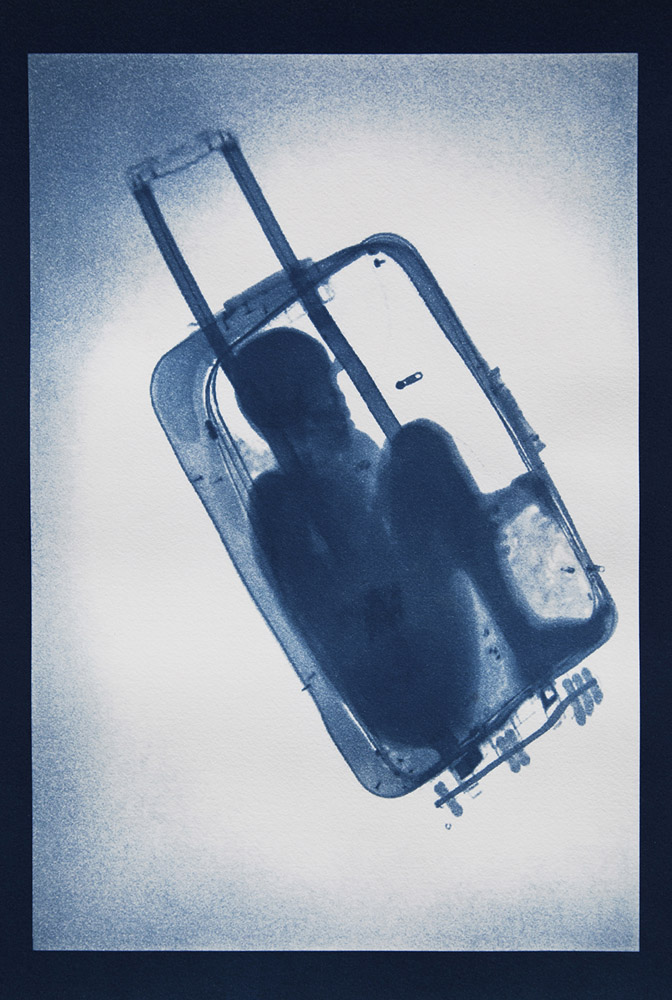
©Noelle Mason, Backscatter Blueprint (La Maleta)/ Cyanotype on Watercolor Paper (18″ x 24″)
Nicole Werbeck is currently a Senior Supervising Editor for Visuals and Engagement at NPR. She is in charge of the photo and multimedia editors. And runs the engagement and social media teams for the radio network.
Nicole was a Senior Digital Photo Editor at National Geographic. While there, Nicole assigned and edited photo and multimedia stories from across the world to publish online and in their magazine, and helped run NatGeo’s social media accounts. Nicole worked with veteran National Geographic photographers and editors as well as recruited new photographers into the fold. Nicole helped bring Agile methodologies into the NatGeo newsroom and worked as a multimedia coach for the Society’s grantees and explorers.
Nicole spent 10 years as an editor at The Washington Post. Nicole was a Project Editor, Photo Editor, and Deputy News Editor. She worked on a variety of important stories, from the September 11, 2001 attacks to Hurricane Katrina.
Rubén Esparza (Founder, Queer Biennial) is an artist and independent curator based in Los Angeles. Esparza’s studio practice spans painting, drawings, and photography, mixing it with elements of Conceptualism, ethnicity and Queer Culture. His curatorial work focuses on under-represented artists primarily in the queer and ethnic communities. His work is included as part of the permanent collections of the Los Angeles County Museum of Art, Museum of Contemporary Art San Diego, the Santa Barbara Museum, National Museum of Mexican Art, Chicago, Illinois, among others.
He has created events and curated exhibitions across the United States, Latin America, and Europe. Esparza is the Founder and Director of the Queer Biennial anchored in Los Angeles, with satellites in New York, Mexico, Miami, Paris, Tel Aviv. and Zürich. He has curated exhibitions at the Ace Hotel/LA, Coagula Curatorial/LA, Industry Gallery/LA, Navel/LA, and the San Diego Art Institute.
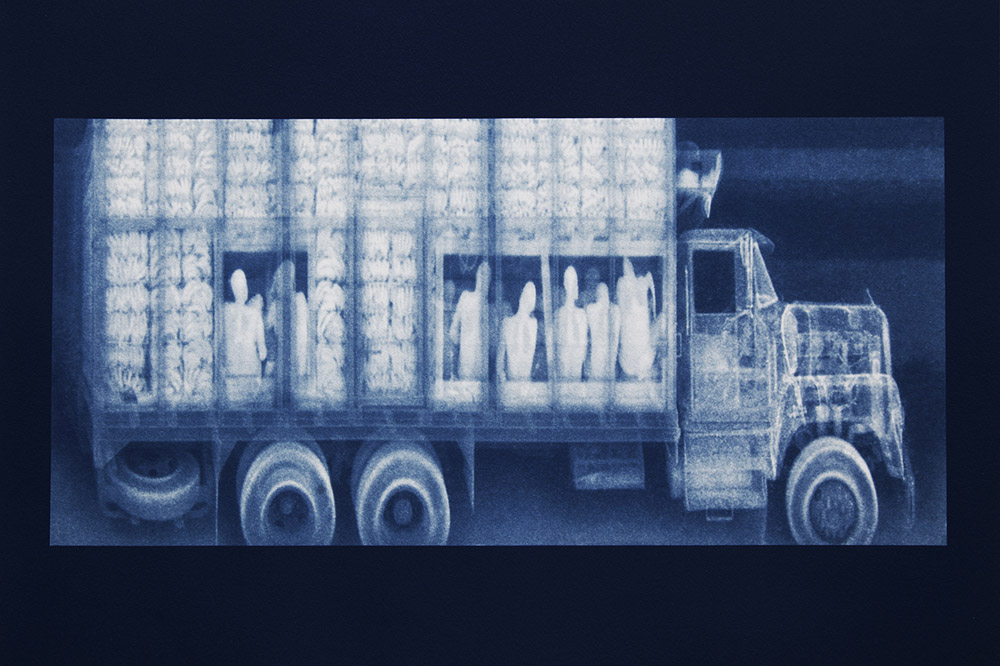
©Noelle Mason, Backscatter Blueprint (Los Bananos)/ Cyanotype on Watercolor Paper (18” x 24”)
X-Ray Vision vs. Invisibility
“X-Ray Vision vs. Invisibility” is a body of work about the phenomenological effects of vision technologies on the perception of undocumented migrants and refugees. This body of work includes three series that remediate digital images made by machine vision used to patrol international borders into historic craft processes. The translation from digital to analog processes is intended to expose how new vision technologies recycle Cartesian modes of viewing and in so doing reinforce a neocolonial worldview historically embedded in digital imaging.
“Backscatter Blueprint” is a series of cyanotypes that reproduce images of trucks taken using a backscatter x-ray machine, tying this new type of digital imaging to the historical processes of image making developed at the beginning of the modern period. The cyanotype process, having been used to reproduce architectural plans resonates with the elevation-like imagery that the backscatter machine produces, images that reveal a jarring tension between the mechanical trucks and their human cargo.
“Coyotaje” is a series of cotton x-stitcheries that depict infrared images of undocumented immigrants crossing the US/Mexico border illegally. Using a computer program the digital files were translated into counted x-stitch maps, and then hand embroidered each stitch representing a single pixel of the original image.
“Ground Control” is a series of hand woven wool tapestries that reproduce images of the US/Mexico border at places of conflict taken by a satellite mounted thermal emission and reflection radiometer. Each work in “Ground Control” was hand woven in Mexico for the amount of money it costs a family of four to cross the US/Mexico border illegally thus transforming the reproducible virtual image into a carefully constructed unique object.
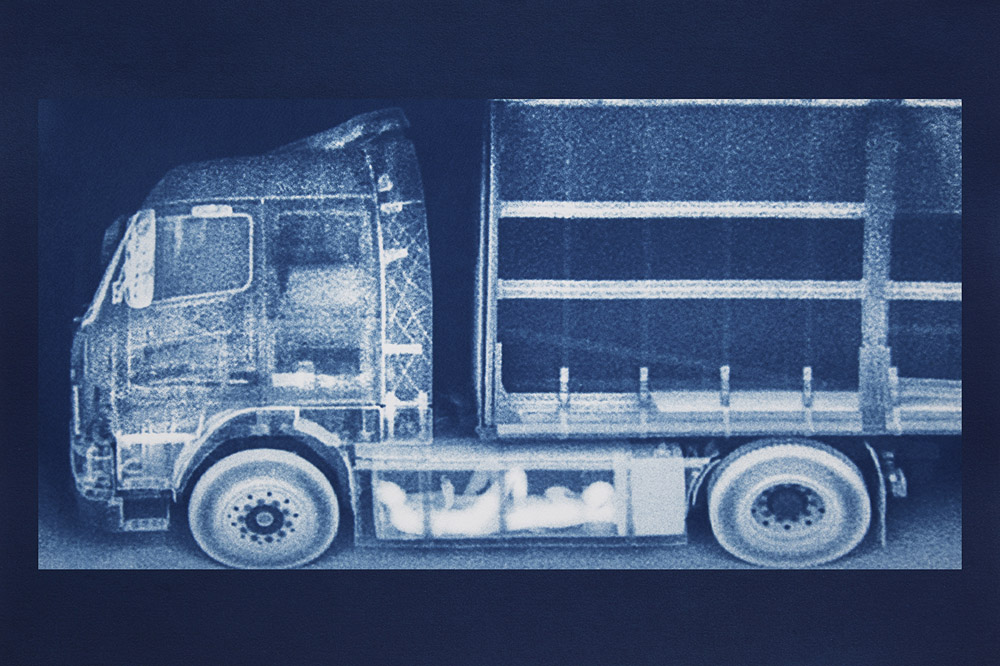
©Noelle Mason, Backscatter Blueprint (Olympia)/ Cyanotype on Watercolor Paper (18” x 24”)
Noelle Mason’s portfolio, “X-Ray Vision vs. Invisibility”, dramatically makes evident the powerful invasive capabilities of technology today. The technology used is x-ray, thermal, digital imaging and satellite imagery that Mason acquired from the US Border Patrol, Minutemen and commercial security sites. She has converted these images into cyanotypes, hand-woven wool Gobelin tapestry rugs (she calls “Ground Control”) and cotton “x-stitcheries”, or “Coyotaje”, as she refers to them. Her social documentary style of expression deals with undocumented immigrants trying to enter the United States illegally.
Mason’s cyanotype images invite the viewer into an unreal twilight-type zone we don’t want to believe exists. She refers to these as a “Backscatter Blueprint”. The images are obtained from a backscatter x-ray machine, a new form of digital imaging. The technology is similar to the full-body scans used at airports for passenger screening. Each blue-toned image is a skeleton-like outline of a truck in which we clearly see chalk-toned ghost-like bodies hidden away. The figures are unnatural looking, not of this world, even though each figure represents a living, breathing person. The figures are standing, bending, sitting and lying. They are in tightly packed groups or alone in different sections of a truck. Some of the trucks are long, some smaller, but all arranged to hide the human cargo.
Mason uses other media to communicate with the viewer. In “Ground Control”, Mason created hand woven wool Gobelin style tapestry rugs that reproduce satellite images of the US/Mexico border locations where illegal crossing occurs. A Gobelin style tapestry is a reference to the famous 15th century French dye and cloth makers. The rug tapestry gives the viewer a different way to engage with photography-based art by walking over it, just like the satellites passing overhead watching our own movements, not just theirs.
The satellite images contrast the US-Mexico border. Depicted are a city of 100,000, on the US-Mexico border, Mexicali/Calexico, through which thousands of people cross back and forth between countries each day. The rug image contrasts the agricultural richness on the US side with the much more barren Mexican side. It engages the viewer to think about what they are looking at, and why different zones on the rug are one color or another, and to ask – why this area? What is special, important or happening in this location that Noelle Mason looks for the time and energy to seek out publicly available information and present it to us in this format?
Mason also created cotton x-stitcheries she calls “Coyotaje”. The word “Coyotaje” is a reference to the operators that smuggle people illegally across the US-Mexico border. An “x-stitch” is a type of stitching pattern. Mason says: “Coyotaje is a series of cotton x-stitcheries that depict x-rays and infrared images of undocumented immigrants crossing the US/Mexico border illegally. Using a computer program the digital files were translated into counted x-stitch maps with each stitch representing a single pixel of the original image. These are strong political statements, permanently presented, forcing us to see and reconcile what we and our government actions have become.
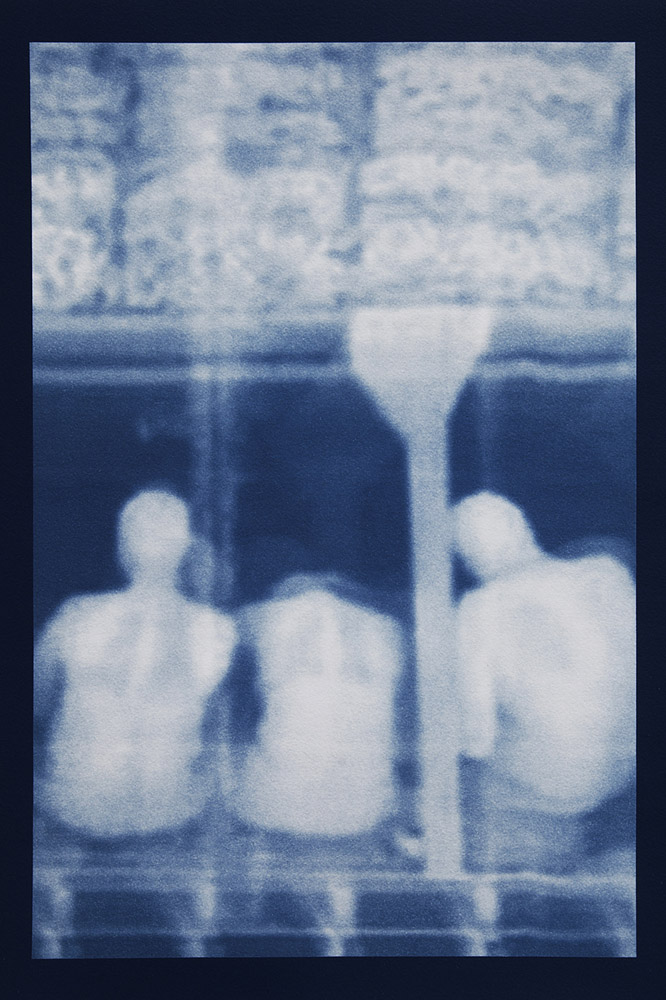
©Noelle Mason, Backscatter Blueprint (Las Tres Gracias)/ Cyanotype on Watercolor Paper (18” x 24”)
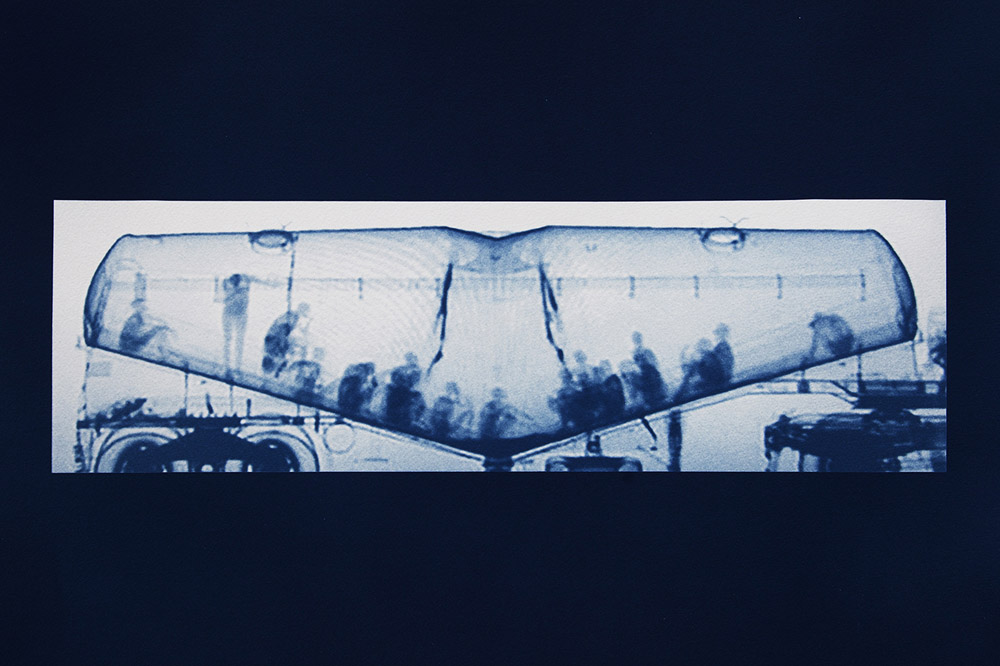
©Noelle Mason, Backscatter Blueprint (Man at the Crossroads) / Cyanotype
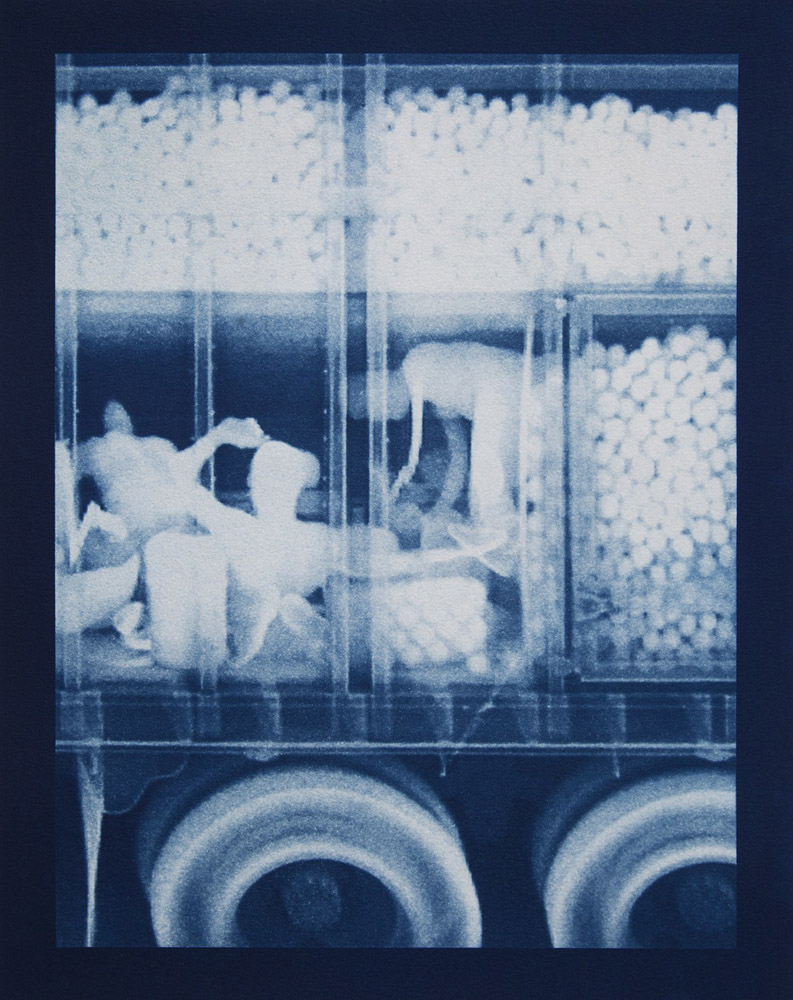
©Noelle Mason, Backscatter Blueprint (Un dimanche après-midi) Cyanotype (16” x 22”)
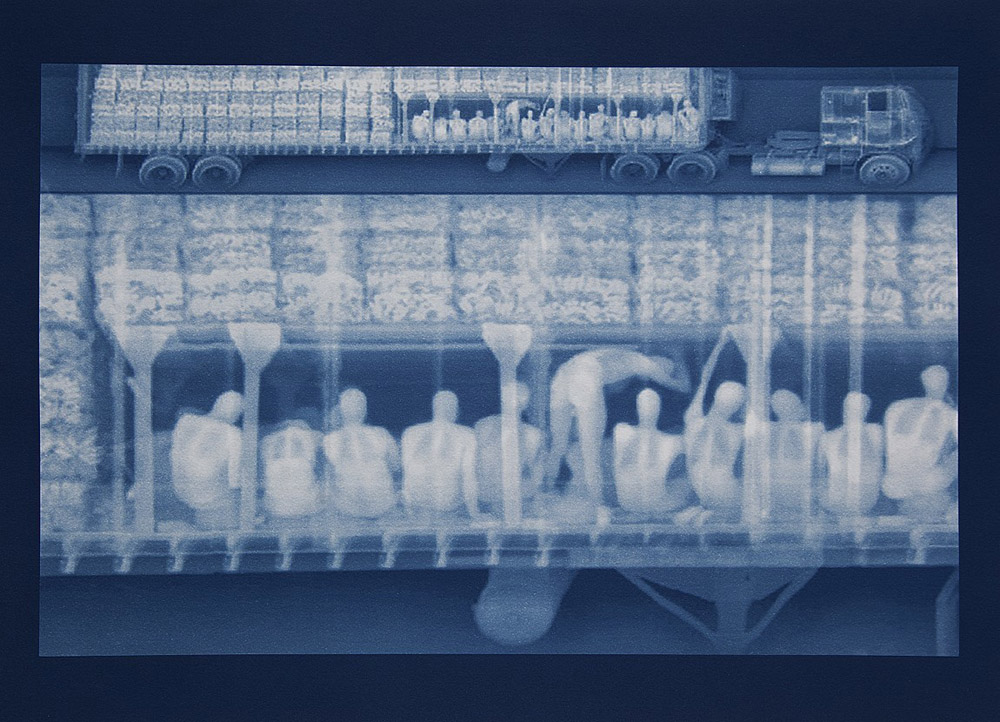
©Noelle Mason, Backscatter Blueprint (Ultima Cena) / Cyanotype (16” x 22”)
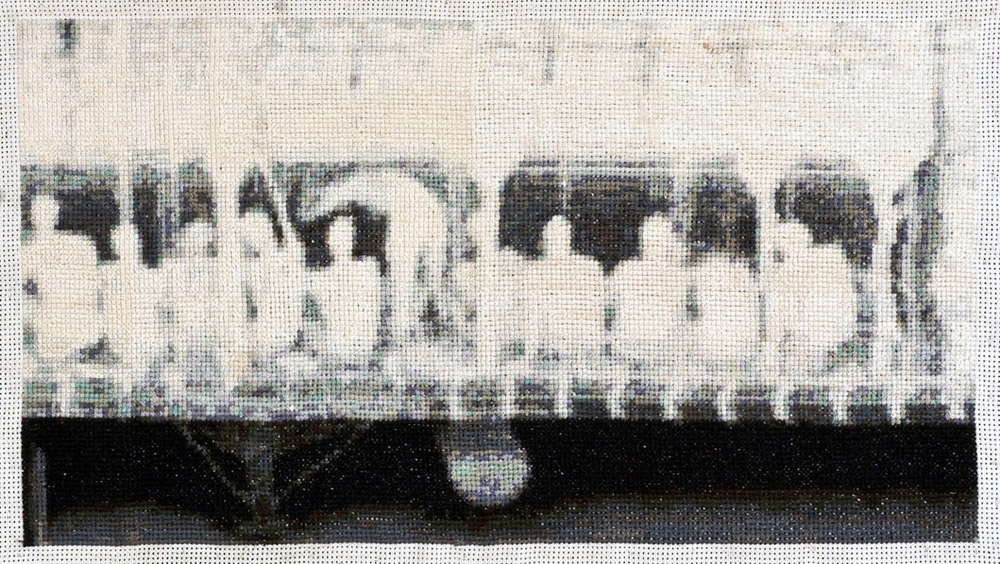
©Noelle Mason, Coyotaje (Ultima Cena) / Hand Embroidered Cotton (12” x 18”)
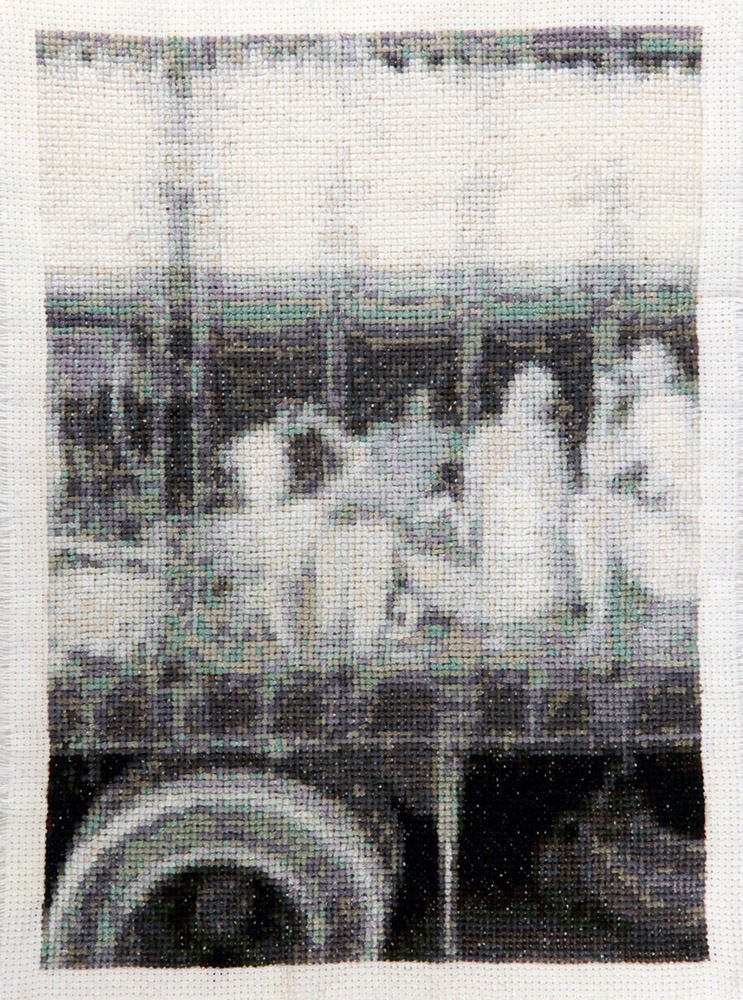
©Noelle Mason, Coyotaje (Gallinero) / Hand Embroidered Cotton (14 ¼” x 10 ¾”)
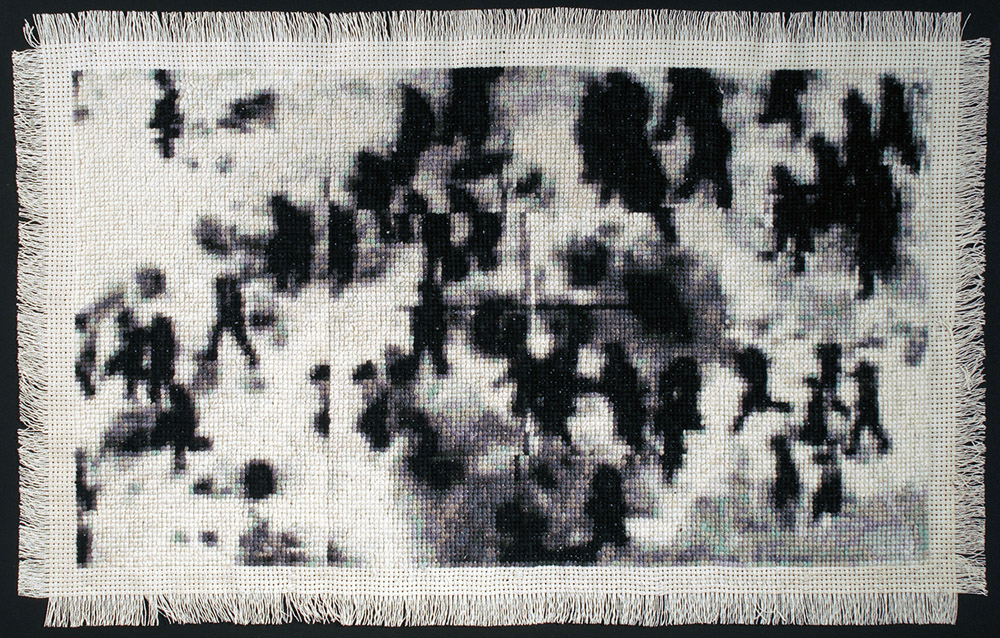
©Noelle Mason, Coyotaje (Los Pollos)
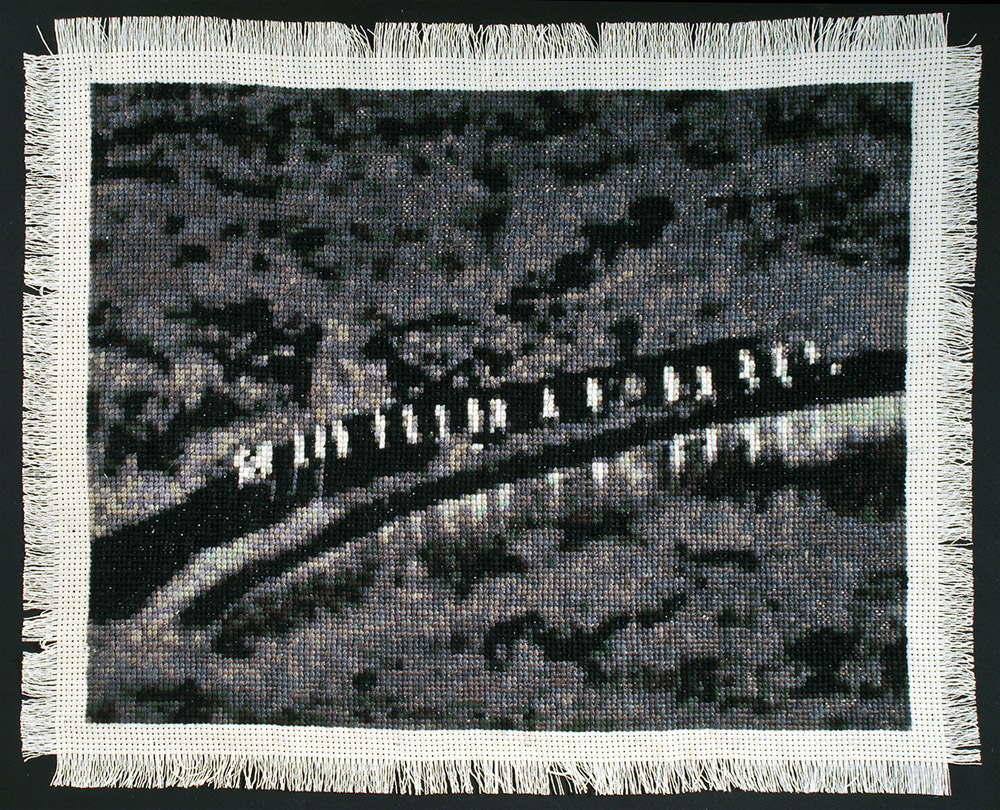
©Noelle Mason, Coyotaje (Rio Bravo)
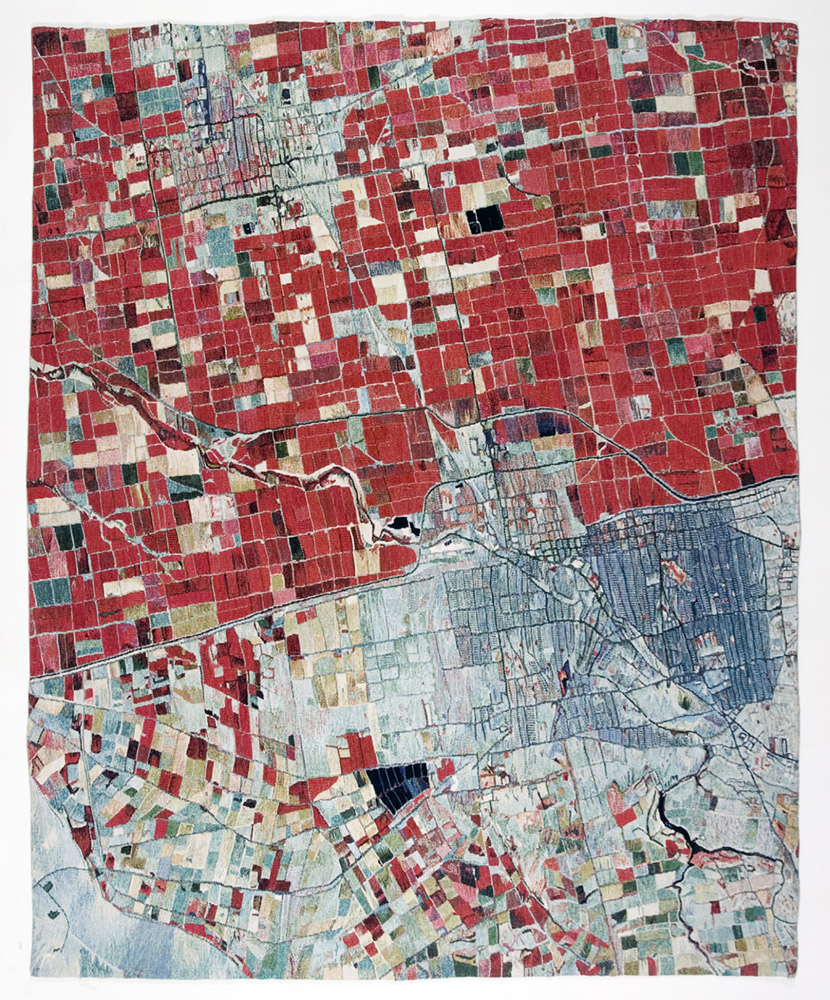
©Noelle Mason, Ground Control (Mexicali/Calexico) / Hand Woven Wool (6’ x 8’)

©Noelle Mason, Coyotaje (Load Truck) / Hand Embroidered Cotton (8” x 29”)
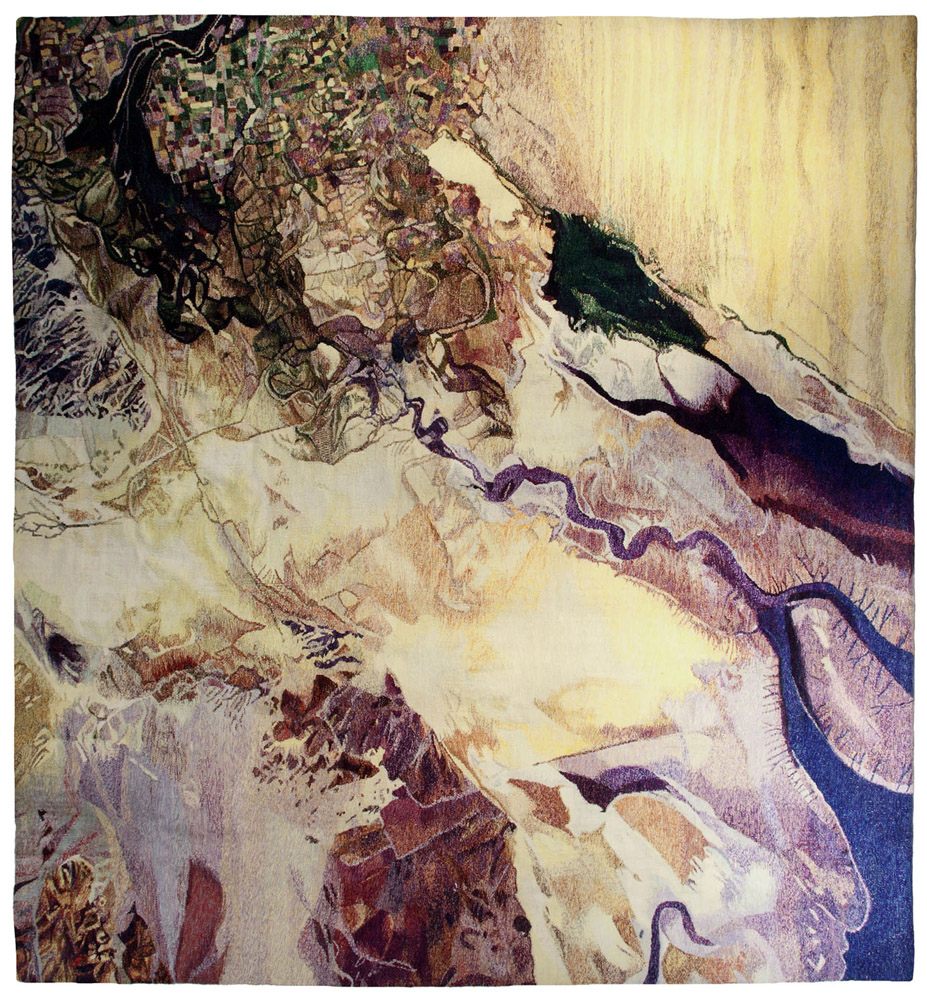
©Noelle Mason, Ground Control (Colorado River Delta) / Hand Woven Wool (9’x11’)
Posts on Lenscratch may not be reproduced without the permission of the Lenscratch staff and the photographer.
Recommended
-
Jonathan Silbert: InsightsFebruary 19th, 2026
-
Olga Fried: Intangible EncountersFebruary 18th, 2026
-
Anne McDonald: Self-PortraitsFebruary 17th, 2026
-

Review Santa Fe: Elizabeth Z. Pineda: Sin Nombre en Esta Tierra SagradaFebruary 6th, 2026
-
Carolina Baldomá: An Elemental PracticeJanuary 5th, 2026