Photographers on Photographers: Joshua Mokry in Conversation with Dionne Lee

© Dionne Lee, Currents II (still), Single Channel Video, 2024
Every August we ask the previous Top 25 Lenscratch Student Prize Winners to interview a hero or a mentor, offering an opportunity for conversation and connection. Today Joshua Mokry and Dionne Lee are in dialogue. Thank you to both of the artists.
I first met Dionne Lee while I was in graduate school, when she participated in the Land Arts of the American West program at Texas Tech University. At the time, I never imagined how much of an impact Lee’s work would have on me as I began researching caves. I selected Dionne Lee because her practice resonates with many of the questions that shape my own. While our projects engage with different environments and histories, I am drawn to the way in which Lee approaches the landscape and her ability to establish a relationship with it through her work.
I am particularly interested in the way Lee’s collages and drawings operate alongside her photographs. Rather than feeling separate from the photographic image, they become extensions of it, serving as points of contact between the artist’s hand and the picture plane. These gestures further connect body to place, creating space for the landscape to participate in the conversation.
This conversation took place over a phone call during the summer of 2026.
Dionne Lee is an artist working across various mediums including photography, collage, and video. Her work has been exhibited nationally and internationally, including the Museum of Modern Art, Storm King Art Center, Swiss Institute, Carnegie Museum of Art, and The Barbican among others. Lee’s work was included in the 2024 Whitney Biennial and in 2025 the 12th International SITE Santa Fe Biennial. Artist residencies include The Center for Photography at Woodstock (2019), Light Work (2021), and Chinati Foundation (2022). Her first monograph “Currents”, published by Aperture, is out now. She is a 2025 Guggenheim Fellow.

© Dionne Lee, Untitled (Hand Drawing, Hand Picture), Silver gelatin print, 2023
Joshua Mokry: What got you started in photography?
Dionne Lee: My father gave me a 35mm [camera] when I was a teenager, and it just became a good creative outlet for me. I grew up in New York City, and my entry into image-making was street photography and making portraits of my friends and strangers. I’m an introvert, but something about being behind the camera offered me a confidence and power to approach strangers and take their picture. I think a lot of photographers experience a feeling of permission by possessing a camera.
When I went to college, I got more experimental in my work and entered a darkroom for the first time.
Joshua Mokry: What usually comes first for you: a place, an image, a question, or something else entirely?
Dionne Lee: There isn’t a single, reliable thing that comes first. I collect a lot of books for collage–maybe I’ll see an image I want to cut out, recreate in some way, or find compelling for whatever reason. It also happens in the field; I can be somewhere and feel compelled by something in the landscape. Sometimes it’s a question. There is no formula; creativity is never that cut and dry.

© Dionne Lee, together on the ground to form the base, Collage of silver gelatin prints with graphite, 2019
Joshua Mokry: The process can seem like it’s contained in a box, and you go to one place to start creating, but it’s really like everything is organic and compounded.
Dionne Lee: For sure. I can go somewhere and be struck by something and know that I need to return and make something. But mostly, I’m living my life, observing, writing, reading, and things arise on their own. It’s intangible.
Joshua Mokry: Yeah, I’m the same way. I’ll get inspiration from a YouTube video about a science experiment, and that doesn’t necessarily lead to an image, but it’ll lead to an idea that will then lead to an image.
Dionne Lee: Totally.

© Dionne Lee, Untitled Rock Drawing V, Silver gelatin print, 2023
Joshua Mokry: When you’re in the field, what makes you decide that a place is worth returning to repeatedly rather than simply working in or photographing once?
Dionne Lee: I tend to go “into the field” in bursts–sometimes it’s through a residency opportunity and other times it’s me going to a place local to me. I go out to collect information, find my questions, and encountering what you pose in your first question: “what comes first?” When I get home from a distant or lengthy field experience, I find the work can be realized. I make so much work where I live, and it’s like I’m always returning. Historically, I haven’t had much luck making work far from where I live. I need to process it all first.
There is this creek by a house I used to live in. It took five minutes to walk to from my house. I would go there all the time because it was easy to get to. I made an entire exhibition in that space [Currents at Cushion Works in San Francisco in 2024], within a span of a few months. Sometimes I’d visit the creek and just think, walk around, other times I’d make some images and capture video–all of it was equally valuable. When I’m exploring unfamiliar places, I don’t feel that comfortable; it can be disorienting. It’s more fruitful when I can encounter things over and over again.

© Dionne Lee, Currents I (still), Single Channel Video, 2024
Joshua Mokry: In relation to that spot that you’re talking about where you made all those works, and maybe others that you can think of, how did that place change for you over time? Like after, you know, the fifth or tenth visit, at what point do you stop photographing and start building a relationship with it? Or vice versa.
Dionne Lee: The relationship comes first. I get freer and more resourceful because I’m trying to figure out ‘what else can I do here?’ I did start with doing these rock drawings where at first I was just placing objects or drawing on the rocks with chalk. Then, I started drawing them with water instead. Then, I was filming. I put this string in the water that I tried to keep in a spiral shape, and I followed that down the creek.

© Dionne Lee, Untitled (Wound), Collage of silver gelatin prints, found images, graphite, 2020
Joshua Mokry: Oh, yeah. [Lee is talking about the creation of Currents II, Single channel video, 18:51 min., loop (2024)]
Dionne Lee: …Then I moved. I’m not terribly far from that location–instead of a 5-minute walk, it’s probably more like 30. Still close, but not close enough, I guess! I often say I like to work hyperlocal.
Joshua Mokry: I had a question going off of that… You were talking about [Currents II and other] works that are a bit more intimate with nature and very close to the ground, compared to some of the collage works that feel critical against traditional uses of photography. Do you find a connection point between that comfort you’re feeling out in the field invites you to make more works that are more intimate with nature – less about critique and more about reconstruction and restoration?
Dionne Lee: Yes and No. Yes, I do think that it helps. Kind of like how I said before, opening myself up and feeling a bit freer in a space. I think there are also levels of permission, which can come through familiarity. So yes, in that sense, it does. However, I’ve become less interested in critique and more interested in just developing that relationship [with place]. The critique is there because I feel like I try to work in opposition to a certain sort of trope in landscape photography. But I don’t want to always feel like I’m making work in response to a certain segment of the canon. I think about it more as I’m just adding more information.
I literally see a cabinet. If Ansel [Adams] is in the cabinet, and Carleton [Watkins] is in the cabinet, what does it look like for my photograph to be in there too? How does that expand or add to this landscape story that we’ve built?
I try not to feel an obligation to always be directly critiquing. I think the work is doing that, but I don’t know if my motivations always need to be coming from that place exactly. My perspective isn’t solely responsive to the work of others.
Joshua Mokry: I love that analogy with the cabinet.
Dionne Lee: Yeah. It’s less pressure, honestly. I think there’s also that line between what your work is doing and then what you choose to say or speak as an artist. You have to leave something for the work to say.

© Dionne Lee, Warnings I, Collage of silver gelatin prints with graphite, 2019
Joshua Mokry: Some collages in your work remain more recognizable, like of a place or a thing within nature. I’m thinking about Warnings I, Warnings II, together on the ground to form the base- I can see these aerial views of a plane crash, or you’re building a fire bed or a shelter. Whereas works in the Fault Condition series are a little bit more abstract for me. Almost like it’s topographical, like you’re creating your own landscape…What guides that movement between that descriptive, more representational imagery versus the abstracted?
Dionne Lee: For Fault Condition, I was trying to think more about the histories embedded in the earth through geology and mapping. I was also leaning into a sparser collage strategy. I was doing a lot of rubbings, graphite on paper, and drawing onto the back of the paper to create an embossed surface.
Earlier, my work [including Warnings] really focused on themes of survival, which felt very immediate. I made a lot of that work in 2019, and the pandemic came shortly after. It was surreal to be making work through the pandemic after spending so much time thinking about survival. The panic and immediacy of that time showed up in the work, I think. Over the years, as I became more interested in geology, I slowed down, which isn’t surprising considering the nature of that discipline. I think that’s what guided a different process. It invited more negative space in the work, more breathing room, and simply less pictures…which is the difference between those two periods of making.
Joshua Mokry: I’m specifically thinking of the image where you extended the lines of the shelter [netting (2019) and loose structure (2019)]. It almost feels like the drawings are becoming extensions to the actual photographs themselves. There is a fluidity where drawings feel like extensions of photographs and photographs feel like drawings. What does drawing give you that photography alone does not? What does drawing allow you to explore?
Dionne Lee: Yeah, that’s a good question. Photography is the only thing I’m formally trained in. Of course, I had to take drawing and painting in undergrad foundations, but I never did those things again. As my practice developed, I would run up against moments where pictures were not doing what I needed them to do–it felt like an organic turn towards mark-making.
The first time I drew on a print was actually an accident. I take notes on the back of my prints in the darkroom, and one time I accidentally wrote on the emulsion side of the paper (the side that exposed under an enlarger). This accident got me out of this precious and scared mindset I think we are trained to have as photographers. I was motivated to loosen up and see what happens if I do the wrong thing.
For that image [Netting (2019) and Loose Structure (2019)] that you’re talking about where I’m extending the lines: that was me trying to imagine the shelter continuing but also coming apart. It’s nonsensical. It stops being a shelter.
I think it [drawing] gives me a sense of freedom. Drawing is a way to fill in the gaps or add complexity. What can exist beyond the frame of the image?

© Dionne Lee, Untitled (Hand Drawing, Hand Picture), Silver gelatin print, 2023
Joshua Mokry: Looking back over the last decade of your practice, what question are you still asking that photography has not yet helped you answer?
Dionne Lee: Well, it’s a recent question, though it’s been with me for a couple of years; I’m trying to think about what photography actually is. I’ve been reframing my understanding of photography as starting with fossils. I’m thinking about the plant fossil as the first landscape photograph and how the Earth has been documenting itself long before we showed up. What could it mean if we accept that we weren’t the first to document the Earth? Could it humble us and shift our relationship to power and land? Again, thinking about that filing cabinet, what if fossils were in there too?
That reframe is very liberating in the sense of: I’m participating in such a vast history that predates humans and even predates the camera. I guess this is something that photography has helped me examine, if I’m looking at those things and thinking about them as a form of photography.
In terms of ‘what has it not helped me answer?’ I think a lot of artists might feel this way, which is, I’m more interested in the questions. I don’t know if I’ve ever looked at photography for answers. It has helped me answer questions, but that’s not why I look to it. It is my tool for asking questions, and those questions bring more questions.

© Dionne Lee, Fault Condition 2, Collage of silver gelatin prints, found images, graphite, 2023
Joshua Mokry: What artist are you looking at in particular and thinking about?
Dionne Lee: Well, one of them I thought about for many years, and I’m going to be in a show with her work in Houston this September. [Divination: Beverly Buchanan & Dionne Lee, September 3, 2026, Nina and Michael Zilkha Gallery, Contemporary Arts Museum Houston]

© Dionne Lee, Netting, Collage of silver gelatin prints with graphite, 2019
Joshua Mokry: Oh, I’ll be there! I’m excited.
Dionne Lee: Great. Yeah, you should come. It’s with Beverly Buchanan. She’s someone whose work I have loved for a very long time. I took a trip to visit her piece Marsh Ruins on the coast of Georgia a couple of years ago, which is a work I view as a master study in responding to histories embedded in the landscape. This was my first visit to Sea Islands, a region of recent resonance within my practice as it is an intersection of issues of land rights, history, and identity that further inform my understanding of the complexities embedded in the American landscape. It’s very special to be in a show with her. She’s been on my mind for years, before the exhibition even came to be. In my studio, I try to hang up photos of artists that I think of as my studio guides. Beverly’s always been up. Ana Mendieta has always been up. Yoko Ono has always been up. Those have been my big three for a long time.
I recently got the book Generalization by Tania Pérez Córdova, which I’ve really been enjoying. I’m a fan of Veronica Ryan; I was brought to tears at her exhibition, Unruly Objects (2025), at the Pulitzer Arts Foundation in St. Louis. I also just went to the 59th Carnegie International and saw one of the best video works I’ve seen in a long time: What Is Your Favorite Primitive (2023) by Yi Li-Fan. Oh my gosh…floored me. A totally brilliant and humorous investigation into the ethics of software tools designed for image production.
I’m also always looking to Gabrielle L’Hirondelle Hill.

© Dionne Lee, Loose Structure, Collage of silver gelatin prints with graphite, 2019
Joshua Mokry: Oh yeah, she gave you the interview in the book [Dionne Lee: Currents, published by Aperture]. That was a wonderful interview.
Dionne Lee: Yeah, she’s a friend. We went to grad school together. She’s one of my favorite artists.

© Dionne Lee, Untitled Rock Drawing VI, Silver gelatin print, 2023
Joshua Mokry is an American artist based in Texas working with photography, sculpture, and performance. He obtained an MFA degree in photography at Texas Tech University in 2026. Mokry’s work has been exhibited both nationally and internationally, with a few select galleries including the Galería Central at Centro Nacional de las Artes (CENART) in Mexico City, Mexico (2026), the Northlight Gallery in Phoenix, Arizona (2025), and the FLOOR_ Gallery in Seoul, South Korea (2023). He has received an Honorable Mention for the Innovate Grant and was part of Lenscratch’s 2025 Student Prize: Top 25 to Watch list. His work has been included in several publications including ZONE’s 4th collective book titled ZIVNE and Float Magazine’s Impactful Photography.
Instagram: @jamokry

© Joshua Mokry, Sun’s Rays, Earth, and Moon and Erupt, Gelatin silver prints, black shadow box frames with black velvet, black sand, 2026

© Joshua Mokry, A Dark Box No. 1, Gelatin silver print, 2025

© Joshua Mokry, Self-Portrait No. 1, Archival inkjet print, 2025
Posts on Lenscratch may not be reproduced without the permission of the Lenscratch staff and the photographer.
Recommended
-
Botanical Photography: The Basics and Moving Beyond the Basics: Carol BouyoucosSeptember 29th, 2026
-

The 2026 Center Awards: Project Launch Grant: Marcus DeSienoSeptember 12th, 2026
-
PHOTOGRAPHERS ON PHOTOGRAPHERS: DAWN ROE IN CONVERSATION WITH BRIDGET CONNSeptember 2nd, 2026
-
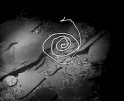
Photographers on Photographers: Joshua Mokry in Conversation with Dionne LeeAugust 21st, 2026
-
Photographers on Photographers: Hannah Schneider in Conversation with Marie GayeskiAugust 20th, 2026