PRC’s 50th Anniversary Mentorship Program: Libby O’Neill and Jillian Guyette

©Libby O’Neill, Haunted House
In celebration of its 50th Anniversary, the Photographic Resource Center (PRC) launched a six- month mentorship program pairing four early-career photographers with four established artists for sustained one-on-one mentorship, critical feedback, and professional development.
The 2026 Mentorship Fellows are alina balseiro, Jaypix Belmer, Libby O’Neill, and Nick Ortoleva, who were paired with mentors Jess T. Dugan, Rashod Taylor, Jillian Guyette, and Tommy Kha. Throughout the program, each fellow met regularly with their mentor to develop their work, strengthen their artistic voice, and receive guidance on their professional practice. The program culminates in an exhibition at the PRC gallery, on view September 11–October 18, 2026, featuring work developed by the fellows during their mentorships.
The program will also be celebrated at PRC’s 50th Anniversary Gala on October 17, where all four mentors and four fellows will be present as honored guests. Created as part of PRC’s 50th Anniversary, the program celebrates the importance of mentorship in photography while fostering meaningful relationships between emerging and established artists and supporting the next generation of photographers.
Today we share feature the work of Mentorship Fellow Libby O’Neill and a conversation with Mentor Jillian Guyette.

©Libby O’Neill, Boxes
House in Mourning
In the weeks leading up to my senior year of high school, my family was evicted from
our home of fourteen years. We were given six days to pack up our entire life.
Suddenly, I was homesick for a place that no longer existed—a physical space I had
loved, lost, and never properly mourned.
Growing up, home was a red farmhouse with cream-colored trim, a tire swing hanging
from a towering tree, acres of hayfields, and a driveway that always announced when
you had arrived. It was where my family grew up, where memories lived in creaking
floorboards, walls covered with artwork, and shelves littered with knickknacks.
Years later, I remain fascinated by how we carry our homes with us. I’ve begun to think
of home as something beyond a physical place—the people, landscapes, cultures, and
familiar rhythms that create a sense of belonging. Looking back, I realize that what
made that house feel like home was deeply rooted in everything surrounding it.
This collection of photographs and keepsakes considers home as both a physical place
and an emotional landscape—what we leave behind, what we inherit, and what remains
long after we are gone. Blending present-day photographs with family archives,
historical documents, and personal keepsakes, the work moves between past and
present in search of what home has been and can be -Libby O’Neill

©Libby O’Neill, Curtain Fabric
Jillian Guyette shares:
It was an immediate yes for me when Catherine LeComte Lecce asked if I had interest in being a mentor for PRC’s 50th Anniversary Mentorship Program. Once I was paired with Libby O’Neill, I knew we were both in the right place at the right time.
When I first met Libby, her deep love of New England and curiosity about what keeps us coming back to our places of origin was palpable. Recently transplanted to Brooklyn, she couldn’t seem to shake the work she had started to make years earlier about losing her family home as she was graduating high school. We chose to explore that project together, her PRC exhibition resulting in a melancholic, yet hopeful photographic document that pairs the pictures she’s taken with small objects and ephemera related to the loss of the house. While the town and home that Libby depicts is located in Massachusetts, she explores a sense of melancholic detachment as she moves through landscapes, and old family photographs.
With no person present in the photographs, apart from a child’s head that peeks from the bottom of the frame of a family snapshot, we are indeed, deeply aware of a family in each frame. It is Libby’s fine tuned ability to slowly paint the whole picture for us, leaving breadcrumbs as she goes, that invites the viewer to insert themselves within the walls, imagining it is their house that has been ripped out from under them. Her sightline on family history from the perspective of a once child, now adult blends together in a way that is painful but hopeful, allowing us all to mourn along with her for our own childhood homes.
Libby’s work makes you want to dig out your family albums, the ones you used to flip through when you were a kid, so that you may- if only briefly, be transported back to a time before you knew too much.

©Libby O’Neill, Fan
Jillian Guyette: Please introduce yourself, and tell us a little about your photographic practice?
Libby O’Neill: Hello! My name is Libby, and I consider myself a documentary photographer. I’m a bit of an old soul—nostalgic and sentimental—which is probably what draws me to photography. As a kid, I was mesmerized by my family’s home videos and photo archive—seeing family members at different ages, occupying the places they once lived, and getting a glimpse into their lives before I was even a thought. For a stretch of years, I asked for a camera for my birthday every year. They somehow stopped working right around the one-year mark—was it because I used them so much, or did I magically think this was how you upgraded? Who knows? I made it my mission to document my own life so I could remember every moment, and that obsession eventually grew into a career in photojournalism.
If I’m not photographing my social circles, my typical approach starts with wandering—taking a long walk, driving down back roads, or simply going about my daily routine and noticing the quirks of whatever place I find myself in. I try to have my camera with me as often as possible, and when I don’t, I’ll make a note to return later. My personal archive is largely made up of the places and people that have shaped my life, and that instinct to document what’s around me has naturally extended to the lives of others. I’m fascinated by the small, specific things that make people and places feel like themselves, how our environments shape us, and how so many of our emotional experiences are universal

©Libby O’Neill, Fog
Jillian Guyette: What drew you to apply for the PRC’s 50th Anniversary Mentorship Program?
Libby O’Neill: I got coffee with Faith Ninivaggi (shoutout), a member of the PRC’s board and planning committee, earlier this year to pick her brain about her freelance career. I had recently moved from Boston, where we had met while working as fellow photojournalists, to New York City, and I was looking for advice as I navigated the transition. I’ve always admired how she balances her photojournalism work with more personal, artful projects—something I had been neglecting while trying to get my bearings in the news world, but really wanted to make space for again.
Shortly after our conversation, this program came up and she thought of me and sent it my way. I was really excited about the opportunity because I had been looking for both guidance and a bit of a kick in the butt to spend some time making personal work again.

©Libby O’Neill, Forsythia
Jillian Guyette: You shifted gears after we initially met and started to work together. Your first project gave way to something that felt more impactful for you personally. Can you speak to that shift?
Libby O’Neill: I actually began a similar project in college, combining family keepsakes with images from my childhood. At the time, it felt too difficult and personal to finish or share with my peers, so I abandoned it. But every so often, I would find myself returning to my family’s archive—scanning old photographs, rummaging through drawings and keepsakes, and essentially keeping the gears turning for the day when I would finally hunker down and do something with them.
My initial idea for this exhibition was much more traditional photojournalism. I planned to follow a clam digger and his business over the course of the summer, but with all the travel between Massachusetts and New York and my changing schedule, it quickly stopped feeling sustainable. For a moment, I worried I’d have to come up with something last-minute and wouldn’t have anything meaningful to say. Then I realized this could be an opportunity to finally revisit that old work.
The loss of my childhood home is at the center of it, but that isn’t necessarily obvious when you first look at the images. The work is fairly subtle, and it’s often only when I have to explain the story and provide more context that I have to confront how personal and difficult it actually is for me to talk about. I think that was part of why working with you felt so right. After looking at your work and seeing parallels in your explorations of home and family roots, I felt you would be the perfect mentor to help me finally revisit something I’d been circling for years.

©Libby O’Neill, Ghost
Jillian Guyette: How has growing up in New England impacted your creative practice?
Libby O’Neill: I think my interest in documenting a sense of place grew out of growing up in New England, even though I didn’t have the words for it at the time. I grew up in the northernmost town in Massachusetts, a stone’s throw from New Hampshire and a short drive to Maine, and being so close to multiple state borders made me fascinated by how much could change within just a few miles. Ten minutes north you were in Seabrook, New Hampshire; ten minutes south you were in Newburyport, Massachusetts—two places that are very different despite being just minutes apart. I didn’t grow up taking vacations that required plane travel, so a couple-hour drive could take me from the White Mountains to the rocky beaches of Rhode Island, which felt like completely different worlds. I noticed the changing landscapes, but I was equally fascinated by how much pride people had in their little corner of the world, what industries fueled each place, and how those things shaped the communities around them.

©Libby O’Neill, Babydoll
Jillian Guyette: Can you talk about any photographers or artists that you look to for inspiration?
Libby O’Neill: These days, I really look to my peers and local photographers for advice and inspiration, and there are far too many wonderful people to mention here. So, for the sake of this answer, I’ll share some of my first inspirations, albeit some big names, from when I was first discovering the world of photography.
Nan Goldin showed me the power of the snapshot to document all of life—not just the beautiful moments, but the difficult ones too. Sally Mann similarly showed me that a snapshot approach can coexist with staging, and I’m drawn to her mix of innocence and darkness within themes of childhood, family, mortality, and place. Stephen Shore taught me that manmade landscapes and the mundane can be interesting. Alex Webb showed me the power of decisive timing, layering, color, and light. Gordon Parks taught me that simple, everyday imagery can speak to injustice. Bill Owens and Martin Parr showed me that photography can be funny, embracing the absurdity, quirks, and sometimes unflattering moments of everyday life. Vinca Petersen introduced me to combining photographs with keepsakes and diary-like writing.

©Libby O’Neill, Market Basket
Jillian Guyette: Have you noticed your point of view evolving or shifting over the past six months?
Libby O’Neill: My point of view on the subject matter I’m addressing in this project hasn’t evolved dramatically over the past six months, but I’ve definitely become much more comfortable making decisions. I’ve always struggled with decision paralysis and can overthink whether I’m making the “right” choice. I think knowing I could bring something to you, get your perspective, and build from there helped me stop treating every decision like it had to be final or perfect. I’ve become much less precious about the work and much quicker to trust my instincts, which is something I’m really grateful to take away from this process.

©Libby O’Neill, Painting
Jillian Guyette: You’ve undertaken a lot during the course of working together. Was there anything that felt sticky or difficult that you worked through during this process?
Libby O’Neill: I think the hardest part has been knowing that this work isn’t only about me. I’ve been very conscious of what revisiting this event might stir up for the other people who were affected by it, especially my siblings and parents. I don’t want seeing the work to bring up difficult emotions for them, and I’ve had to sit with the fact that I can’t completely control how other people will respond to it.
I’ve also been weirdly hesitant to invite people to the celebrations. I think I’m more comfortable making the work than I am with people seeing it and then looking at me while they process it. There’s something very strange about putting something so personal on a wall and then standing in the room with the people looking at it. I’m still figuring out how I feel about that, but I think that discomfort is probably part of what makes this project meaningful for me.

©Libby O’Neill, Penders
Jillian Guyette: Was there something I brought up in our conversations that shifted your perspective on your work at any point?
Libby O’Neill: Definitely. I think from the very first time I brought up the idea of revisiting this work, your excitement and curiosity played a huge role in my decision to really pursue it. When I showed you some of the older images and collages, I was definitely visibly squirmish—you could probably sense how hesitant I was—and I think it was pretty clear that this was a topic that stirred up a lot of emotions for me. You encouraged me to explore that rather than shy away from it, and that really pushed the work forward.
Along the way, you described some of the images as feeling both melancholic and childlike, which I found to be such an interesting combination. The more I think about it, the more I feel like those qualities are particularly relevant to this project because, in a lot of ways, I’m looking back at a past version of myself.

©Libby O’Neill, Receipt
Jillian Guyette: What has been the most valuable aspect of working one-on-one with a mentor through the PRC program?
Libby O’Neill: For me, it felt like a really natural fit. I was really drawn to your style of photography and connected with the analog approach, the presence of nature, and the feeling of snapshot family life throughout your work. Although I mainly work in the photojournalism world and you have a lot of experience in commercial photography, there seemed to be a lot of overlap in the themes and overall feeling of our photographs, at least from my perspective. Because of that, I was genuinely excited to hear your take not only on my project, but on the world of photography more broadly and your own journey through your career.

©Libby O’Neill, Silhouette

©Libby O’Neill, Snow
Jillian Guyette: What role do you think mentorship plays in the development of emerging photographers?
Libby O’Neill: Mentorship is incredibly important. I’ve had a few close mentors and many people who have generously given me their time and advice, and there are still little things people said to me years ago that I can remember word for word. One small comment from someone you respect can give you an incredible amount of fuel.
I think that’s especially important as a freelancer, when there can be a lot of isolation and self-doubt. Having someone you respect genuinely look at your work, offer constructive criticism, or even just tell you that something is working can give you the confidence to keep pushing. I honestly don’t think I’d be where I am without the mentors who have given me that validation—that they see something in me and genuinely want to help me. They made me believe that this dream was something I could actually fathom as a reality, and that has been invaluable. So thank you for being one of those people and for being so lovely throughout this whole process.
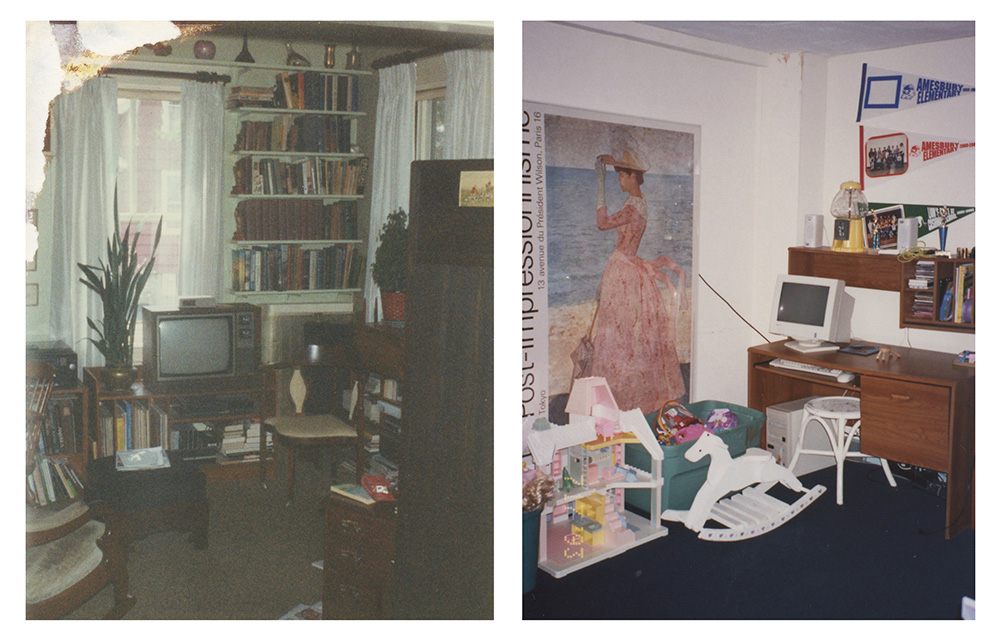
©Libby O’Neill, TV Computer
Libby O’Neill is a Brooklyn-based photographer specializing in photojournalism and
documentary work. Raised in a small Massachusetts town near the New Hampshire
coast, she is drawn to stories rooted in place, seasonal traditions, classic Americana,
and the quiet oddities of everyday life.
She began her career at The Town Common before becoming a staff photographer at
Essex Media Group, covering breaking news and daily life across Massachusetts’ North
Shore and Greater Boston. Since transitioning to freelance work, she has contributed to
The Boston Herald, The Boston Globe, Getty Images, Reuters, and the Associated
Press.
O’Neill earned her BFA in Film, Photography & Visual Arts from Ithaca College in 2020.
Her work is influenced by the intimate, satirical, and quietly melancholic storytelling of
Martin Parr, Nan Goldin, Vinca Petersen, Charles Schulz, and Fred Armisen.
Instagram: @libbyoneill_photography

Portrait of Jillian Guyette
Jillian Guyette is an American photographer (b. 1990) from Rochester, New York. Raised in the Finger Lakes region by a psychic medium and a painter, she received a BFA in Fine Art Photography from the Rochester Institute of Technology in 2012. Known for her sensitivity with her subjects, Jillian’s work is profoundly curious about how caregiving informs and impacts creative practice, the nuance of women’s familial relationships, and our inherited histories. She currently lives between New York City and Philadelphia.
Instagram: @jillianguyette

©Jillian Guyette
Posts on Lenscratch may not be reproduced without the permission of the Lenscratch staff and the photographer.
Recommended
-
Brynne Quinlan in Conversation with Douglas BreaultSeptember 27th, 2026
-

Richard Provencio: The Delivery of MagicSeptember 26th, 2026
-

PRC’s 50th Anniversary Mentorship Program: Nick Ortoleva and Tommy KhaSeptember 11th, 2026
-

PRC’s 50th Anniversary Mentorship Program: Libby O’Neill and Jillian GuyetteSeptember 10th, 2026
-
PRC’s 50th Anniversary Mentorship Program: Jaypix Belmer and Rashod TaylorSeptember 9th, 2026