Guggenheim 2026: Samantha Appleton
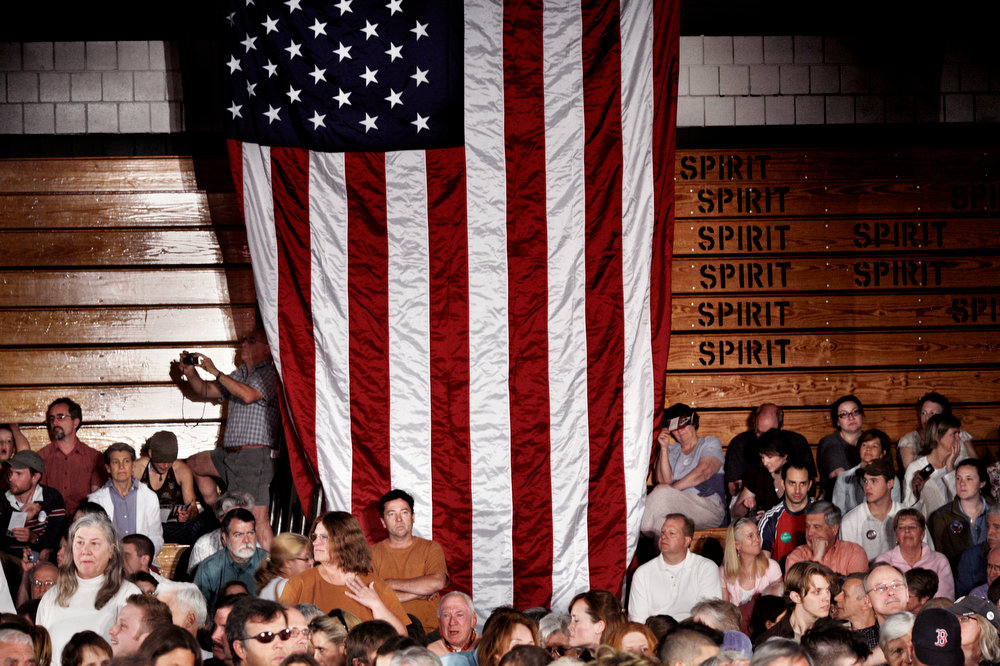
© Samantha Appleton, “American Spirit.” Voters wait for a campaign event for U.S. Sen. Barack Obama to begin at Rye Elementary School in Rye, N.H. months before the New Hampshire Democratic Primary. He was an overwhelming underdog in the primary race and campaigned for a full year (34 trips in New Hampshire alone) before the primary.
Over the next few months, we are featuring the work of many of the 2026 Guggenheim Fellows as a way to celebrate their achievements and understand legacies and projects that have brought them this tremendous recognition.
The Board of Trustees of the John Simon Guggenheim Memorial Foundation announced their appointment of the 101st class of Guggenheim Fellows, including 223 distinguished individuals working across 55 disciplines. Chosen through a rigorous application and peer review process from a pool of nearly 5,000 applicants, the Class of 2026 Guggenheim Fellows was tapped based on both prior career achievement and exceptional promise. As established in 1925 by founder Senator Simon Guggenheim, each Fellow receives a monetary stipend to pursue independent work at the highest level under “the freest possible conditions.”
“Our new class of Guggenheim Fellows is representative of the world’s best thinkers, innovators, and creators in art, science, and scholarship,” said Edward Hirsch, award-winning poet and President of the Guggenheim Foundation. “As the Foundation enters its second century and looks to the future, I feel confident that this new class of 223 individuals will do bold and inspiring work, undaunted by the challenges ahead. We are honored to support their visionary contributions.”
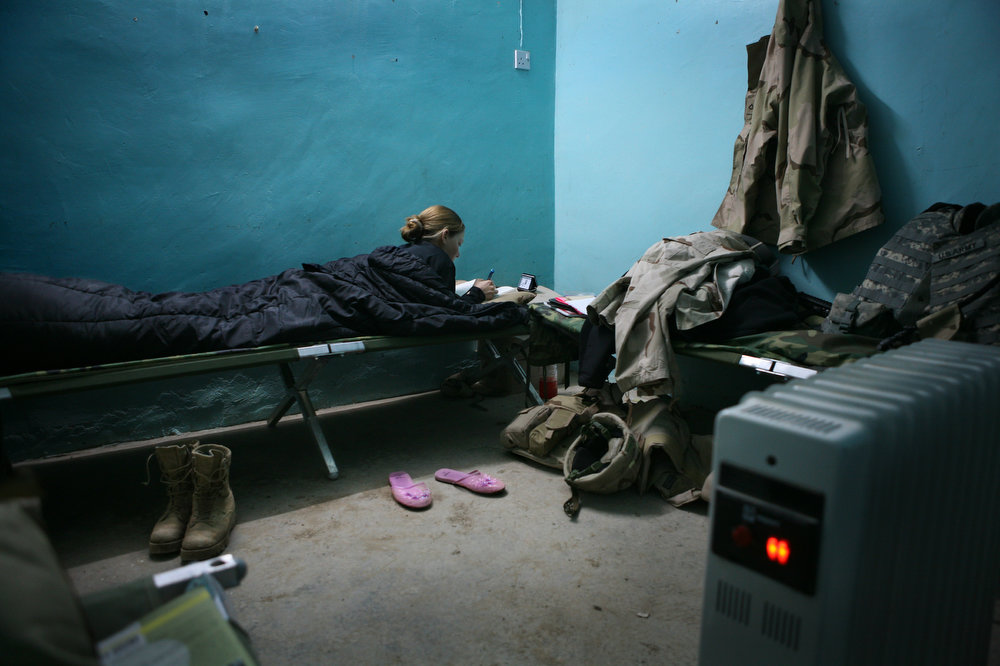
©Samantha Appleton, “An American Soldier.” Resting in a bunker in Tal Afar, Iraq amid bombing.
Samantha Appleton is an award-winning photojournalist, current Guggenheim fellow, and former Nieman Fellow at Harvard. She has covered many of the most tumultuous events of the 21st Century. Primary stories have included conflict in Iraq, Afghanistan and Lebanon, social issues in Africa, and immigration issues in the US. She was an official White House photographer for the Obama administration and co-founded the photo agency Noor Images to promote projects in support of human rights and social justice.
An interview with the artist follows.
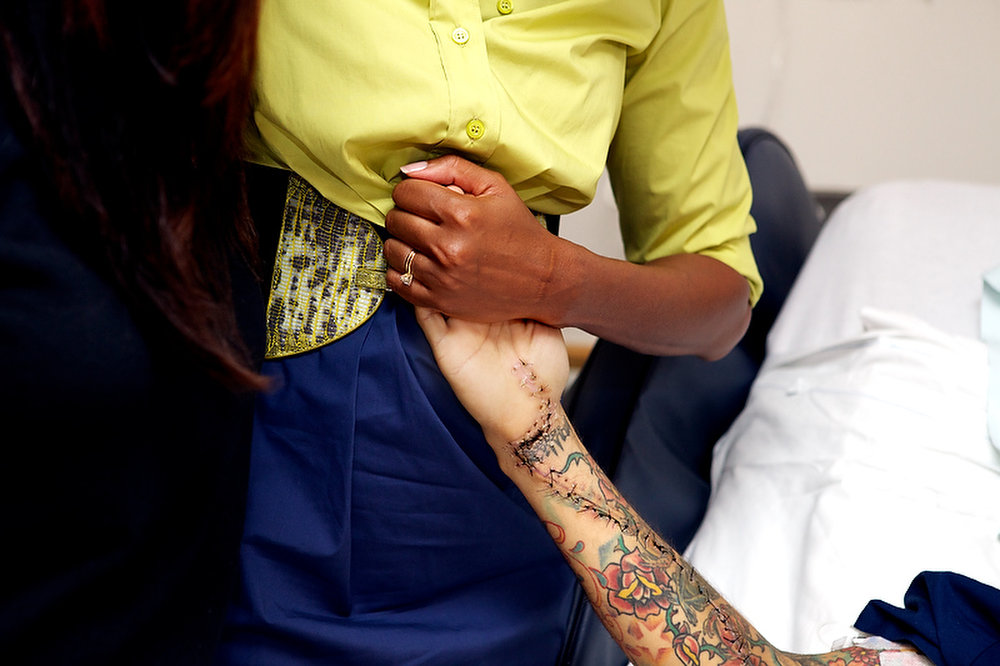
©Samantha Appleton, “Wounded Vet.” First Lady Michelle Obama meets with a wounded U.S. service member at Walter Reed National Military Medical Center in Bethesda, Maryland. More than 32,000 U.S. service members were injured in the war, and 4500 killed. Despite President Obama’s campaign promise to bring the war to a close, and his success in removing troops at the end of 2011, 5000 troops were still there when he left office.
Congratulations on being selected to be a Guggenheim Fellow. What was it like being selected, and what does it mean at this stage of your career?
I’ve never met anyone who’s gotten the Guggenheim on their first try, although I’m sure there are some. I think this was my third time applying. It might have been my second, but only because one time I went through the process, and then I think I was too chicken to submit it. So let’s call it my third time. It’s one of those things where you have to have confidence in your work. So it didn’t disappoint me too much when I didn’t get it the first time. I’m going to sound crazy, but I’m glad I got it on this proposal and not the idea I submitted four years ago. That idea was similar, but not fully baked. It wasn’t as personal as this one.
Can you elaborate?
The first time it was about tracing back cultural touchstones in society. And also understanding our own histories. So for instance, my grandfather was a barefoot kid living on a farm with nine siblings. They had no money. He joined the Navy and ended up getting a loan to start a business and a loan to buy a house. His Black fellow sailors did not have the opportunity to get those loans. So my grandfather was a self-made American dream kind of story. But we can’t lift-up that American dream mythology without understanding the good fortune that came with white European ancestry. There’s nothing wrong with what my grandfather did. But we must understand that that wealth came from something that was not afforded to other people. It’s important when we talk about self-made that we acknowledge that it’s not the same for everybody. So that’s what the first project was. How to photograph these privileges as a way of flipping the switch, asking what were the benefits that white people have had.
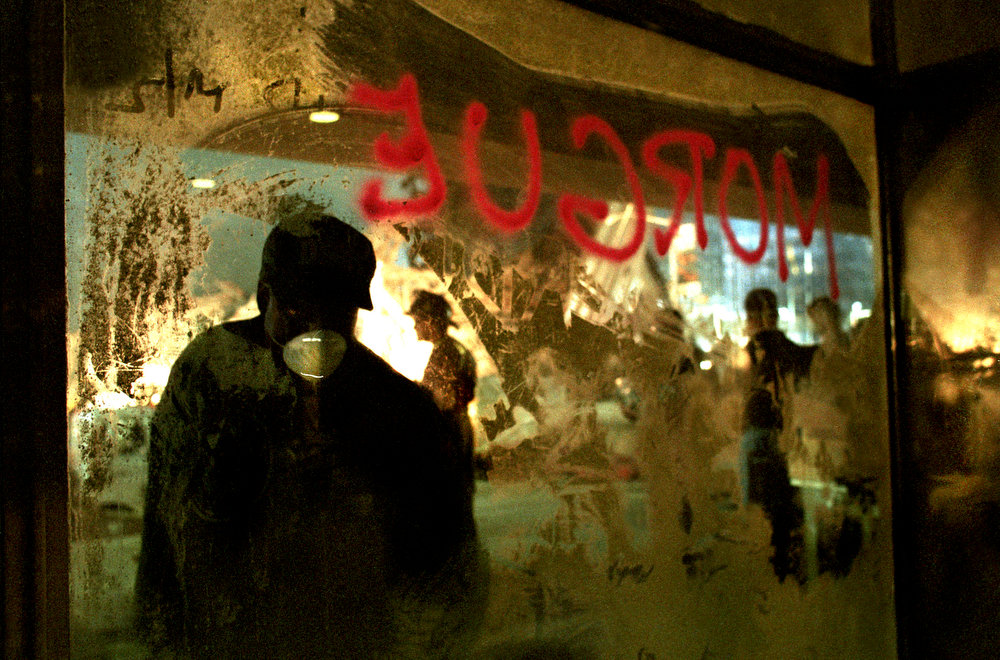
©Samantha Appleton, “Morgue.” Rescuers set up a makeshift morgue, in a Brooks Brothers store across the street from the World Trade Center, in the initial scramble to find survivors and the dead after the attack on 9/11/2001. In the middle of a night, an EMT peered into the window to see if any bodies had been found. Few were.
Did you ever find out why your second submission was preferred?
No. Actually the way I was notified was in an email that said – Don’t tell anyone, because it’s not confirmed until the board votes on it. So I was like – Did I get it? I kept opening the email and wondering – This is what this means, right?
The more I talk to people who have gotten in this year and in the past, I think they’re giving it to people who have shown consistency and commitment in their work, in addition to having a strong personal desire to do the project. If you look at the threads through my work, they’re all leading to this project. If I was to submit something impersonal but something I thought would be catchy, I think it wouldn’t appeal to them. You can’t fake your way into it. I think that’s why it takes a few times.
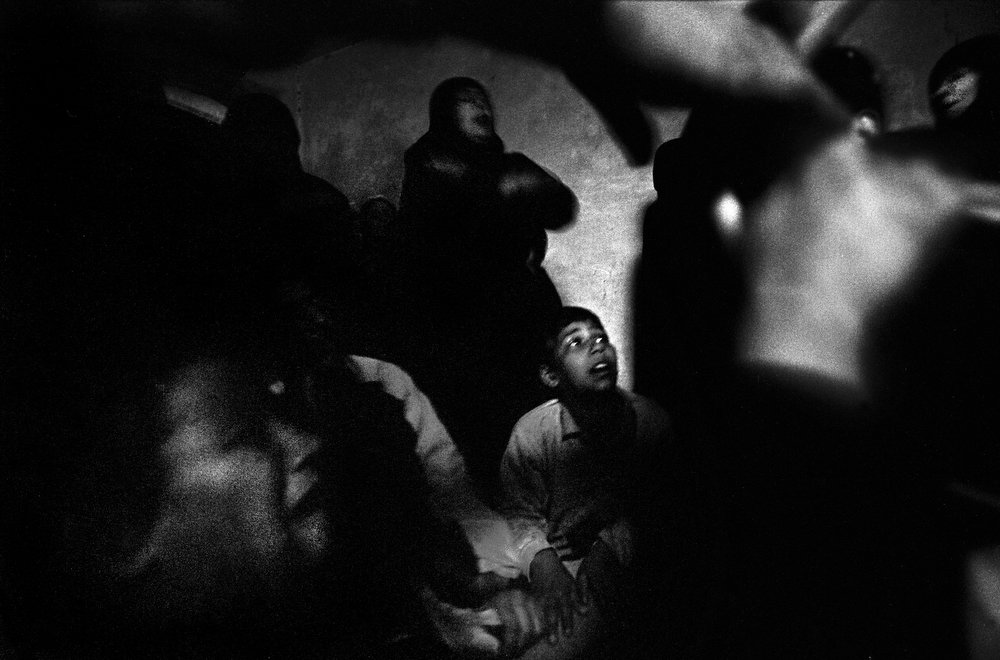
©Samantha Appleton, “Mourning. ” A young boy looks up as incoming mortar rounds land near his home during a funeral for his father, killed the night before. After a year of occupation, Shia militias began to form and fight American troops. Despite initially aligning with the American invasion, the militias and their supporters saw little change and were being threatened by Sunni insurgents. In one of Baghdad’s poorest slums, Sadr City, fierce fighting erupted.
You said when you look at the threads through your work, they’re all leading to this project. Can you elaborate? You covered conflicts in the Middle East and worked in the White House for President Obama. What role did those experiences play in this?
It’s only recently that I started calling myself a historian. I see myself as a historian, because I am photographing history, not just in the sense of the cliché – journalism is the first draft of history. My focus is more – how is this going to play 50 years from now? That is the way that I look at these stories. It’s a way of editing out. I’m wrong all the time, so I’m not saying that I have some sort of crystal ball. But I try to edit, thinking – This [issue] is going to be important in 50 years. That is not going to be important in 50 years.
For example, recently in Maine a Colombian immigrant who was here with a work visa was shot. The story keeps changing, but as of now it seems the wrong person was targeted. It’s interesting to see that his death, even though it made national news, didn’t reach the level of Renee Good and Alex Pretti. But to me, this is all the same story, and it’s an important story to tell. It’s part of our history. I can only pray that 50 years from now we will see this as a dark part of our history as opposed to the beginning of where we may be going in 50 years. But I don’t know. That’s the part I can’t predict.
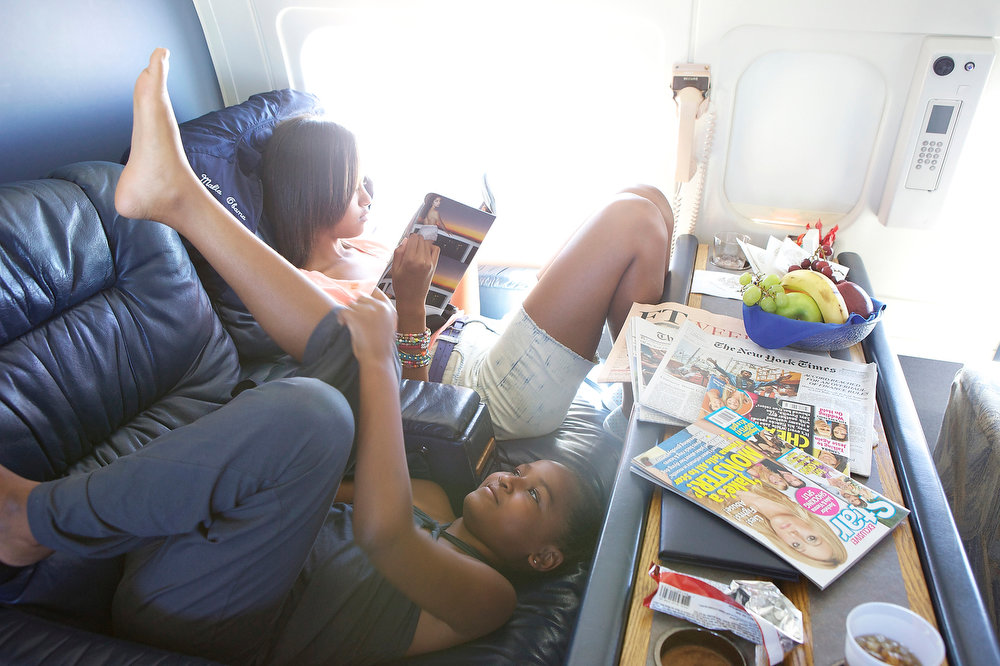
@Samantha Appleton, “First Girls.” First Daughters Malia and Sasha Obama relax on a flight with their mom, First Lady Michelle Obama. Their parents tried to normalize their kids’ lives despite the significance of living in the White House, and its security and travel apparatus. As the first African American First Family, every day was history.
What sort of things sustained your practice until you got the Guggenheim? You mentioned that you were a single mom and juggling a lot of things, and that it was a tough time for photojournalists.
Being inspired by my friends and colleagues. Going to museums and shows and reading books. I went off Instagram for a year. I didn’t take my account down. I just didn’t look at it, and I didn’t post anything for a year. That was following Donald Trump’s election. I just couldn’t look at anything. Everything felt hollow to me. Every ad, every vacation picture people posted, every political thing somebody posted, even the activist stuff that I agreed with. I just couldn’t do it. I just found it the opposite of inspirational. I started getting up in the morning, having my coffee and I would knit for a little bit or go to the museums or read more. Getting off the [Instagram] cycle and getting back to the things that inspire really helped me enormously.
What kind of impact do you think the Guggenheim fellowship will have on your work, your career?
It’s like a stamp of approval, like I’m on the right path. I see it like an express elevator to – I’m not exactly sure where yet. But I find that it allows me the space to create the work. Also having the auspices of an organization is so helpful because it’s a shorthand way to say – this idea has been vetted, my career has been vetted. I think that shorthand is enormously helpful in the art world, in particular, but in other worlds too. My contractor who is doing a renovation at my house was aware of it. He commented on it and he was happy for me.
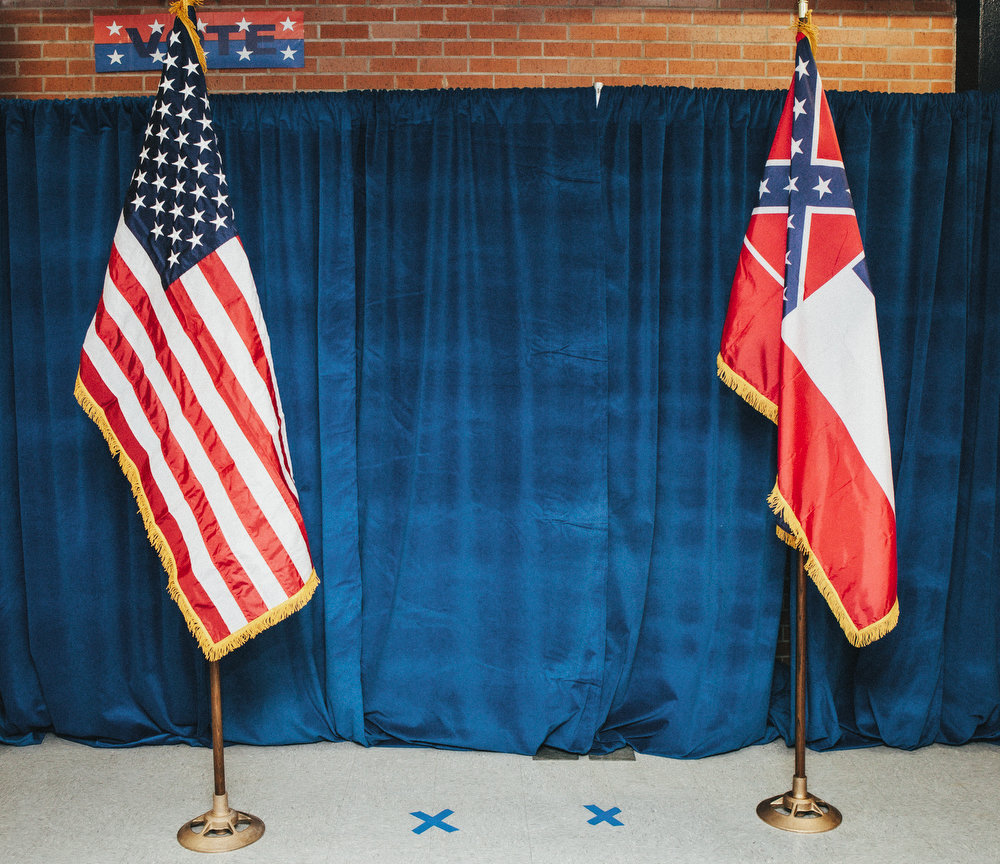
©Samantha Appleton, “Mississippi.” Flags await a photo op with First Lady Michelle Obama in a Jackson, Mississippi elementary school. She was there to promote her “Let’s move!” campaign. Mississippi is firmly a red state and, despite its 38% black population, has flown a flag with Confederate insignia since 1894.
The project you’re working on is called “Bones of our God.” Can you describe the project and the origin of the name?
This is where it connects to the previous project that I applied for. It’s about American mythology and who are our gods. Our gods are things like capitalism and individualism. Patriotism itself is a uniquely American thing. When people from other countries come here they’re amazed that the American flag is so ubiquitous. Growing up here, it’s like – Don’t people in France do that? Don’t people in Vietnam do that? No, this is a very American thing.
I’m reading a book called “Darkology,” about blackface in America. It’s such a good book. It outlines how so many things in American culture come from the minstrel shows and blackface. Songs that we grew up singing like “Oh Susanna,” songs that I thought were just innocent folk songs actually came from that tradition. So I am looking at things like that.
What did we grow up thinking was culturally important? What are the roots of these cultural things, and do they deserve to be held up? Those kinds of questions are where that term the “bones of our god” comes from. We’re not old enough to have developed anything like Greek mythology or the imperialist mythology that England has. But we have other mythologies.
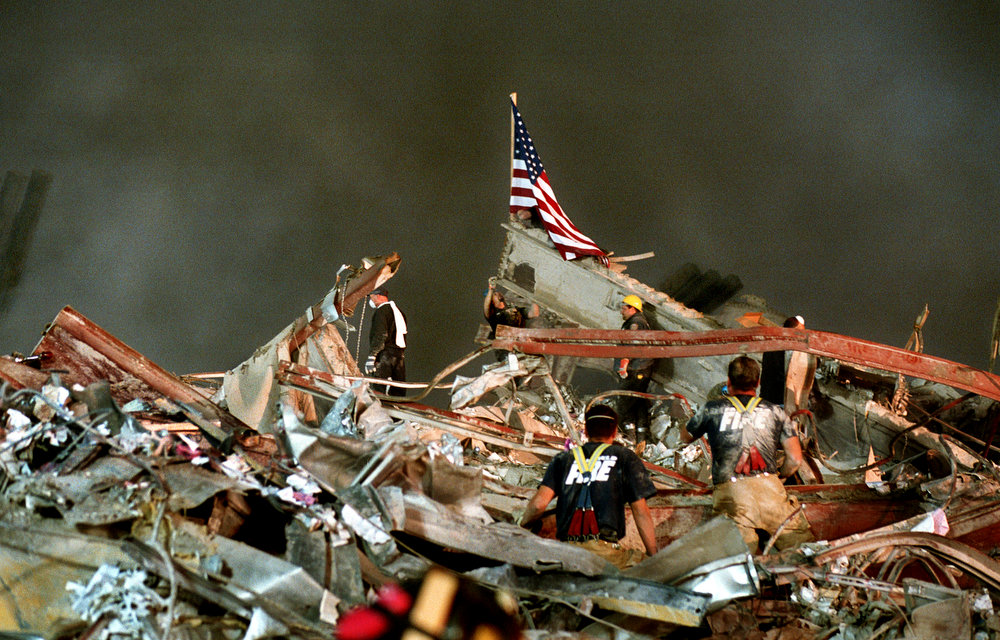
©Samantha Appleton. “First Responders.” Searching for bodies in the rubble on the night of Sept. 12, 2001 in New York City.
One of our mythologies is The Great American Road Trip. I love that you are structuring your exploration around a series of road trips. Can you talk about that a little bit, including how you are deciding what to focus on?
The road trip is such a manufactured mythology, but you can know that and still love it. It’s intertwined with the creation of the road system and with car manufacturing and with manifest destiny. So it’s like the ultimate god of our country. People from other countries come here to do a road trip.
In this polarized environment, I try to think about what is the unifying thing that brings Americans together. What is an American? I really have trouble finding what that is other than this incredible geography that we have. If you just focus on the geography, it is so unique in terms of its diversity. And the road trip is the only way that you can experience it. But it’s such a huge net. If you could see my first list, it was hundreds of places and things that I want to photograph. Now I am editing brutally. I’m keeping the net wide. but I’m starting to let things go.
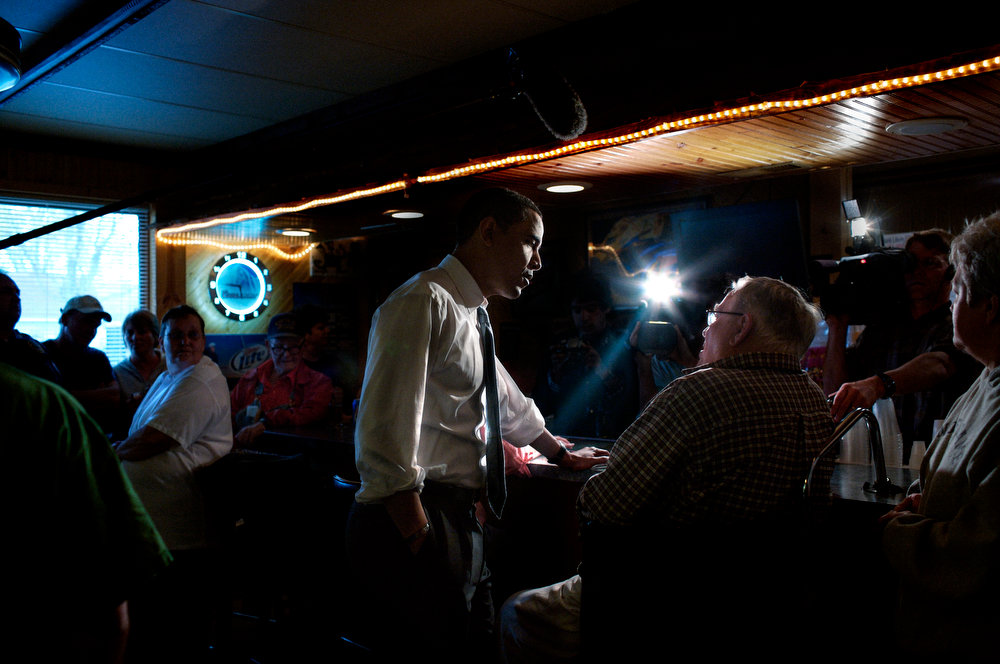
©Samantha Appleton, U.S. Sen. Barack Obama campaigns at a Veterans of Foreign Wars (VFW) hall in North Liberty, Indiana. Barack Obama was a relative unknown in 2004 and thus did not have the political baggage of the Senate vote to authorize the War in Iraq [His presidential campaign rivals, Senators Hillary Clinton and John McCain, did.] His campaign was a fresh page and benefited from Americans’ frustration with an unjustified war.
I’ll give you an example. We went to Alabama and photographed the Clotilda, which was the last known slave ship to the U.S. Although the government had banned the importation of slaves in the early 19th century, the practice continued illegally until the Emancipation Proclamation. They were very much African immigrants, and they wanted to go home. But they could not afford to go back home to Africa, so they started a town called Africatown. There are still descendants that live in that area. There’s even an audio of one man named Cudjo talking to Zora Neale Hurston about being taken from his village, the Middle Passage and arriving in the U.S. It’s incredible that there is an audio of him, that it was the writer Zora Neale Hurston who interviewed him, that he survived to tell his story. Thank God Zora Neale Hurston was an anthropologist, that in addition to being a phenomenal writer, she did this act of preserving history. I mean my mind is blown by it.
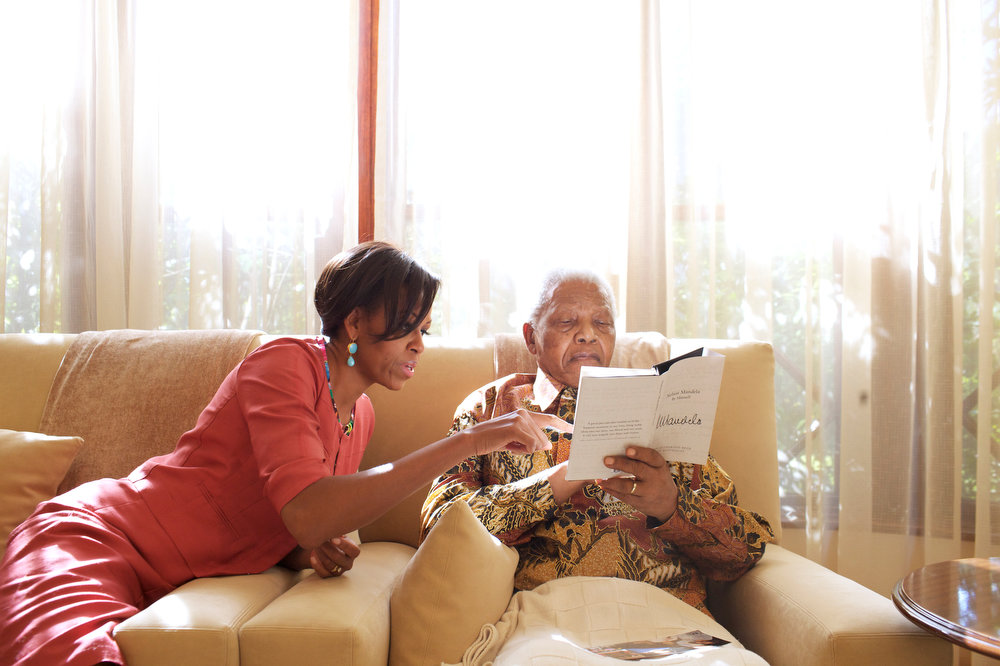
©Samantha Appleton, “Mandela.” First Lady Michelle Obama sits with Nelson Mandela in his home in South Africa in one of his last public photographs. Barack Obama and Nelson Mandela were both awarded the Nobel Peace Prize for their extraordinary leadership in multicultural cooperation.
You talked about this project being a conversation with the public. What sort of questions do you want to tackle?
As we got into the Deep South, there were a lot of Confederate flags everywhere. And I want to know – What does that mean to people? It’s too easy to just say, oh it’s racism or whatever you want to say. But I want to have a conversation with people so that they can express what that means culturally to them.
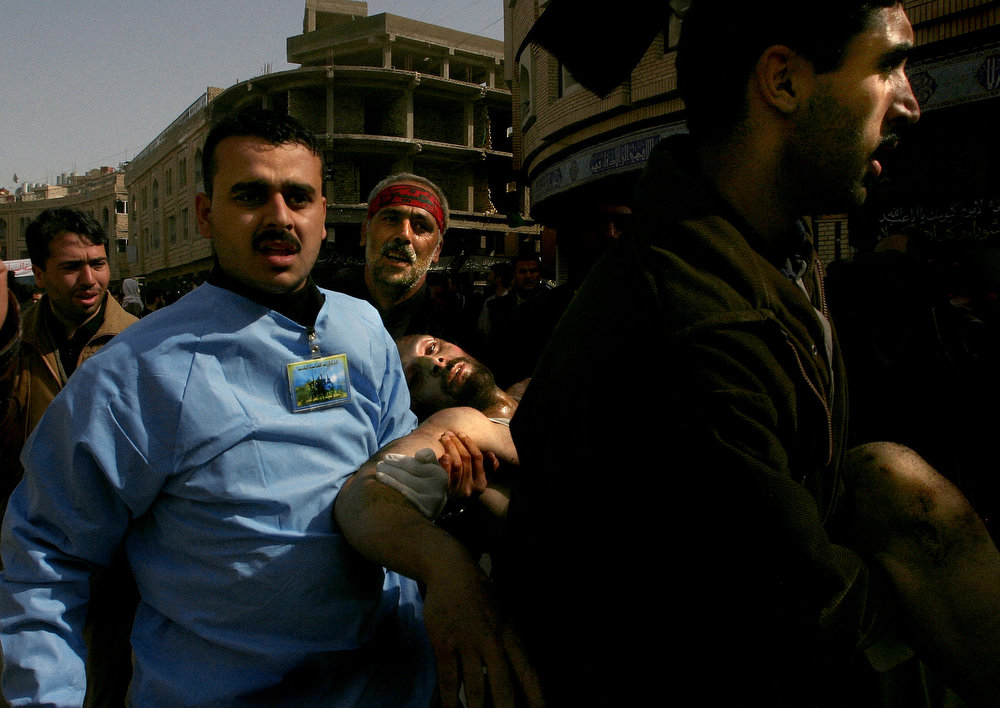
©Samantha Appleton, “Bombing.” A man is killed in a series of suicide bombs in Karbala, Iraq on the holy day of Ashura. More than 200 Iraqis were killed that day, and the attack was a key escalation in the Iraqi civil war. Sunni insurgents known as Al Qaeda in Iraq, were, in a cruel irony, formed in response to the initial 2003 invasion, which was based on the fallacy that Al Qaeda was in Iraq.
I was particularly intrigued by your project because I am intensely interested in the current national debate over how history should be told. How do you see your role in this debate?
It wasn’t the inspiration for this project, although the timing may very well have helped me get the Guggenheim. I’ve always been in fear of history being rewritten, but I never thought we would go backwards. So the fact that it’s going backwards and some are trying to claw back the recognition of things like slavery is shocking. Even though there are museums to tell these stories, I feel that in 2026, I have to put a flag in the ground. The very first stop we made for this project was in Philadelphia. We walked into Benjamin Franklin’s house, and there were signs that said that due to Executive Order xxxx, these panels were taken down. It was the very first thing we saw.
Then we went to Fort Sumter a few days later, and the same thing happened. The panels weren’t as explicit about why they were taken down, but you could see the wiring where they took the video monitor down. Fort Sumter is basically the start of the Civil War. So it’s fascinating.
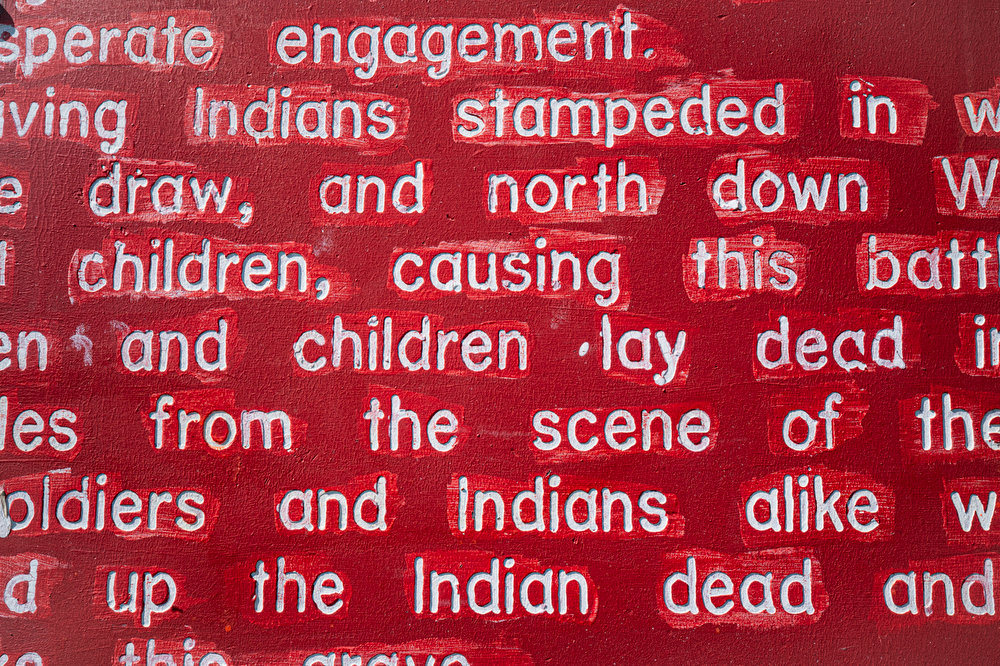
©Samantha Appleton, “Thunder Valley.” A hand painted sign at Wounded Knee, the site of one of the bloodiest and last massacres of indigenous Americans in history, is the only marker of the historic place. In December 1890, the U.S. Army escorted hundreds of Lakota to a creek miles from their home to assuage the anxiety of nearby white settlers. They then opened fire killing 268 children, women, and men. Nineteen U.S. Soldiers received the Medal of Honor for the massacre – the military’s highest honor. The Pine Ridge Reservation site has a small rudimentary graveyard and one sign, but little else, despite being a National Historic Landmark designated by the U.S. Department of the Interior.
So let’s say you’re driving through North Dakota. Do you already have a story in mind? Have you already spent time researching it? Or are you just looking for one?
It’s a little bit of both. I can’t answer for North Dakota yet, but I could tell you about South Dakota. It a fascinating part of our history. In my Guggenheim proposal, one of the things that looms very large is Wounded Knee, which was one of the largest massacres in American history. I went to see it maybe five years ago. That trip was not part of this project, but it was one of the inspirations for this project.
There is a little cemetery, with a rudimentary metal fence around it. And there is a hand painted sign, as if it’s just this tiny thing that happened, when in fact it’s so significant that it changed the course of American history. It was a massacre, an absolute human rights violation, and yet we’re not honoring it. So that is a situation where I know it is important in our history, but I don’t know exactly how it needs to be raised up. So that was a big inspiration for me. That graveyard could go away. That whole area could be commercialized in the wrong way. So that’s where the mystery of the project comes in. I don’t know what I’m going to find when I get there.
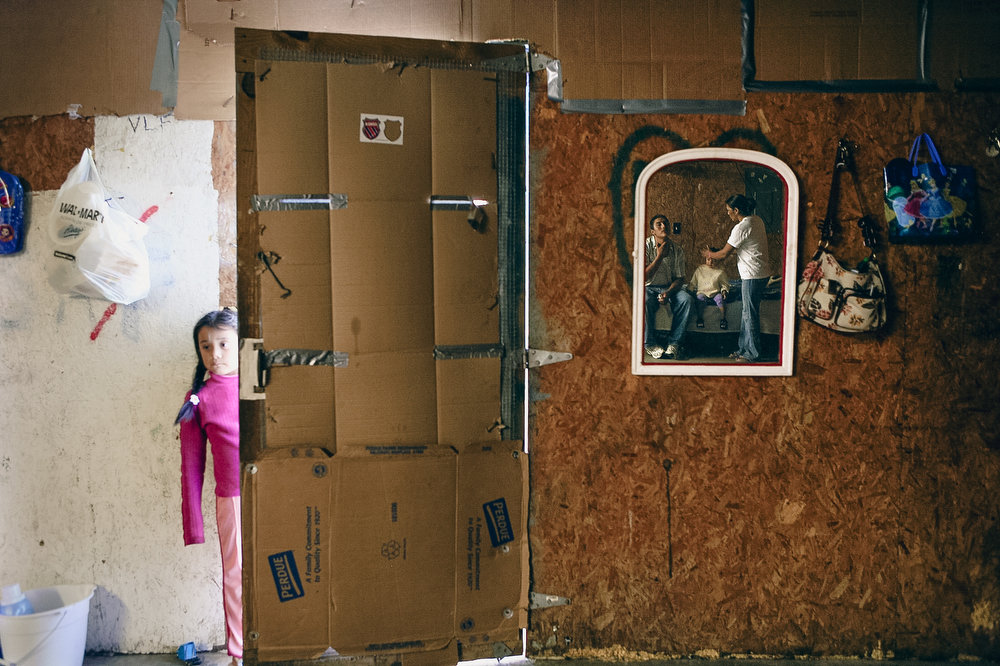
©Samantha Appleton, “Migrant Family.” An undocumented migrant family, and their American-born children, live in rudimentary housing on a farm in N.C. Despite the political rhetoric to the contrary, undocumented people in America commit fewer violent and non-violent crimes than American-born citizens. Laborers with full time work can often barely afford housing and when they find it, there is little recourse if it is not up to legal standards.
In some ways, it’s like being a foreign correspondent. You do research, figure out where you want to go, and then you get there and discover things with fresh eyes.
I find that as I’m older now and more entrenched into a certain race and economic class, I do feel like a foreign correspondent in this country. I feel like a foreign correspondent when I hang out with teenagers or elderly people or whoever. This country is so vast and so diverse culturally and racially, that it really is like dropping into another country.
Since the beginning of this year, historical projects like this quickly become political, especially with things like the ICE raids. It took a long time to say that the Japanese American internment camps were wrong. But to be able to say they were wrong and then go and have these detention centers is wrong. If you don’t talk about the internment camps or slavery, or a school with a history of abuse in Florida, which I photographed, If you don’t talk about those things, then you’re saying that it’s okay. So to recognize again and again what was wrong in our history helps give us the tools to push back against things that we find wrong in our present.
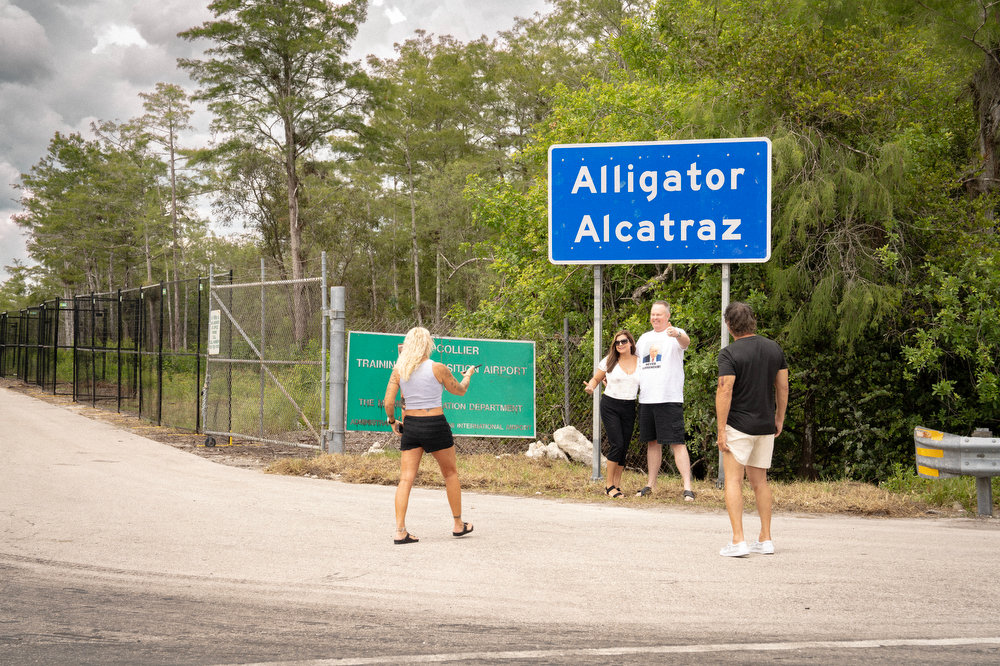
©Samantha Appleton. “Alligator Alcatraz.” Florida residents celebrate the newly-constructed “Alligator Alcatraz,” a highly controversial federal immigration detention center in the middle of the inhospitable Florida Everglades. Just over a year later, it was officially closed after local outcry.
Do you want to talk a bit about the notorious reform school in Florida that you recently photographed?
Yes. To say it’s a road trip is to kind of put a cute title on it but really it’s about looking at the dark and the bright corners of America. One of those dark corners is in our recent past, which is the Dozier School for Boys, which was mostly for – I don’t know how outdated this terminology is but – juvenile delinquents. The school existed until 2012. There were tons of abuse allegations and in 2012 they found a mass grave of 81 sets of remains, and there are still eight sets that have not been identified. These were very poor kids that did not have families that could provide for them. These kids were forgotten by American society. When you have an individualist society, as we do, that’s one of our gods, the result is, those who can’t keep up are shunted off into a school like this and forgotten.
It’s just so profoundly sad, but it’s important to recognize that because there are other institutions of abuse that are happening right now. So if you don’t shine a light on that one, you’re never going to save someone else or help reform some other institutions that is abusive.
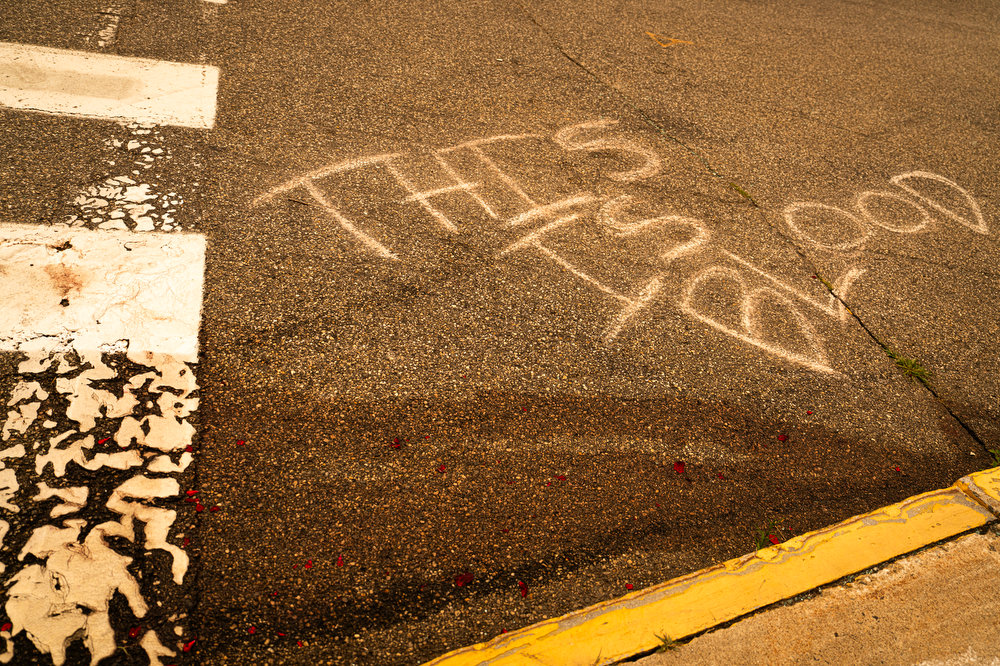
©Samantha Appleton. “Migrant Murder.” Two days after ICE officials murdered legal immigrant Joan Sebastian Duran Guerrero, his blood is still visible in the street in Biddeford, ME.
You said you were photographing both the dark and the bright corners of America. What are the bright ones?
Oh my gosh, this would have been such a different answer 10 years ago. Having worked for the Obama administration, it just felt like things were advancing. I’m feeling very political today, but this project is not overtly political.
One thing that I have loved in my travels is that I’ve noticed on the overpasses you see people protesting. Here in Maine, our winters are brutal. Yet there are people up on the bridges, sometimes it’s just one person. They’re holding up a “No King’s” flag or whatever. And I’m thinking: Thank you! Thank you for doing that work. Even if I don’t agree with you or I do agree with you. There’s something so beautiful about that courage and conviction to do that. I love that about our country.
I love photographing caucuses and primaries. That’s how I got to know President Obama. I love the town halls. I remember going to one in New Hampshire with Mike Huckabee, who was running for president in 2008. It was a spaghetti dinner. He sees me and hugs me and says, thank you for coming. I was the only journalist at this at this spaghetti dinner. His earnestness was so powerful to me.
What do you hope will happen to this project? A book, exhibition something else?
I’m talking to a designer right now about doing a handmade book, something highly crafted with limited copies. I want it to be acquired by institutions and viewed as a historical document. As I travel, I am also collecting the kind of ephemera that is very 2026, like receipts, hotel key cards, things that are going away. I want it to be preserved as a document that says, this is how we felt about these subjects at the time.
Posts on Lenscratch may not be reproduced without the permission of the Lenscratch staff and the photographer.
Recommended
-

Guggenheim 2026: Samantha AppletonOctober 9th, 2026
-
Guggenheim 2026: Chris Aluka BerryOctober 7th, 2026
-

The 2026 Center Awards: Callanan Excellence in Teaching Award: Andrew PattesonSeptember 18th, 2026
-
The 2026 CENTER Awards: The Me and Eve Award: Peter TehSeptember 17th, 2026
-
The 2026 Center Awards: ENVIRONMENTAL AWARD: Volodymyr VoznyySeptember 16th, 2026