PHOTOGRAPHERS ON PHOTOGRAPHERS: DAWN ROE IN CONVERSATION WITH BRIDGET CONN
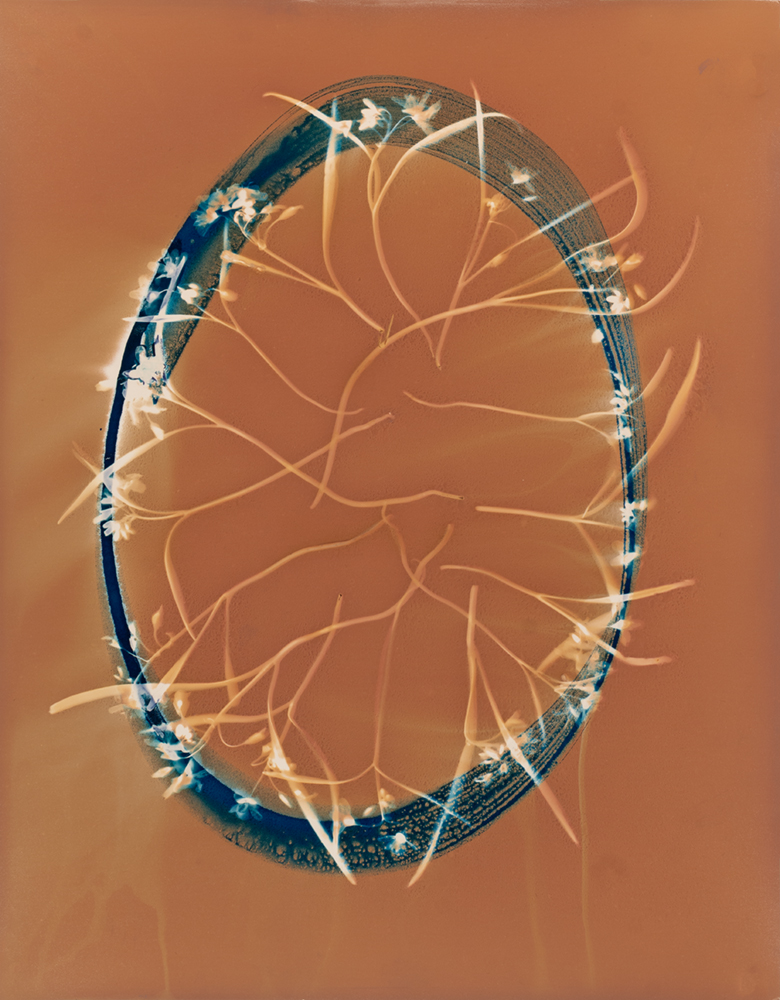
©Bridget Conn, Spring Ephemeral (Virginia Springbeauty); fixed silver gelatin cyanolumen print; 14” x 11”; 2026
Bridget Conn is a photographic artist who explores the potential of photography as a chemical and physical medium through cameraless experimental processes. Dealing with themes of societal struggles, awe and wonder, challenges in communication, digitized vs. physical encounters, and the importance of making and admitting mistakes, Conn investigates the boundaries of photography with prints, wall installations, and sculptural works. She received her BFA from Tulane University and MFA from the University of Georgia. She currently resides in Nashville, Indiana, USA.
Conn’s awards include Klompching Gallery’s FRESH 2022 exhibition finalist, rfotofolio’s 2021 Denis Roussel Awards, and being shortlisted for the 2023 and 2024 Denis Roussel Fellowship. She has exhibited at Gallery 1/1 in Seattle, the Center for Fine Art Photography in Fort Collins, CO, the Griffin Museum of Photography in Winchester, MA, Candela Books + Gallery in Richmond, VA, The Halide Project in Philadelphia PA, and Sparks Gallery for the Medium Festival of Photography in San Diego. Internationally she has shown in the Chiang Mai Photography Festival in Thailand, the Institute of Photographic Studies of Catalonia in Spain, as well as venues in Italy, Hungary and South Korea. Her work has been featured in Analog Forever Magazine, The Hand Magazine, Exposure Magazine, Aeonian Magazine, Focal Plane Journal, and in Christina Z. Anderson’s 2022 book “The Experimental Darkroom”.
Conn is the founder and former director of The Asheville Darkroom in Asheville, North Carolina. An enthusiastic educator, she has taught workshops at the Penland School of Crafts in NC, through Penumbra Foundation in NYC, at The Experimental Photo Festival in Spain, at conferences for the Society for Photographic Education, and at numerous colleges, universities, and art venues across the US. She is currently establishing The Experimental Photo Kitchen, a darkroom teaching facility on her property in southern Indiana.
Instagram: https://www.instagram.com/bridgetconn/
Dawn Roe: Hi, Bridget! I’m very excited to have this virtual conversation with you as we’ve been in each other’s photography and friendship lives for many years now. I’ve structured these questions to span a range of time, giving you space to reflect back on how earlier and more recent works have informed aspects of your current practice.
Bridget Conn: Hi Dawn! Thanks for these great questions, and for years of wonderful conversations about art. I miss our snack-filled crit group from Asheville! Those were the days.
Dawn Roe: Indeed they were! Let’s start our chat by discussing a fairly recent series of yours, Control, begun in 2023 and ongoing. These works exist somewhere on the edge of a sort of organized structural form (the repeated smaller, rectangular shapes situated within the larger rectangle of the parameters set by the dimensions of each individual sheet of paper) and a more chaotic suggestion of inner worlds (the unpredictable gestural patterns within). You describe these tensions manifesting as “documents of sincere efforts to harness a rectilinear shape, as organic ‘mistakes’ intrude” and further describe the work being “driven by concerns of control that women have over their bodies, that trans individuals have over their health, and that conservative governments are placing upon education.” I love how you seem to challenge the very notion of “control” in this series, as you say, with sincerity. Can you share a bit more about how these overlapping concerns influenced the work?
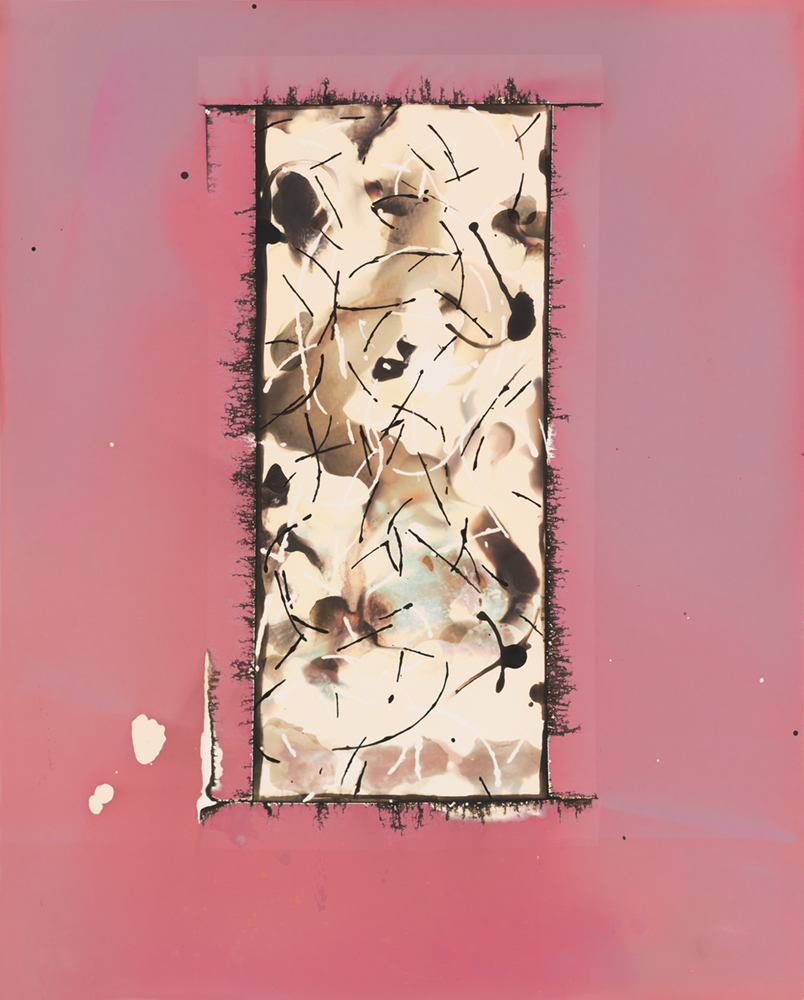
©Bridget Conn, Control #19 (08/24); fixed silver gelatin chemigram / unfixed lumen print; 10” x 8”; as documented in 2024
Bridget Conn: Starting with the first Trump administration, I became quickly overwhelmed by headlines and found it impossible to digest and process even one horrific event before another five would occur. It’s never been in me to pick up a camera and try to directly document the people most impacted by the administration’s actions – this has never really been my relationship with photography, and I think there is some anxiety thrown in there that I’m trying to work through. So I kept searching for a way to talk about these impacts by using as personalized and broadly-interpreted language that I could. Control began as the ultra-distillation of years of working in this way – feeling so overpowered by everything that has happened over the last 10 years that there was nothing left for me as a method of expression other than pure non-representation. I just kept trying to get to the core of how all my recent bodies of work had connected to each other, and I arrived at these ideas about the concept of Control connecting them all.
From a technical standpoint, I have been working with the chemigram for many years and am interested in exploring its variety of forms. I find that most people turn to chemigrams for a practice in liberation, so I started wondering what it would look like to flip that idea on its head and really try to control the visual outcome. When I saw the results I got by trying to keep that chemistry concentrated on the center rectangle or square, it just felt like this perfect visual refinement of all the issues our society is coping with. But it also references trends I observe in the art education world where a lack of control with art processes are a welcome alternative to our information-fueled lives, which is such a different approach than I received in school. That is reflected in the outer area of each piece being an unfixed lumen. I think our society is so full of “correct” answers with access to information that mistakes have become celebrated in the art world. So I kept exploring different types of silver gelatin paper, different resists, different methods of applying chemistry all while contemplating this push and pull of control that we either have to endure or wish to avoid. And of course, in trying to make these rectilinear forms “perfect”, the chemistry usually spills over, despite me trying my best to contain it. I had a little mini breakdown one day while creating some of these pieces – it this almost ridiculous action to try to keep a few milliliters of photo chemistry in one spot on a piece of paper – yet it sort of hit me all at once that nothing is ever truly in my control, despite my constant efforts to keep my life running smoothly with plans and calendars and whatnot.
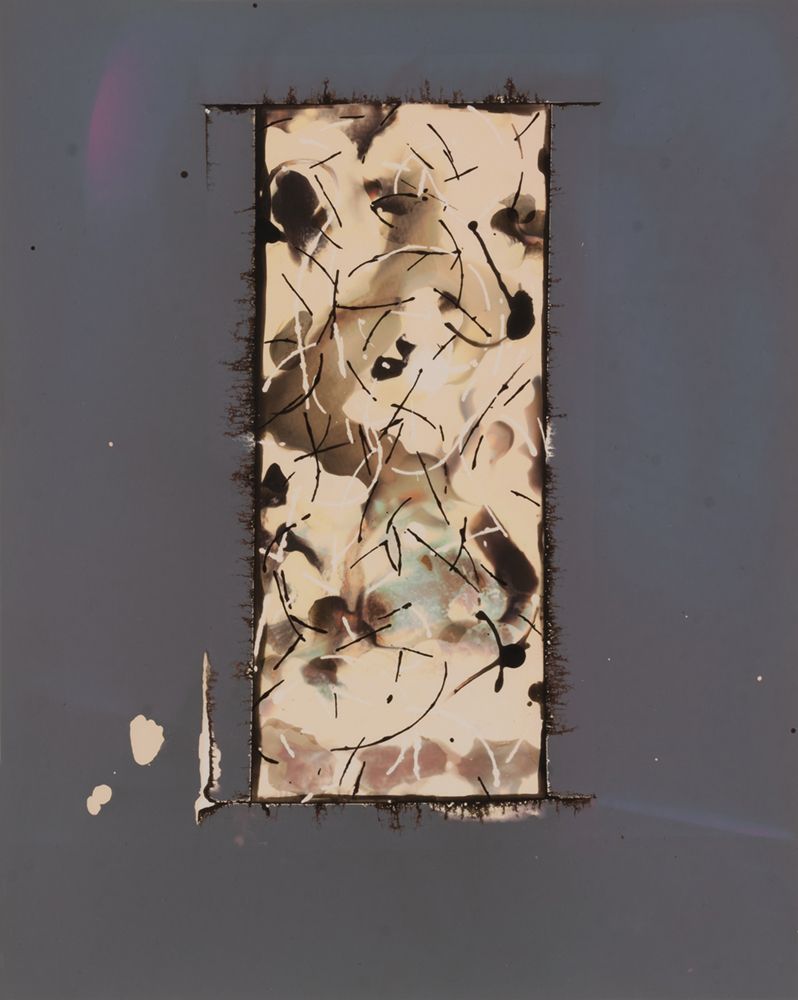
©Bridget Conn, Control #19 (01/25); fixed silver gelatin chemigram / unfixed lumen print; 10” x 8”; as documented in 2025
Dawn Roe: I love hearing all of this, it’s really nice to get a sense of how such seemingly disparate concerns manifest themselves in this project. And, as a fellow arts educator, I can very much relate to the welcome lack of control in certain art processes as being a nice counter to the expected precision of a “right” answer, or outcome. Yet, there is still/always a struggle to negotiate ingrained expectations. The push/pull of these internal/external processes also comes up in a work of yours from several years ago, Leaving Piece (titled in response to one of Yoko Ono’s instruction-based pieces from the 1960s). I wrote about this work for a little catalog I put together as part of the group exhibition, a thing re | sembling a win • dow, in Asheville, North Carolina in 2016. About the piece – a series of sewn together, chemigram prints forming a grouping of long scrolls that stretched from floor to ceiling before unfolding along overturned pedestals on the floor – I wrote that, “each individual image persists both as a recording of a unique situation and a manifestation of a secondary encounter, its form resulting from a chance response to photo-chemical processes” and suggested that, these works emanated from “the enactment of seemingly mundane repetition, re-staged and rigorously examined until something entirely new emerge[d].” I wonder how this read of your work sits with you now, strangely enough, exactly 10 years later, as you embark upon a different sort of response to the beautifully strange repetition of leaf and branch forms encountered within the natural spaces surrounding your new(ish) home in Indiana?
Bridget Conn: I’ve used repetition in my work for a very long time. I feel like it initially began as a sort of reference to prayer, which I like to think now is more like manifesting or conjuring. Repetition is also how I learn effectively. I know it’s really frowned upon now, but when I am trying to learn a foreign language, I still want to write out those verb conjugations five times, the way I learned Spanish decades ago. The repetition involved in Leaving Piece was a little bit more of a technical exploration at the time. Even though it was early on in my chemigram career, I still found myself wanting to explore its restrictions by using a silkscreen to make a chemigram of a chemigram – taking an experimental photo process that was inherently unique and applying the traditional reproducibility of the photographic medium to the technique. Of course, no two resulting chemigrams could still be alike. Leaving Piece was also the start of my exploration of the gestural mark as a symbol of the present moment – that it could abstractly represent my mental state and physical environment around me.
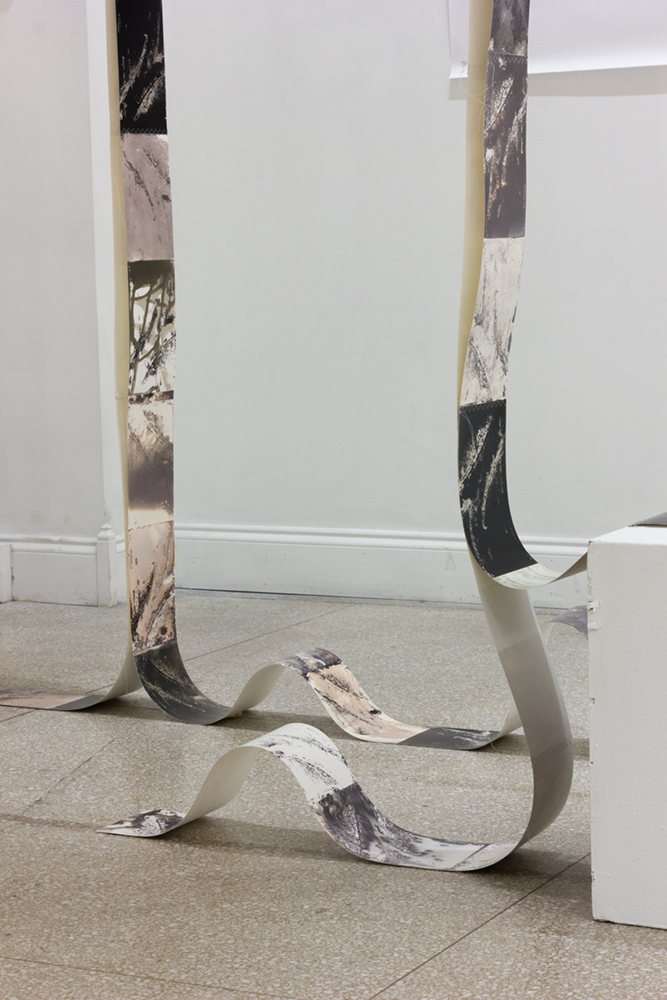
©Bridget Conn, Leaving Piece (detail); silver gelatin chemigrams, thread; 5 sections, 5″ x 24′ each; 2016; installed at the Asheville Area Arts Council Gallery at the Grove Arcade, Asheville, NC
I suppose there is a repetition to the plant life I am currently using to explore my new environment in Indiana, but I don’t think about it as the same type of repetition I’ve used in the past. In this newer work I’m documenting what is emerging on our 5 acres as we let the land grow wild and do its thing, so I feel I’m subject to whatever the land wants to give me, rather than ordering the results. In my upcoming solo exhibition though, I would say my piece 90 Days deals with repetition, although this is in the form of words. I exposed a piece of silver gelatin paper to mylar with the words “the time is now / now is the time” every day that I was at home over the course of, roughly, a season (90 days). Each of the 69 prints are made with the same brand and surface of photo paper, and becomes a visual document of that day’s environmental conditions. I like the subtlety of that phrase depending on the direction you read it – either literally drawing attention to this moment in which to be present, or it serving as almost a call to arms for paying attention to the various problems we need to combat in American society.
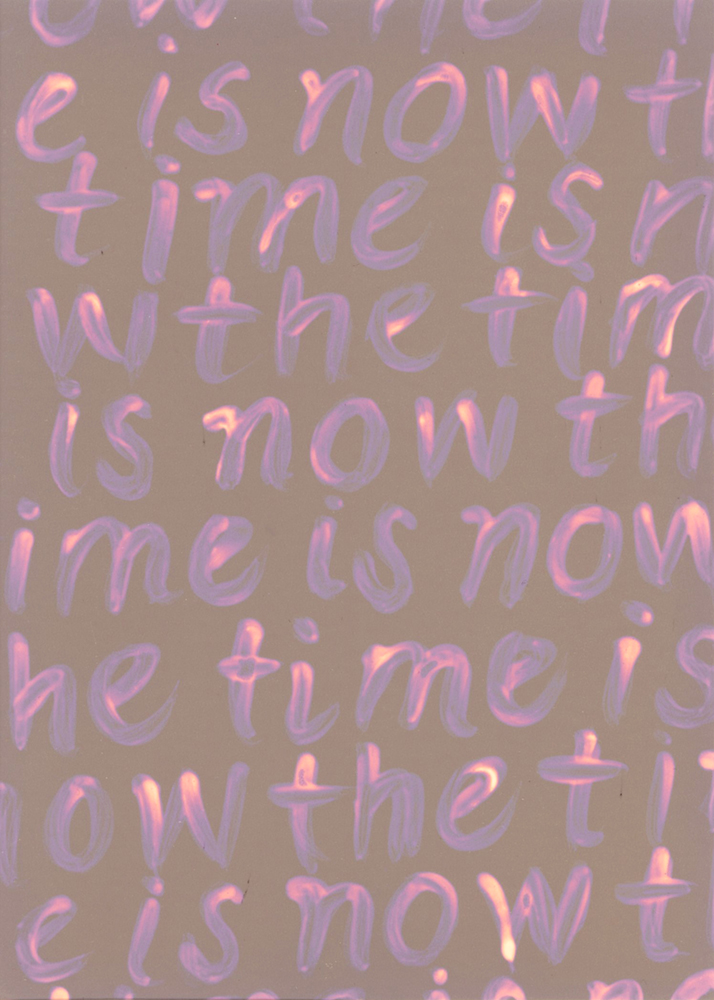
©Bridget Conn, 90 Days #3 (detail of wall installation); fixed silver gelatin lumen print, 7” x 5”; 2026
Dawn Roe: Right, I can see how this play on human-generated language in the form of a (seemingly) simple phrase with inherently multiple meanings can seem different from the language that emerges from plant life. It’s interesting to think, though, about whether the plants in their repetitive leaf or vine patterns might be uttering something similar. This makes me think a bit about your use of the sewing machine – another repetitive pattern shows up here, the stitches forming their own kind of abstract language perhaps – a kind of wild bridge between technology and the human hand. You’ve been using this method of stitching prints together for some time now as a means of bringing them into various forms of relation. And, there also seems to be an emphasis on both fragmentation and (re)connection in these sewn together amalgamations – the imagery is somewhat disrupted yet brought back together with an almost deliberate emphasis upon the rupture. How do you go about considering what sort of composition results from the eventual arrangement of components that form the final, stitched together piece?
Bridget Conn: Yes – I love sewing photo paper for many reasons, and am rarely trying to hide the thread. I use the thread to try to support the use of photo paper as a sculptural material. But the resulting visuals definitely reference fragmentation, especially in some of my works from the late 2010s, where the words / letterforms I was using were a bit more overtly political. It’s the biggest understatement in the world to say there is so much division in our country, yet our states and life experiences are bound together in this same disjointed way, for better or worse. In those works like Mantra #5 (Persist), I spent a lot of time considering the composition as I rearranged cut prints to create optical movement in the composition. Often that consideration would take weeks as they would be laid out in my studio and I kept revisiting them. I don’t want there to be too strong of a singular focal point. I prefer it to be more like a Pollock painting, where you’re just swimming around inside of it, and perhaps have multiple entry points for the composition. I think this also relates to how I try to approach my work conceptually in that I try hard not to direct my viewer into a singular “correct” read of my work. Perhaps some people get into the political reasons that drive me once they move past the aesthetics, or maybe they don’t.
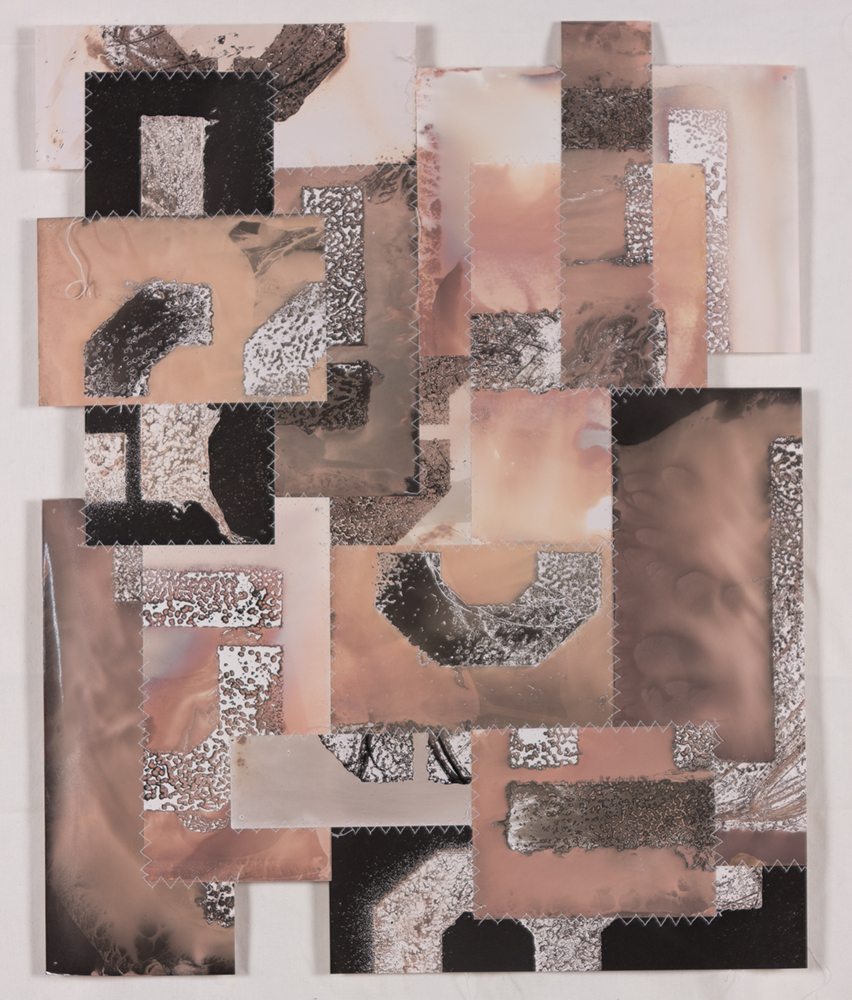
©Bridget Conn, Mantra #5 (Persist); silver gelatin chemigrams, thread; 20” x 16”; 2020
The approach to the compositions of the newer sewn work, like in New Land Studies, is actually completely different. Because I am making lumen prints that reveal more of an identifiable object, the plant matter has to lay on top of the connected paper, which is frequently pre-sewn before the print is chemically-treated. So for these works, I have to do a bit more pre-planning, in that I study the color palettes of different photo papers when used for lumens, in hopes that I’m constructing a piece that will create a similar type of visual movement. Needless to say, not all of them are successful, and it’s a lot of work to cut, sew, expose, and process a piece whose final composition is somewhat a flop. Although, I’m just starting to experiment with using toners and bleaches to try to coax some of the compositions back into something I want. So again, a dance between control and lack of control.
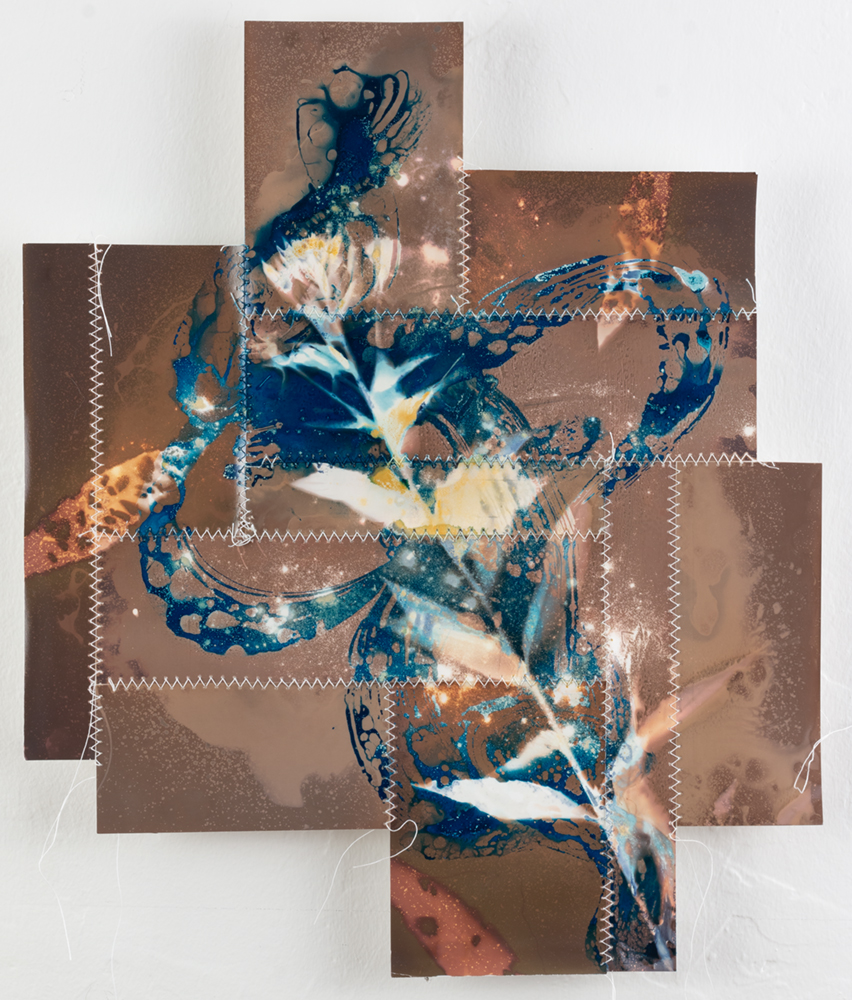
©Bridget Conn, New Land Studies (Evening Primrose); partially-fixed silver gelatin cyanolumen print, thread, turmeric; 13” x 11”; 2024
Dawn Roe: I’m picking up on such a beautiful reverence for the plant life in this response, Bridget. And, of course this makes sense – you are beholden to something outside yourself in these works that go beyond chemically or bodily produced abstractions. There is also an interesting reference to maps and borders that came through (for me) in your description of the disjointed image components. I often find myself pondering the absurdity of territorial lines drawn on maps that are of course entirely invisible – especially to plants and animals! I wonder if the plant’s capacity to encroach upon space is something you are thinking about at all?
Bridget Conn: I really appreciate you seeing this reference to maps – maybe this is bubbling up from my subconscious because I have always loved randomly studying road atlases, taking geography quizzes, getting lost in US interstate maps. As a grad student I spent a month in Ghana, and I couldn’t escape the Paul Simon song “Under African Skies” living in my head as I gazed upward. And even though there is no hard science behind an African sky versus an Australian sky, it’s difficult to not melt into the poetry behind the idea. So I can live with the contradiction of nerding out on maps but also realizing their arbitrariness, and that plants have no regard for our rules. Even on the microcosm of our hill, I’m amazed at how the plants are just taking over any possible space and transforming the landscape into something that looks like an entirely different location in the winter. Right now I’m at an impasse with our gravel driveway – it’s nice for people to understand where to drive a car, but I’m also not wanting to kill off this variety of plants that most would write off as “weeds”. I remember being told as a kid that weeds were less valuable and I shouldn’t get excited about picking them for bouquets, which is a concept that never sat right with me. I’m working with a lot of these “weeds” in my wall installation Hill Diary, which I’ll discuss more later in our conversation.
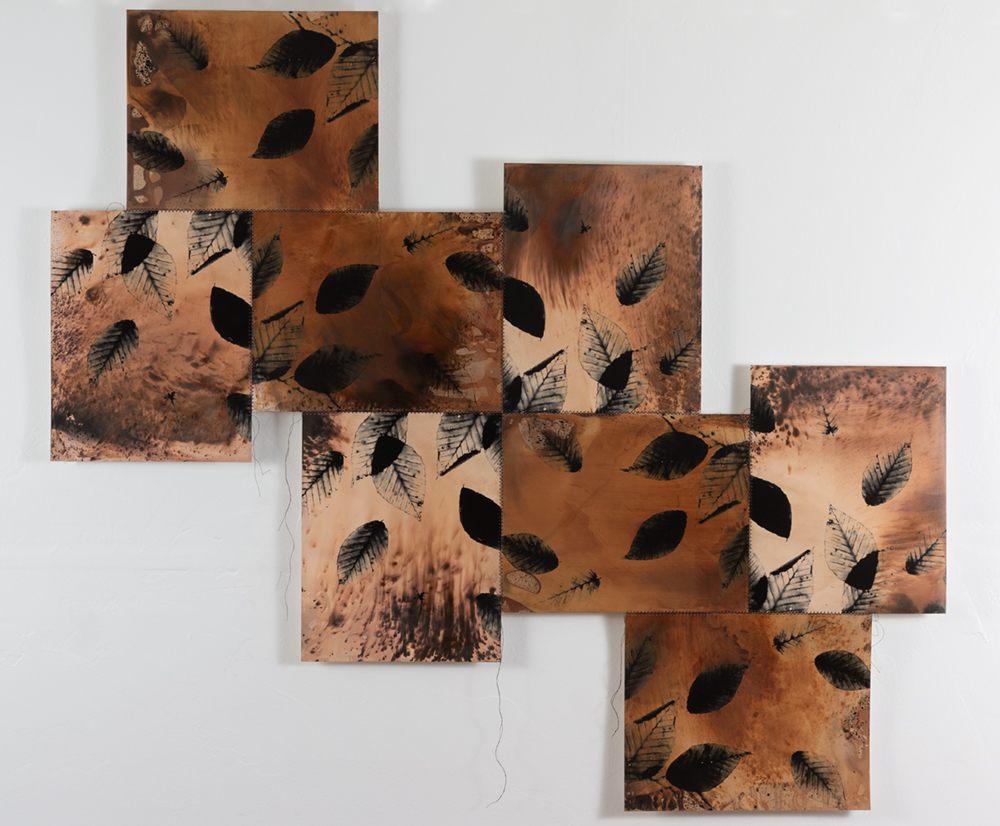
©Bridget Conn, What Remains in February (Beech); silver gelatin chromo prints, thread; 32” x 36”; 2026
Dawn Roe: I also want to be sure we devote at least a bit of space to consider the particular aesthetic qualities of the cyanolumen process, and how it emerges in your work. There is just something incredibly captivating about the combination of deep, Prussian blue specific to the cyanotype process and the rich, warm red, oranges, and browns of the lumen process. In some ways, this introduces a slightly different palette to your overall body of work. How are you responding and reacting to these colors and tones?
Bridget Conn: Chemigrams were my starting point for considering the range of color that is possible from black and white silver gelatin paper. Being that I had a traditional darkroom education, the idea that this paper could produce and retain color was absolutely fascinating to me. While it’s possible to get blue from a silver gelatin chemigram, you’re right – it’s just not that same alluring blue that belongs to the history of photography as cyanotype. I see it as just an expansion of what is possible with analog photo materials, and I’m more interested now than I’ve been in the past to see what all those color possibilities are. I know some viewers of my work won’t get the societal and political observations that drive my practice, especially in the face of abstraction. I think if I can use an aesthetic quality such as color as an entry point to my work, it can only help open the conversation. So I’m happy to welcome a variety of color when the weather conditions allow for it.
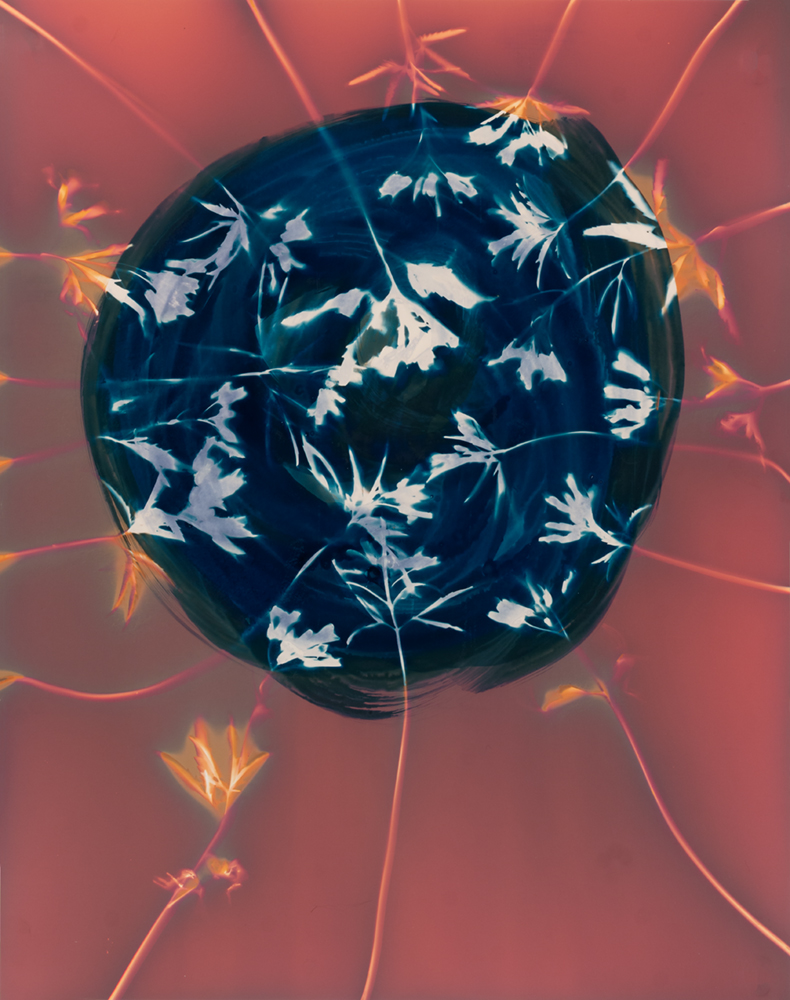
©Bridget Conn, Spring Ephemeral (Cutleaf Toothwort); fixed silver gelatin cyanolumen print; 14” x 11”; 2026
Dawn Roe: I’m lucky enough to have been part of your world when your initial chemigram experiments began during the fantastic early days of the Asheville Darkroom. You shared early prints at several group critiques and I remember you working through how to deploy the language of abstraction in these works, and also thinking through what was happening with the sort of gestural lexicon you were developing (no pun intended!). There is a conversation to be had related to the more recognizable forms of plant life in the recent pieces discussed above – though I understand you still consider these as participating in the realm of the abstract (as do I) – but I wonder how these earlier explorations have carried through to your current works, such as the juxtaposition between handmade and plant-generated sweeping forms in your recent backyard explorations.
Bridget Conn: Chemigrams are so in my blood that it feels a little weird to have stepped away from them in 2026, even temporarily. I began my chemigram work in the mid 2010’s with a series called Gestures, which still continues through to this day, actually. They feel like a home that I can always return to, as the act of physically touching and marking the present moment by drawing with (or through) a resist was what finally lured me back into chemical darkroom processes after a 10+ year hiatus. I think that initial celebration of the mark of my hand being present in the paper still holds. I actually think that’s where cyanotype has started to serve this role in the creation of cyanolumen works. When I began to experiment with cyanolumens, I briefly coated the whole surface of the paper as I saw through examples. But it didn’t take long for me to connect the cyanotype brush back to how I use resists as drawing tools. The mark of the cyanotype can be seen as evidence of my presence in the geography that I am representing more directly with the plant lumens. But the cyanotype marks can also represent the presence of something else – something along the lines of a sentient being that is the physical geography / nature that I live aside on my land. So the gestural mark still has a role in my work, broadly referencing the importance of physical interaction above surrendering our lives to online spaces.
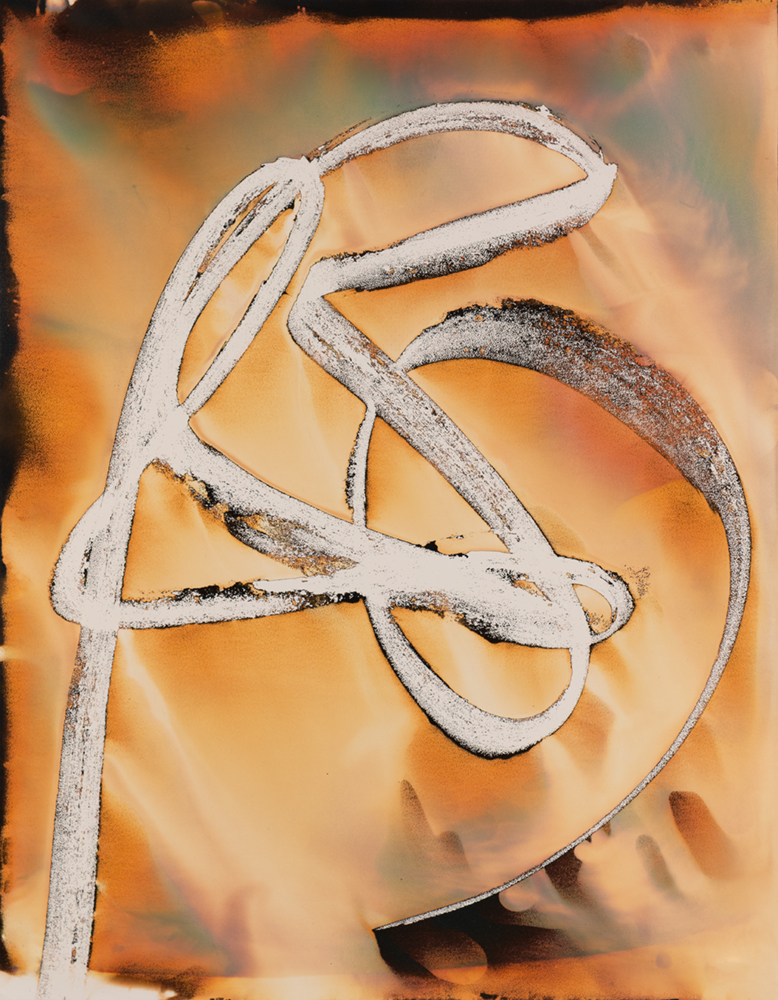
©Bridget Conn, Gesture #29; silver gelatin chemigram; 14” x 11”; 2026
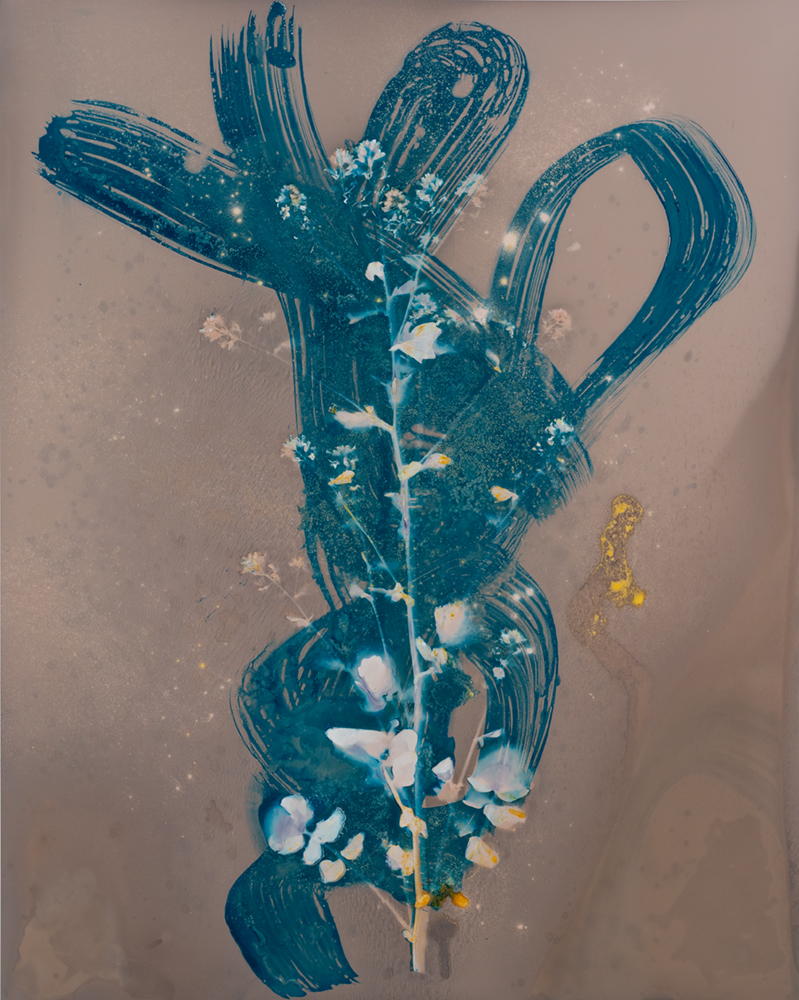
©Bridget Conn, Spring Arrival (Yellow Rocket); fixed silver gelatin cyanolumen print, turmeric; 20” x 16”; 2026
Dawn Roe: And, in terms of the handmade manipulations in your work – I notice a playful variance in terms of compositions. Is there any sort of tension between a choice to carefully arrange components on the surface of the paper in an effort to create a particular sort of image, and the element of chance in terms of what visual expression might sort of organically or magically emerge?
Bridget Conn: I have made some works with multiple flowers / plants within one composition, and with these I am usually trying to follow some kind of cyanotype form – either a line or a circle. I don’t have a pre-determined vision for how to adjust the elements within those flowers, but I’ll notice things during the arrangement like proximity and size. I can’t make too many adjustments once in place though because the cyanotype is frequently still wet, and there are other materials I’m using that will be disrupted if I try to get too fussy about the composition. It’s definitely true that not all compositions I’ve made are successful for this reason. But there are more choices happening in the cyanolumens than in my cyanotype wall installation Hill Diary. Here I was mostly trying to take more of a hands-off, Anna Atkins-style documentary approach to this exploration of wildflowers, “weeds”, and plants that began to emerge from March onward. That meant usually letting the plant do its thing and not get too subjective or tricky with the composition, although breaking off the edge of the paper and using diagonals is pretty-well engrained in me. This series has really taught me to identify such a variety of plant life and understand my immediate environment as so much more densely layered than I was able to in 2025. This ability to see what I couldn’t see before in the landscape helps me with noticing larger societal issues in the United States that need attention, and encourages me to dig into their origins.
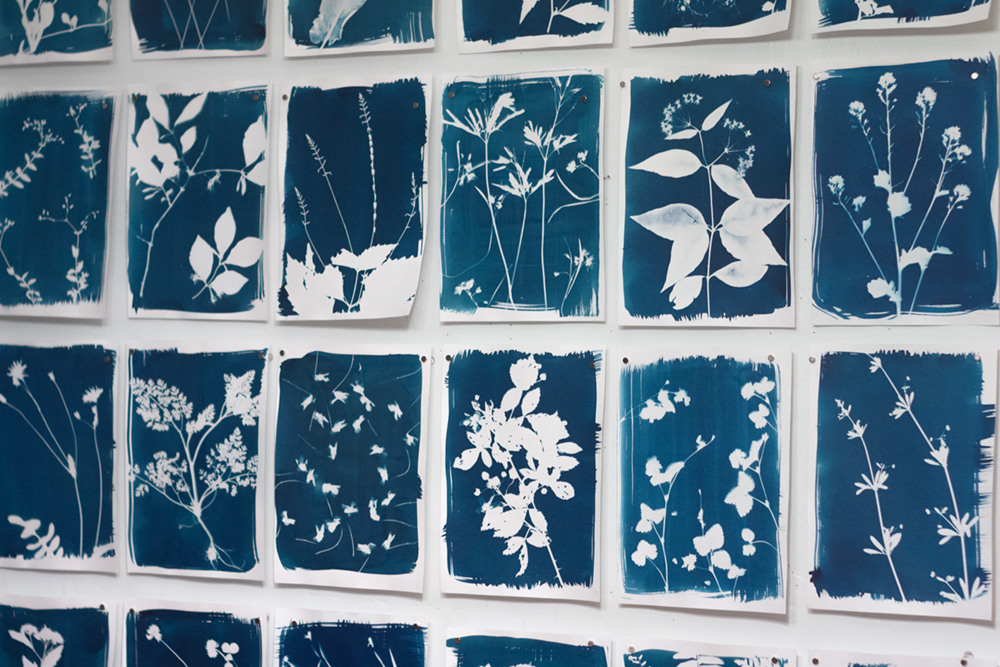
©Bridget Conn, Hill Diary; 50 cyanotype prints; 10” x 7” each; 2026; detail of in-progress studio install
Dawn Roe: This makes me think of enchantment, in a way, and I want to suggest there is perhaps a bit of magic (a word, form, concept, action I fully embrace, in full disclosure) showing up within some of the prints from New Land Studies. There are these beautiful, specular aspects sort of sprinkled throughout, seeming to reflect or react from/with an unknown or unseen substance, sometimes appearing celestial – one meaning of which is being from the sky, or out of this world – perhaps appropriately so considering the material properties of the prints themselves, reliant upon light from the sun. Interestingly though, sometimes these celestial bits appear as stars (another form of a celestial body), and I know you’ve also been experimenting with fireflies as potential collaborators. Can you describe your thoughts on these varying roles of light in your work?
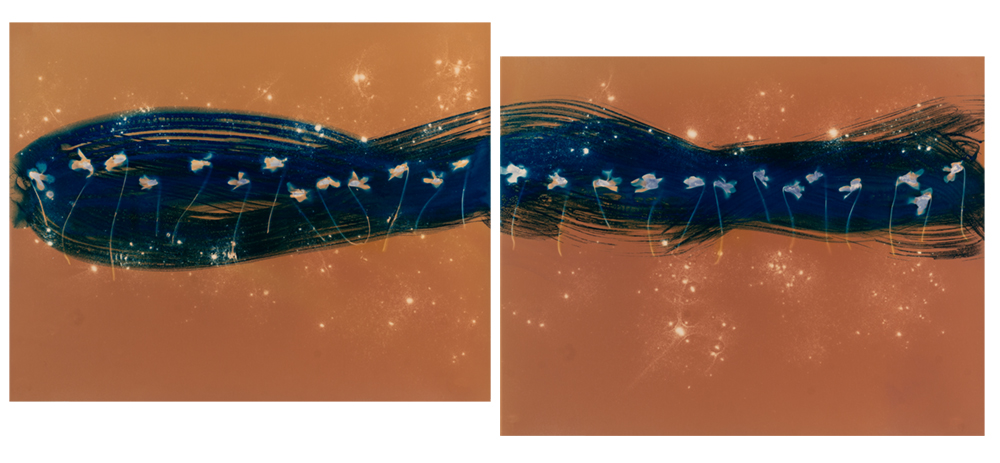
©Bridget Conn, Spring Ephemeral (Violets Diptych); fixed silver gelatin cyanolumen prints; 12” x 28.5”; 2026
Bridget Conn: I enjoy seeing how these little magic sprinkles appear in the final compositions, as it’s hard to control what will happen with them. I haven’t thought about them as a light source in and of themselves, but I do love that interpretation. I tend to see them as more related to that sentient presence in nature that I mentioned with the cyanotype marks. I’m still working through some connections between these visuals and the element of wind. Some of my earliest childhood memories involve feeling an intense awe when in the presence of strong wind. I think wind was my earliest sensation of being grounded in the present moment and place. It’s like the land is trying to let you know that there is something tangible here that you may not notice otherwise. I want to work towards involving wind in my practice, but for right now, these visual elements that I am using are the closest thing I have to capture that feeling of awe.
But back to light! Yes I have been creating some pieces collaborating with fireflies – very new work. And of course very seasonally-restricted work. I love the idea that there is something that I can’t do until a certain season arrives, that it’s something I have to wait and yearn for and then appreciate while I can. I grew up in Florida, where the seasonal changes are virtually non-existent, and where I didn’t have fireflies (at least where I lived). Rather than dreading the heat of summer, I love living in Southern Indiana, where summer is actively celebrated. And I live in a place where the fireflies are active during this season, which is also a marker of a healthy ecosystem. This is also leading me into some experiments with photograms made with moonlight, since we live in a pretty isolated area without much light pollution. It’s been wonderful to walk outside at night with a red headlamp and feel like the whole world is my darkroom.
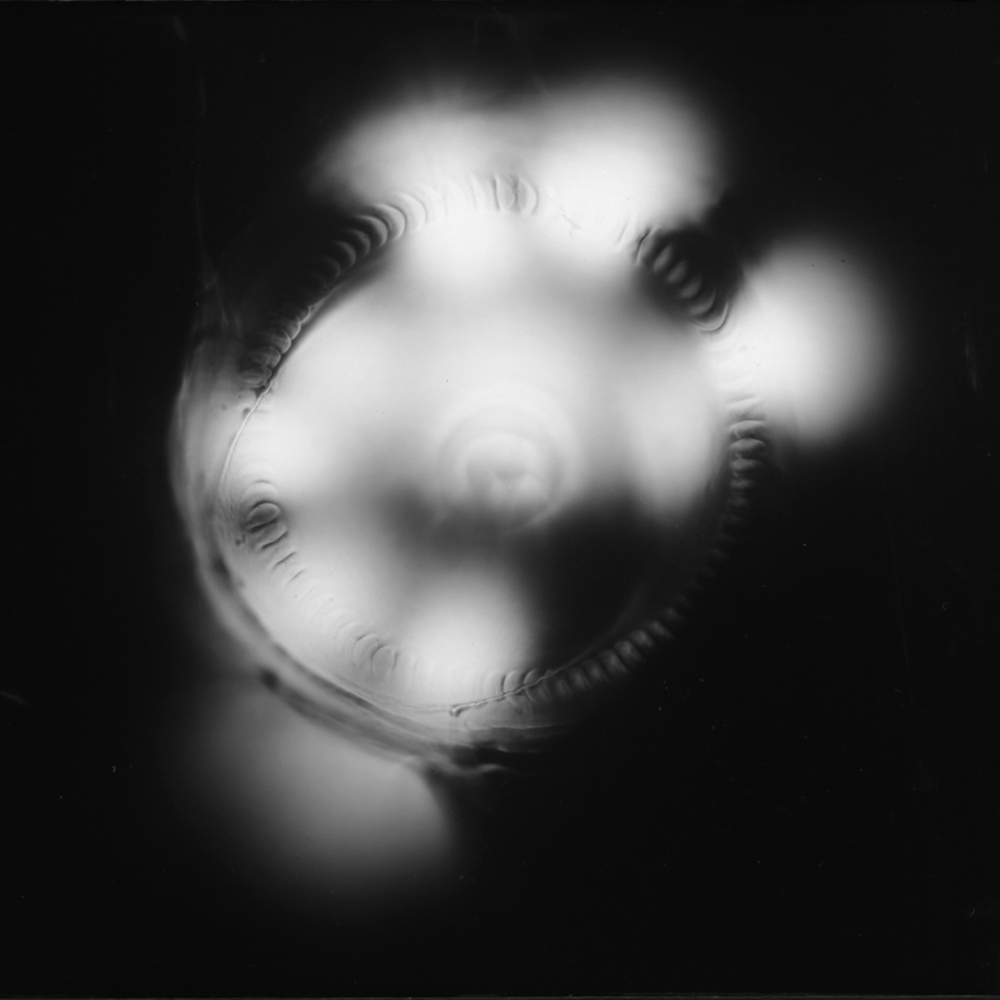
Bridget Conn, Summer Jar #2; silver gelatin print; 4” x 4”; 2026
Dawn Roe: Okay, first, I just have to share that reading your description of wind and awe immediately conjured the closing image from Andrei Tarkovsky’s 1975 film, Mirror – thank you for that! But, continuing along these lines, do you ever find yourself thinking about the difference between creating prints using the light generated from electricity harnessed by technology in the form of indoor bulbs versus the raw energy of the sun? I can’t help but think about the (still young) history of photography as continually transforming alongside increasingly rapid developments in imaging systems. There is potentially a LOT to unpack within these entanglements, and you hint at some of this in the description of your in-progress work, Antidote, in your allusion to impacts of AI as well as your reminder that, “[s]ewing machines were once a technology in our culture, as was silver gelatin paper in the darkroom.”
Bridget Conn: I’ve thought about the differences in terms of the resulting paper color palettes I can get from indoor bulbs versus the sun, but not so much as a broader conceptual topic, which, thank you for bringing up! I recently gave an artist talk at Aurora Photo Center that spanned the years of my whole artistic career thus far, and so I found myself trying to look for threads that have run through almost 30 years of artmaking. And so much of it has boiled down to a relationship with light more so than using lens-based media. Chemigrams are so consistently confused with paintings, but I have zero interest in using paint to create a likeness of the imagery I create. It’s more about a collaboration with the elements as they react to the inherent potential of the paper, and that reaction is set forth by the presence of light. When I sometimes question my relationship to this medium, I take solace that the invention of photography in 1839 wasn’t centered on the ability to create an image, it was centered on the control of the action of light. I still love working with processes that require the use of technology-based light as directed by an enlarger, but maybe your question does explain why I’ve been so drawn in more recent years to create my work in the presence of sunlight. With so much of our lives lived in front of phone and computer screens now, I don’t want my artmaking to take place in that arena if I can help it. But that’s not just for rebellion’s sake — I feel like a lot of what I’m concerned with right now has to do with being grounded in our physical geographies so we don’t get swallowed up by the divisiveness that is actively being forced up on us in our online environments. Sunlight is such a basic element that everyone shares despite however else they may be different culturally or politically.
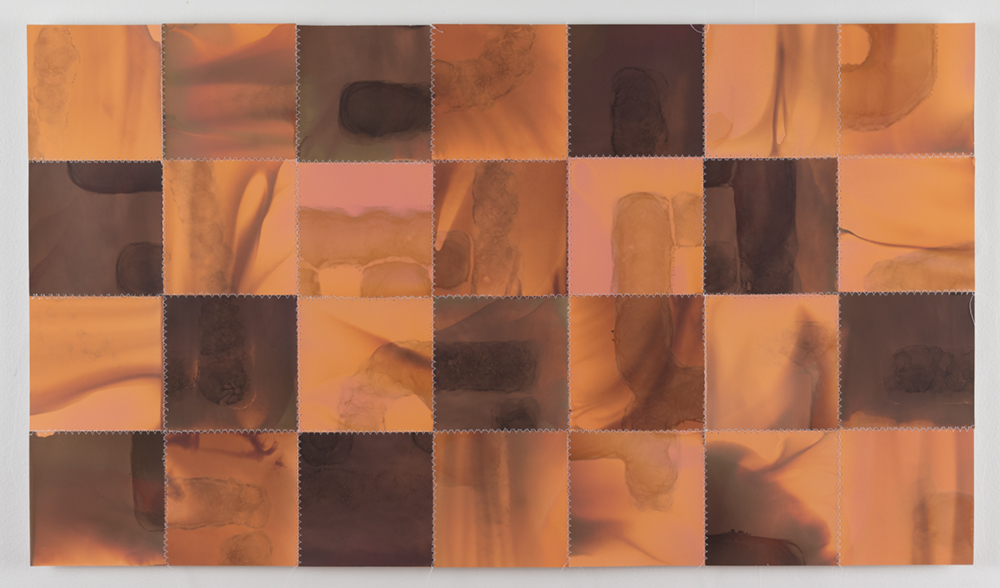
©Bridget Conn, Box Breathe (13 Moons) #10; silver gelatin chemigrams, thread; 16” x 28”; 2020-2021
Dawn Roe: So true! And light from this same sun enamored the earliest experimenters with what we now call photography. On a tangential note, I was very excited to read the session description for a panel at the upcoming SPE conference to be chaired by Eleanor Oakes and Millee Tibbs that challenges conventional notions of the “birth” of photography – they suggest that, “Photography’s history has long been anchored to 1839 as a singular moment of invention as a Western, technologically-driven origin story centered on fixing an image onto a flat surface. While convenient, this narrative is incomplete. It overlooks parallel developments across cultures, obscures pre-existing image-making technologies, and reinforces frameworks shaped by colonial, patriarchal, and capitalist systems.” Does this resonate with you at all, in terms of the socio-political aspects that drive your work?
Bridget Conn: Oh this is great – I haven’t been able to attend a national SPE in years, and this is tempting! It definitely resonates. When I taught Intro Photography at the university level and discussed history, I always felt like I was shortchanging students by briefly mentioning that camera obscuras were present in China in the 6th century BCE, but then feeling like I had to focus on developments from France and England. This history needs to be reconsidered and broadened. I guess it makes sense that the “invention” date of 1839 (being tied to the patent and not the actual first daguerreotype creation) is all about appeasing capitalism by creating a process that could be easily monetized. And that the next photography revolution was generating even more income in the 1890s by Eastman Kodak placing box cameras and roll film into the hands of people who did not consider themselves photographers. In my upcoming Cameraless Photography course with Ágora, I talk a bit about how cameraless photography is commonly seen as this crazy offshoot from standard photography, and is sometimes even met with disdain. But photographic history IS cameraless photography, well before 1839. I am writing with light just as much as someone using a lens. Speaking of lenses and gear, I once gave an artist talk all about my cameraless chemigram work, and the first question in the audience literally was, “Canon or Nikon?” This was frustrating not only because they hadn’t been listening, but also because photography so often gets mired in this talk of gear. I think a lot of Americans feel that something must be purchased in order to validate an experience, hence souvenir shops. Mainstream photography feeds into this by providing new and improved trinkets to drop money on, even if it still results in that same “bee on flower” photograph. Cameraless photography is a wonderful voice for subverting capitalism because you are often slowing down, avoiding the expensive gear, and placing focus on the process and experience of creation and not just the final reward of the image.
Dawn Roe: Yessss!!! To all of the above. This has been such a fun chat and has really made me miss our conversations. Thanks so much for all of this, Bridget. I’m excited to see how light, form, color, and culture continue to come together in your work. And lastly, as is typical with such formats, you of course have the last words! Are there any other aspects of your practice or particular projects you’d like to share here?
Bridget Conn: I’m fortunate to have a bunch of great opportunities on the horizon here. I just returned from the Experimental Photo Festival in Barcelona, a community I’ve been involved with since 2020. This year I directed the Horizontal Portfolio Review, which relates to an upcoming class I will be teaching for Ágora, the online school of the Festival. The Collective Mentorships of Experimental Projects is a course that will run from October 2026 through April 2027, meeting every two weeks on Zoom to help students develop their concepts and exhibition/book goals with experimental photo processes. I’ll also offer an asynchronous online Ágora course on cameraless photography called From Sunlight to Safelight.
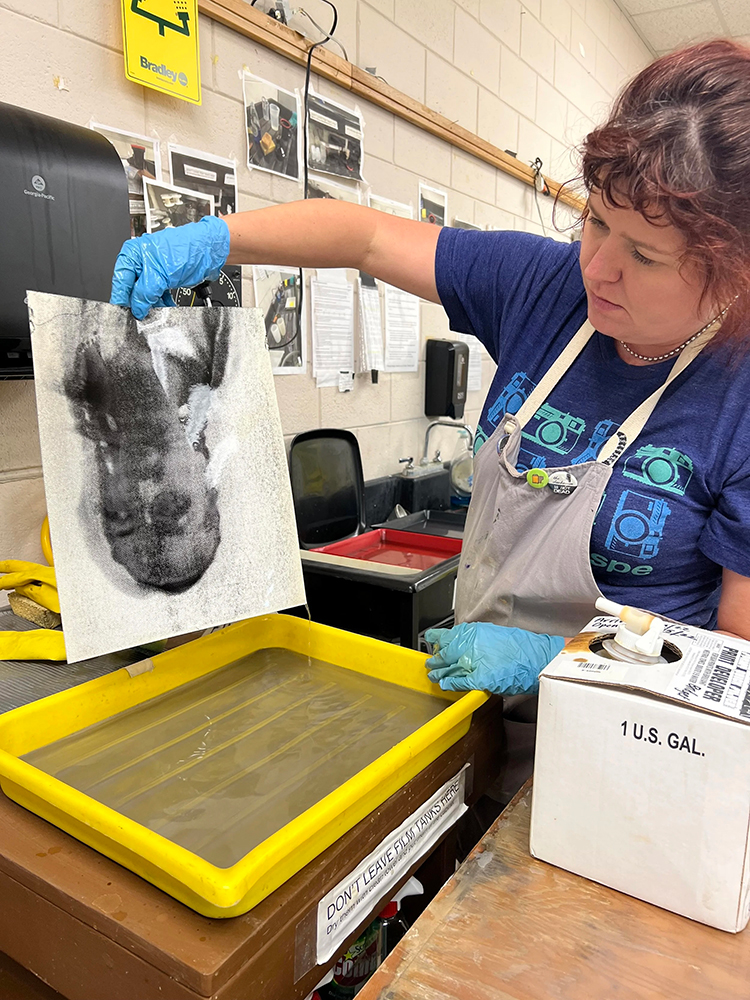
Bridget Conn at Penumbra, ©Morgan Zichettella
I also have synchronous online courses scheduled with Penumbra Foundation for Chemigrams and Chromoskedasic Sabattier starting this fall. Next February, Maine Media Workshops will also offer my online Chemigram class for analog beginners. Earlier in May of this year I started offering in-person workshops through the facility I am building on my land in Indiana – The Experimental Photo Kitchen. I am in the process of building a 6-enlarger darkroom and classroom on my property, but right now workshops are held from the basement kitchen of my home. I work in-person with groups and also offer online one-on-one sessions. My goal with The Kitchen is to prioritize workshops that make use of the land as both subject matter and medium, and eventually develop a residency program for photographic artists working with land, geography, and environmental / social issues.
Lastly, much of the work we discussed will be seen in my solo exhibition “Now is the Time / The Time is Now” at the 411 Gallery of the Columbus Area Arts Council in Columbus, Indiana. This opens on September 3 and closes October 16. The vast majority of the work is new in 2026 as I have watched the changes take place across our land with the changing seasons. By diving into the ecosystem on our hill with this show, I’m thinking a lot about 24-hour news cycles, anxiety, and the roles of creation vs. consumption in American society. I see this work as a way to stay grounded, to remember that the oxygen mask needs to be on my own face before I can assist others, to reject being paralyzed by despair, and to help gather strength for what may happen to our democracy over the next two years. I wish life were simple enough to say they are just pretty images of flowers, but American society is too complex for that right now.
Thanks for this conversation, Dawn!
Dawn Roe (b. 1971, Sault Ste. Marie, MI) was born and raised amidst what are now known as the Great Lakes where she developed a lifelong interest in land/water relations between human and more-than-human communities. Informed by early studies in experimental filmmaking and darkroom-based photography, Roe’s site-responsive practice combines historic and contemporary photographic methods with film and digital video. Energized by continuous, impossible attempts to form a collaborative atlas of earth, plant, and animal forms living and dying together across both great and small distances, she visualizes the cohabitation of species as a collective endeavor through re-presentation(s) of both routine and remarkable encounters.
Roe lives between Asheville, North Carolina and Winter Park, Florida where she serves as Professor of Art at Rollins College. Her work is represented by Tracey Morgan Gallery in Asheville.
Instagram: https://www.instagram.com/dawnroe/
Posts on Lenscratch may not be reproduced without the permission of the Lenscratch staff and the photographer.
Recommended
-
The Female Gaze: Kimberly Schneider – Uncovering the IneffableOctober 11th, 2026
-
Winky Lewis: Shadow KidsOctober 4th, 2026
-
Botanical Photography: The Basics and Moving Beyond the Basics: Natalie Colette WoodOctober 2nd, 2026
-
Botanical Photography: The Basics and Moving Beyond the Basics: Oriana Poindexter: Cascadia Coast ExposuresSeptember 30th, 2026
-
Botanical Photography: The Basics and Moving Beyond the Basics: Carol BouyoucosSeptember 29th, 2026