Widline Cadet: Ritual [Dis]Appearance
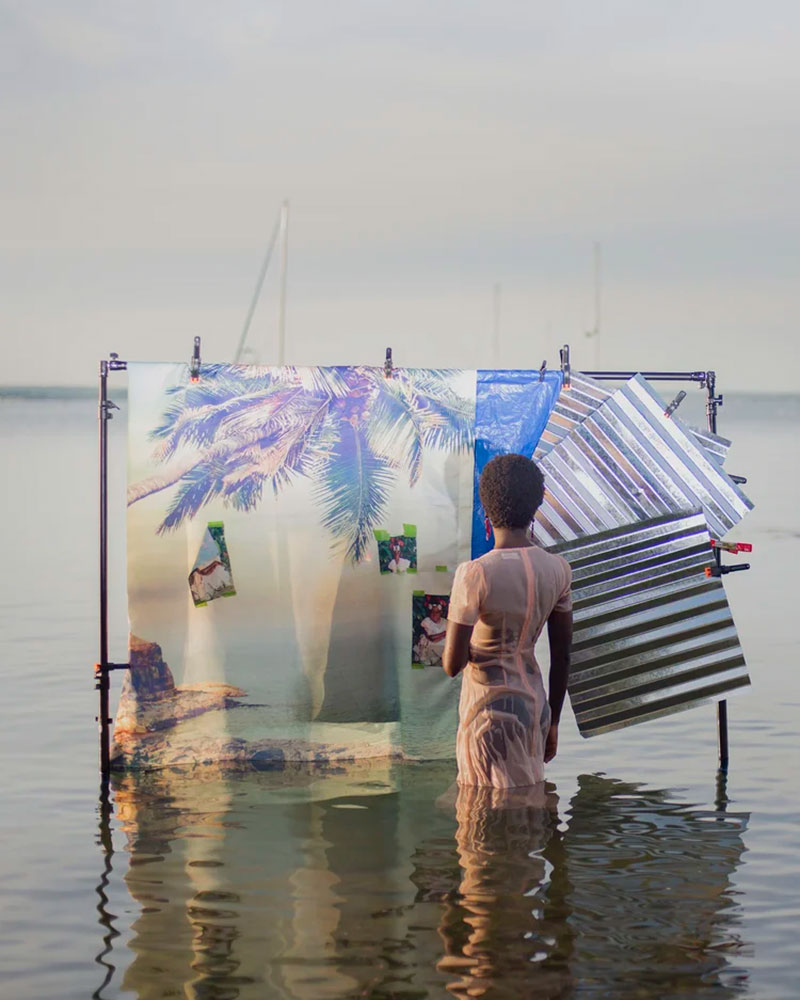
© Widline Cadet, Seremoni disparisyon #1 (Ritual [Dis]Appearance #1), 2019
We all strive to determine our place in the world, building a personal story grounded in memory. But what if a rupture occurs — memories are scattered, family ties are strained and histories forgotten. Widline Cadet has accepted the introspective challenge to reconstruct her personal history as a Haitian immigrant with both exuberance and authority. Her first solo museum exhibition in the United States, Currents 40: Widline Cadet, is on view in the Herzfeld Center for Photography and Media Arts at the Milwaukee Art Museum through August 9.
The exhibition is curated by Kristen Gaylord, Herzfeld Curator of Photography and Media Arts, who collaborated with the artist to transform the galleries into a floating landscape — Cadet’s personal vision of her family’s migration story. The exhibition presents 52 photographs and videos, as well as installations that include ceramic objects, and images from her personal family archive, “objects that could travel across distance and time.”
After spending the first decade of her life in Haiti, Cadet moved to New York City where her mother had preceded her. She grew up there, ultimately received her MFA from Syracuse University and relocated to Los Angeles to establish her practice. I asked the artist about how she transformed the disruptions and unfamiliar spaces in her life into this intriguing body of work. She describes the various techniques—titles in the Haitian Kreyól language, unconventional displays and spatial strategies—which convey her personal identity and family heritage.
The exhibition is curated by Kristen Gaylord, Herzfeld Curator of Photography and Media Arts, who collaborated with the artist to transform the galleries into a floating landscape — Cadet’s personal vision of her family’s migration story. The exhibition presents 52 photographs and videos, as well as installations that include ceramic objects, and images from her personal family archive, “objects that could travel across distance and time.”
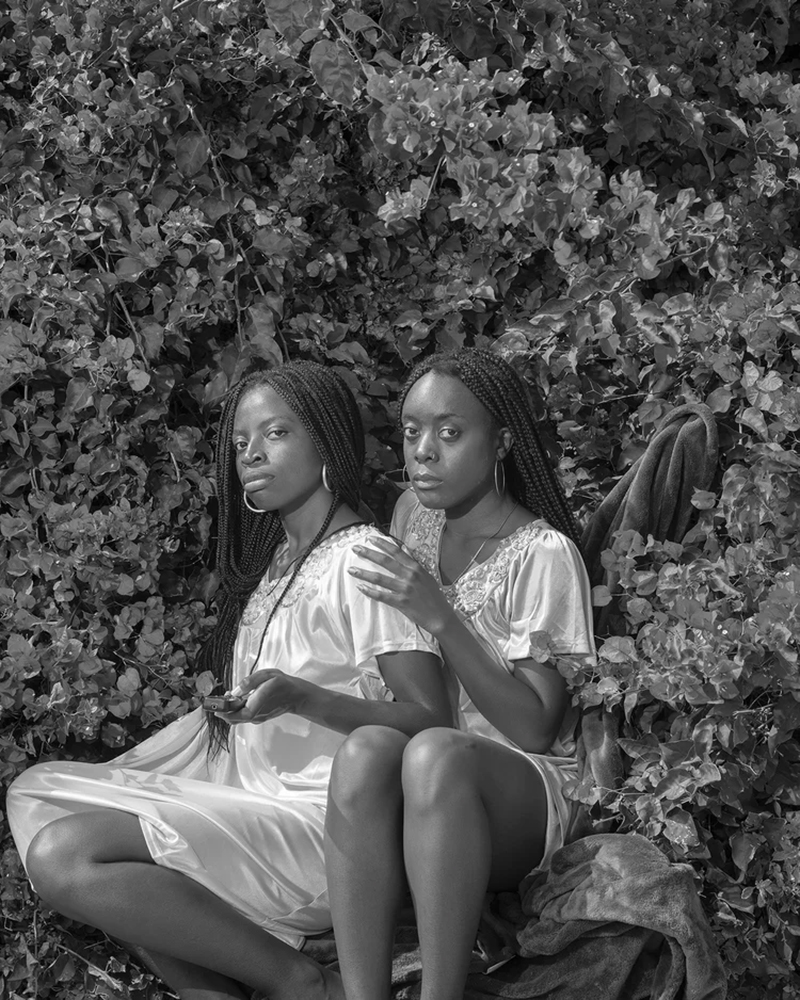
© Widline Cadet, Yon etranje ki pa sanble youn #2 (A Stranger Who Doesn’t Look Like One #2), 2019
LL: Widline, you have been working on this project for about a decade. Can you describe important moments in its evolution: your introduction to photography, developing your process, when you knew you were on to something and how you knew you had completed this body of work?
WC: Sure! I started photography in my junior year of high school and instantly fell in love with it. Fast forward to undergrad, I kept pursuing it, but it wasn’t until after undergrad that I realized I wanted to do it with more intention and so I went to grad school–-which is when I started working on Seremoni Disparisyon (Ritual [Dis]Appearance). At the start, I had no idea what I was doing. I took a break from working on another series (Home Bodies) and was forced to think and make work in a completely new way and so for the first two years I had no idea what I was doing and felt pretty dejected. But I kept going, the hardest part was building the language of this work from scratch and not really having a blueprint for it. The earliest image made in this new language in the exhibition is from 2017, but it wasn’t until 2019 that I made one or two images that made me feel like I was onto something and that was when I made Seremoni disparisyon #1 (Ritual [Dis]Appearance #1), 2019 and Yon etranje ki pa sanble youn #2 (A Stranger Who Doesn’t Look Like One #2), 2019, and Plezi pale menm lang lan #2 (The Pleasure of Speaking the Same Language #2), 2019 all within that same year. That’s when I felt like I was finally able to use the language that I had built at will to make images.
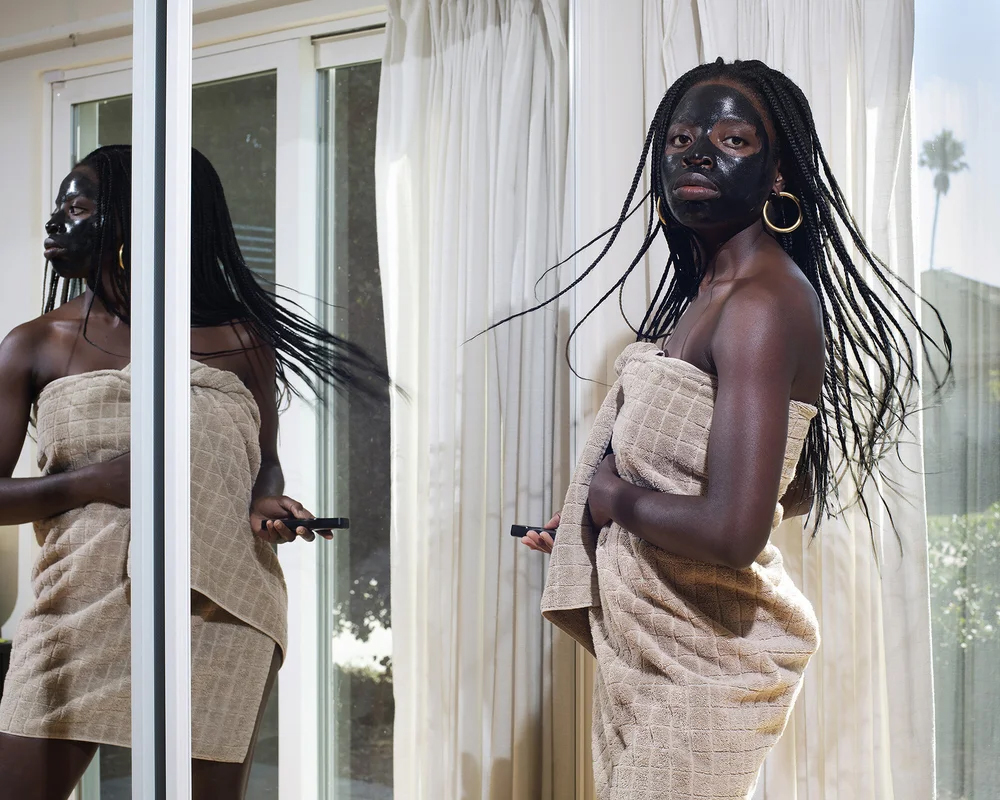
© Widline Cadet, Plezi pale menm lang lan #2 (The Pleasure of Speaking the Same Language #2), 2019
I knew I had completed the series in 2025 as I was working on my book and a gallery exhibition at the same time. The good thing about it is that I was able to see what was missing from the series by the holes left in the book. As I worked on editing and sequencing, I saw what was missing, and made those images and when I got to a point where I didn’t feel like anything was missing, I knew it was time to end the series.
LL: Your references to building your own language are both visual and verbal. The way a story is told is as important as the images. Fragmentary captions, in both English and Kreyól, are enigmatic. Do they reflect the process of assembling memories for a personal archive? What is the relationship between caption and photograph in your work?
WC: They definitely do reflect the process of assembling memories for a personal archive. The relationship between titles and image varies across different works. These titles come from various sources including quotes family members have said, words from books I’ve read, movies, or anime that I’ve watched, or I make them up.
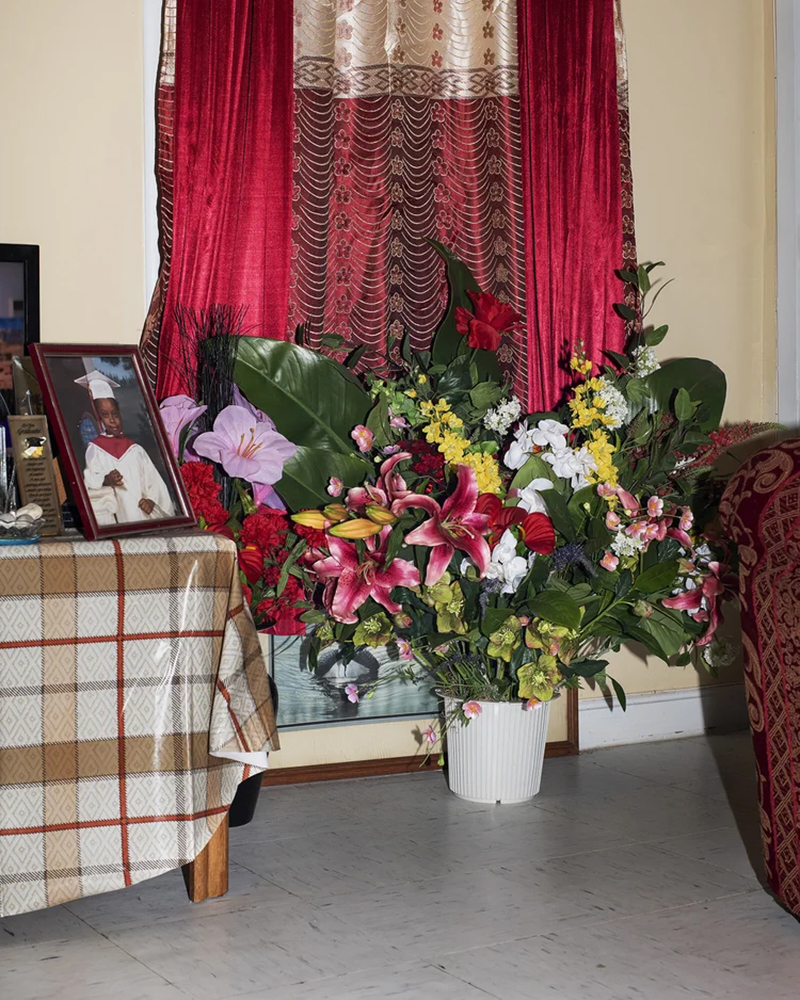
© Widline Cadet, Sa yo se premye rido ou achte mwen renmen, pa gen anyen ki ka wè soti nan deyò (These Are the First Curtains you’ve Bought That I’ve Liked, Nothing Can Be Seen From Outside), 2020
In some instances I make the image and then I add the title to influence how the image is read. An example of that is Sa yo se premye rido ou achte mwen renmen, pa gen anyen ki ka wè soti nan deyò (These Are the First Curtains you’ve Bought That I’ve Liked, Nothing Can Be Seen From Outside), 2020-–this title comes from a conversation between my sister and my mom. They probably don’t even remember ever having this conversation, but it stayed with me for a long time. And as someone who thinks a lot about my mom’s aesthetic choices in decorating her home and how to replicate some of those elements in my work, I felt like this part of their conversation was a really good additional element to add to an image of my mom’s living room.
In other instances, I start with the title and then I make the image or work. Sometimes the work is made to fit the title and the ideas behind it, sometimes they have no connection to each other and exist as two separate things.
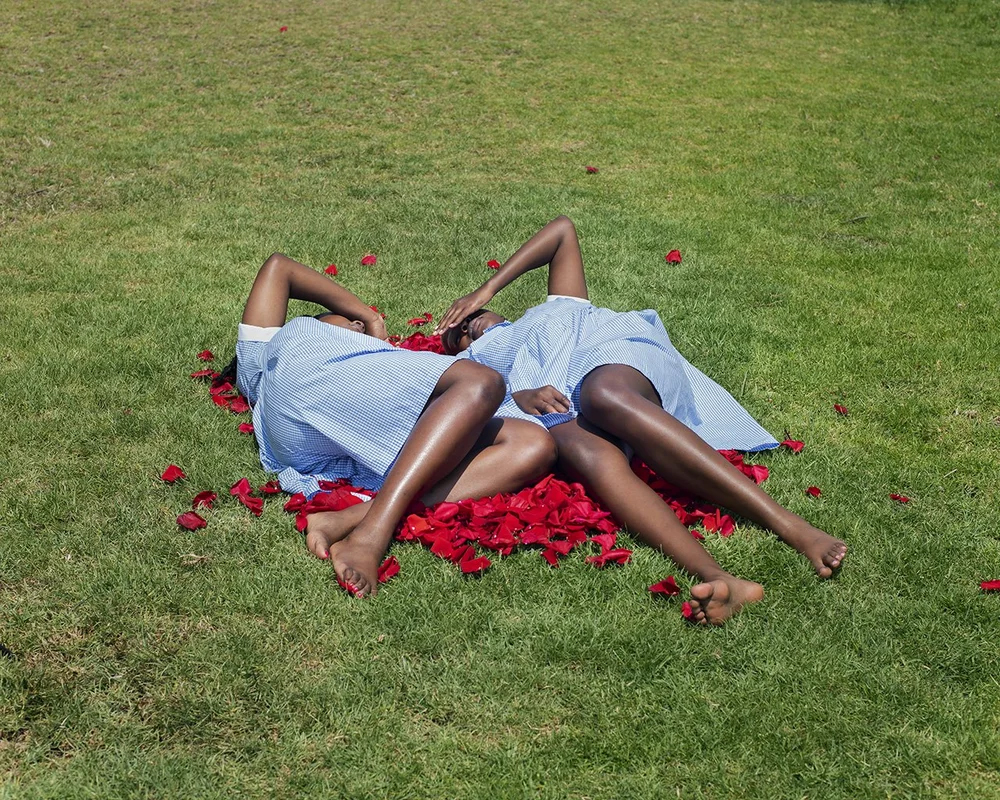
© Widline Cadet, Nan Letènite (In Eternity), 2021
In addition to that, there are other aspects that I take into consideration when it comes to titles, some are in Kreyòl only, some are in English only, and others are in both English and Kreyòl and even the ones that are in both languages, the translations aren’t always exact. All of that is related to this idea of language and meaning changing and shifting over time and across geography as a result of migration.
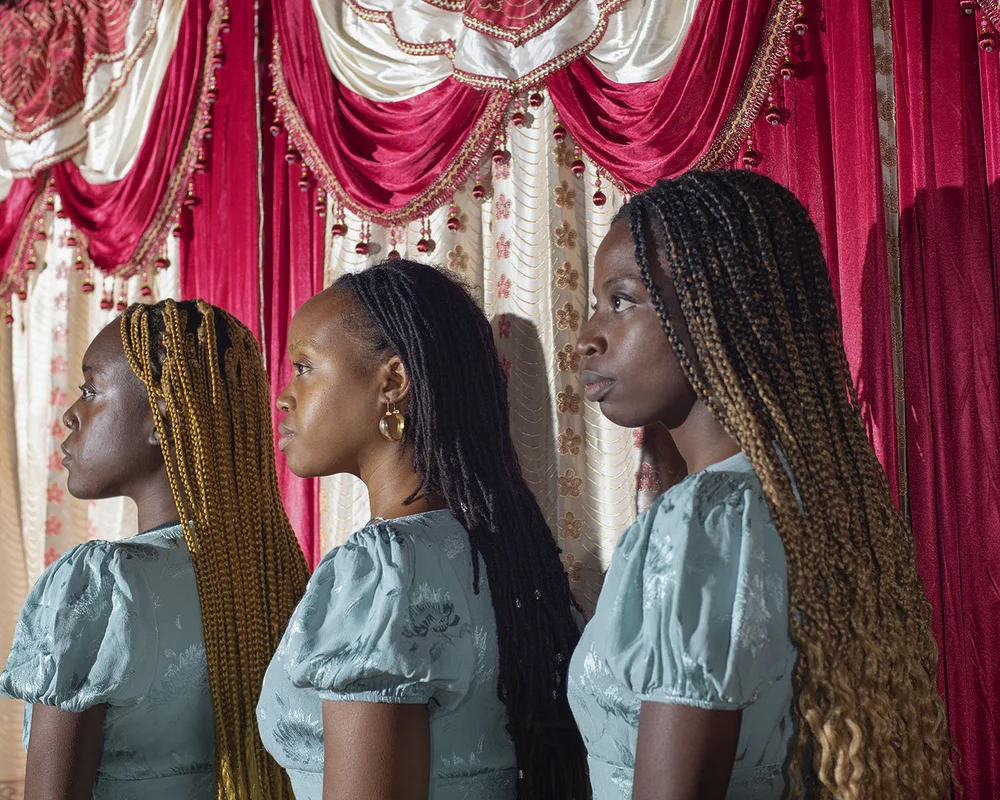
© Widline Cadet, Jiskaske enfinite vini nan you fen (Until infinity Comes To An End), 2021
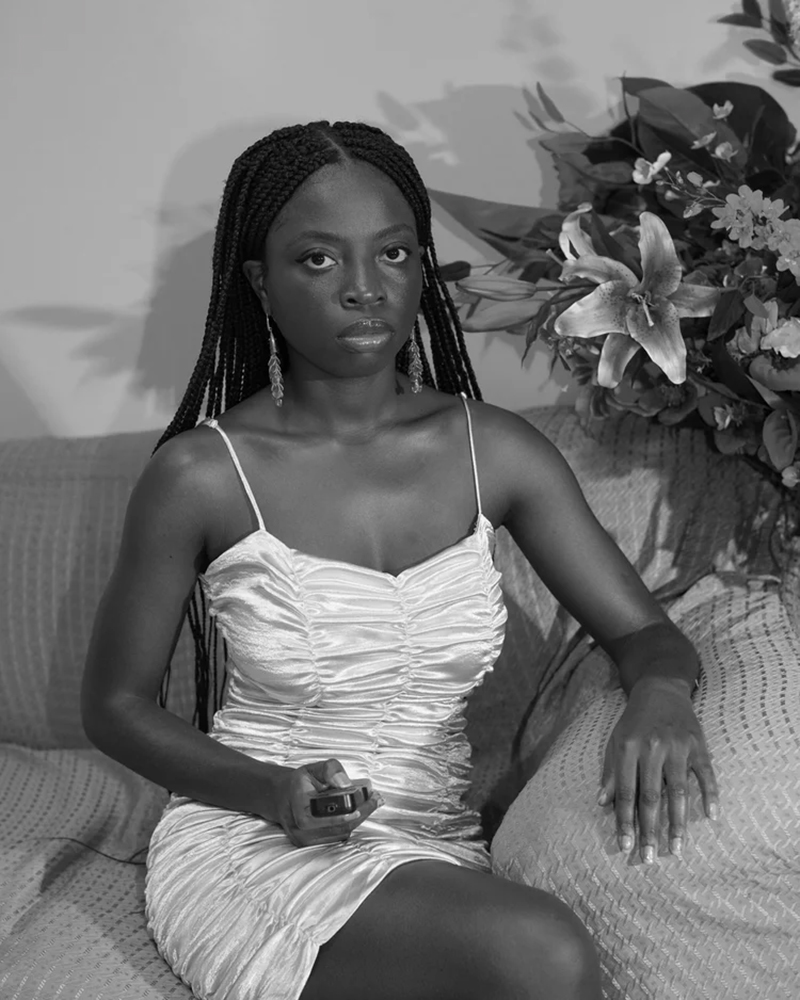
© Widline Cadet, Ki jan nou wè tèt nou nan tan kap vini an #1 (How We See Ourselves In(to) The Future #1) 2020
LL: Your photographs are created with control and conviction, and your formal portraits and self-portraits radiate power and authority. Images of women dominate your work. Portraits of your mother are repeated through the exhibition and female subjects are carefully arranged in specific geometries. In other images, women and fabric are a swirling force or appear as disembodied spirit traveling outside of time. What wisdom and authority does the matriarchy represent for you?
WC: I grew up surrounded by the women in my family, I had my mom and her siblings, their kids, I also have five sisters, and so all of these women have influenced and shaped my life. It was the same when I moved to the U.S. Even as a child I recognized that most of the support and community care that my mom had found when she immigrated here came from Black women. The same can be said for me, as so much of what I know and how I navigate life comes from the lens of being a Black immigrant woman. The work that you see is a reflection of a life that has been entrenched in matriarchy, and as a result, it centers, acknowledges and celebrates the power of the matriarchy, sisterhood, care, and community that I’ve found within it across generations and diaspora. To me, that looks like an all-encompassing force with the power to make something out of nothing and defy the logic of the world.
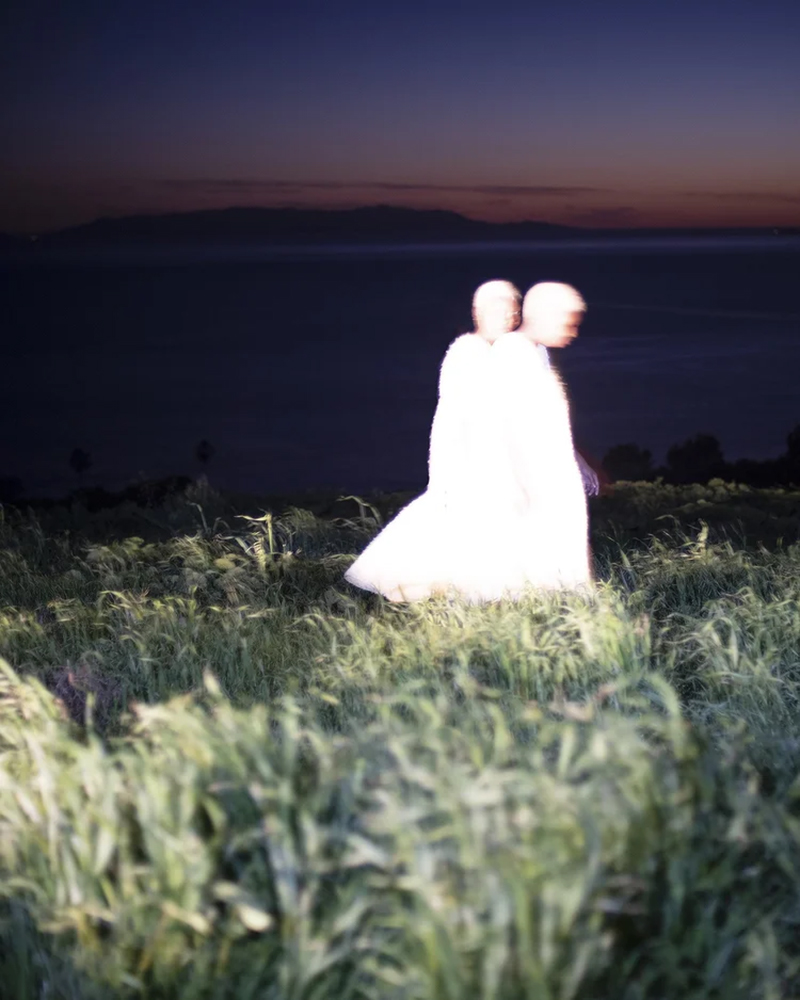
© Widline Cadet, Manyen distans (Touching Distance), 2023
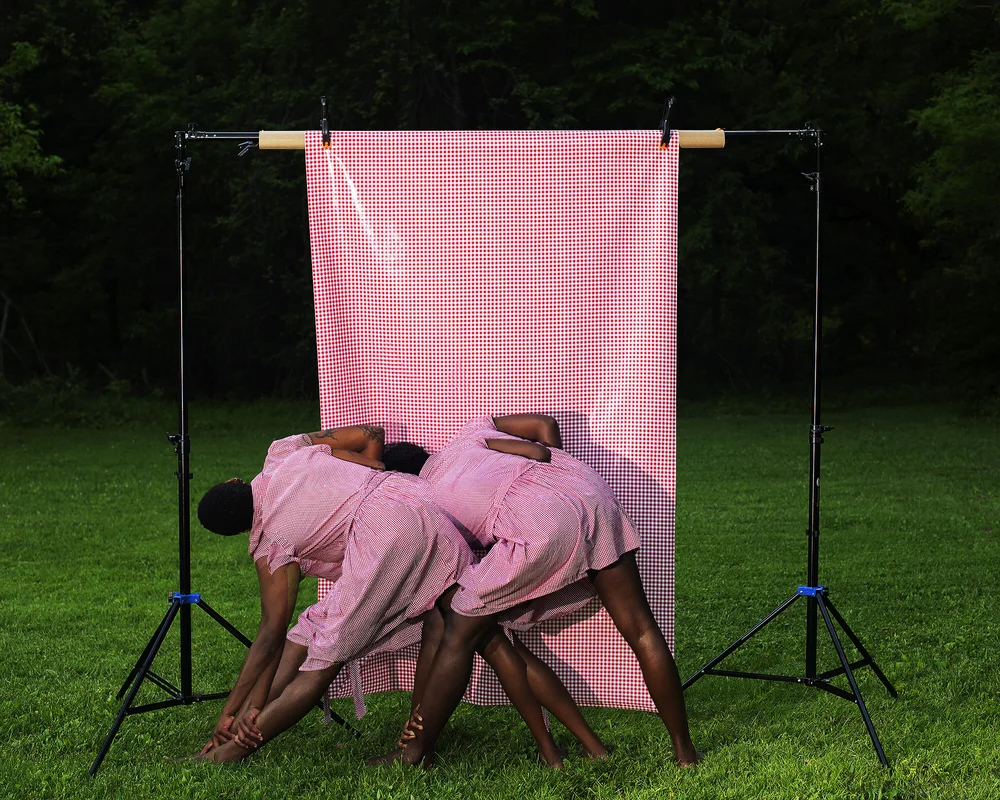
© Widline Cadet, Nou fè pati, nou se, nou anvi (We Belong, We be, We Long), 2023
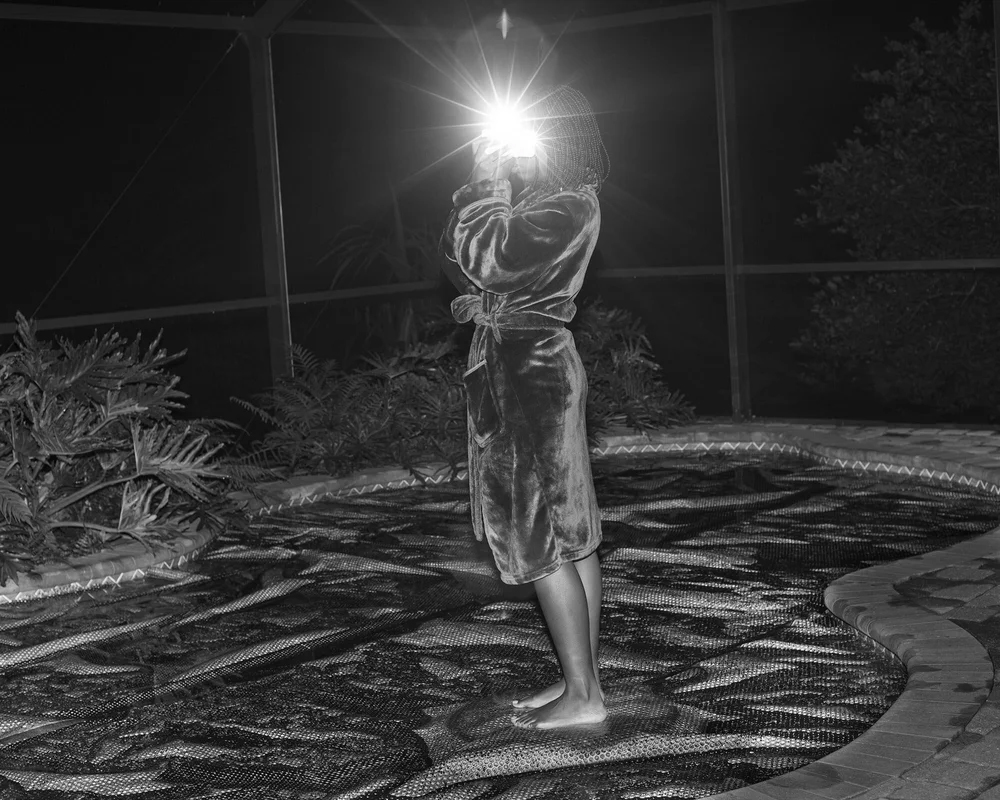
© Widline Cadet, Seremoni disparisyon #1.20 (Ritual [Dis]Appearance #1.20), 2020
LL: Like glimpses out of the corner of your eye, you have used images that refer to the nature, culture and history of your homeland in subtle ways. Can you comment on how these images inform your experience?
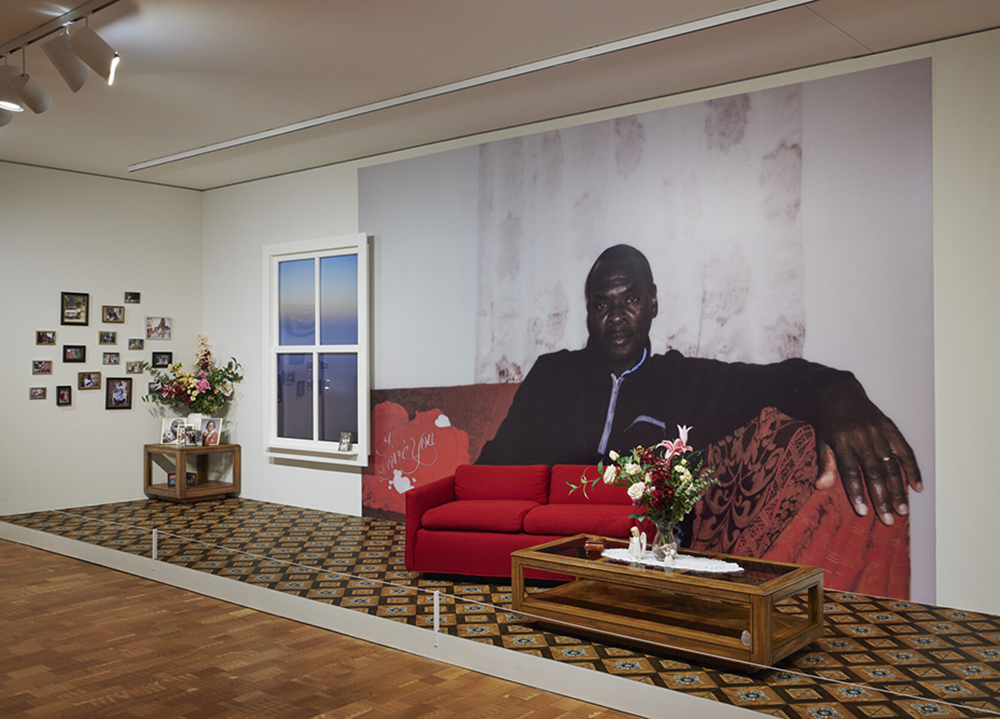
Installation View, Milwaukee Art Museum. © Widline Cadet, Altar #2
WC: It’s hard to explain, but I would say when I made (Father) Altar #2, Sa yo se premye rido ou achte mwen renmen, pa gen anyen ki ka wè soti nan deyò (These Are the First Curtains you’ve Bought That I’ve Liked, Nothing Can Be Seen From Outside), 2020 and Bougenvilye, ki itilize pou bote, vi prive sou liy kloti, ak pwoteksyon pikan (Bougainvillea, Used for Beauty, Privacy on Fence Lines, and Thorny Protection), 2019, I was focused on how the people in my family have created a home and what this idea of home is grounded in?
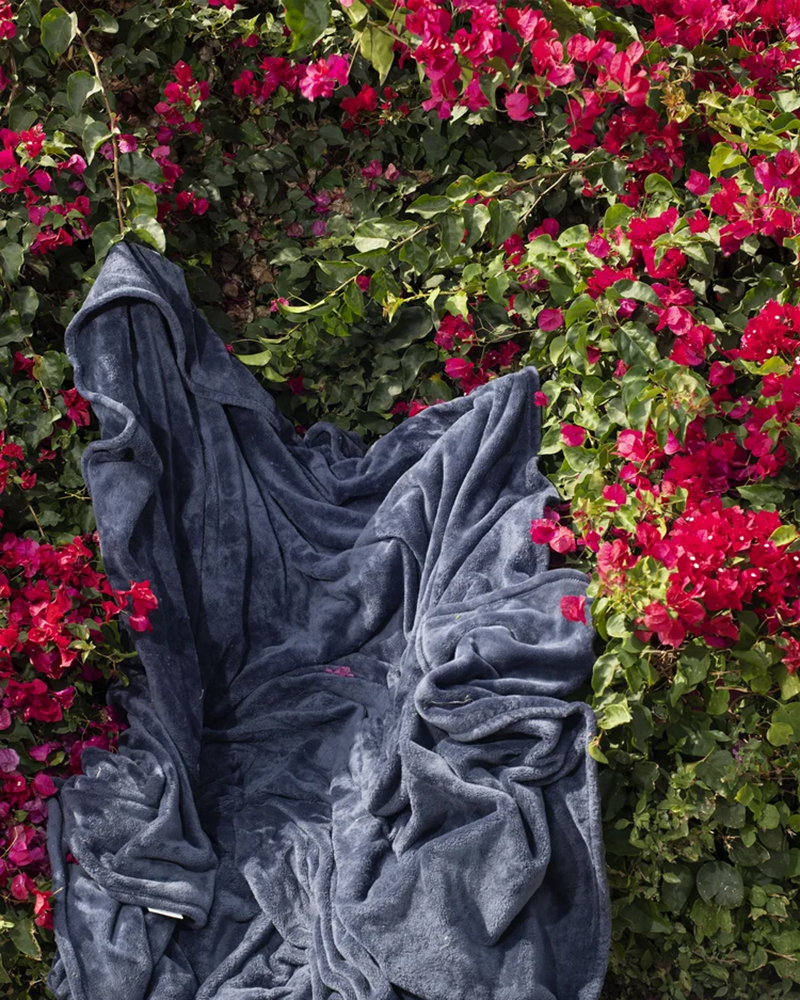
© Widline Cadet, Bougenvilye, ki itilize pou bote, vi prive sou liy kloti, ak pwoteksyon pikan (Bouganvillea, Used for Beauty, Privacy on Fence Lines, and Thorny Protection), 2019
In the case of these three works, it’s grounded in using memory to transport different aspects of my life across time and space. In the image of the living room I was thinking about how my mom created this interior space that is influenced by some of the same aesthetics from our home in Haiti in New York CIty. In the case of the bougainvillea image, I was still thinking about memory, but in a different way. In the image of the living room I was thinking about my mom bringing the past into the present, but in the bougainvillea one, it was more so me experiencing the bougainvillea in the present and in the U.S.and that stirring something up in my memories of the past when I used to encounter the same flower as a child in Haiti. There is a back and forth between the past and present, and future that happens in both instances.
I utilize those same ideas in Altar #2, but rather than an image I decided to make an installation that functions as a collage, one that gathers some of these disparate aspects and ideas about home, culture, history, memory in a physical three dimensional space within the exhibition.
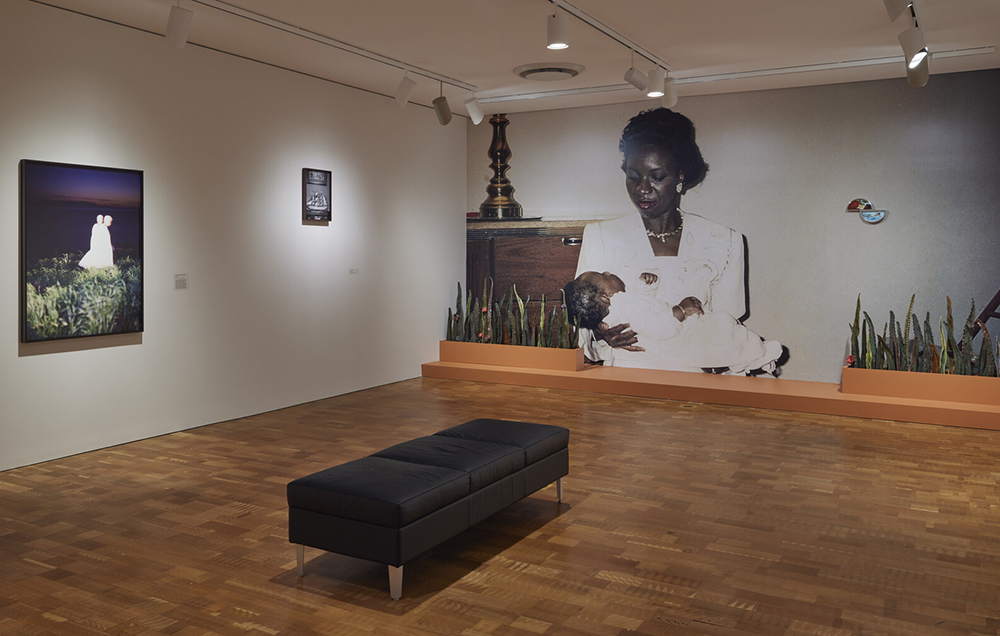
Installation view, Milwaukee Art Museum. © Widline Cadet, Altar #3
LL: How do you anticipate the viewer to move in the gallery space? What did you learn from the process of building this installation with so many diverse elements? Do you plan to expand on these strategies going forward?
WC: The way that Kristen and I organized the flow of the gallery space is one of my favorite aspects of the show. It’s very free and not all linear, and even the way the works are hung at various heights, like some of them are floating, echoes that. And so I hope those are some things that encourage viewers to move and think about the positions from where they’re looking at the works and how some of that might be related to my interests in memory, architecture, portals, and so on.
This is my largest exhibition to date, so it’s my first time having to think about how to organize and curate the different sections of the gallery spaces with intention and in ways that complement each other. The fact that the Herzfeld Center for Photography and Media Arts’ architecture and layout is so particular added another element to it, which felt a little overwhelming at first, but then it became a bit of a challenge that I knew once I figured it out, it would push the exhibition into the next level. Part of that was Kristen and I worked closely with David Russick, the exhibition designer, and the installation team at the museum to bring all these different elements together.
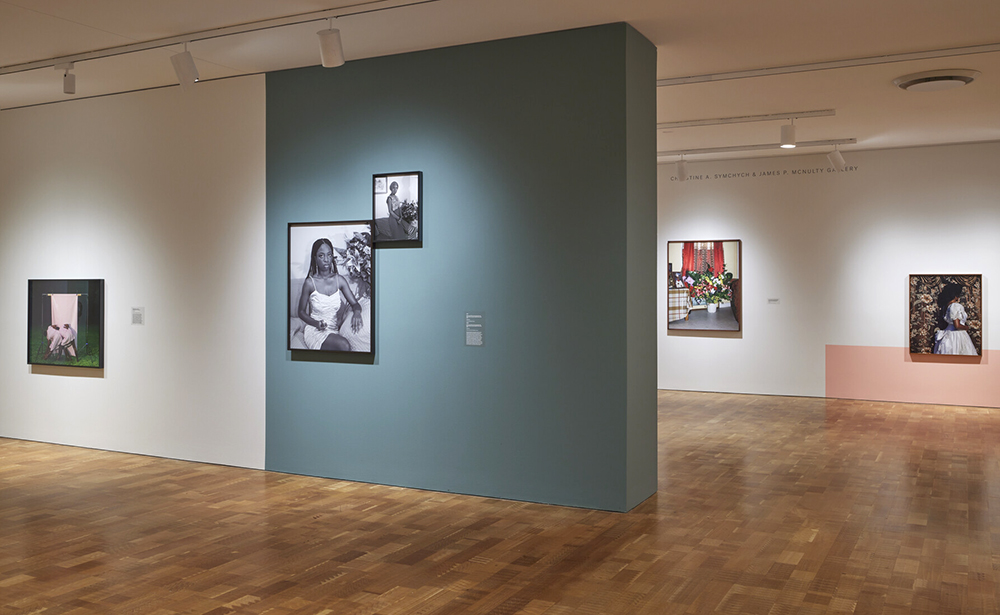
Installation view, Milwaukee Art Museum, foreground. © Widline Cadet, Left, Ki jan nou wè tèt nou nan tan kap vini an #1 (How We See Ourselves In(to) The Future #1) 2020 Right, Ki jan nou wè tèt nou nan tan kap vini an #2 (How We See Ourselves In(to) The Future #2) 2020
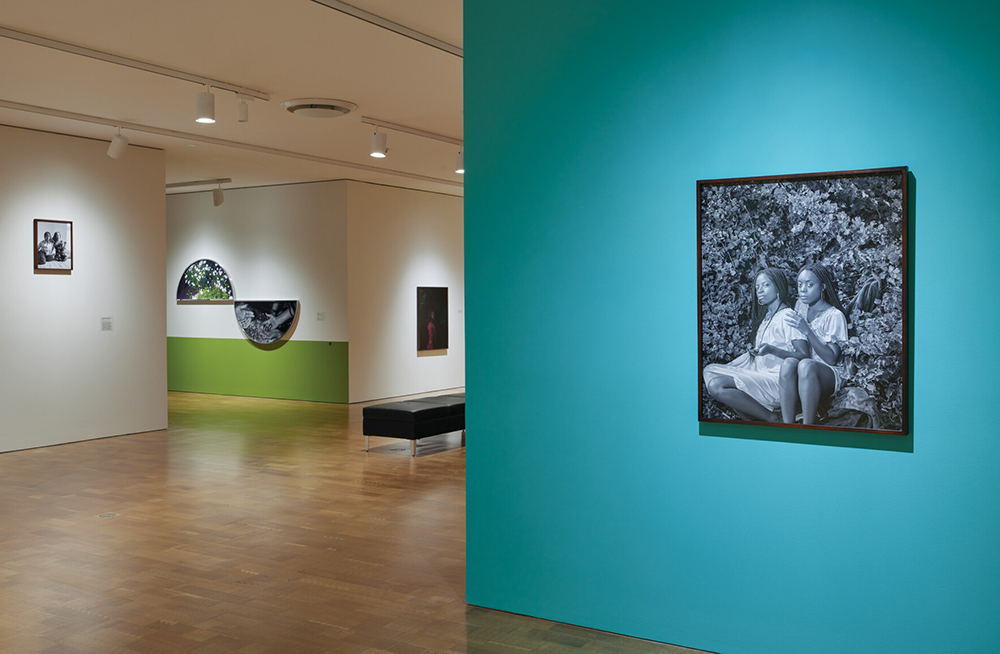
Installation Entrance, Milwaukee Art Museum. © Widline Cadet.
Figuring out the rhythm for the hanging style was one of the more challenging parts of putting the show together and working with Kristen and David on that taught me that when I’m unsure to start with one thing and let that one thing inform the following decisions. I definitely want to expand on these tactics going forward, especially the installation elements, hanging style, and sound out in the open.
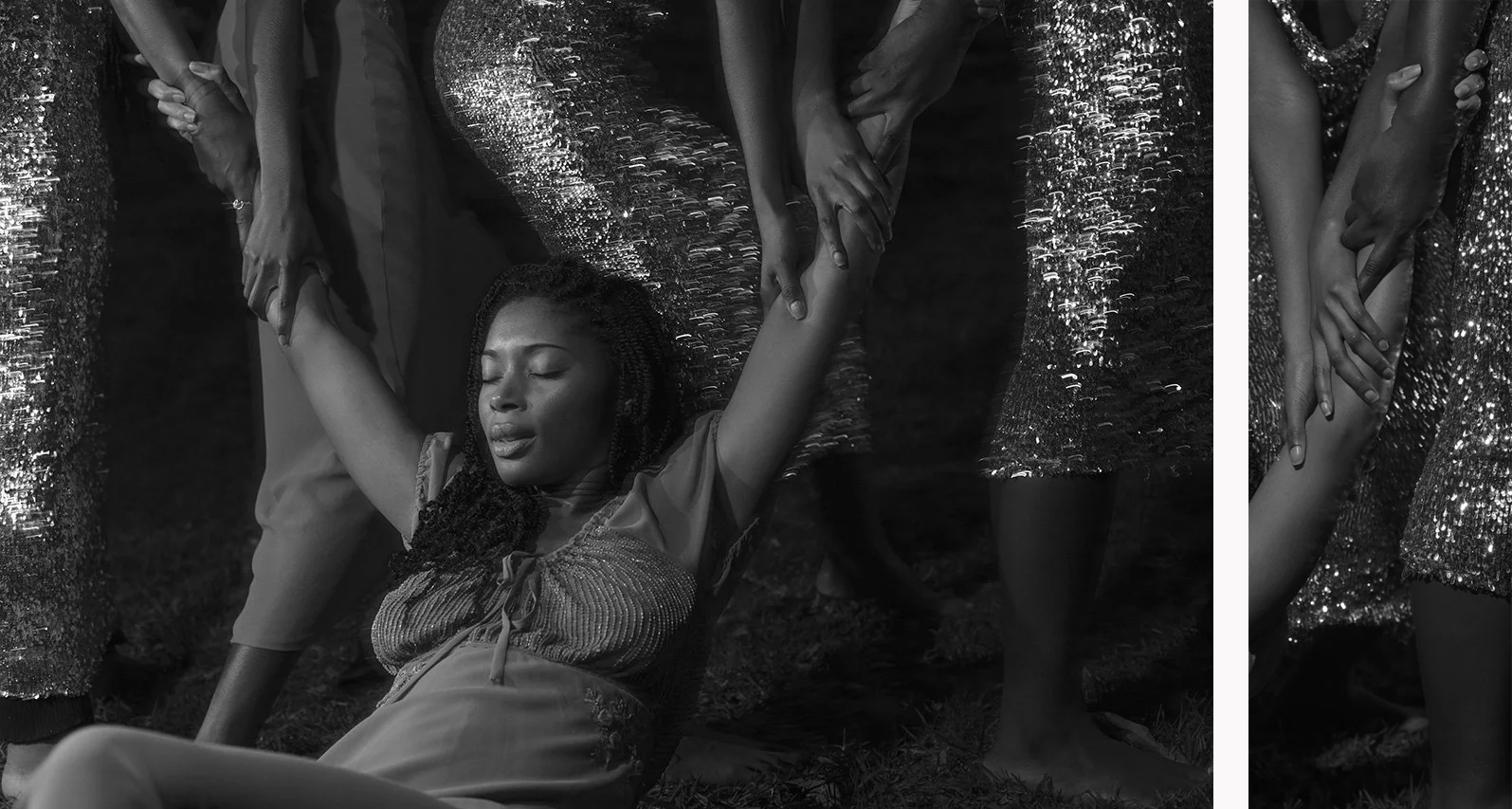
© Widline Cadet, How Far Is Soon?, 2024
LL: You use video to great effect, embedding clips directly onto your photographs. What prompted you to adopt this format? How do you pair the video and photograph combinations which generate a sense of simultaneous presence and absence in time?
WC: Thank you very much! I appreciate you saying that. I think video came at a point where I wanted to expand beyond what I felt photography could do for my work. The more staged images leave a lot of room for interpretation and I wanted to include something that was a little more grounded in a more recognizable language similar to the family archive pictures.
So much of my practice exists as an archive and I knew I wanted and needed some components of it to be heard sonically and seen as moving image. As part of that, I also think about ways to communicate feelings and ways to make people really feel things in a visceral way. When I thought about it, some of the things that have done that to me include sound, films, anime, TV shows, moving image as a whole with its capacity to do that and to do it using various senses in the body, and so I wanted to try it in my practice.
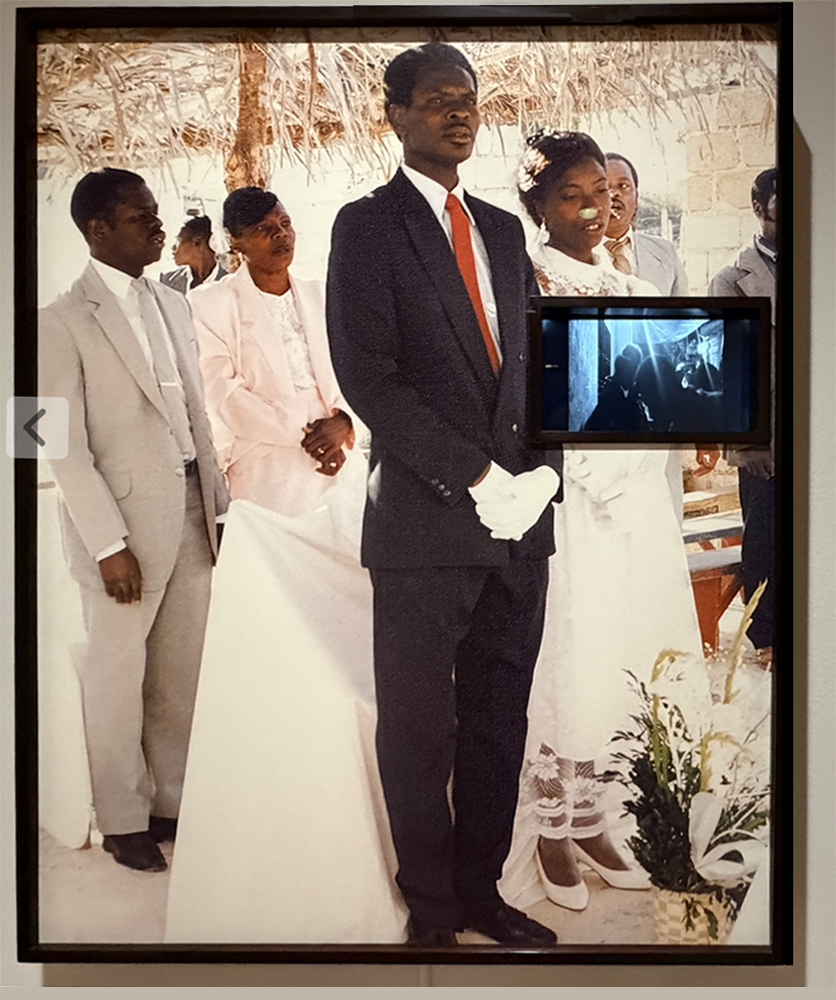
Installation View. © Widline Cadet, Pou lèdemen kòmanse san nou #1 (For When Tomorrow Starts Without Us, #1), 2021
The process for choosing which videos pair with which images varies. Part of it depends on which element I want to have the most presence whether it’s the image versus the video. In the case of the image/video frame of my parents’ wedding photo Pou Lè Demen Kòmanse San Nou #1 (For When Tomorrow Starts Without Us #1), 2020, I knew I wanted the image to be the focus and so that image itself is pretty eye-catching, whereas the video in the frame of my paternal grandmother’s wake is black and white, and plays in the background of the image and the space of the museum. I wanted this one to feel more visceral and that’s why it’s just the upbeat music of the wake that makes up most of the audio. The fact that it’s black and white and just a short clip, with music and is less than two minutes gives it a different kind of presence and legibility —something somewhat similar to social media posts in a way.
In the case of Ant yè ak demen (Between Yesterday and Tomorrow), 2023, I wanted the video to have more of the viewer’s focus and for the still image to be more in the background. So that image is black and white, pretty dark and ghostly in terms of the figures, while the video is a compilation of these mostly bright and colorful scenes and the sound is played via headphones rather than speakers.
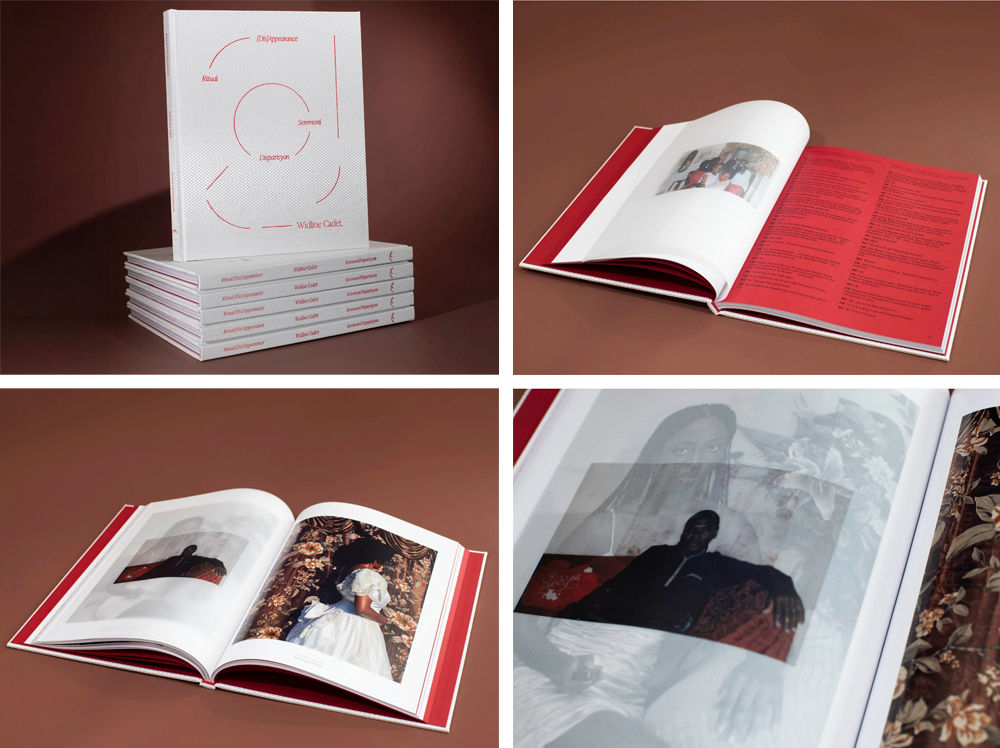
© Widline Cadet, Book: Ritual [Dis]Appearance / Seremoni disparisyon, 2025
LL: You have published a book which accompanies this exhibition. You combine your family archive printed on vellum with your own images, as well as interviews with family members. How do you see this form working alone and in conversation with the exhibition?
WC: I think the book form is something that works both as its own thing, but also in conversation with and as an extension of the exhibition. One of the things I find most exciting about photography as a medium is the potential to move between so many different forms of viewing and experiencing images. When thinking about the construction of the book and the inclusion of the family archive images printed on the vellum, and the interview questions, a part of me wanted it to feel like it’s multiple books in one.
One of the most challenging aspects in making this body of work was figuring out how to have these aesthetically different images exist together in a cohesive way. And in all honesty, I spent way too much time worrying that they wouldn’t. I developed the more layered and collage-like frames that combine the two styles of images into one work as a sort of bridge for when it comes to exhibiting the work. I was especially worried about that when it came to making the book, but instead of worrying about it I decided to lean into the differences between the two styles of the images and the way I wanted them to function.
Something I’ve come to realize recently is that I’m very consistent/obsessive in my interests, even across mediums, and this is a prime example of that. I’m still interested in this idea of layering and combining of mediums that started with the layered works that contain multiple images or a combination of images and video. The visual elements in those works can function/be read either together or separately. The same can be said for how the family archive images printed on the vellum interact with my more staged images. They have the capacity to exist as single images, or as layered ghostly images on top of the more staged images.
Another example of that is the inclusion of the interviews of my great-aunt, mom, and sister within the book, as well as the video piece of me interviewing my mom that’s included in the exhibition.
LL: You are clearly deliberate and thoughtful about your future path. Finally, Widline, describe the origin of Black Mountains Studio (BMS), your experimental space for extending your artistic practice. What will you be exploring, thinking and making there in the future?
WC: I created Black Mountains Studio (BMS) in 2025 when I was getting ready to publish my book. I had been working on the book on and off since 2020 after being approached by a publisher and in 2024 I started taking book making classes with For The Birds Trapped In Airports. It was through that process that I was able to really focus and make a book dummy from scratch. And as soon as I made it, I knew this was what I wanted the book to be, but it was also a complicated and somewhat expensive book to produce due to my material choices, design ideas, and overall binding. As a result of that, and due to a series of events, I decided I wanted to publish the book myself.
At the same time I was also going through a small existential crisis as an artist and feeling like I was losing ownership of the things I was making and that my work was not just my own anymore—but something that is shared with others in ways that, as someone who is very possessive, I was not very comfortable with.
So with all of that going on at the same time, I felt that I needed an outlet that was fully my own with no restrictions or outside input and that’s when I created Black Mountains Studio. The name comes from the area my paternal grandfather lived in Haiti, but translated to english. It just worked out perfectly that publishing my book was the first project I did with it. The ideas behind it are still very much in progress, but at the core of it I just wanted to create a space in my practice that was fully mine and not having to share it with anyone.
I’m building it slowly and intentionally as a space that fosters new ideas, interests and my love of exploring new mediums in a way that’s not influenced by financial gains, losses, or pressure.
Widline Cadet is a visual artist born in Pétion-Ville, Ayiti and currently based in the United States. Her practice is rooted in photography and includes video, sound, sculpture, performance, and installation. Her work centers her family’s lived experience of immigrating from Haiti to the United States as source material to explore the complexities of Black diasporic life and survival.
Cadet earned her BA in studio art from the City College of New York and an MFA from Syracuse University. She a recipient of a 2013 Mortimer-Hays Brandeis Traveling Fellowship, a 2018 Skowhegan School of Painting and Sculpture artist in resident, a 2019 Lighthouse Works fellow, a 2019 Syracuse University VPA Turner artist in resident, a 2020 Lit List finalist, the 2020 Museum of Contemporary Photography’s Snider Prize winner, a recipient of a 2020 NYFA / JGS Fellowship in photography, a 2020-21 artist in residence at The Studio Museum in Harlem, and a 2021-2022 visual arts fellow at The Fine Arts Work Center. Her work has been featured in Aperture Magazine, FOAM, The New Yorker, TIME Magazine, The New York Times Magazine, Financial Times, Wallpaper* among others. Cadet has exhibited in the U.S. and internationally. Her work is held in various public and private collections including, The Whitney Museum of American Art, The Museum of Contemporary Photography, The Huis Marseille, The Los Angeles County Museum of Art (LACMA), The Pérez Art Museum Miami (PAMM), The Milwaukee Art Museum, and The Princeton University Art Museum.
Cadet lives and works in Los Angeles, CA.
Instagram: @widline_
Instagram: @blackmountainsstudio
Kristen Gaylord is the Herzfeld Curator of Photography and Media Arts, where she recently organized Widline Cadet’s first solo exhibition at an American museum (2026) and Erin Shirreff: Permanent Drafts (2025), as well as serving as site curator for the V&A’s Arresting Beauty: Julia Margaret Cameron (2024). This year she also opened Beneath the Surface: Mining and American Photography, a major survey of the relationship between photography and extractive industries in the U.S. from the 1840s until today, co-curated for the National Gallery of Art and currently on tour. Previously, Gaylord was a photography curator at the Amon Carter Museum of American Art in Fort Worth, where she organized exhibitions including Moving Pictures: Karl Struss and the Rise of Hollywood (2024), worked with artists including Stephanie Syjuco and Camille Utterback and Art That Moves (2019), and brought landmark surveys of Christina Fernandez and An-My Lê to Fort Worth. Gaylord also held multiple curatorial roles at The Museum of Modern Art, where she contributed to various exhibitions and publications, as well as research and teaching positions in New York and California. She holds an MA, MPhil, and PhD in art history from the Institute of Fine Arts at NYU.
Instagram: @kaygegay
Posts on Lenscratch may not be reproduced without the permission of the Lenscratch staff and the photographer.
Recommended
-
Widline Cadet: Ritual [Dis]AppearanceJuly 13th, 2026
-

Dawoud Bey: Material Histories, Living LandscapesJuly 9th, 2026
-
The 2024 Paula Riff Award Winner: Minwoo LeeJuly 1st, 2026
-
Kathryn Rodrigues: HomesickJune 24th, 2026
-
FROM HERE TO THE HORIZON: Photographs in Honor of Barry LopezJune 23rd, 2026