Claudia Moreno: Axes & Power
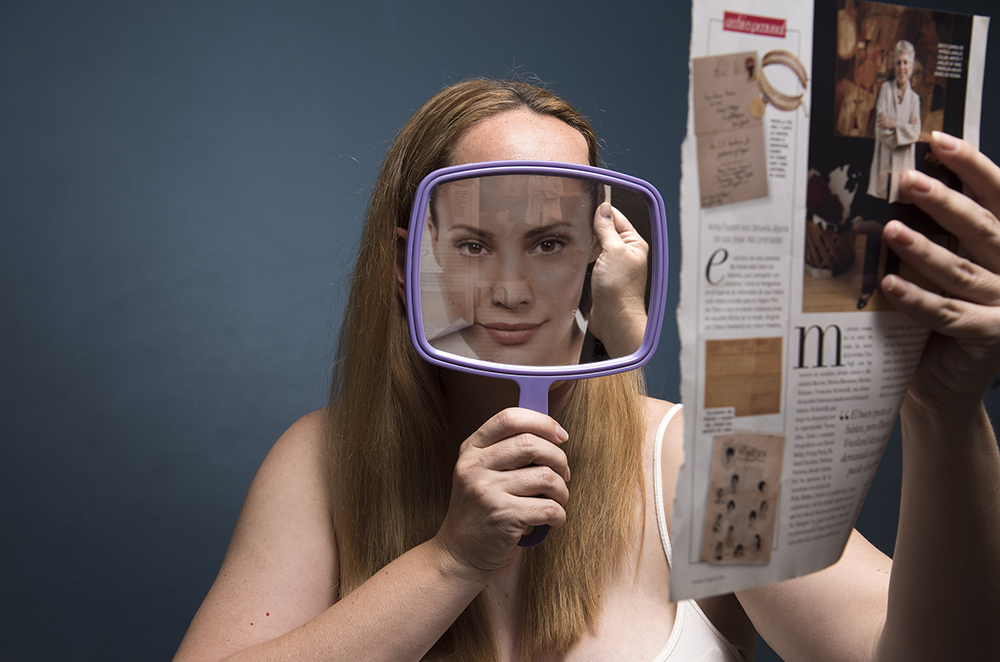
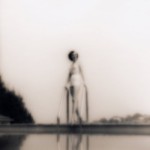
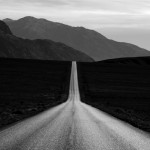
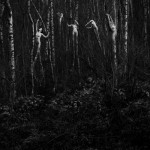
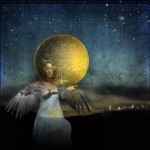
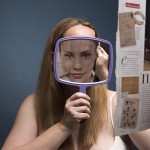
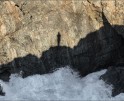
© Claudia Moreno, Reflection, from Stopping Time, 2017
Born in Magdalena de Kino in the state of Sonora, Mexico, Claudia Moreno is heavily focused on her current project, “Cuota de Género” as part of her responsibilities with the Mexican Art Creators National System/Sistema Nacional de Creadores de Arte (SNCA). The term, “cuota de género,” translates into English as gender quota, and refers to policies or regulations requiring a specific percentage or number of women (or a particular gender) to be included in candidate lists, legislative bodies, or company boards to ensure representation. Although Moreno also does commercial photography and editorial management, she has placed those activities on pause for now, in order to devote time to her ongoing political reportage. While photography is her main creative tool, she also produces video works as part of her practice. I was originally introduced to Claudia’s work through a lecture she presented through the San Diego City College photography program.
Could you describe your practice?
Right now I am interested in developing a strong body of work around various topics that interest and concern me. I am working on a documentary project in addition to another series that is more on the conceptual side, although both of them are somewhat connected. I also don’t rule out the possibility of curating exhibitions in the future, as I’ve had the opportunity to do two small projects of that kind. At the moment, however, I am focused on producing my own work.
Around the year 2000, I began to think of various types of production as ways of exploring potential solutions to my concerns. Although I’ve actually practiced photography since I was a child. I have a bachelor’s degree in communication sciences, with a specialization in marketing. I later supplemented my studies with a variety of workshops in journalism, film, and contemporary art. In recent years, I have studied the production of publications and book processes, and a diploma in graphic design.
My first projects were very formal in orientation. Nowadays, I’ve incorporated research as a fundamental component of enriching the themes that I explore. In these ways, my goal for all my projects is that they be integrated into my vision. For example, in an ongoing body of work, I am very clear that image, representation, issues of aging, and societal expectations placed on women are apparent as an ongoing concern. Ensuring that all my projects are interconnected over time is my objective.
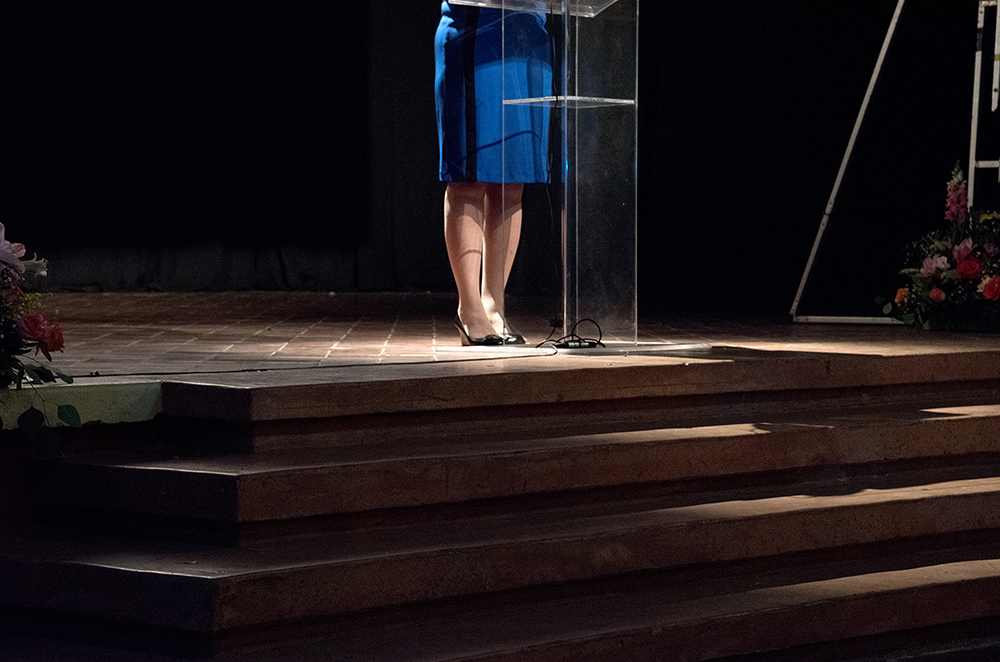
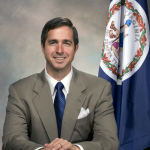
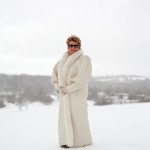
© Claudia Moreno, Representative Giving an Activities Report, from Gender Quota, 2017
Are there artists who have influenced your practice?
In photography, I am influenced by Rineke Dijkstra, Richard Avedon, and Martin Parr. I like apparent simplicity in imagery that, at the same time, can register complex meanings. Also, however, I find the types of approach taken by the Mexican artist Teresa Margolles [a conceptual artist, photographer, videographer and performance artist born in Culiacán in1963] very necessary, I believe that I am still very far from having a remotely similar practice.
My work explores some of the expectations placed on women and examines how we’ve lost our sense of self-criticism in the face of these expectations. Since I don’t like how we often blindly obey these expectations, I frequently use my own body within my practice to pose various types of challenges to these notions. Related to this, I would like to have more direct encounters and conversations with the public at every opportunity to exhibit new work. I work within inclusive feminist and women-centered collectives that are grounded in openness and shared perspectives, shaping both my worldview and artistic practice. I’ve learned a lot working with my sisters and supporting them in their projects. I also review photographic practices with other colleagues in my apprenticeship programs. My main audience is other women, and I’d like my work to reach more girls and young women too.
My projects have often taken a long time. One of them that I have been working on since 2017, will be finished next year—so it will include a decade of work. My “Stopping Time” project will take me a lifetime!
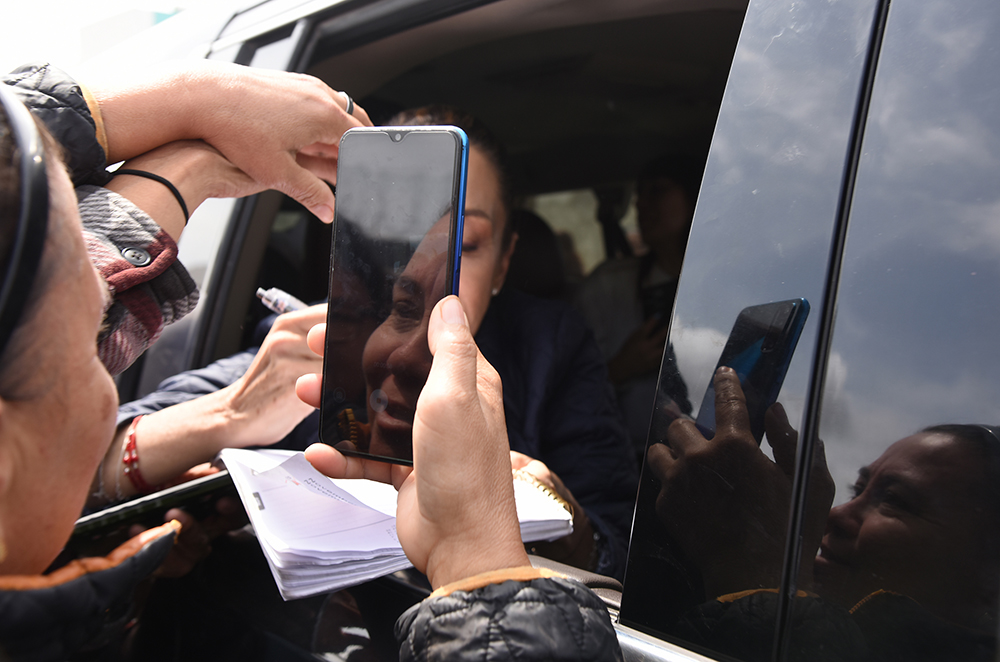
© Claudia Moreno, I Got Video of the President, from Gender Quota, 2025
What is the cultural landscape like in which you function, and how does your work reflect this?
Due to the nature of the work and the way art circulates in Mexico, it has so far only been shown in Mexican institutions. It has managed to reach Italy thanks to some non-profit initiatives. I don’t think a specific level of visual literacy or art historical knowledge is necessary to engage with my work on an emotional or intuitive level.
However, familiarity with visual traditions around the body and the archive—particularly within feminist practices—can deepen its reading, especially in how images negotiate memory, embodiment, and domestic space. In the case of my project “Cuota de Género,” some awareness of the recent Mexican political landscape and its gender-related policies can also provide important context, allowing the work to resonate more fully in relation to representation, power, and structural equality that the system had allowed on the last electoral process.
While there may be some generational barriers for young women to engage with my photographs, we are in an excellent moment with initiatives that reinforce female empowerment—which is very current and highly relevant.
“Gender Quota” is entirely based on the Mexican political system and the documentation of women’s entry into it through equal quotas, since 2006 legal regulations. Popular culture and traditions also play a role in this project. Although it is always present in my practice, since beauty standards—examinations at the core of my work—are deeply permeated by pop culture, and social, pop culture, and internet media.
The Gender Quota project is extremely complex and, from an artistic standpoint, will not fully reflect the reality of women’s representation in various aspects. However, it is a highly interesting piece of documentation that had not been undertaken in Mexico until now. So, I’m very excited to complete the project and start to show it. With regard to the project on aging and aesthetic canons, most of the work has focused on me during this initial stage. I am very excited that, once my current commitments to the art-creating system are complete, I will be able to continue working on incorporating the perspectives of other women into this body of work.
I enjoy being asked about the complexities of the gender quota project, especially because some photos have an anecdotal component. It’s also very interesting to have to work within the context of a personal story, so that the photo can be received in broader ways, without knowing the exact stories surrounding the series, and particular images.
Some of the images seem to depict not only political processes, but also your own mediations regarding the coverage of candidates in Mexico. Because of the combination of their documentary, yet meta-like qualities, I wonder if you might describe the strategies you considered in working through this body of work?
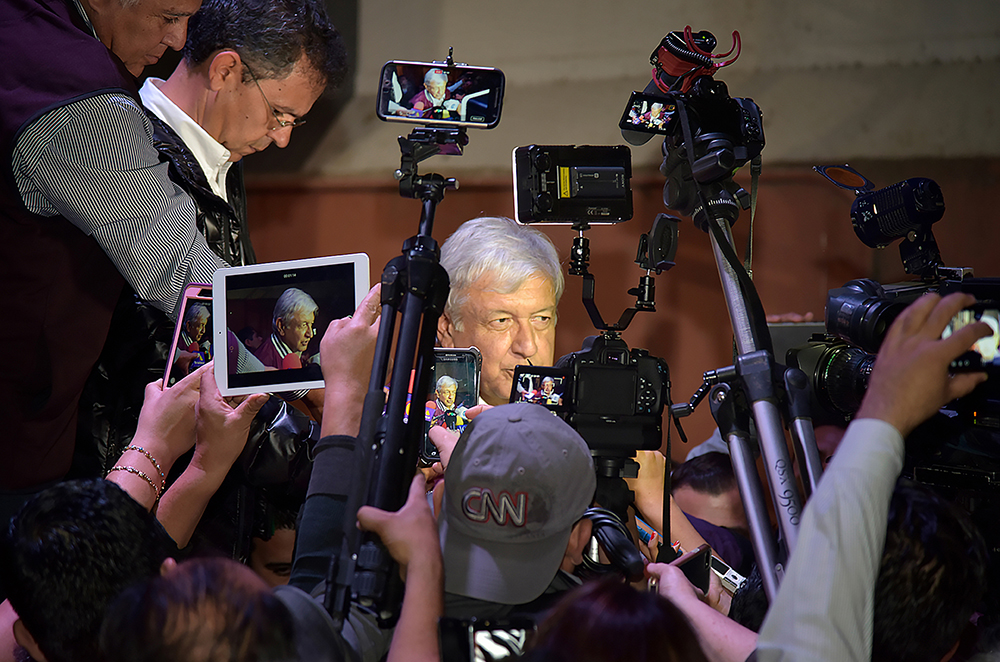
© Claudia Moreno, Eight Images of the Same Person, from Gender Quota, 2018
During my initial impression of the “Cuota de Género” project, I thought it might resemble something akin to Daniela Rossell’s photographic approach. [In an Artforum review of April 2000, critic Nico Israel wrote: Daniela Rossell’s repugnant yet alluring photographs of nouveaux riches theatrically posed in the tacky opulence of their homes expose a lack that gnaws at the heart of wealth.]
Since I had access to a certain social circle where I could interview local first ladies and high profile women on the political spectrum, and, due to the connection with my “Stopping Time” long-term project, I definitively considered these kinds of possibilities. Nonetheless, I decided to focus my research just on women who were directly connected with decisions and power systems. That being said, and, with two other high profile women cases that heavily influenced me over the years, such as Theresa May and Carmen Romano de Lopez Portillo, I started to attend public meetings.
When I arrived at the first event, on December 2017, I was clearly impacted by two decisive considerations. One: I needed to focus on all women, not just the candidates, because there are a lot of important roles being done by women besides running for office. Each woman was in fact situated in a specific place at every meeting. And that matters. This realization took me to the second fact: No photographic inspiration could fully educate me enough nor prepare me for dealing with the extensive array of situations that these meetings presented. After that particular event, I decided to be as extensively prepared for each event as possible, and let my eye freely find each photo without previous influences. By 2023, I found that I was probably in many ways leaning towards an Anna Fox/Martin Parr style of story telling.
For me, it’s inexplicable how we humans feel incredibly powerful and yet don’t realize how vulnerable and dominated we are by systems that we ourselves have created. In the end, it often seems that women consistently end up paying the consequences of these events.
Another body of work of relays a recognition of the gaze in various ways. Could you talk about some of the issues framed by this series?
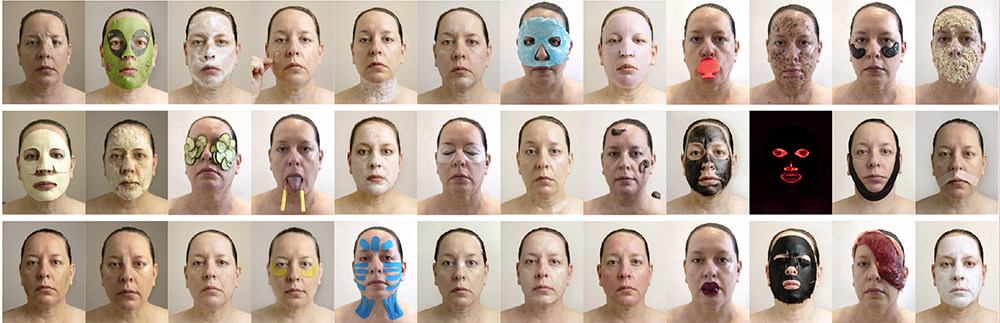
© Claudia Moreno, My Name is Claudia and I Am on a Dysmorphia Process, from Stopping Time
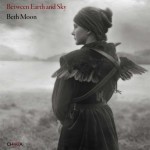
These were composed as part of a photo performance. I often freely photograph myself alone, in close spaces. Mirror and masks are core elements for these choreographed portraits. That is just a two shot picture, because I thought It was impossible to achieve a decent result. But I was very happy with what I captured! For my beauty/dysmorphia mask collection I had created a very detailed mini studio set up inside my bathroom in order to control the shots. And it has worked very well from 2016 until now. Each mask is selected according to a research process and is related to a specific part of my life. So, I can say that I’m working on a self biography where my face reveals this.
Yet another body portrays, in visceral and schematic ways, acts that compel the viewer to question political issues. What went into producing this work?
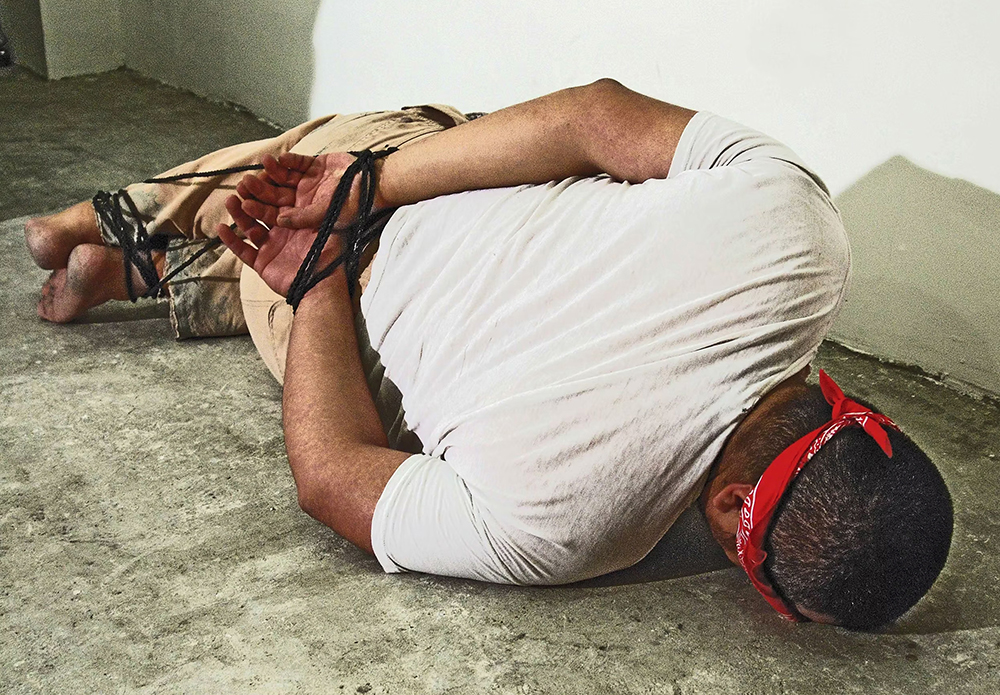
© Claudia Moreno, Imagining a Crime
“Imaginando un Delito (Imagining a Crime)” was done during a very dangerous time in Tijuana. I spent a lot of time imagining what would happen to my daughter if I was caught on a street. I even taught her how to get out of her car seat by herself. She was then 3-6 years old, and I try to not talk about it with her. The idea of kidnapping was so new at that time. I asked myself, how will I react? How can a person possibly move? Will I be on the floor all the time? I started searching for an artist who wanted to collaborate in this piece. Initially, I had the chance to work with the late renowned actor Paco Mufote, and he played a police figure. Then I pitched the idea to Roberto Romero Molina, a close friend to my family in-laws, and what a surprise! Roberto was in full performance mode, and was interested in doing a powerful collaboration together. He is a great artist with a very wide practice. These pictures were included in the 2006 Baja California Photography Biennial.
Could you describe your studio work and publication activities?
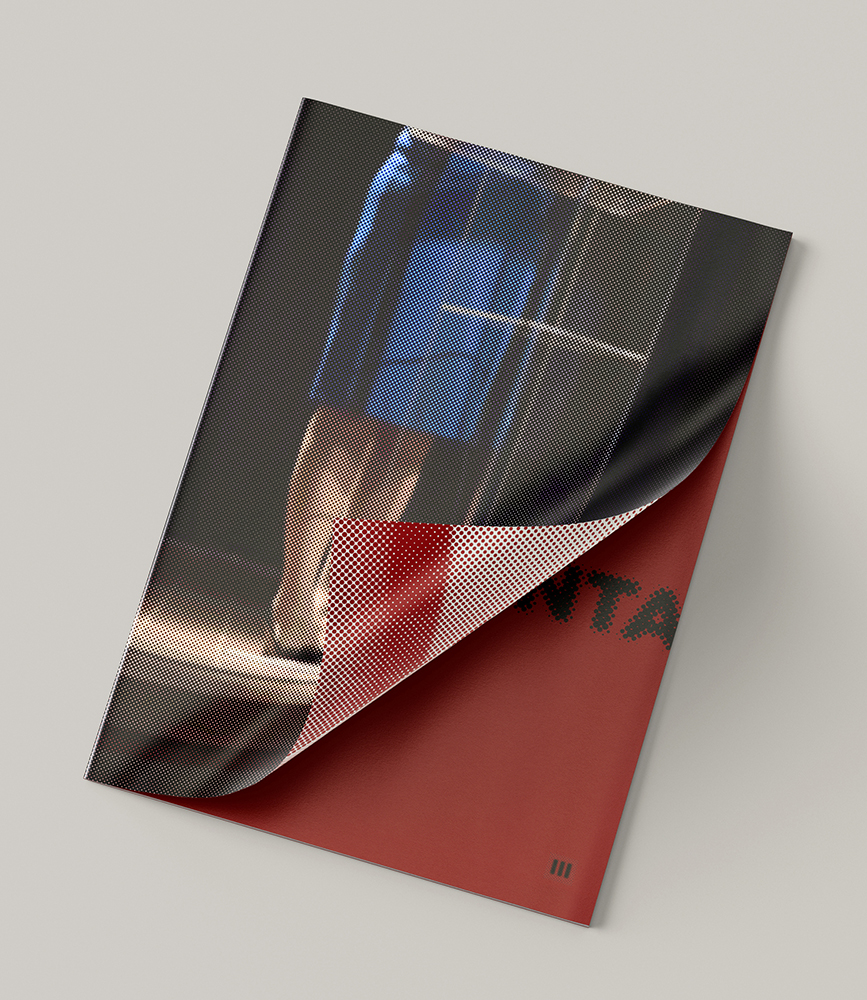
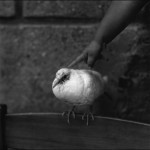
© Claudia Moreno, Representation, 20-page publication #5, from Stopping Time
I created a fanzine (I call it fanzina) intended to get Cuota de Genero displayed in museums, galleries and similar spaces. It’s a lighter, conceptual publication of the main ideas of the project, more like a summary. Eventually this will comprise a set of three publications. The first one, “Representation” was displayed in 2025 in an artist book show in Tecate, and it will be featured this year at Cecut, an event organized by Border Collage Collective.
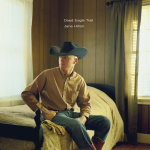
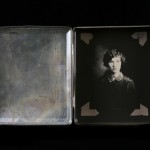
Since I also do studio work, this is reflected in a series called “Esencias.” From within the studio, I aimed to portray figures with an impact in my life. Most of the people included were friends and family, where the photographs were also conceived by them. The idea was to do collaborative work, but confined to my studio, which is what I was doing at the time.
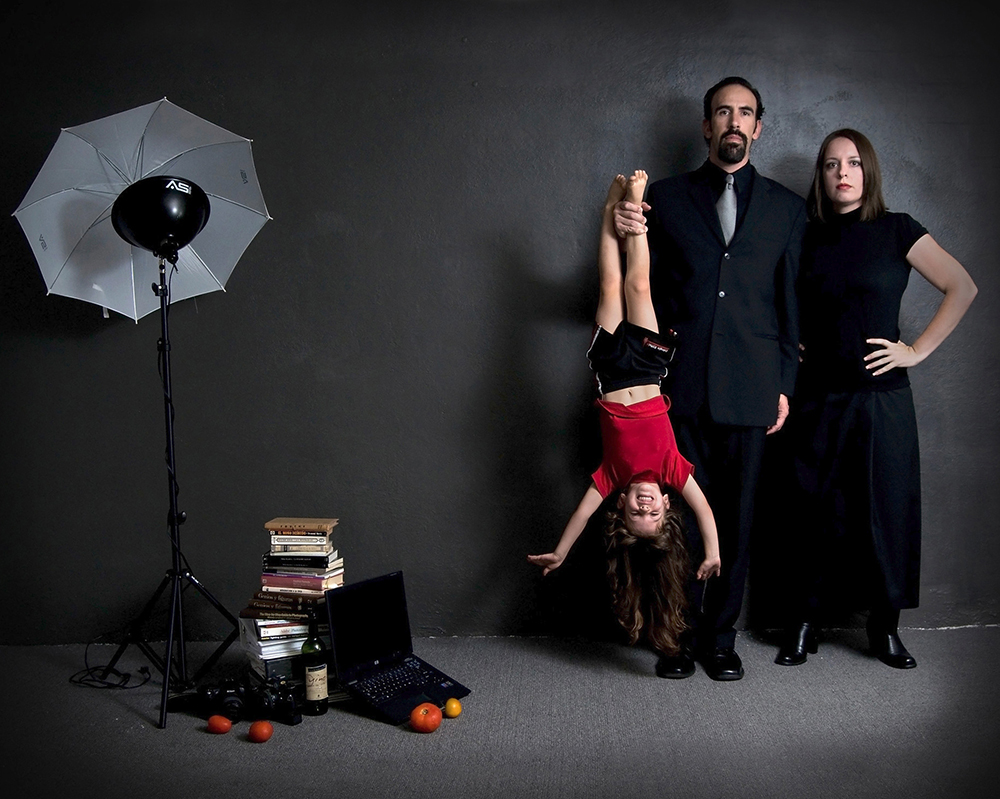
© Claudia Moreno
As you can see, I move along two axes that constantly reshape one another: the ideas that insist, that unsettle, that refuse to let me rest (and gnaw at me and keep me up at night), and the conditions I inhabit, the moments that catch my body in the world. Between them, I shift. Sometimes I am in the studio, sometimes in the street, sometimes somewhere in between, where these definitions begin to blur.
What remains constant is the act of looking—and questioning what this act produces. I will continue to work as a photographer, in a moving versus a fixed position; in a practice that becomes sharper, more critical, more aware of the structures it moves within and against. Each project isn’t a conclusion, but rather a re-calibration—a way of extending how I see, and of refusing to look away.
Posts on Lenscratch may not be reproduced without the permission of the Lenscratch staff and the photographer.
Recommended
-

Marky Kauffmann and Louise Kauffmann: We Were ChildrenAugust 10th, 2026
-
The 2026 Lenscratch 3rd Place Student Prize Winner: Diana SosnowskaAugust 5th, 2026
-
Student Prize: Top 25 to WatchAugust 2nd, 2026
-

Camilo Echavarria: Rincón del MarJuly 25th, 2026
-
Kerry Mansfield: The Intertidal ProjectJuly 22nd, 2026